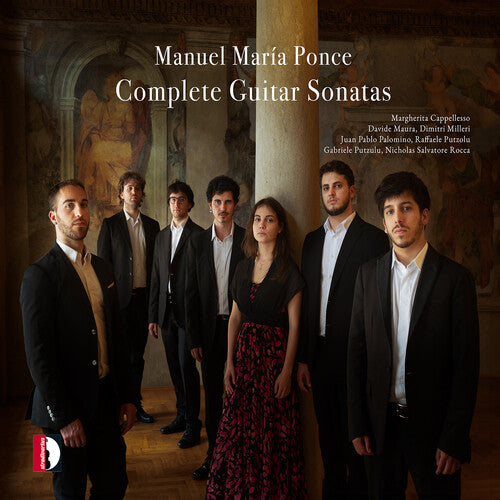
... So what, then, did Winterreise mean to us? At the risk of stating the obvious: it was a journey - albeit a journey with no real destination. The depth of this Everest-like score offered new insights and fresh layers with every reading. Consequently, there was never - and still isn't, despite years of preparation and live performances - a real sense of completion, no point at which we could say we were "finished" studying each lied. And perhaps the Wanderer's journey is also without destination. A physical trek through a cold and indifferent, if not openly hostile, nature, it is also a psychological path through the difficult phases of processing loss - a process that, in truth, never completes. The traveler clings to the pain inflicted by a society that rejected him and continues to reject him, like the barking dogs announcing his passing, finding refuge only in the suffering of memory and in each weary step through the snow
Pre-order
Franz Schubert: Winterreise
$24.99
CD
Stradivarius
February 27, 2026
STR37344
Baltic Soundscapes
Stradivarius
CD
$16.99
February 27, 2026
The album features ten works by Ciurlionis, arranged for cello and piano by Lithuanian cellist Juozas Celkauskas. These arrangements open a new window for experiencing the piano works of Ciurlionis as chamber music, while his pictorially enhanced musical vision remains intact. In addition to the pieces by Ciurlionis, the album introduces three contemporary opuses composed especially for this project by Lithuanian composer �ibuokle Martinaityte, Latvian composer Arturs Maskats and Estonian composer Mihkel Kerem. Each of them, drawing personal inspiration from Ciurlionis, not only wrote a new composition for cello and piano, but also dedicated their creative efforts to the Ciurlionis' anniversary and this duo of performers, thus making this album not only a retrospective, but also a lively, creative dialogue between eras, cultures and personalities. This album is not merely a musical recording. It is a return to the source for the journey, during which the four bars of an unfinished work are transformed into a newly born world.
Pre-order
Baltic Soundscapes
$16.99
CD
Stradivarius
February 27, 2026
STR37343
Carlo Alessandro Landini: Music of Twilight
Stradivarius
CD
$16.99
February 27, 2026
Time brings with it many changes in the course of a lifetime. "The only constant in life is change," stated the ancient Greek philosopher Heraclitus. The Italian composer Carlo Alessandro Landini, whose string quartet was premiered by the renowned Arditti Quartet at the Darmstadt Summer Courses in 1994 and has made him famous in Germany since, has always been concerned with change and transformation, both embodying the deepest essence of music. In the meantime, his works have become calmer, more balanced, exuding aesthetic beauty and harmony through their tonal inventiveness. The listener is surprised by the extremely subtle sound visions that the pieces presented here suggest. They could be understood today as counter-designs-probably due to the composer's spiritually oriented creativity-to our restless times. This leads us right into the heart of these four works. In the background of his creativity, Landini believes in the special proximity of all art to the realm of metaphysics. He is virtually inspired by this aspect and sets out in his compositions in search of what holds the world together. His more recent works convey his message of a "world soul" of some kind. His music requires a listener who opens up in order to broaden the shared horizon and feel more strongly what is happening between heaven and earth. Landini continuously unfolds his music from a nucleus. The composer demands intensive, sensitive listening to space and time from himself, his performers, and his listeners. Olivier Messiaen, whose student Landini had been, must have encouraged and inspired him in this.
Pre-order
Carlo Alessandro Landini: Music of Twilight
$16.99
CD
Stradivarius
February 27, 2026
STR37335
Moon Ha: String Works
Stradivarius
CD
$16.99
March 06, 2026
String Works As a teenager, I studied violin privately for about a year. Despite my best efforts, I never truly learned to play-couldn't even manage a simple melody. Yet the raw, untamed sounds of the violin-the fleeting, wild noises it could produce-captivated me. Even now, though I still can't play a tune, I remain enchanted by it's voice: the subtle, mournful cries and the bright, shimmering whispers. String instruments have long been my silent idols, their voices resonating with a deep, almost mystical beauty. Since I began composing, I've been drawn again and again to their warmth, vibrancy, and the intensity of their impassioned screams. Over the years, I've written many works for strings-each one an attempt to enter, and perhaps never fully master, their enigmatic world. String Works gathers pieces I've written for strings across the past decade. Creating them has been my joy, my privilege, and my constant fascination: an unfolding journey into a soundworld as elusive, strange, and beautiful as the strings themselves.
Pre-order
Moon Ha: String Works
$16.99
CD
Stradivarius
March 06, 2026
STR37320
Klaus Huber 100
Stradivarius
CD
$16.99
March 06, 2026
Once upon a time. To walk with Klaus Huber along the path of creation for more than two decades is a singular experience. It's always in the present tense, because his friend's human imprint is indelible, and his music is one of those whose line and density transcend time. The political and musical projects carried out in their time with talent, and each in their own style, by the great musical figures of the twentieth century, including Luigi Nono, Pierre Boulez, Iannis Xenakis, Klaus Huber and others, reveal by contrast an abysmal contemporary void. Maintaining a confusion between entertainment and culture, subject to the diktats of the quantifiable, the marketable and the "accessible," our leaders now navigate by relying on a deregulated sextant: vagueness, ignorance, mediocrity and the secondary triumph. In this chaos, Klaus Huber's mission to give music the ability to shake people's consciences has taken on an imperative, not to say quasi-revolutionary, character. However, let there be no misapprehension: Klaus Huber's revolution is not that of those critics whose appetite for tabula rasa is merely the mirror image of their fascination for a conservatism even more outrageous than the one they claim to oppose. History is full of these false noses. His is in a completely different vein. It is personal, authentic and uncompromising, astronomical in the sense of a backward-looking movement, and a demanding but also benevolent introspection. His weapon? Music, which demands of both performer and listener a disposition that transcends and emancipates us in the sharing of an active spiritual communion of listening. Like the vigorous flame of utopia preserved from the mortifying Soviet glacis by the poet Ossip Mandelstam, a literary source, among others, where Klaus Huber drank, the flame in the form of a legacy that Klaus transmits to us, at a time when we are celebrating the centenary of his birth, radiates our chaotic and suffering contemporary horizon with it's invigorating and regenerating fires. Jean-Luc Menet
Pre-order
Klaus Huber 100
$16.99
CD
Stradivarius
March 06, 2026
STR37345
Georg Philipp Telemann: Quadri
Stradivarius
CD
$16.99
March 06, 2026
The quartets featured on this CD belong to the first collection of quartets that Telemann wrote in Hamburg in 1730, in anticipation of a trip to Paris (which he would only make in the autumn of 1737, staying in the French capital for eight months), invited by four important French musicians: the flautist Michel Blavet, the violinist Jean-Pierre Guignon, the gambist Jean-Baptiste Forqueray and a cellist and harpsichordist named Prince �douard. The collection was published in 1730 and contributed significantly to the spread of the composer's fame throughout Europe, particularly in France (so much so that it was reprinted by the Parisian publisher Le Clerc in 1736); it includes six quartets, and was published under the Italian title Quadri a violino, flauto traversiere, viola di gamba o violoncello, e fondamento: ripartiti in 2. concerti, 2. balletti, 2. sonate. The six Quadri constitute a r�union des go�ts, as they incorporate diverse national styles. Although traces of the "German style" can be detected in each of them, the French style clearly prevails in the suites, while the Italian style dominates the sonatas.
Pre-order
Georg Philipp Telemann: Quadri
$16.99
CD
Stradivarius
March 06, 2026
STR37338
Simone Fontanelli: Strings of an Imaginary Theatre
Stradivarius
CD
$16.99
March 06, 2026
All the works on this CD share a constant feature: the musical "gesture," which is at the origin of each piece. This "gesture" may appear in several ways. It may be brief and concise, as in the opening of ".a riveder le stelle," or more complex and extensive, as in the beginning of "Mosaico." In all cases, however, the "gesture" creates a "figure" and a "situation" that sets off a process of transformation. As in a theatrical scene, even a short one, the instrument is like a character who acts through this or that "gesture," expressing speech through articulated transforming figures. Just like a monologue or, in other cases, like a dialogue. A guitar, a violin, a harp, or a cello are not just musical instruments. They are "characters" with their own personality and a story to tell. Furthermore, each piece is a story where several situations occur and memories from the past return. "Narration" is another basic element of my way of composing. It can take different routes, reaching different destinations. The last part of "Youth," written for harp, rediscovers the vague memory of a 70s song that I loved when I was a teenager. The end of ".a riveder le stelle" and "Mosaico" are concluding moments of a journey where many things had happened, and where now, looking back, we can understand the sense of them and the sense of the journey itself. At no point are the direction and the destination set at the beginning. They are "found" along the way, for what is important is the journey. Simone Fontanelli
Pre-order
Simone Fontanelli: Strings of an Imaginary Theatre
$16.99
CD
Stradivarius
March 06, 2026
STR37354
Francois De Fossa: The Guitar Soldier - Samuele Provenzi
Stradivarius
CD
$16.99
March 06, 2026
This recording is a thematic and cultural journey through the figure of Fran�ois de Fossa, a nineteenth-century military musician and guitarist who distilled multiple influences through his nature as both traveller and innovator. The selection of works highlights not only the guitar's virtuosic possibilities, but also it's remarkable ability to act as a bridge between cultures and musical styles. Viennese Classicism: Through his transcriptions of Haydn and his admiration for Beethoven, de Fossa brought the guitar into dialogue with one of Europe's most refined and universal musical idioms. The Iberian Connection: His travels in Spain and his military career exposed him to Iberian melodic and rhythmic patterns that weave their way throughout his music.
Pre-order
Francois De Fossa: The Guitar Soldier - Samuele Provenzi
$16.99
CD
Stradivarius
March 06, 2026
STR37288
Estrellita
Stradivarius
CD
$16.99
March 06, 2026
The rich musical heritage of the Litvaks is only just beginning to be explored. The music by Jewish composers who were born in, lived in, or emigrated from Lithuania has been lurking in the background for many years. This new creative chapter opens with an album that features two prominent musical figures, the Lithuanian violinist Dalia Dedinskaite and the Canadian pianist Walter Delahunt. Together, they present a musical journey showcasing the creativity of the Litvaks, from Lazdijai in Lithuania to Hollywood in the USA. The album's title, Estrellita (The Star), is not only an allusion to one of it's pieces, but also a multi-sensory symbol. Estrellita, also the Star of David, is a light in the darkness, a star of remembrance. It illuminates the paths of personalities, destinies, and creativity, from those who left to those who stayed. The album Estrellita draws parallels between the lives and works of two legendary 20th-century Litvaks, Jascha Heifetz (1901-1987) and Joseph Achron (1886-1943). It also opens up the musical world of Anatolijus �enderovas (1945-2019), one of the most prominent Lithuanian composers of the second half of the 20th century and the early 21st century.
Pre-order
Estrellita
$16.99
CD
Stradivarius
March 06, 2026
STR37349
Bliss
Stradivarius
CD
$16.99
March 06, 2026
Why our title Bliss? It is a word that evokes a joy so perfect, so blessed, that it transcends daily life and is distilled into the work of art. The songs contained in this album explore the sentiment of love in it's several aspects, shading from feelings of desire to regret for absence, from passion to surrender, from tenderness to melancholy. Amy Beach, C�cile Chaminade and Gilda Ruta transformed the evocative power of love poetry into music, capturing in their canti d'amore moments of pure ecstasy and heartrending beauty. But Bliss refers not only to the ecstasy of love: it is also an ecstasy of artistic creation, the act of expression by which these composers gave voice to their sentiments, unrefined and in absolute sincerity.
Pre-order
Bliss
$16.99
CD
Stradivarius
March 06, 2026
STR37334
Within the Waves - Sanna Vaarni
Stradivarius
CD
$16.99
March 06, 2026
A programme that brings together two compositions very far from each other in time, both entitled Sonata, promises much for the imagination. The two Sonatas, for opposing reasons, were the last sonatas to be published during the lifetime of the two composers. Between them, like a bridge, is a piece permeated by the memory of water: how, then, can one give form to this intertwining? A profound ambiguity, between smiling and melancholy, inhabits the poetic world of the Sonata in G major, Op. 78, D. 894. Schubert had very clear ideas about the formal structure of the piece, thinking of a unified structure in four movements. Schubert had already seen that framework dissolve in the hands of his beloved Beethoven, who, in the two Sonatas of Op. 27, blurred the lines with regard to his scores, constructing complex, sometimes cyclical structures in which all traditional patterns disintegrate, creating a genre that is increasingly difficult to appreciate; on the other hand, with the Sonata in A minor, D. 845, Schubert had already been designated by music critics as the possible successor to such experimentation. Luciano Berio, who dedicated memorable tributes to Schubert such as Rendering (1989/90), also experimented, in the last years of his life, with the form that so obsessed Schubert: Sonata (2001) is a wonderful piece that brings both his career and his piano repertoire to a close. To explain how to approach it, we would like to pass the word to Marco Uvietta, who was able to study it's structure closely, consulting with the composer himself: Berio speaks of the Sonata as a structure made up of different blocks, which are held together by elements that act as continuous transitions. In the words of the composer: just as when traveling by train, the landscapes change, but the pylons continue to pass before our eyes, and we always look out of the same window.
Pre-order
Within the Waves - Sanna Vaarni
$16.99
CD
Stradivarius
March 06, 2026
STR37331
Autumn Gold
Stradivarius
CD
$24.99
March 06, 2026
A selection of Lieder, however broad, focuses perforce on the German language, as dictated by the theoretical, historical, and technical definition of the word "Lied," of the genre "Lieder." What is more, this particular selection of Lieder, though broad, gravitates around a strong poetic inspiration which, entrusted here to Sara Mingardo, is oriented towards the evocation of moonlit nights, of mysterious nocturnal scents, of that contemplative solitude that quivers between the two extremes of eros and nostalgia. The Lieder of Brahms and Mahler promise cosmic dimensions in the sphere of the sublime. In these, too, the listener also moves, but in ascent or descent: (s)he "moves his (her) steps" not here and there, but into the depths which, when inverted, lead to the heights of heaven, in a sphere almost independent of time and space. At this point our reconnaissance brings us to the music presented for our enjoyment on this CD. Here again, one senses the air and the motion of the passeggiata, of an easy, informal stroll. This apparently unlikely association is prompted by the metaphorical image of music in the open air as a leisure pursuit, as entertainment. And here is the nub: this image, which implies the idea of "movement" in space and time (the brief space of a public garden, the brief space of a spring afternoon, or that between summer and autumn), takes on much broader ramifications as soon as we establish a logical connection between the democratic social and cultural function of the "Proms" and the mature self-analysis of the kind of lofty, profound music, intimately bound up with a poetic text of similar spiritual level, that was such a feature of Austro-German culture between 1860 and 1914, between the national (or even "nationalistic") undertones of the said culture and the First World War. The historical parallel is not negligible. Between the phenomenon of the provision of music in a social and urban context-typically but not exclusively British-and an inspiration that can be discerned in the work of two supreme composers who shared the same German language and culture, Brahms and Mahler, we seek to trace an element of continuity. Additionally, we might note, however, how any and every possible concert programme (including every recording and every conceivable form of electronic reproduction) is always a journey, a path; and how music, too, always and in any case, is a language that would not exist if it did not move in space and time, forwards or backwards, towards the "before" or towards the "after," up into the highest heavens or down into the unfathomable depths, emphasised on occasion by the very notion of walking, as in Musorgsky's Pictures, or driven by the desperation of a headlong flight from oneself, as in Schubert's Winterreise. And now, without further ado, let us listen!
Pre-order
Autumn Gold
$24.99
CD
Stradivarius
March 06, 2026
STR37155
Alessio Santolini Raggi: Interplay - Duet for One and for Th
Stradivarius
CD
$16.99
February 06, 2026
The record Interplay: Duet for One and for the Other brings together two albums for piano and Disklavier-Diagram and Projection and Spring Scenes-which engaged me as pianist, composer, and producer throughout 2024 and 2025, and which were conceived as an artistic inquiry into the shifting boundaries between human agency and machine autonomy in the contemporary world. This project was carried out as part of the SecondLevel Master's in Piano "Play & Rec", directed by Maestro Roberto Prosseda, with the support of B�sendorfer Klavierfabrik GmbH. The two suites form a unique project worldwide that places Disklavier technology at the very center of both composition and performance-not as separate stages, but as synchronous and interdependent acts within a single creative process. Indeed, until now the Disklavier has been employed as a medium-for performance, recording, or composition-but never as the core of an aesthetic in which all these phases are integrated and mutually influence one another by virtue of it. I chose to regard the aesthetic framework as the common thread linking both suites, while at the same time expressing it in different ways in each project.
Alessio Santolini Raggi: Interplay - Duet for One and for Th
$16.99
CD
Stradivarius
February 06, 2026
STR37348
Osvaldo Coluccino: Diade (Various Artists)
Stradivarius
CD
$16.99
February 13, 2026
Duality as essence The fullness of an almost empty space within which only two presences distil their separated essences; the completeness of only two subjects representing all the rest; the awareness in subordinating oneself to the magnetism of the subtracted and the missing; the consistency of silence, immobility and timelessness; the essential value of otherness. Each of the titles of these duets, all of a single word, carries semantic potentialities inherent in duality, a contradiction resolved in the ideal of recomposing dualism into unity. Ali (Wings), equivalent laterality as duality, which divides in two and equally holds together; Diade (Dyad), couple, duality, and in biology the chromosome of germ cells formed by two homologous chromatids united, maternal and paternal; Talea (Cutting), in botany the birth of a life through another that mutilates and grafts itself; Appulso (Appulse), in astronomy the apparent approach of a star to a planet, so that the star seems to touch it; Giano (Janus), the twoheaded god, who can look at the two entities future and past but not at the present, in charge of thresholds, of passages, who presides over all beginnings; Specchio (Mirror), the reflecting "other", in the mutual comparison of every couple or duo; Cenere (Ash), matter inclusive of the original fullness - simulacrum of what it was - and of it's dissipation, emblem of the invisibility to come; Gemina (Twin), that which is double, an adjective declined here, in Italian, in the feminine, leaving open the interpretation (double musical expression?, a double union of performers?... ), and in genetics the "bivalent pair" of chromosomes, which merges and then splits; Stati (States), in addition to being a noun - the word that in Italian in one of it's meanings is related to staticity, from the Latin status, "that which stands still" -, is also a past participle that makes the subjects exist in the same time for how they are now and for what they have "been", "stati" (thinking of this piece, divided into three parts, in the sequence stasismotionstasis: �You alone knew that motion is not different from stasis.� Eugenio Montale, from Satura); Stigma (Stigma), explicit imprint of an implicit owner of it, but also, in botany, the part of the pistil destined to receive and germinate; Etra (Air), a kind of air that, here, makes physical wind and metaphysical wind copresent, which mix in a haunted vortex... Osvaldo Coluccino
Pre-order
Osvaldo Coluccino: Diade (Various Artists)
$16.99
CD
Stradivarius
February 13, 2026
STR37342
Giacinto Scelsi: The Scelsi Collection, Vol. 9 - Fabrizio Ot
Stradivarius
CD
$16.99
February 13, 2026
The Isabella Scelsi Foundation promotes the production of contemporary music in a broad and wide-ranging manner, with particular attention to the work of it's founder, Giacinto Scelsi. This is the direction taken in the Scelsi Collection, a series of recordings produced in close collaboration with the Stradivarius label, which presents the Maestro's works performed by leading musicians and renowned vocal and instrumental ensembles. We are pleased to present this new CD, which further enhances the collection and encompasses many features of extraordinary interest. Fabrizio Ottaviucci, the distinguished pianist who, through his contact with Giacinto Scelsi, had the opportunity to deepen his interpretation of the great composer's piano music. Here he presents large-scale work, previously unpublished, rediscovered thanks to the research carried out on the Foundation's Historical Archive, as described in detail in the CD presentation. A further point of interest is undoubtedly the fact that the CD is the result of a live recording, allowing listeners to immerse themselves and enjoy that unique and unrepeatable moment experienced during the performance, which took place in a concert organized by Area Sismica, a noteworthy association for the promotion of new music. Gianni Trovalusci President Fondazione Isabella Scelsi
Pre-order
Giacinto Scelsi: The Scelsi Collection, Vol. 9 - Fabrizio Ot
$16.99
CD
Stradivarius
February 13, 2026
STR37267
Handel: Flute Sonatas
Stradivarius
CD
$24.99
January 09, 2026
The reconstruction of the compositional chronology of Georg Friedrich Handel's repertoire for flute is extremely complex. There are various reasons for this, stemming from two essential factors: on the one hand, the typical tendency for much of Handel's music to transmigrate from one instrument to another and the consequent impossibility, at times, of determining precisely which version of a particular piece is the original; on the other hand, the proliferation, at a time when no copyright regulations existed, of diverse printed editions. Many of these, unauthorised, generated different versions, errors or misinterpretations, which were possibly also passed on over time. For this CD recording, which features a substantial part of the complete corpus of the sonatas for recorder and transverse flute, we compared the two earliest printed versions containing sonatas for solo instrument by Handel. Both were published by the London publisher Walsh, although for a long time the first of the two editions was attributed to the Amsterdam publisher Roger, but then, thanks to the studies of Terence Best and David Lasocki, it turned out to be a 'pirate' publication by the same publisher Walsh (who probably had not yet obtained Handel's permission to publish).
Handel: Flute Sonatas
$24.99
CD
Stradivarius
January 09, 2026
STR37274
Henry Purcell: A Choice Collection of Lessons for the Harpsi
Stradivarius
CD
$16.99
January 09, 2026
Henry Purcell, also known as Orpheus Britannicus for his ability to enchant the public with his music, is the most celebrated English composer of the Baroque period. He was largely appreciated for his dramatic works, but he also wrote a significant number of instrumental compositions such as A Choice Collection of Lessons for The Harpsichord or Spinnet. The title of the collection indicates the intended instruments: "for the Harpsichord or Spinnet". At that time in England, spinnet was a widely used instrument. Due to it's modest size, it became a privileged instrument for the domestic learning, especially in wealthy families. This practice can be traced in multiple artistic representations, where the typical performer was typically young and female. Their composed appearance is very far from the flamboyant virtuosity or exuberance. The Lessons have the same courteous attitude, but they are rich in emotional nuances. Gentleness emerges through an elegant musical style that is never overly sentimental.. Music sometimes can be vigorous, but it's never bold. Two centuries passed before a new composer could rival Purcell's reputation: when Benjamin Britten chose some of Purcell's works and published them in a modern arrangement, he declared that he wanted to maintain that mix of clarity, brightness, tenderness and originality that shines through all his music.
Henry Purcell: A Choice Collection of Lessons for the Harpsi
$16.99
CD
Stradivarius
January 09, 2026
STR37317
Kevin Swierkosz-Lenart: Luminaria
Stradivarius
CD
$16.99
January 16, 2026
Writing the liner notes to this album necessarily compels me to begin with a preamble which fully complieswith the music and renditions it contains: listening to a discographical work is an active act of creation, the moment when we choose to shift our point of observation towards an imaginative reality that, once experienced, appears more authentic and faithful than everyday's ordinariness. This record is intimately aimed at a cultural elite, aware and solid, not necessarily to be identified in guitar confraternities , capable of seizing and elaborating the connections and the sentimental, substantial correspondences between the sound of the guitar and the cultural facts the author decided to express through it. The title �Luminaria� recalls the feeling of a Van Gogh's Night, where lights do not seem to belong to the city anymore, but rather to nature. The author himself says about these works for guitar: �the landscape is nocturnal, we're moving within gilardinian poetics, the pieces are no pianistic milestones, nor are they orchestral solos; they're feeble village lights at the procession for a saint, which do not illuminate the night, and yet make it exist.� These are works complying with the poetics of �places� and of �memory�, both converging in a third one represented by �distance�. This music deals with an �elsewhere�, referring to �here and now� rather than to a spacial acception, there's no irony, magic or enchanted realism, but a vision forged in architectures dense with a thought that fiercely invokes this very �hic et nunc�, recalling the powerful verse by Montale to burn now , no other is my meaning. Kevin SwierkoszLenart entrusts these pieces to a young guitarist who has all the qualities to receive and elaborate the author's intimate perceptions; Giovanni Martinelli, dedicatory of these oevres, has one gift distinguishing him from most of his generation's performers: the precocious ability to observe the many facets of things and of the world from above, whose vision he renders deeply and very clearly through the guitar. Thus, both special and rare seems the artistic alliance between author and performer, as if they showed the way one another, and the composer's ideas are embraced by the guitarist with such natural predisposition.
Kevin Swierkosz-Lenart: Luminaria
$16.99
CD
Stradivarius
January 16, 2026
STR37330
InCanto Notturno
Stradivarius
CD
$16.99
January 16, 2026
It is a rather widespread opinion that the genesis of musical compositions intended to positively impress the listener's soul is often connected to an initial illumination that expands within a creative process that is per se rather ordinary. It is that creative spark constituting the generating principle which, as it unfolds, gives form and narrative cohesion to the sound archetype. This is the premise underlying the album by the duo Cardinali-Redorici, the realisation of a project that presents itself as a refined exploration of soundscapes delineated by the poietic encounter between viola and piano, through a dialogue aimed at capturing the most varied emotional nuances. In the panorama of string instruments, the viola is characterised by a highly suggestive timbral eloquence stemming from the range of frequencies within which it moves - an extension that makes it possible to perceive, at opposite extremes, sensations of both a lyrical luminosity typical of the violin and dark tones attributable to the gravitas of the cello. This contributes to making this medium ideal for translating into sound an expressiveness of musical thought drawing it's quintessence from a persistent search for intimacy, oscillating between lightness and depth. In this sense, the listener of InCanto Notturno is projected into an intense and exciting sound journey - ranging from the exploration of affections ascribable to a certain romantic lyricism to the stylistic refinement typical of Impressionism -, also reaching suggestive incursions into less beaten territories of the repertoire with the proposal of rarely performed compositions.
InCanto Notturno
$16.99
CD
Stradivarius
January 16, 2026
STR37332
Amy Beach: Present Reflections
Stradivarius
CD
$16.99
August 29, 2025
The album "Present Reflections" offers an anthology of Amy Beach's piano works, showcasing her remarkable compositional talent and stylistic range-from expressive virtuosity to deep interpretative intimacy. This distinctive quality is due not only to her extraordinary gift but also to several factors: the profound cultural shifts she experienced between the late 19th and early 20th centuries-bridging late Romanticism, the emergence of the avant-garde, and the advent of jazz-and her unmistakable emotional expressiveness. Despite the strict, self-imposed discipline of her compositional process (she was entirely self-taught), her style remains deeply personal and authentic in every work. Looking back in time, beginning with her later compositions, one can observe a radical evolution in her writing. These works are not only a significant contribution to American piano literature but also a testament to the transformation of an era-one that slips away from the present to become almost immediately part of the past. In this way, Present Reflections becomes a mirror of today's world, reflecting the epochal changes of which we are all a part. Mrs. Beach's incredible talent, which enabled her to emerge as one of the greatest composers of her time, tells the story of both women and men-transcending the limitations imposed by society and leaving behind a musical legacy that deserves not only rediscovery but celebration. Katia Spluga