All Products
25001 products
-
Whitacre: The Pacific Has No Memory / Anne Akiko Meyers
$8.99CDAvie Records
Jan 30, 2026AV2853 -
-
-
-
-
-
-
-
-
-
-
-
-
-
-
-
-
-
-
-
-
-
-
-
-
-
-
-
-
-
-
-
-
-
-
Christopher Gunning: Symphonies Nos. 8 & 9
$19.99CDSignum Classics
Nov 21, 2025SIGCD949 -
-
-
-
American Classics - Gould: American Ballads, Etc / Kuchar
This Naxos release celebrates several works that brought Gould to critical acclaim, beginning with 'American Ballads' composed in 1976. Including such notable themes as the "Star Spangled Overture" and "Amber Waves," the six-movement work captures tender themes and melodies close to the soul of any patriot. The 'Stephen Foster Gallery' suite also represents those uniquely American themes in an exquisite arrangement of songs. Gould's most famous work, 'American Salute' (based on the melody "When Johnny Comes Marching Home"), shows Gould's unmatched ability to create a synthesis between concert and popular music. Militaristic percussion and brass are accented by the soft, weaving harmonies of the woodwinds and strings.
Under the direction of conductor Theodore Kuchar, the National Symphony Orchestra of Ukraine offers a sensible, yet light-hearted rendering of the music. Firmly grasping the essence of Gould's American spirit, the orchestra communicates the music's strong nationalism with great skill and plausibility.
Whitacre: The Pacific Has No Memory / Anne Akiko Meyers
Latino Ladino: Songs of Exile & Passion / Yaniv d'Or
-----
Reviews:
Latino Ladino is the latest album from the inventive countertenor Yaniv d’Or. His rich, honeyed falsetto guides us through various Ladino traditions, eventually crossing the Atlantic to the Missa Mexicana of 1677. Here d’Or multi-tracks both voices of Francisco Escalada’s Canten dos Jilguerillos, a wonderful flamenco-infused setting of two goldfinches watching over the Christ child. Flamenco also appears in the Ladino song ‘A la una yo naci’, which d’Or has traced as far as Peru. This sumptuous programme is enhanced by excellent booklet-notes from Richard Jones, who explains how each performance has been constructed in what d’Or himself often calls a folk-Baroque style.
– Gramophone
This recital by countertenor Yaniv d'Or mixes a wide variety of music, from Spain to South America, from the 17th century to the 21st. The program's chief novelty, as the title suggests, is to mix Jewish and non-Jewish elements convincingly; recordings of music from the Ladino tradition of Spain's Jewish community generally focus on that tradition to the exclusion of others. D'Or maps it onto a wider theme of exile and wandering, reaching back to the African-influenced marizápalos and canarios dances cultivated by various composers of the Spanish Baroque, but also bringing in music by Albéniz, the Chilean folk singer Violeta Parra, and even a song of his own composition. But really the main attraction is the limpid voice of d'Or, who has performed this program live and entranced audiences with darkly beautiful readings of traditional Ladino songs from across the Jewish diaspora. An innovative and lovely recording.
– All Music Guide (James Manheim)
Pott: Christus / Winpenny
Acclaimed for his sacred choral and organ works, Francis Pott was recognized in 2021 with the Medal of the Royal College of Organists, its highest award. Regarded as an Everest of the organ repertoire, Christus is a Passion symphony that traces this dramatic Biblical narrative through evolving tonality, portraying Christ’s vast struggle through betrayal and crucifixion towards ultimate triumph. Christus here enjoys itsfirst studio recording, made in the presence of the composer. Included also are premieres of Surrexit Hodie (a toccata for Easter Sunday) and a commemorative chorale prelude, Schmückedich, Oliebe Seele.
Sierra: Chamber and Piano Music
Widor: Organ Symphonies, Vol. 2
Gillespie, Porter, Jobim, Rodgers & Miller: Solo in Barcelon
Adina
Three American Violin Sonatas / Cho-Liang Lin, Parker
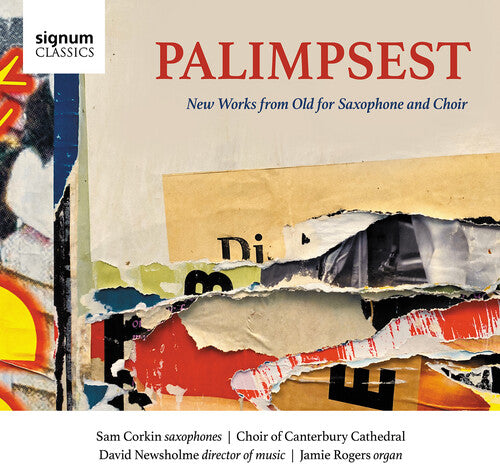
Palimpsest - New Works from Old for Saxophone & Choir
This album marks the culmination of a landmark project to re-imagine new works from old for saxophone; choir and organ. Each work has been specially commissioned and boasts compositions by leading composers including Gabriel Jackson; Errollyn Wallen and Roderick Williams. Celebrated saxophonist Sam Corkin is joined by Canterbury Cathedral choir to bring a fresh perspective to some well-loved repertoire; recorded within the iconic surroundings of Canterbury Cathedral.
Penderecki: Complete Music for String Quartet & String Trio / Tippett Quartet
Penderecki wrote music for string quartet over a period of 56 years. His StringQuartetNo.1was written in the same year that he achieved international success with Threnody (Naxos8.554491), and includes a wide range of playing techniques reflective of the avant-garde. String Quartet No. 2 reveals the influence of Ligeti, while No.3is a personal, even autobiographical work. In No. 4 there are modal or even folk inflections, in writing that is both limpid and abrasive. The eventful Derunterbrochene Gedanke completes Penderecki’s music for quartet, while the String Trio exemplifies his music’s motoric energy.
REVIEW:
Penderecki's First Quartet pointed to his fascination with hard-edged atonality and 12-note influences, the one movement score expressed in pizzicato and lasting just a little over six minutes. With his Second Quartet he had begun to move away from astringency to a more legato quality but with atonality to signpost things to come. There was to be a gap of twenty years before the more lengthy Third appeared in 2008, and it was period when he ‘took stock’ of the way music was going. At the same time his music was moving to an even more communicative melodic period we experience to a final degree in the Fourth of 2016. Now in a more ‘traditional’ two movements, and with a Vivo finale, its style has a melodic starting point. Integrated into these changes were two further works for strings, an extremely brief String Quartet from 1988 given a title Der unterbrochene Gedanke (The Interrupted Thought), and a String Trio from 1990. Both fit neatly into the changing moods of the quartets that surround them. They are here performed by the much acclaimed British-based Tippett Quartet who encompass these changes with a conviction that would place the performances as my number one choice and in quite superb sound.
– David's Review Corner (David Denton)
Widor: Organ Symphonies, Vol. 3 / Christian Von Blohn
Charles-Marie Widor’s ten organ symphonies sit at the heart of his extensive oeuvre. They reveal Widor’s mastery of the form with their profundity, technical difficulty and sonorous color. Symphony No. 7, Op. 42, No. 3 inaugurated a new, orchestral approach to the genre and encompasses dreamlike sonorities, Chopinesque melancholy and majestic bravura. The Symphonie gothique, Op. 70 makes explicit reference to Gregorian chant, developing a kind of theological ‘programme music’ that is both austere and consolatory.
Generali: Adelina (Live)
Sinigaglia: Complete Works for String Quartet, Vol. 1 / Archos Quartet
The renowned Italian composer and mountaineer Leone Sinigaglia wrote a fascinating series of pieces for string quartet that reflect his powers of characterization and elegance. Flowing melodies can be heard throughout, not least in the Concert-Etude, Op. 5, while the more substantial Variations on a Theme of Brahms, Op. 22 display his technical skill and expressive variety, whether reflective, somber or exuberant. His String Quartet in D major, Op. 27 exemplifies his dual inheritance: a commanding central European facility, combined with a natural Italian lyricism.
Danielpour: Toward a Season of Peace / St. Clair
-- All Music Guide
Bach: Cello Suites, Vol. 1 (Arranged for Guitar) / McFadden
-----
REVIEW:
McFadden avoids the result coming too close to a version for harpsichord, though the guitar can never equate to the range of tonal colours available from a solo cello, nor, for that matter the dynamic range of the instrument. Though we do hear fingers moving around the fret, let me conclude this short review by admiring the clean-cut playing of this world famous Canadian guitarist. We can now look forward to the second disc.
– David's Review Corner (David Denton)
Bacewicz: Complete String Quartets Vol 1 / Lutoslawski Quartet
Musicologist Adrian Thomas considered Grazyna Bacewicz’s string quartets “unrivalled in 20th-century Polish music and… one of the century’s most significant contributions to the genre”. Her folk-music infused First Quartet dates from student days at the Paris Conservatoire, while exceptional polyphonic skill, intense emotion and playful, high spirits characterize the Third Quartet. Both the Sixth and Seventh Quartets unite tradition with a strikingly effective and highly personal exploration of progressive contemporary techniques. As Lutoslawski observed, in the “rapidly changing artistic currents” of the times, “it was [Bacewicz’s] music which helped create that atmosphere.”
Danielpour: Talking to Aphrodite, Symphony for Strings & Kaddish, Rachlevsky, Russian String Orchestra
These three recordings cement the bond between the award-winning composer Richard Danielpour and the conductor Misha Rachlevsky, one of the composer’s most dedicated and perceptive interpreters. It was Rachlevsky who gave the American premiere of Symphony for Strings, a transcription of the Sixth String Quartet- a work saturated in farewells, complete with a hymn and variations. Talking to Aphrodite is the result of a collaboration between Danielpour and the writer Erica Jong, while Kaddish addresses the eternal issues of life, death and eventual peace.
Bretón: String Quartets Nos. 1 & 3
Korngold: Songs, Vol. 2 / Stallmeister, Fischer, Schenker-Primus, Simon
In his song settings, Korngold pursued the Romantic ideal and lavished considerable care and inventiveness on their composition. His seemingly effortless gift for melody is everywhere ap-parent in this second volume (Vol.1 is on 8.572027), whether in the early works or the songs from the 1940s, which would not sound out of place in an operetta or a Broadway musical. Also present, notably in the Drei Gesänge, Op.18, is an exciting, experimental approach to harmony that reflects the music of his most radical opera, Das Wunderder Heliane (8.660410-12).
REVIEW:
Already in the 1920s, as a young man, Korngold was composing in a powerfully vocal idiom, as can be heard in the four Lieder des Abschieds (Songs of Farewell). He did not become a prolific art song composer, but there are lieder dotted among his long list of compositions This second volume of his complete songs include Sonett fur Wien from 1953, just four years before his death. The mezzo, Sibylle Fischer, has the task of expressing so much sadness in the four Lieder des Abschieds, a mood she passes to the baritone, Uwe Schenker-Primus, in the Drei Gesange. He also has the task to hark on sorrow in the Lieder aus dem Nachlass, and we hear him to better effect in the forthright Five Songs. That Korngold wrote songs for the cinema surfaces with Morgen from the film The Constant Nymph, here recreated with a piano trio accompaniment, and sung with a smooth elegance by Britta Stallmeister. Together with the pianist, Klaus Simon, the vocal trio give us a rare chance to hear forgotten Korngold.
– David's Review Corner (SDavid Dento)
Beck: Symphonies Op 4 No 1-3... / Stilec
The principal competition for this release comes from CPO, and its set of Op. 3/4 played by La Stagione Frankfurt. Those performances employ period instruments, and these do not, but they are every bit as good. The strings play with appropriate rhythmic verve and (typically) smoother timbre, while the harpsichord continuo remains happily where it belongs–in the background. The oboes have a sweet tone characteristic of the Czech school of woodwind playing, and the horns blend well with them. Czech horn playing tends to be softer and more mellow in sonority then most modern schools, and I have to wonder if this is not in fact more “authentic” than the brassy, brazen tone typical of so many period instrument groups.
Whatever the reality, conductor Marek Stilec leads with well-jedged tempos and brings plenty of life to the music–energy without crudeness. This release will give a great deal of pleasure to anyone interested in the best symphonic works of the early classical period.
-- David HurwitzClassicsToday.com
Christopher Gunning: Symphonies Nos. 8 & 9
Xiaogang Ye: Mount E'mei / Various
Xiaogang Ye is regarded as one of today’s leading Chinese composers, having won prestigious awards for his concert music and for numerous highly successful film scores. The works on this recording share a deep affection for the beauty and power of nature and landscape in China. Mount E’mei eulogises the great spectacle and cultural significance of the mountain, creating a multi-dimensional picture through the use of traditional instruments. Lamura Cuo and The Silence of Mount Minshan describe mystic atmosphere and melancholy silence, while Scent of Green Mango uses vibrant colors and shading to express gratitude for the fruit’s refreshing fragrance.
Interpretations - The Norway Sessions
Perosi: Piano Quintets Nos. 3-4; String Trios / Bevilacqua, Roma Tre Orchestra
Known primarily as a composer of choral music, Lorenzo Perosi was also a priest and much admired by Puccini. Stellar Italian pianist Matteo Bevilacqua is joined once again by members of the Roma Tre Orchestra in these 20th-century Italian chamber music discoveries. Includes world premiere recordings. Perosi’s piano quartets and String Trio No. 2 are available on Naxos 8.574375.