Products
25001 products
-
-
-
-
-
Alfano: Concerto for Violin, Cello & Piano, Piano Quintet
$14.99CDBrilliant Classics
Oct 10, 2025BRI97310 -
-
-
-
-
-
-
-
-
-
-
-
-
-
-
Alfonso Rendano: Piano Concerto, Allegro in A minor
$16.99CDDynamic
Sep 19, 2025DYN-CDS8081 -
-
-
-
-
-
-
-
-
-
-
Alfred Cortot - The Complete French Recordings, 1942-1943
$19.99CDAPR
Sep 05, 2025APR6046 -
-
-
-
ALEXEY STADLER CELLO - KARINA SPOSOBINA
Alf Carlsson & Jiri Kotaca Quartet - Our Stories
Alfabeto Falso
Alfano: Complete String Quartets
Known more widely as a composer of operas, Franco Alfano also composed a body of chamber music including the three string quartets heard here in world premiere recordings.
String Quartet No. 1 in D major was composed during the First World War between 1914 and 1918. The String Quartet No. 2 in C major In Tre Tempi Collegati, composed in 1925–26, is a smaller scale work than the first, and mostly much more tonal in harmonic structure. The String Quartet No. 3 in G minor was written in 1945 and premiered in Rome on 28 November 1947.
The Quartet comprises violinists Elmira Darvarova and Mary Ann Mumm, violist Craig Mumm and cellist Samuel Magill. The same ensemble can also be heard on the acclaimed Naxos album of Alfano’s Violin Sonata and Piano Quintet (8.572753). Alfano's Cello Sonata and Concerto for Violin, Cello and Piano can be heard on 8.570928.
REVIEW:
The first two quartets date from a period that reached from the Great War to the mid-1920s. The opening of the String Quartet No. 1 is a Vivacissimo but the word stands feebly in the face of the torrid, angular tumult that is the first movement. An implacably melodious and fluently flowing Calmo was written as a memorial to his son who died while serving in the Italian military. It is followed by a Largo-Allegro Deciso. The first particle of this movement is a short extension of the mood of its predecessor but soon says a dry-eyed farewell with writing that is, at first, long on a tungsten determination. This is clearly relished by these four players. The music ends with a noble determination that seems to speak of a will to hold it together.
The tonality of the String Quartet No. 2 is placed under less stress than the First Quartet although it is by no means facile listening. It feels inventive. The second movement is marked ‘like a children’s song’. It is a delicate Thumbelina dance of a blossom. The final ‘danse villageoise’ accelerates all the way through.
The 1940s dealt blows to Alfano: much of his music was destroyed in the bombing of Turin and his wife died in 1943. It comes as little surprise that the writing of the first movement of the Third Quartet pierces a path into melancholy. Misty-eyed happiness is recalled but clearly it is not to be experienced again. Joy of a sort is grasped in the next movement, tipping over into the melodic complexity of the powerful Allegro finale. Alfano’s final String Quartet had a Rome premiere in 1947.
The CD’s notes could hardly be more needful – and incidentally meeting that need – when the music is otherwise unknown to all but a few. They are by the disc’s cellist, Samuel Magill. The performances are wondrously fervent, hot-house products. The sound is at your throat, heated and upon you with tiger-like ferocity.
-- MusicWeb International (Rob Barnett)
Alfano: Concerto for Violin, Cello & Piano, Piano Quintet
Alfano: Concerto, Cello Sonata / Magill, Dunn, Darvarova
ALFANO Concerto for Violin, Cello, and Piano. Cello Sonata • Samuel Magill (vc); Scott Dunn (pn); Elmira Darvarova (vn) • NAXOS 8.570928 (60: 06)
These days Franco Alfano (1875–1954) is remembered more for his controversial and much maligned 1926 completion of Puccini’s Turandot than for his own well-crafted and often quite striking music. His career started promisingly. In 1904, his opera Risurrezione , based on Tolstoy’s last full-length novel, made him internationally famous (see Henry Fogel’s review in Fanfare 28:4). In 1918, he rose to the directorship of Liceo Musicale, Bologna, and two years later helped to found the society Musica Nova. His career remained on the ascendancy until 1926, when Toscanini’s de facto damnation of his completion of Turandot made him an odd man out in Italian music. Add to this that two of his contemporaries, Malipiero and Respighi, were changing the focus of Italian music from opera to purely instrumental, while Alfano continued doggedly in the operatic realm with Madonna imperia (1927), Cyrano de Bergerac (1936), Don Juan de Manara (1941), Il dottor Antonia (1949), Vesuvius (1950), and Sakùntala (1952). Then further add that Alfano was on favorable terms with Mussolini’s fascist government and one has a pretty good recipe for his subsequent obscurity.
Then there is the music itself, as illustrated by these two chamber works—soft edged, introspective, and quietly luminous in a most Debussian manner. Cellist Samuel Magill, in his liner notes to this release, points out that Alfano was half French (on his maternal side), and spent the years from 1899 until about 1905 in Paris, where he composed light music for the Folies Bergère. It is plain from these two pieces that he soaked up the atmosphere and found it most congenial. The earlier of these two works, the Cello Sonata, was commissioned in 1928 by Elizabeth Sprague Coolidge. It is a tour de force in its exploitation of the cello’s full compass and coloristic possibilities. The high A-string writing makes it seem a super violin, and the use of harmonics in combination with quiet sustaining pedaled piano figurations creates moments that would have made both Ravel and Debussy proud. It is a long and discursive work that opens serenely, as if to say “I will reveal a great mystery,” and then travels from the elementally abstract toward the more and more intelligible; unfathomable mystery gives way to unbridled passion, and then to a moment of sublime peace.
The Concerto for Violin, Cello, and Piano of 1932 is similar to the Cello Sonata, but given the third instrument, the violin, it is richer in tonal possibilities. Its opening revealing a kinship with Renaissance polyphony, indeed farther back than that, shows how easily those languages can dovetail into that of the French Impressionists. Alfano, like Bruckner and Brahms, was an antiquarian. In both of these works, Debussy’s idea that pure sonority should be an element of music equal with melody, harmony, and rhythm, is writ large.
All three performers are excellent and play with razor-edged accuracy, passion, and insight in these two world-premiere recordings. The recording, alas, is harsh in its upper register, requiring treble cut on my system, but, on the other hand, it reveals everything, as if under a microscope. The piano, however, is splendidly registered throughout.
FANFARE: William Zagorski
Alfano: Madonna Imperia / Gavazzeni, Ushiroda, Valerio, Carraro, Italian Philharmonic
As soon as he had finished the finale of Turandot [1925-6], Alfano began working with political journalist and man of letters Arturo Rossato, [Vicenza 1882-1942]. He offered Alfano a libretto in one act, Madonna Imperia, based on La belle Impéria, by Honoré de Balzac. The fair lady of high society Imperia enjoys the protection of the chancellor of Ragusa and lives a life of pleasure in Constance among prelates and nobles and bewitches one of the bishop of Bordeaux’s young choristers, Filippo Mala, who declares his love for her and has to sing her a song as though he were a troubadour. This love arouses the jealousy of Ragusa, who makes Filippo go away and leave Imperia to him, but the passion between Imperia and Filippo wins out and the opera ends with an erotic encounter between the two offstage.
Alfano: Piano Works
Alfano: Risurrezione / Duprels, Vickers, Lanzillotta, Orchestra Del Maggio Musicale Fiorentino
Franco Alfano’s opera Risurrezione draws its inspiration from Tolstoy’s novel Resurrection and was the work that ensured Alfano’s considerable success as a composer. The plot narrates the story of Katiusha and her tragic love for prince Dimitri who seduces and abandons her, condemning her to a life of sacrifice and desperation. Seen here in Fancesco Lanzillotta’s acclaimed Florence production, Risurrezione recalls Richard Strauss and Puccini – the drama evolving in an uninterrupted flow with moments of soaring lyricism alongside striking and evocative orchestration. The work gives voice to an idea that Alfano left in his memoirs: ‘Recoiling from catastrophes, I believed and still believe in the renovation, regeneration, and final purification of human passions from evil to goodness.’
Alfano: Risurrezione / Duprels, Vickers, Lanzillotta, Orchestra Del Maggio Musicale Fiorentino
Also available on standard DVD
Franco Alfano’s opera Risurrezione draws its inspiration from Tolstoy’s novel Resurrection and was the work that ensured Alfano’s considerable success as a composer. The plot narrates the story of Katiusha and her tragic love for prince Dimitri who seduces and abandons her, condemning her to a life of sacrifice and desperation. Seen here in Fancesco Lanzillotta’s acclaimed Florence production, Risurrezione recalls Richard Strauss and Puccini – the drama evolving in an uninterrupted flow with moments of soaring lyricism alongside striking and evocative orchestration. The work gives voice to an idea that Alfano left in his memoirs: ‘Recoiling from catastrophes, I believed and still believe in the renovation, regeneration, and final purification of human passions from evil to goodness.’
Alfano: Songs / Pirozzi, Abbate
Franco Alfano was a major musician and teacher who enjoyed considerable success with his operas during his lifetime, but who has been overlooked for decades. Generally regarded as the regenerator of the Italian art song, the works featured in this album offer a generous overview of Alfano’s vocal output, from his Opus 1 Cinq mélodies, written in 1896 when he was a twenty-one-year-old student at Leipzig, to Due liriche per canto, violoncello e pianoforte from 1949, five years before his death. Anna Pirozzi has established herself as the leading Italian dramatic soprano of today, performing on the most prestigious international opera stages. She is joined here by the acclaimed pianist Emma Abbate and renowned cellist Bozidar Vukotic.
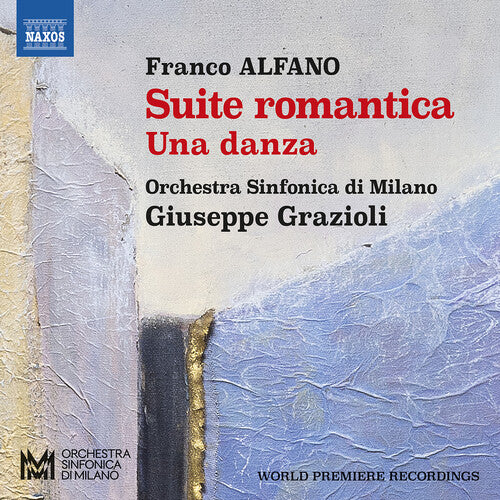
Alfano: Suite romantica; Una danza / Grazioli, Milan Symphony
Franco Alfano possessed an innate melodic facility combined with a talent for unexpected timbres. From the neo-Classical Divertimento to the noirish post-war Nenia, the lightness of touch of Amour… Amour… to the impressionistic Una danza and luxuriously orchestrated Suite romantica, each work reveals a different aspect of this multifaceted composer. This release of world premiere recordings features the Orchestra Sinfonica di Milano conducted by Giuseppe Grazioli who makes his Naxos début.
REVIEW:
Franco Alfano (1875–1954) remains a marginal figure in musical life despite a fair degree of coverage in record catalogs. Yet he is a thoroughly original composer, one who possessed an innate melodic gift combined with a talent for unexpected timbres, as can be heard in the lavishly orchestrated Suite romantica. The half-hour work is heard on this album in a very colorful and expressive, excellently performed interpretation.
With Una danza, completely different colors are expressed and one may hear an influence of Debussy. This is followed by Nenia, a somewhat melancholy solo piece for accordion, sensitively played by Davide Vendramin, which finds its counterpart in the Aria of the Divertimento, even if the outer movements are very lively and playful.
The program, pleasing and excellently played, ends with the Waltz Amour… Amour…, originally composed for piano in 1901 and orchestrated in 1928.
-- Pizzicato
Alfano: Violin Sonata - Piano Quintet
Alfonso Ferrabosco Jr. & William Byrd: Consort Music
«Apt for Viols and Voices». That's how the fusion of voices and viols is mentioned in several documents of the English renaissance. This CD is devoted to two of the most important composers of that period who've bequeathed us an important body of 'consorts' for 4 and 6 part viols as well as some very moving 'consort songs'. Both were employed at the royal court. The former Elisabeth the 1st, the latter by James the 1st. The elder remains faithful to the basic principles of polyphony acquired with his master Thomas Tallis for whom he writes the poignant elegy 'Ye Sacred Muses'. The second musician, on the other hand, a viola virtuoso, leads his instrument into new avenues and develops his polyphony through audacious experiments.
Alfonso Rendano: Piano Concerto, Allegro in A minor
Alfonso X: Cantigas
Alfonso X: Cantigas of Santa Maria
Alfonso X: Chamber Music
Alfred Brendel - My Musical Life
When, in December 2008, six decades into his illustrious career, Alfred Brendel bade farewell to an emotional Viennese audience, it was not a “full stop”, as it may have appeared at that moment. Rather a “semicolon”. With more time on his hands, the celebrated pianist went on to focus on other activities – writing (essays on music, poetry), giving lectures, leading masterclasses. In January 2021, Brendel will celebrate his 90th birthday, possessing profound knowledge and experience, as well as a great zest for learning new things. And also a sense of humour, which he has often turned against himself. Precious few artists have influenced the perception and performance of music as much as Brendel has. He was the first to have recorded the complete Beethoven piano works, he succeeded in bringing Franz Schubert’s music back to the concert stage, among other achievements. Of late, Brendel has often visited Prague to give lectures and masterclasses at the Rudolfinum, highlights of which are captured on the present release. Beethoven, Mozart and Schubert are the figures he, as a pianist, treasures most. The autobiographical lecture My Musical Life provides the viewer with a glimpse of the universe full of paradox that gave rise to the legend called Brendel – unveiling the sources of his inspiration, education and artistry, that formed his vision of the world.
Alfred Brendel Plays Beethoven Piano Sonatas Vol I
Alfred Brendel Plays Beethoven Piano Sonatas, Vol Iii
Alfred Brendel Plays Beethoven Sonatas Vol 2
Alfred Brendel plays Busoni & Liszt
Alfred Brendel Plays Liszt Vol 2 - Opera Transcriptions, Etc
Alfred Brendel Plays Schubert
ALFRED BRENDEL: IN PORTRAIT
Alfred Cortot - The Complete French Recordings, 1942-1943
Alfred Cortot - The Warner Classics Edition
His exceptional touch and sense of phrasing, his deep and personal understanding of the most varied repertoires, or even the legendary trio he formed together with Jacques Thibaud and Pablo Casals, made Alfred Cortot the greatest pianist of his time. Master of many disciples, notably the brilliant Dinu Lipatti, Samson François and Clara Haskil, Cortot also had a lasting influence on the Russian piano school through Samuil Feinberg and Heinrich Neuhaus, the latter himself being the revered teacher of Sviatoslav Richter.
All of the recordings in this set had undergone careful sound restoration in 2012, in order to respect as closely as possible the original sound. The remastering was carried out under the expert control of Mr. Guthrie Luke, a former disciple of Alfred Cortot who attended many recording sessions by Cortot. These recordings do not represent a "complete" edition: the many rolls engraved by the artist for Duo-Art, Aeolian and Pleyela labels have not been reproduced here, most of them doubling the 78-RPM repertoire. The first recordings are acoustic; and the ones with an electric microphone appeared as early as 1926.