Alpha Classics Sale 2026
Over 600 titles from Alpha Classics are on sale now at ArkivMusic!
Discover titles from composers such as Giacomelli, Haydn, Godowsky and more!
Sale ends at 9:00am ET, Tuesday, April 14th, 2026.
622 products
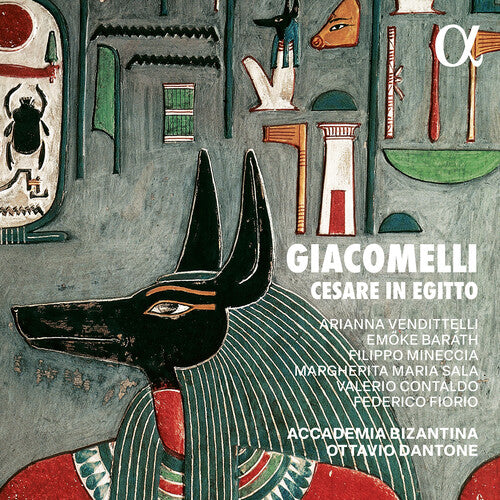
Giacomelli: Cesare in Egitto
Alpha
Available as
CD
The Italian conductor Ottavio Dantone breathes new life into Cesare in Egitto, an opera by Geminiano Giacomelli (1692-1740) based on a libretto written by Domenico Lalli with the assistance of a young collaborator not yet in his thirties: Carlo Goldoni. Cesare in Egitto, is considered to be Giacomelli's masterpiece; his drammi per musica enjoyed great success in Parma, Venice, Milan, Rome, Turin and Graz. He also influenced the most eminent musicians of his time: Vivaldi, for example, used arias by Giacomelli in his pasticcio Bajazet. This world premiere recording was made with the Accademia Bizantina and first-rate soloists at the Innsbruck Festival, where Ottavio Dantone has been music director since 2024.
Haydn 2032, Vol. 12 - Les Jeux et les Plaisirs (LP version)
Alpha
Available as
Vinyl
This programme focuses on fantasy and pleasure, with three symphonies punctuated by lightness and wit. In addition to ten photos by Magnum photographer Cristina Garcia Rodero, a literary text that appears exclusively on the vinyl edition of the series provides a continuation of the musical experience. Philippe Claudel, President of the Academie Goncourt, here focuses on the pleasure and sensuality of a fleeting youthful encounter: "The third movement of the symphony accompanies us towards the taut velvet of the great lime trees. We are no longer walking through life. We tread upon a dream. And music gives this dream the profundity of legend. [...] I experience my own mythology in this May evening. We lie on the lawn. Our eyes search for each other in the darkness. Our pupils are stars cast into the lofty skies of May. I am not fifteen. I am no longer fifteen. This does not mean anything. Time does not exist."
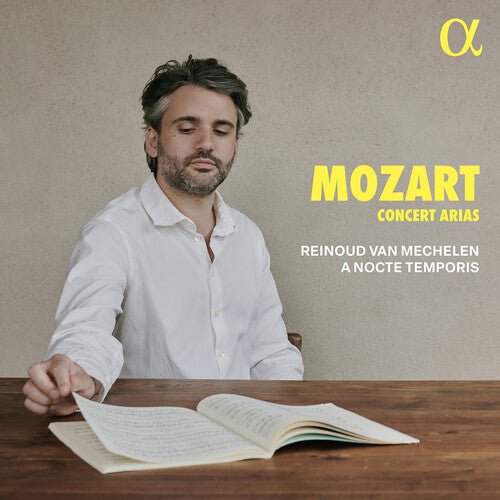
Mozart: Concert Arias
Alpha
Available as
CD
Fresh from his triumphant onstage success in Paris, Berlin and Brussels singing leading roles in the operas of Rameau and Mozart, tenor Reinoud Van Mechelen presents his long-awaited first Mozart recording. Together with his ensemble A Nocte Temporis, he has devised a highly imaginative programme. From the eleven single opera and concert arias for tenor and orchestra that are ascribed to Mozart, the Belgian tenor has selected those that are entirely in the composer's hand - leaving out the ones completed or reconstructed by others, and adding an exquisite aria from Mitridate, re di Ponto. Mozart was only nine years old when in 1765, during his stay in London, he launched into his first opera aria for tenor and orchestra, to verses from a libretto by Metastasio. At the end of 1766, on his return to Salzburg, the child prodigy composed Or che il Dover - Tali e cotanti sono KV 36 for a festive celebration, making the court aware of his enormous talent. Throughout his career, alongside his own operas Mozart also wrote arias intended for insertion into the operas of other composers, hidden masterpieces that now receive revelatory performances.
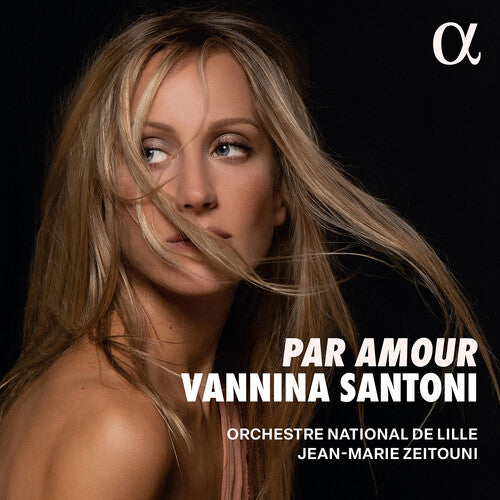
Par amour
Alpha
Available as
CD
Love is the common thread running through this first recorded recital by soprano Vannina Santoni; it's also an opportunity to look back over her fifteen-year career, through her leading roles, alongside her favourite musicians. With the help of the Orchestre National de Lille and Quebecois conductor Jean-Marie Zeitouni, she places her sensual voice at the service of famous operatic arias featuring the amorous heroines of Gounod, Massenet, Puccini ('O mio babbino caro'), Catalini ('Ne andro' from La Wally) and Verdi (Desdemona's poignant 'Ave Maria' from Otello). The programme also includes a rare but sublime aria from Franco Alfano's Tolstoy-inspired opera Risurrezione (1904), as well as the magnificent 'Saint-Sulpice' duet from Massenet's Manon, with tenor Julien Dran. Finally, Vannina Santoni pays homage to her Corsican roots with a new orchestration of the lullaby 'O Ciucciarella' that Corsican mothers have sung to their children for generations.
Godowsky, Franck & Rachmaninoff: Chiaroscuro
Alpha
Available as
CD
In 2022, 19-year-old pianist Roman Borisov became the youngest winner of the prestigious Kissinger KlavierOlymp competition. After taking part in Alpha's 'Next Generation Mozart Soloists' collection (ALPHA991), he now presents his first solo recital in Alpha's ongoing 'Piano Stories' series, which he sees as a 'conversation with the past', featuring composers inspired by earlier styles to create new works. Born in 1870, the brilliant virtuoso pianist Leopold Godowsky composed twenty-four 'free arrangements' of music by masters of the Baroque. Among these, Roman Borisov has selected pieces based on works by Rameau, Corelli, Scarlatti and John Loeillet (whose pieces were originally mis-attributed to Lully)... In 1931, Rachmaninoff composed his last original work for solo piano: a set of variations on 'La Folia', a 15th-century dance theme that Corelli famously used in one of his violin sonatas. The encounter between the Baroque style and the harmonic richness of the Russian composer is fascinating. The superb Prelude, Chorale and Fugue composed by Cesar Franck in 1884, an obvious tribute to J.S. Bach, concludes Roman's pianistic journey through time.
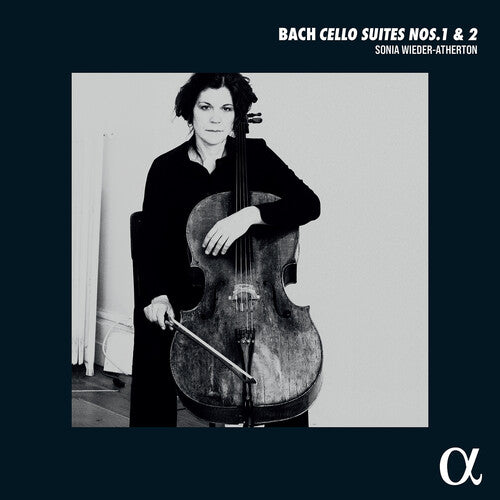
Bach: Cellos Suites Nos. 1 & 2
Alpha
Available as
CD
The Franco-American cellist Sonia Wieder-Atherton has always sought to make music a language open to the world. A prizewinner in the Rostropovich Competition at the age of twenty-five, she is the interpreter of choice for many contemporary composers, among them Pascal Dusapin and Wolfgang Rihm, and has collaborated with actresses such as Fanny Ardant and Charlotte Rampling, as well as the film director Chantal Akerman. Sonia Wieder-Atherton's partnership with Alpha Classics comprises three recordings of Bach's Cello Suites, beginning with this recording of Suites Nos. 1 and 2. This and the following two volumes (Suites 3 to 6) feature photos by the great Sarah Moon: "For me, playing Bach's Suites is always at some point or another seeing the image of Giacometti's hands tirelessly moulding clay until a face appears. (...) To get to grips with the Bach Suites is an experience very close to that. It's a question of digging into the string until the phrase is born, as well as the right way to breathe it. (...) And then came the encounter with Sarah Moon. When my desire to record the Bach Suites was born I dreamt of her images. Because, when I look at them, I imagine the creation of the world, the separation of the waters, the appearance of the earth, before history begins."
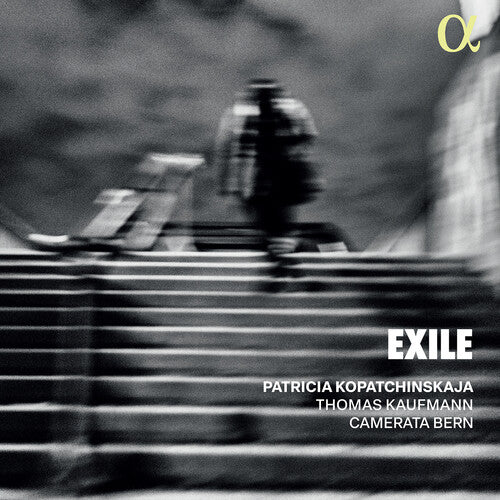
Exile
Alpha
Available as
CD
This programme brings together composers who, for the most part, were compelled to flee their homeland. In 1920, Ivan Wyschnegradsky took refuge in Paris, where he wrote for a quarter-tone piano at a time when, in Russia, the slightest dissonance was considered a political provocation. Andrzej Panufnik left his native Poland in 1954. Alfred Schnittke settled in Hamburg in 1990, eight years before his death, having spent most of his life in the Soviet Union. Although Schubert never moved away from Vienna, the pain and solitude of his inner exile are palpable in his music. Finally, the Belgian violin virtuoso Eugene Ysaye emigrated on account of the First World War and it was in the United States, in 1917, that he wrote the melancholy musical poem recorded here, which he called Exil! Is exile nothing but pain and isolation, or also a source of inspiration which, with music, expresses what words cannot say, acting as the ultimate refuge? 'Let's listen to what they have to say', suggests Patricia Kopatchinskaja, herself 'uprooted for ever'. She is joined by cellist Thomas Kaufmann and her friends from Camerata Bern.
Desmarets & Campra: Iphigenie en Tauride
Alpha
Available as
CD
Nearly a century before Gluck, another opera called Iphigenie en Tauride - same plot, same protagonists - had immense success on the opera stage. This 'first' Iphigenie has rather a curious history. The opera was sketched out by composer Henri Desmarest around the year 1695, but he was then banished from France by Louis XIV for having married a young girl without her father's consent. The uncompleted score of Iphigenie was then entrusted to Andre Campra. The opera, since lost and forgotten, was rediscovered by Benoit Dratwicki, Director of the Centre de Musique Baroque de Versailles, who marvels at it's stylistic unity: 'Campra easily adopted Desmarest's style. He just added some virtuoso arias to the divertissements, as well as the tuneful choruses that were his speciality.' Iphigenie en Tauride had it's premiere on 6 May 1704, and was revived throughout Europe from 1711. Thanks to Herve Niquet, a top-flight team of singers, an orchestra well versed in French repertoire, and all their collaborative research into the practices and specific playing techniques of the early 18th century, Iphigenie sees the light of day once more.
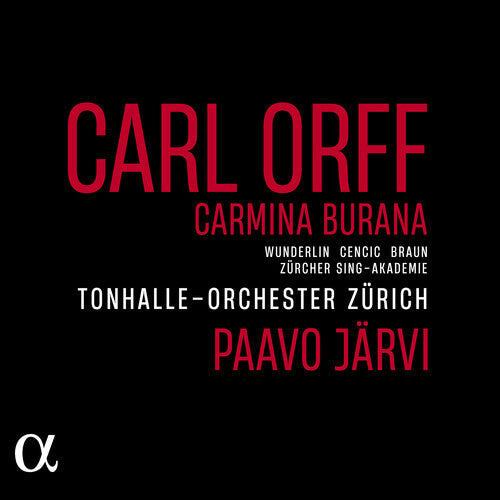
Orff: Carmina Burana
Alpha
Available as
CD
Carmina Burana, the staged cantata by Carl Orff, is a work unique in musical history, claims conductor Paavo Jarvi: 'The convergence of medieval texts with such daringly original orchestral colours creates a soundworld that is both archaic and yet beyond time, in which chorus, orchestra and soloists vie in splendour.' The work also has an unusual history: composed shortly after the Nazi takeover of Germany, it was at first rejected because of it's Latin texts and the erotic character of some of it's songs; yet Orff and his work subsequently became highly prized by the Reich. The composer (who was secretly 'a quarter Jewish') did not support the regime, but made the best of his success... Orff was 42 by the time he experienced this breakthrough with his Carmina, which he designated as his Op. 1, disowning all his previous compositions. Departing from the Romantic style, he now wanted to create music linked to rhythm, simple repeated melodies, and non-complex forms. This work's popular success confirmed that decision.
Montalbetti: Orchestral Pictures
Alpha
Available as
CD
By 2014 eric Montalbetti had amassed 20 years of experience as Artistic Director of the Radio France Philharmonic Orchestra, all the while he had also been composing, something he had been engaged in since childhood: an activity he did not publicly reveal until 2015. Conscious of the heritage of Debussy and Messiaen ('my very first heroes') as well as skilled in the serialism of Boulez - whose teaching courses he attended at the College de France - and fascinated by the sonic nuances of spectral music, eric Montalbetti seeks a point of convergence, a possible synthesis enabling him to blend modality and serialism, without rejecting the harmonic contours of composers such as Murail. This new album dedicated to Montalbetti's work includes a Flute Concerto, whose commission was encouraged by Emmanuel Pahud: it's telling title is Memento vivere (Remember that you must live).
Mozart: Violin Concerto No. 5, KV 219; Piano Concertos Nos.
Alpha
Available as
CD
Volume 11 of the 'Next Generation Mozart Soloists' series presents Violin Concerto No. 5 in A Major along with Piano Concertos KV 40 and KV 449. The Piano Concerto No. 3 is a very early work, derived from works by other composers, whereas No. 14 was written in 1784 by a fully mature Mozart, who was moving away from functional music towards expressing his ideas in a more dramatic structure. What links the two, says Swiss-Canadian pianist Teo Gheorghiu, is that they are both "concertos mainly joyful and optimistic in expression". French violinist David Castro-Balbi says "of Mozart's violin concertos, No. 5 has the strongest operatic character". These two soloists are accompanied by the Mozarteumorchester Salzburg under the baton of Howard Griffiths.
Haydn2032, Vol. 11 - Au gout parisien (LP)
Alpha
Available as
Vinyl
The eleventh volume of the complete HAYDN2032 symphony cycle moves it's focus to Paris: 'Every day one perceives more clearly, and consequently admires more, the productions of this great genius, who, in every one of his works, knows so well how to draw rich and varied developments from a single subject', wrote the Mercure de France in April 1788, adding that Haydn was 'quite different from those sterile composers who constantly move from one idea to another...'. The symphonies presented here are no.2 (the first to be published in France), No. 24 (the first to be performed there) and the so-called 'Paris' symphonies Nos. 87 and 82 'L'Ours', with it's references to fairground atmosphere and it's famous contredanse finale. This limited and numbered edition contains two vinyl LPs along with an album of photos by Jean Gaumy (Magnum Photos) and a magnificent unpublished text entitled How I could talk about Joseph Haydn... by the writer Hanns-Josef Ortheil.
La Comedie Humaine - Chansons balzaciennes
Alpha
Available as
CD
Arnaud Marzorati and his singers, 'Les Lunaisiens', are unrivalled specialists in the popular French songs of the past centuries. Here they tackle two great monuments of 19th-century France: the writer Honore de Balzac, and songwriter Pierre-Jean de Beranger, a poet and composer highly famed in his day for his genius in depicting society in all it's social diversity, from the poorest to the very richest. During this period Balzac was also making his sharply drawn portrayals of more than 5,000 characters in the course of his great opus of around 90 novels bearing the overall title of The Human Comedy. Here the 'Lunaisiens' have recorded musical settings of a wide selection of witty and often satirical verse, reflecting all the Parisian themes that obsessed Balzac: social climbing, money and greed, corruption, love and betrayal. With the participation of Lucile Richardot and Cyrille Dubois, Arnaud Marzorati and his ensemble give an enthusiastic account of Balzac's extraordinary human menagerie. As Marzorati concludes: 'The Human Comedy was greatly inspired by song.'
Ferrum Splendidum
Alpha
Available as
CD
Following his Rossini recital (Alpha 791), Florian Sempey shares another of his passions: his enthusiasm for the world of knights and medieval narrative. For him, "a mysterious force emanates from castles and other antique buildings; their ancient stones have always fascinated me." Ferrum Splendidum (the Latin for 'Resplendent Metal') recalls the singer's ancestors, who were blacksmiths in the Perigord region. Though not following in that family tradition, Sempey concentrated instead on forging and moulding the metal of his brilliant baritone voice. Now a much sought-after opera soloist at the height of his art, he has devised a programme ranging widely through different heroic characters and operas, including Gretry's Richard the Lionheart, Hamlet by Ambroise Thomas, Meyerbeer's Le Pardon de Ploermel, as well as Tchaikovsky's opera The Enchantress, Wagner's Tannhauser, extracts from Carl Orff's famous neo-medieval cantata Carmina Burana, and even the premiere recording of a piece by Romain Dumas, Le Chevalier d'eon, composed in 2019. Once again Florian teams up with the Orchestre National Bordeaux Aquitaine and it's young maestro Victor Jacob, who was named a 'Revelation' in the conductor category at the 2023 Victoires de la musique awards.
Orlando, A Melancholic Portrait
Alpha
Available as
CD
Orlando di Lasso (b. 1532 in Mons) was one of the most important and prolific composers in the whole of sixteenth-century Europe. Famed as a singer from boyhood, he escaped several kidnapping attempts ordered by princes who coveted his talent for their courts. Di Lasso is a fascinating character: an extravagant and provocative musical figure, an adventurous artist and cultivated polyglot. On being asked to provide the soundtrack for a documentary on di Lasso by Joachim Thome, Simon-Pierre Bestion became immersed in the composer's multiverse. This album, an extension of the music for that film, projects the iconoclast di Lasso into our 21st century world. As Bestion explains: 'I made a deliberate choice here to interpret this music with a great freedom of instrumentation and of timbre. What is more, even though there were no drums or saxophones in di Lasso's day, the performer was free to choose whichever or the ornamentation he wanted.' Join La Tempete for this unpredictable, fantasy-enriched exploration of the timeless realm of Orlando.
Invisibles / Siranossian, Gouin
Alpha
Available as
CD
Astrig Siranossian and Nathanael Gouin pluck from obscurity three rare works that time has rendered (temporarily) invisible. The first of these sonatas for cello and piano, recorded at the La Grange-Fleuret Music Library, was composed by Jean Cras in 1901, when he was a young naval officer aged twenty-two. It displays his precocious mastery of form and texture. Pierre-Octave Ferroud's Sonata, written in 1932, four years before this promising composer died in a car accident at the age of thirty-six, evokes a very different mood. Marcelle Soulage is certainly the least-known of the three. A pupil of Nadia Boulanger, teacher, radio producer and journalist in addition to her work as a composer, she was a founder member of the Groupe Instrumental Feminin in the 1950s. Her Sonata in F sharp minor, written in 1919 when she was twenty-five, reveals inventive qualities that were already very apparent.
A. Hugo: Mélodies sur des poèmes de Victor Hugo
Alpha
Available as
CD
This album pays homage to the composer Adele Hugo (1830-1915), the fifth child of the great poet Victor Hugo. Suffering from lifelong psychological instability, she spent half of her tragic life in mental institutions, from the age of 42 until her death aged 85. Hers was an exalted and sensitive temperament; she became passionately fond of music from an early age, studying the piano and then composition. Her musical manuscripts were recently rediscovered, and the Director of the Victor Hugo Museums in Paris and Guernsey entrusted them to composer Richard Dubugnon, so as to research and reconstruct the jigsaw of these often quite fragmentary scores, which had been lying forgotten for more than a century. What has emerged is a set of fourteen of her songs on poems by Victor Hugo and verses taken from his great novel Les Miserables, as well as five songs without words. Appropriately, the Orchestre Victor Hugo and it's Music Director Jean-Francois Verdier have been involved in the project, and they invited Dubugnon to orchestrate the pieces, presented here by a multi-generational team of leading singers.
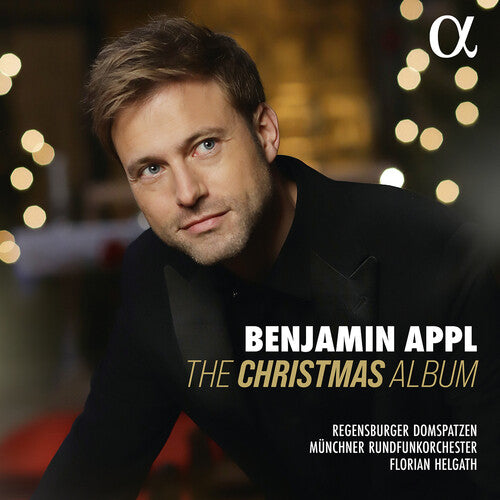
The Christmas Album / Benjamin Appl
Alpha
Available as
CD
German baritone Benjamin Appl celebrates Christmas through the enduring tradition of Bach chorales and popular carols, from as far afield as Germany, Austria, America, Britain, Sweden, France and the Netherlands. For this truly universal Christmas celebration he is accompanied by Germany's most famous children's choir, of which he was a member in his youth, the Munich Radio Orchestra and instrumentalists (including his own mother on guitar): "Christmas evokes intense memories and emotions in all of us. It takes us back to our childhood: that sense of magic and excitement, so often reawakened by the sight of a traditional Nativity scene, or the lights on a Christmas tree, or by hearing Christmas carols... It was with all these images in mind that I returned to my home town to record this album with 'my' boys' choir. When, after more than twenty years, I found myself back among the choristers and heard the familiar sound, the emotion was very intense."
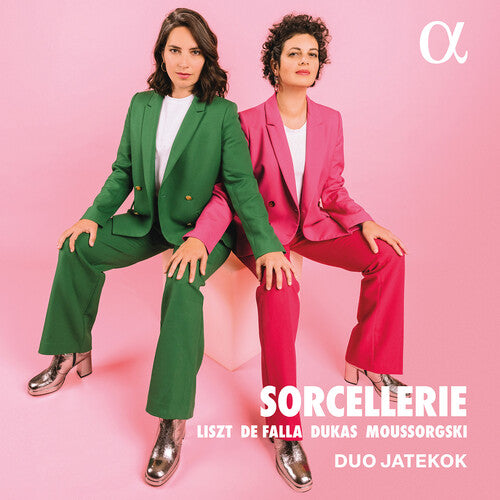
Sorcellerie / Duo Jatekok
Alpha
Available as
CD
Enchanting tales and timeless legends are the common threads running through this album conceived by Duo Jatekok: Na�ri Badal and Adela�de Panaget are transformed into sorceresses on four hands and two pianos - enchanting guides who lead us through a programme featuring a Faustian pact, magic, and the world of childhood. At it's heart is Liszt's Piano Sonata, brilliantly transcribed for two keyboards by Saint-Saens: 'It illustrates the eternal struggle between the hubris of excess and the tragic fall, between light and darkness', say the duo of this 'Faustian' masterpiece by Liszt, a great admirer of Goethe. In a more carefree but equally fantastical vein is the famous Sorcerer's Apprentice, which Paul Dukas himself transcribed in 1898. The trance-like atmosphere and frenzied dancing continues with Manuel de Falla's El amor brujo (Love the magician). Finally, Mussorgsky's Night on the Bare Mountain, a 'danse macabre between the world of the living and that of the spirits', rounds off this supernatural odyssey.
Haydn2032, Vol. 16 - The Surprise
Alpha
Available as
CD
'Joseph Haydn not only liked surprising his audiences, he also enjoyed a laugh', writes Christian Moritz-Bauer in the introduction to this sixteenth volume of the Haydn2032 complete recording of the symphonies. Take, for instance, the false conclusion of Symphony No. 90, composed in 1788: the music seems to have reached the last chord but, after a pause, the movement resumes to end with a powerful coda. Another example of Haydn's mischievous wit is the famous Andante 'with the drumstroke' that forms the 'surprise' of Symphony No. 94, a fortissimo chord designed to wake up audiences who dozed off towards the end of his concerts... In this volume focused on humour, Giovanni Antonini pays tribute to a great admirer of Haydn, Gioachino Rossini, by recording the sparkling opening Sinfonia of La scala di seta (The silken ladder), a one-act opera written in 1812.
Wagner: Ring Odyssey
Alpha
Available as
CD
'If, in a parallel universe, Wagner wrote a symphony rather than a sixteen-hour Ring, it might actually resemble my Ring Odyssey.' These are the words used by the new music director of the Orchestre National Bordeaux Aquitaine, Joseph Swensen, to present this anthology of Der Ring des Nibelungen for soprano, tenor, bass-baritone, male chorus and orchestra, which he composed on the basis of Wagner's monumental tetralogy. The American conductor confesses that, during a performance of Tristan, Wagner was suddenly revealed to him as 'a dreamer' full of 'humility, tenderness, vulnerability and generosity'. Swensen has made a point of following the chronology of the operas and respecting the original music: 'My solemn promise to Wagner was that, aside from the occasional solo timpani roll denoting the passage of time, I would not change or add a single note to his masterpiece.' An enthralling traversal, recorded at a memorable concert and delivered by exceptionally committed singers and instrumentalists.
J.S. Bach: Cello Suites Nos. 5 & 6
Alpha
Available as
CD
For me, whenever I play the Bach suites, all of a sudden I find myself visualising Giacometti's hands incessantly moulding the earthen clay until a face appears. Getting to grips with the Bach suites is very closely related to that sense. You have to dig deeply into the string to give birth to the phrase, to make sure it breathes correctly: a phrase that is perpetually becoming, endlessly making and remaking itself. I waited a long time before recording these suites. Then one day, or rather one night, I began. Then there was my meeting with Sarah Moon. When I first felt my longing to record the Bach suites, I dreamt constantly of her images; because whenever I look at them I think of the creation of the world, the separation of the waters, the earth appearing, all before the beginning of history. Sonia Wieder-Atherton
Mozart: Concerto for Two Pianos, KV 365; Sinfonia Concertant
Alpha
Available as
CD
This tenth volume in the 'Next Generation Mozart Soloists' series presents works that are less frequently recorded, including a concerto for two pianos (in it's original orchestration), separate movements for violin and orchestra (an Adagio and two Rondos) and, following in the footsteps of the Baroque concerto grosso, the Symphonie concertante for oboe, clarinet, horn, bassoon and orchestra. It's an opportunity to discover a superb array of soloists from very different backgrounds: the Sakamoto piano duo, 2021 winners of the prestigious ARD competition in Munich; the Syrian violinist Bilal Alnemr, a member of the West-Eastern Divan Orchestra; the Frenchmen Nicolas Ramez, also an ARD winner, and Gabriel Pidoux, an existing Alpha recording artist (ALPHA789); Theo Plath, principal bassoon with the Frankfurt Radio Orchestra; and Bla� Sparovec, principal clarinet with the Gurzenich Orchestra in Cologne.
Crossroads / Ksenija Sidorova
Alpha
Available as
CD
After Piazzolla Reflections, (ALPHA664), Latvian accordionist Ksenija Sidorova devotes this new recording to Bach and compositions influenced by his music - starting with the famous Concerto BWV 1052, which has inspired so many adaptations for piano, violin and even heavy metal guitar, "so I don't think a version for an instrument with two keyboards will surprise anyone!" says Ksenija. The programme also includes Sergey Akhunov, a composer who featured on her previous album, with a work inspired by Bach's Chaconne BWV1004; Beyond Bach by Gabriela Montero, the Venezuelan pianist and composer famous for her improvisations; and Horizons by the Anglo-Bulgarian composer Dobrinka Tabakova. The programme is completed by Bach's Chorale Prelude Ich ruf zu dir, which has accompanied Ksenija since childhood: 'I think this organ piece works particularly well on the accordion. Both instruments use bellows, but the accordion offers a much more flexible dynamic range. You can really let the music breathe.'
Destinées / Sophie de Bardonnèche
Alpha
Available as
CD
Destined to be musicians? The female composers to whom Baroque violinist Sophie de Bardonneche pays tribute enjoyed very different fates: while the name elisabeth Jacquet de La Guerre (1665-1729) continued to be remembered, who knows Mlle Duval (born around 1718), the second woman to have a work presented at the Paris Opera and nicknamed 'la Legende' in her time? Her opera-ballet, Les Genies, remains a testament to her great mastery. Then there were Anne-Madeleine Guesdon de Presles and elisabeth-Louise Pellecier, composers married to composers - the latter signed her works with the name of her husband, Papavoine... Others found it easier to achieve the limelight because they were aristocrats, like Mlle de Menetou (1679-1745). No fewer than ten female composers are brought back to life in this programme of sonatas, overtures and dances devised by Sophie de Bardonneche, a founder member of Le Consort, who is accompanied on her first solo album by her partners Lucile Boulanger and Justin Taylor.