BIS Records - Spring 2025
Over 300 titles from BIS Records are on sale now!
Founded in 1973, BIS Records is one of the most highly respected classical labels in the world, praised for the sound quality of its recordings and for the versatility and variety of its catalogue, which to date includes more than 1700 titles.
BIS Records has established themselves as one of today’s leading independent classical labels, with a strong focus on Scandinavian and Baltic composers and landmark projects including the complete works of Sibelius and the Suzuki Bach cantata series.
Shop the sale before it ends at 9:00am ET on Tuesday, June 24, 2025.
362 products
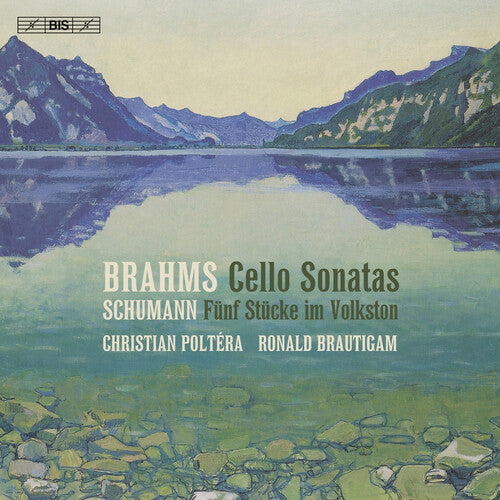
Brahms: Cello Sonatas Nos. 1 & 2 - Schumann: 5 Pieces / Poltera, Brautigam
Six years after their acclaimed disc devoted to Mendelssohn’s works for cello and piano, Christian Poltera and Ronald Brautigam now tackle the two cello sonatas by Johannes Brahms, two central works in the repertoire, unquestionably the most important since those by Beethoven.
The First Cello Sonata was composed between 1862 and 1865 when Brahms was in his thirties. He seemed intent on showcasing the lyricism of an instrument that is often compared to the human voice. Composed 24 years later, the Second Cello Sonata makes greater use of the cello’s range, particularly in the upper register. A common feature of these two sonatas is that the role of the piano is never secondary (Brahms was an excellent pianist) and the dialogue between the two instruments is both inexhaustible and complex.
The programme also includes the Funf Stucke im Volkston (Five Pieces in Folk Style) by Robert Schumann, Brahms’s early mentor. Composed in Schumann’s late years, this short cycle reflects the composer’s taste for small, expressive pieces in, as the title suggests, a popular and accessible idiom. These miniatures draw their charm not only from the cello’s marvellous nuances but also from the ‘folk style’.
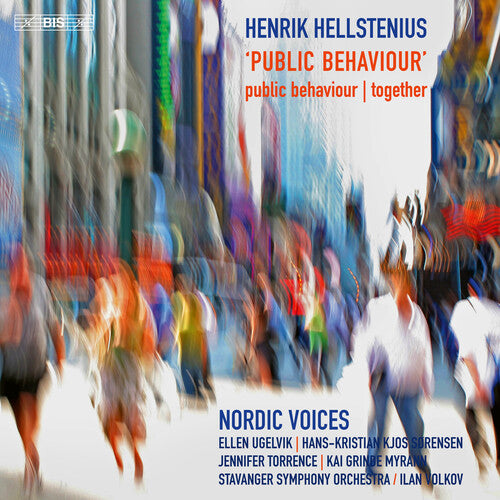
Hellstenius: Public Behaviour / Stavanger Symphony Orchestra
Ever since he was a child, Norwegian composer Henrik Hellstenius has sought to explore music more freely than by simply mastering the classics. His language, which draws its inspiration from the modes of expression of his time, takes shape in the course of his work through sound, movement, rhythm and silence, as well as in his encounters with musicians and their instruments.
Here, much of what is expressed is part of an intense inner monologue: a litany of doubt, affirmation and frustration being whispered, said, sung and shouted. Everything about these two works, from their titles to their modes of expression, suggests that they are directed outwards towards society in general and towards individuals in particular.
Public Behaviour is about how we act together in an age of extreme individualism. The work presents musical situations in which the soloist, vocal ensemble and orchestra depict encounters and conflicts around the theme of the individual versus the collective space. Together is a meditation on the relationship between ‘me and the other’. The question is how we relate to the people we meet, work with and live with. The versatile vocal ensemble Nordic Voices performs both works and is joined by some of the best musicians on the Norwegian contemporary scene.
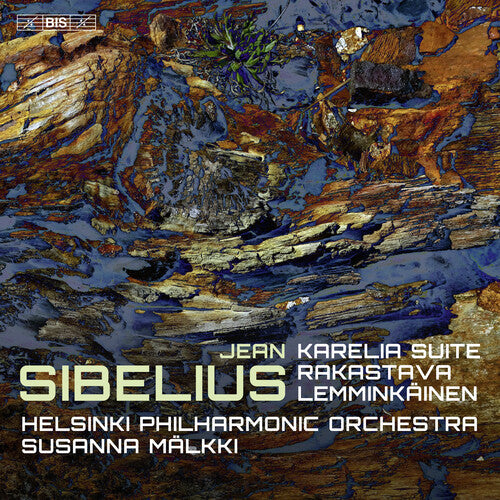
Sibelius: Works for Orchestra / Mälkki, Helsinki Philharmonic
The Helsinki Philharmonic Orchestra can with justification be regarded as ‘Sibelius’s own orchestra’, as it was this orchestra, usually conducted by the composer, that premièred most of his major works. On this disc of three such pieces, the orchestra is conducted by Susanna Malkki; the recording follows on from their three acclaimed albums devoted to the music of Bartók.
Although they were all later revised, the three works on this recording all originated within a very short period in Sibelius’s career: the years 1893–96, a time when he was beginning to establish himself as a composer and a time of national awakening.
One of his most popular works, the Karelia Suite is drawn from a series of tableaux that evoked events in the history of Karelia, the region where Finland and Russia meet. In late 19th-century Finland, the promotion of Karelian folk culture was both fashionable and politically relevant. The short suite Rakastava [The Lover] is a subtle reworking of a work for male voices based on lyrical poems from the collection Kanteletar; Sibelius often conducted it in concert. Sibelius often drew inspiration from the Finnish national epic Kalevala, and episodes from this poem provide the subject matter of Lemminkainen, a substantial four-movement suite (including the captivating Swan of Tuonela) that recounts the adventures of a daredevil hero, a sort of Nordic Don Juan.
REVIEWS:
Mälkki and the orchestra remarkably conjure the dark, swirling soundworld of ‘Lemminkäinen in Tuonela’ (the Hades of Finnish legend). And the concluding ‘Lemminkäinen’s Return’ canters along in roistering style.
-- BBC Music Magazine
Susanna Mälkki and the Helsinki Philharmonic Orchestra produce wellcrafted, beautifully detailed accounts on a par with rival versions – including the Helsinki orchestra’s own with Segerstam (with warm Ondine sound) from the mid-1990s.
-- Gramophone
Schubert + Brahms / Çakmur
For his series called Schubert+, pianist Can Çakmur juxtaposes the complete major piano solo compositions by the Viennese composer with works by other composers who were inspired by his music, thus providing the opportunity to see these works in a new light. While making up a near complete anthology of Schubert’s completed major piano music, each disc is also intended as a selfcontained recital.
In this second instalment, Çakmur performs pieces published after Schubert’s death, the three Klavierstucke, D 946, which are not known to have been intended as a new series of impromptus. Since their first editor was Brahms, it seemed logical to include one of his late cycle of miniatures, here the Vier Klavierstucke, Op. 119. The pieces by Schubert and Brahms share a spontaneity, even an apparent lightness, that often conceals an unsuspected depth beneath the surface. The programme concludes with the Four Impromptus, D 935, an ambitious cycle also published after Schubert’s death. Schubert’s name would become closely associated with this genre, often characterised by a lyrical melody and a free-flowing structure, with a sense of spontaneity. With it, Schubert seems to have found an ideal setting for the expression of his genius.
Mozart: Overtures / Willens, Kölner Akademie
From the mid-seventeenth century onwards, the overture became an orchestral piece intended to precede a large-scale dramatic work. This recording brings together twelve overtures from Mozart’s operas. They foreshadow the action, sometimes stylistically, sometimes by quoting themes that will appear later, to create a dramatic impression before we even see anything on stage – think of the memorable overtures to Don Giovanni and Die Zauberflöte.
The twelve overtures brought together here cover 21 years of Mozart’s career: from Mithridate, composed when he was just 14, which testifies to the young composer’s familiarity with the galant style then in vogue, to La Clemenza di Tito (1791), the high point of his work in the opera seria genre that was to disappear with him, not forgetting masterpieces such as Die Entführung aus dem Serail, Le nozze di Figaro and Così fan tutte.
The Kölner Akademie, playing on period instruments, and its conductor Michael Alexander Willens demonstrate Mozart’s unrivalled ability to capture the audience’s attention with these brilliant overtures, some of which are among his most famous works, both on stage and in concert.
REVIEW:
The interpretations are very fresh, the playing virtuosic. The historical instruments provide a clear, crisp, and transparent sound, which is reproduced by the sound engineers with good spatiality and balance, with a clean and beautifully present bass.
-- Pizzicato
End of My Days / Hughes, Manchester Collective
The inspiration for this album came about from Ruby Hughes’ first collaboration with the Manchester Collective in the spring of 2020. During the first Covid lockdown, they built the programme of this recital for the purpose of touring the UK and uplifting their audiences at a time when we were all being confronted by challenging notions of mortality and isolation. As artists, they asked themselves what music might attend to the prevailing concerns of this time. Their answers came in the form of this offering.
The title of this album, End of My Days, comes from Errollyn Wallen’s song; a resounding celebration of life that embraces death without regret or sadness but with great verve and acceptance. The other songs, each in its own way, evoke silence and separation, but also love and hope and even the reassurance that we will return whence we came and light shall lift us into eternity. The concluding song, Deborah Pritchard’s Peace, is a message of hope, willingly received as the world emerged out of lockdown in 2021. Luminous tranquillity moves us into the light, towards eternity.
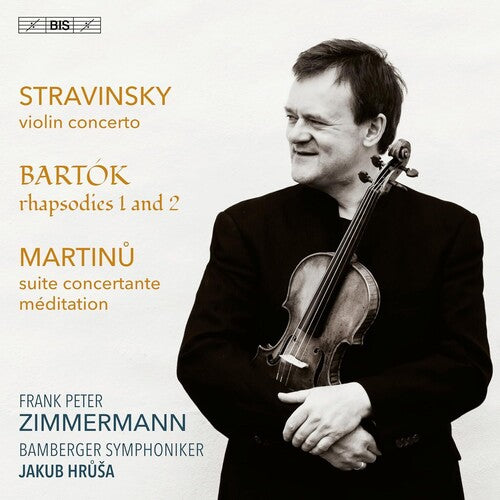
Stravinsky, Bartók & Martinů: Works for Violin & Orchestra / Zimmermann, Hruša, Bamberg Symphony
Stravinsky, Bartok and Martinu were established international figures when they wrote these works for violin, travelling across Europe as well as the United States. With the onset of World War Two, all three composers would ultimately emigrate because of their rejection of fascism. In an age of political upheaval and cultural displacement, each of them found an individual approach to reinventing the language of tonal music, laying down roots in the west without abandoning their Eastern European identities. While the Russian-born Stravinsky was experimenting with possibilities of modern violin technique in his concerto, Martinu took these efforts a step further in his Suite concertante by blending the sounds of his native Bohemia with the colours of French neo-classicism. In the Rhapsodies, Bartok turned to the folk music of Hungary and Romania.
Frank Peter Zimmermann, joined here by the Bamberger Symphoniker and its conductor Jakub Hrůša, continues his exploration of the great violin works of the 20th century after his acclaimed recordings of works by Hindemith (BIS-2024), Shostakovich (BIS-2247) as well as Martinu and Bartok (BIS-2457), a recording unanimously acclaimed by the critics, gaining a Diapason d’or and named ‘Concerto Choice’ by BBC Music Magazine, ‘Editor’s Choice’ by Gramophone and one of Classica’s ‘Chocs de l’annee’.
REVIEW:
With Jakub Hrůša and his super-attentive Bamberg orchestra, Frank Peter Zimmermann trumps the self-confident projection of his younger self. Stravinsky’s framing movements seem defter now, particularly the opening Toccata with its chortling bassoons.
-- Gramophone
Their interpretation of Stravinsky’s Violin Concerto becomes an equally sarcastic and seriously elaborated confrontation. Even in the opening Toccata, taken from the baroque form, the notes buzz and chirp like a summer meadow full of birds and insects. In general, the performers give the work a floating lightness that dispels everything earthly. At no point do you notice the technical demands.
In the two arias, too, the participants maintain the intensity and musical pressure. The concluding Capriccio then gives Zimmermann another opportunity to let his violinistic fireworks leap, jump, and shine in an artfully choreographed manner. He knows he is in the best of company with his accompanists, as they also carry the sarcastic aspects of the score as well as demonstrating the ambiguity with pointed articulation.
Bartok’s rhapsodies are constructed in two parts, like a Csárdás, which has a slow and a fast part. Bartok has retained much of the character of the music here, which he borrowed from folk melodies. The performers know how to show this raw side of the music of the people with verve and well-dosed energy.
The first version of the Suite concertante already had a difficult genesis, as Martinů was, to put it casually, lovesick during its composition. The elegiac music of the meditation therefore has a special depth of expression, which Zimmermann and his accompanists shape with deep feeling.
Martinů created the fundamentally new second version of the suite primarily at the request of the soloist Samuel Dushkin. The Aria from this version links up with Stravinsky’s concerto, as does the same original soloist. Many of the elements that characterize Martinů’s works – references to Czech folk music, vitality, changing rhythmic patterns and a mostly traditional harmony that does not exclude harsh dissonances – can also be found in the suite.
Zimmermann also demonstrates his violinistic skills in the suite, which are characterized by elegance and mastery of the instrument, in an engaging and memorable, yet spontaneous manner, so that the suite shines with fresh brilliance and brings Martinů to the trapeze. Hruša and the Bambergers are still to be found at his side and are audibly at ease with the music of their not only geographical neighborhood.
-- Pizzicato
Mahler: Symphony No. 8 / Vänskä, Minnesota Orchestra
For its final concert of the 2021–22 season and Osmo Vänskä’s last as artistic director, the Minnesota Orchestra chose to present Mahler’s mammoth Eighth Symphony, which calls for one of the largest complement of performers in the history of music, a symbol of the communitarian spirit of collective cultural, social, and religious-philosophical endeavor in what has been referred to as a ‘Mass for the Masses’.
Mahler’s Eighth Symphony, unlike his others, reveals no contrary despairing voice. It is instead a monumentally affirmative expression of human spiritual achievement achieved through the union of two seemingly incompatible texts: the Latin hymn Veni Creator Spiritus and the conclusion of the second part of Goethe’s Faust. Its première in Munich in September 1910 gave rise to the greatest triumph of Mahler’s career, and a rollcall of European royalty and the artistic élite attended the final public rehearsal and the performances.
The Minnesota Orchestra and Osmo Vänskä are here joined by Carolyn Sampson, Jacquelyn Wagner, Sasha Cooke, Jess Dandy, Barry Banks, Julian Orlishausen, Christian Immler as well as the Minnesota Chorale, the National Lutheran Choir, the Minnesota Boychoir and the Angelica Cantanti Youth Choir.
J. Kuusisto: Symphony; Pictured Within
This disc is a double tribute. The first work, Pictured Within, is a collective effort conceived as a major project to mark the 60th birthday of conductor Martyn Brabbins, whose reputation in new music and British music is beyond reproach.
Following the pattern of Edward Elgar’s Enigma Variations, Pictured Within is a series of 14 variations on a theme, each of which takes up the character of the equivalent variation in Elgar’s work, the difference being that here 14 different composers have each contributed a variation in tribute to Brabbins.
Also on the SACD is Jaakko Kuusisto’s Symphony, a fitting tribute to the composer, conductor, and violinist who passed away in 2022. Illness left Jaakko no time to complete his work, so it fell to his brother Pekka – who conducts here – and Jari Eskola to finish it. The result is a powerful piece, full of familiar themes and melodies derived from Jaakko’s existing compositions, to which are added autobiographical extra-musical elements. The moving conclusion is a collage of fragmented phrases inspired by the signals emitted by lighthouses and ships, as if Kuusisto’s spirit had been sent out to sea.
Leiviskä: Orchestral Works, Vol. 1 / Stasevska, Lahti Symphony
Conductor Dalia Stasevka, who received the BBC Music Magazine’s ‘Personality of the Year’ Award in 2023, and the Lahti Symphony Orchestra present three works by the Finnish composer Helvi Leiviskä, who was Finland’s first major female composer. Initially inspired by the language of late Romanticism – she mentioned Brahms as her favorite composer – Leiviskä developed an original, modern style that eschewed all schools, convinced that it was more important to tread one’s own path than to follow fashionable styles. While her output may seem small in terms of quantity, it more than makes up for it in the quality of the works, especially her symphonies, a genre she considered ‘the highest manifestation of music’.
This disc presents three works: the Sinfonia Brevis, a confidently crafted work reminiscent of Sibelius; the austere, restrained, melancholy and at times very dissonant Symphony No. 2, which could be called ‘tragic’; and the Suite for orchestra No. 2, which uses material from a powerfully descriptive score originally composed for a film. This recording bears witness to the ‘Leiviskä renaissance’ that has taken place in recent years, which has contributed to the rediscovery of a neglected but important voice in Finnish music.
Jarrell: Orchestral Works / Gringolts, Jodelet, Orchestre National des Pays de la Loire
The music of Michael Jarrell has been said to ‘examine states of dream and unreality, searching for a moment of truth’ – a truth which is often found in the lowest sonorities and slowest tempi, a place where time stands still. His works are often interrelated, not only by a certain sensitivity or a distinctive tone, but also by the recurrence of particular features that he reworks in different contexts. The present disc combines three orchestral works composed over a period of almost a quarter of a century. In Paysages avec figures absentes, played here by solo violinist Ilya Gringolts, the composer wished to find a new approach to writing for violin within an ensemble.
Premièred a few months before this recording by the Orchestre des Pays de la Loire and Pascal Rophé, the Sechs Augeblicke for orchestra suggest a concentration or implosion of sound matter within musical fragments, as a sort of reference to Schubert. Finally, the guiding idea of Un long fracas somptueux de rapide céleste with solo percussionist Florent Jodelet is a short, powerful ‘initial explosion’ that recurs, like a punctuation mark, throughout the piece, more or less regularly, in different forms.
Ferguson, Bliss & Holloway: Octets & Clarinet Quintet / Wigmore Soloists
Following their critically acclaimed albums of Schubert (BIS-2597), Mozart and Birchall (BIS-2647), works for clarinet trio (BIS-2535) and, more recently, Beethoven and Berwald (BIS-2707), the Wigmore Soloists now turn their attention to twentieth-century English chamber works which, while eschewing some of the continent’s modernist tendencies, are both deeply personal and supremely written, highlighting the specific colors of each of the instruments.
Howard Ferguson’s Octet, a direct and engaging work, was the first of his works to attract attention. Ferguson’s skill is brilliantly demonstrated in this tonally ambiguous work, which takes its instrumentation from Schubert’s famous Octet.
The main characteristic of Sir Arthur Bliss’s Clarinet Quintet, like those of Mozart and Brahms with the same instrumental line-up, is its intense, overtly emotional lyricism, but the sunny, extrovert aspects of Bliss’s character ultimately prevail in the brilliantly energetic finale.
Robin Holloway’s Serenade in C for octet is the most recent work on this disc, and also features the instrumentation of Schubert’s Octet, which the composer acknowledges as a model. Few contemporary composers display as keen a sense of humor as Holloway who wished here to give “an affectionate twist to tonal common practice and light-music clichés all the way from Biedermeier Vienna to Southend Pier”.
Solitary Poems for Soprano Saxophone / Anders Paulsson
The project ‘Solitary Poems for Soprano Saxophone’ is a creative response to the COVID-19 pandemic and its consequent obliteration of livelihoods for freelance musicians. The 23 world premières presented on this album were all composed specifically for Anders Paulsson so that he and they could keep growing artistically during the pandemic when all concerts and touring came to a standstill, and simultaneously to support the creation of new music for soprano saxophone. Some pieces turned out to be extremely virtuosic while others were more contemplative and lyrical. While the vast majority of the pieces are for solo soprano saxophone, some feature a second instrument, including one that is a dialogue between Paulsson and himself. Composers from across the world have been given free rein to express musically what the pandemic has meant to them, whether it’s a reflection on solitude or on the imposed standstill, a hope for a better tomorrow, a concern for crucial environmental issues or a sense of wonder at nature. All the pieces also reveal the extraordinary potential of the soprano saxophone as a classical soloist instrument. Available in Dolby Atmos on selected streaming services.
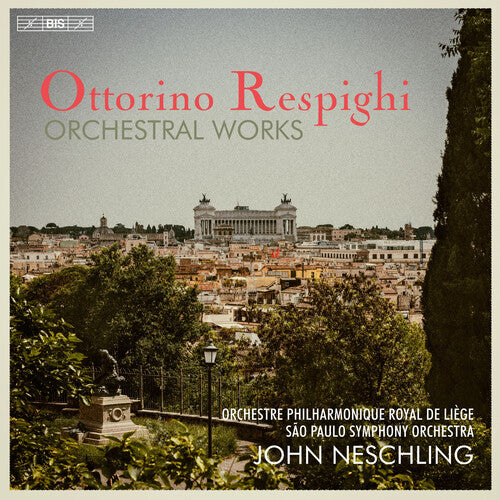
Respighi: Orchestral Works / John Neschling
This 7-SACD collection includes recordings made by Brazilian-born conductor John Neschling of the orchestral works of Ottorino Respighi, alongside Puccini the best-known Italian composer of the first half of the twentieth century. Widely praised by the press, including BBC Music Magazine, which described them as ‘the finest-ever survey of the composer’s orchestral output undertaken by a single conductor’, these recordings reveal Respighi’s extraordinary range.
His transcriptions of works from the baroque period bear witness to his great musical refinement and are an example of the way in which people dared to adapt to current tastes at the beginning of the 20th century. His original compositions, whether symphonic poems, ballets or symphonic works, often call for a large orchestra, sometimes with the addition of numerous percussion instruments, piano, organ and even, in Pines of Rome, a phonograph, present a synthesis of the musical traditions of his native Italy and contemporary romantic, impressionist and neo-classical trends while remaining resolutely closed to modernist developments and atonality. Respighi’s lavish sound palette and the spirit that fills his scores were to find an echo in Hollywood film music, and John Williams considers him to be one of his most important influences.
Past praise of the previously released recordings included in this set:
Respighi: The Birds; Ancient Airs & Dances
These performances are uncommonly airy. Much of this music is suffused with an autumnal melancholy, and Neschling and his orchestra capture that very well.
-- Fanfare
Respighi: Metamorphoseon, etc.
All of the performances here are expert, but conductor John Neschling deserves particular credit for keeping things movement purposefully forward in the first two long, and mostly slowish, movements of the Belkis suite. The same work’s vulgar (let’s not kid ourselves) concluding Danza orgiastica also sounds more musical than usual–less like a back-alley gang bang–but with no loss of energy. The Liège orchestra plays with great bravura, and BIS’s SACD sonics, typically, are just terrific. In short, a very worthy entry in this ongoing series.
-- ClassicsToday.com
Respighi: Roman Trilogy / Neschling, Sao Paulo Symphony
The São Paulo Symphony Orchestra is a superb ensemble by any standards, and displays their virtuosity in the three Respighi symphonic poems.
-- SA-CD.net
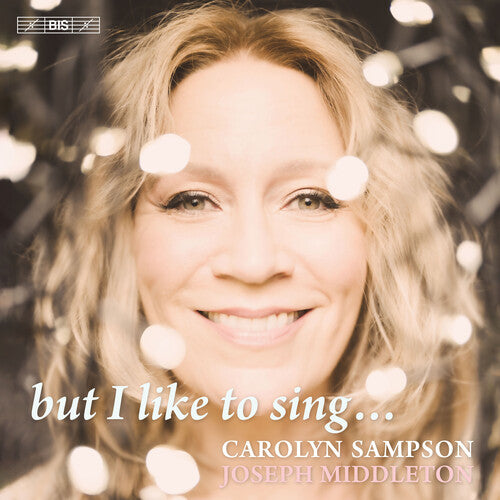
but I like to sing... / Carolyn Sampson & Joseph Middleton
After many acclaimed releases on BIS, most recently ‘Sounds and Sweet Airs – A Shakespeare Songbook’ (BIS-2653), Carolyn Sampson’s latest recital with Joseph Middleton lives up to its name: it is an eloquent testimony to the English soprano’s love of her art. This programme artfully blends well-known and lesser-known lieder by German and Austrian masters such as Schubert, Mendelssohn, Brahms, Richard Strauss and Hugo Wolf with French songs by Gounod, Poulenc and Franck, as well as works by Anglo-Saxon composers such as Hubert Parry, Samuel Barber and Ivor Gurney. Female composers are not forgotten, with rarely-performed songs by Rita Strohl based on slightly risqué poems by Pierre Louÿs, music by Cheryl Frances-Hoad, Kaija Saariaho – who has recently passed away – and Deborah Pritchard, whose song presented here was composed especially for Sampson. And while Leonard Bernstein’s comically cheeky song ‘I hate music’, appears to be a call not to let music take itself too seriously, Errollyn Wallen’s ‘Peace on Earth’, which concludes the album, invokes calm and encourages us to find peace, a message that seems more relevant today than ever.
Children! Viola Music by Bach & Living Composers / Hiyoli Togawa
After Songs of Solitude (BIS-2553), a project designed by Hiyoli Togawa at a time when Covid forced people across the world into isolation (released in March 2021), the Japanese-Australian violist now presents another themed album focusing on the situation of children. During the pandemic, she kept thinking of the many children who do not have a loving home and were forced to stay at home, and so were exposed helplessly to violence, hunger and poverty.
As with her previous disc, she commissioned works on the theme of childhood from composers around the world. Thirteen of them, from Europe, Asia, North America and Australia, answered the call and embarked on a journey into childhood. The result is a collection of lullabies, childhood memories and adventures. Playful, wild, silent, funny, serious or dreamy, these works are musical pleas for the rights of children around the world. Hiyoli Togawa combines them with the Allemandes from Johann Sebastian Bach’s Six Suites for solo cello. Each of these Allemandes presents a new character, opening a very special dance universe. They invite us to surrender ourselves to the genuine and undisguised joy of playing and perhaps, almost, to lose ourselves in it – to find ourselves.
Through the Night - Night Music from Renaissance to New / United Strings of Europe
For their fourth release with BIS, the United Strings of Europe with their director Julian Azkoul present another innovative programme, dedicated this time to the night, a source of wonder and fascination, rich with metaphorical associations. The ensemble’s varied, tailor-made programme features counterpoint, aching dissonance and chromaticism from across a range of styles spanning nearly 500 years, from the Renaissance to the present day.
The album is built around two post-romantic masterpieces: Richard Strauss’s Metamorphosen (here in an arrangement by Éric Mouret), a work composed during the final months of the Second World War that evokes destruction, mourning, nostalgia, but also hope for progress and transformation, and Arnold Schoenberg’s Verklärte Nacht, based on a poem by Richard Dehmel, which, in a nocturnal dialogue between a man and a woman, shows the power of love that can overcome the greatest challenges. These two major works are joined by arrangements for strings of vocal pieces by Maddelena Casulana, Carlo Gesualdo and Henry Purcell, as well as a new work by Daniel Kidane, Be Still, featuring percussionist Beibei Wang, a reflection on recent years marked by lockdowns during which everyday markers, such as meeting with friends and family, travelling or attending concerts vanished.
Beethoven: String Quartets Nos. 10 & 13 / Chiaroscuro Quartet
After the six Op. 18 quartets, the much-acclaimed Chiaroscuro Quartet now turns to two masterpieces from Beethoven’s middle and late periods. String Quartet No. 10 in E flat major, Op. 74, nicknamed ‘Harp’ because of the abundant pizzicati in its first movement, comes across as a genial and unproblematic work that was very well received immediately upon publication and has remained one of the composer’s best-loved quartets. String Quartet No. 13 in B flat major, Op. 130, is in a very different vein. Belonging to the series of so-called ‘late’ quartets composed between 1824 and 1826, it is a six-movement structure modelled on an eighteenth-century divertimento, adding two movements to the traditional four-movement scheme: an Alla danza tedesca and a Cavatina. Despite its evocation of an archaic dance, the Alla danza tedesca is typically Beethovenian, with its original treatment of dynamics. The Cavatina, which moved the composer to tears during its composition, is a lyrical and moving piece. Beethoven had intended to conclude this imposing work with a large-scale fugue, but its boldness baffled his first listeners and, at the request of his publisher, he resorted instead to a more approachable movement presenting a mixture of laconic dryness and, in places, tender lyricism.
REVIEW:
Though there’s no shortage of recordings of the Beethoven quartets, versions by groups taking an historically informed approach to these works, such as these from the Chiaroscuro Quartet, are still relatively rare. The ensemble's sound world is warmer, more expressively flexible and transparent than we have become so used to in this familiar music. The wonderfully paced opening of the E flat Quartet Op 74, grows steadily in insistence, until it blossoms into melody in a totally unforced way, setting the tone for everything that follows; there seem to be no preconceptions in these performances, everything comes from the music itself.
The challenges of the B flat Quartet Op 130 are on a different level, and not every decision the Chiaroscuro make in that work is convincing – the great slow movement, the Cavatina, is taken just a fraction too fast, for instance, but the finale that follows (the replacement that Beethoven composed in 1826, not the original Grosse Fuge) has a wonderfully clipped character that, like a lot in these performances, seems perfectly appropriate.
-- The Guardian (Andrew Clements)
Pickard: Mass in Troubled Times / Brabbins, BBC Singers
Previous BIS releases of works by John Pickard have mainly featured instrumental compositions. This recording presents another facet of the British composer’s work, with compositions for choir under the expert direction of Martyn Brabbins as well as two instrumental pieces.
The five short Latin motets as well as Ozymandias, Pickard’s opus 1, can be described as ‘occasional pieces’ composed during the composer’s student years or for the choir he conducts at the University of Bristol. They display solid tonal grounding and mainly homophonic writing and provide a stepping-stone to some of the more dissonant style found in the latter works. Written for the BBC Singers, whose reputation is well established, the Mass in Troubled Times is an ambitious work bearing witness to a context of global uncertainty. The Mass is a collaboration with the writer Gavin D’Costa, who conceived a complex text based on multiple sources in five languages, combining Western and Middle Eastern religious texts with poetry evoking the plight of refugees. Orion for trumpet and organ, which is partly programmatic, evoking the most splendid constellation and allowing trumpeter Chloë Abbott to shine, and Tesserae for solo organ, with its dazzling virtuosity, played here by the work’s first performer, David Goode, complete this disc.
Bach: Sonatas & Partitas, Vol. 2 / Zimmermann
Also available: Bach: Sonatas and Partitas, Vol. 1 / Zimmermann
Since the mid-1980s, Frank Peter Zimmermann has earned recognition as one of the world’s leading violinists, admired not only for his technical skill and interpretive intelligence, but also for his versatility in a wide-ranging repertoire. His extensive discography ranges from Bach concertos and Beethoven sonatas to works by composers such as Martinu, Ligeti, Magnus Lindberg and Brett Dean. He waited until the fourth decade of his career, however, to take on Bach’s Sei solo a Violino senza Basso accompagnato, the six sonatas and partitas for solo violin. The first disc (BIS-2577) dedicated to this absolute pinnacle in the repertoire for the instrument was released in February 2022 to great critical acclaim. Now comes the much-awaited conclusion to this collection. Zimmermann compares these works to ‘a mighty tree, which protects me and crushes me at the same time’, the music giving him hope and strength at the same time as it confronts him with his limits as a violinist. On this new release, he now offers us the Sonata No. 1 in G minor, as well as the B minor Partita No. 1 and the Sonata No. 3 in C major.
Nørgård: Symphony No. 8; Orchestral Works / Storgårds, Bergen Philharmonic
Having celebrated his 90th birthday in 2022, Per Nørgård is undoubtedly one of the most important Danish composers since Nielsen. His important production that covers all genres is a highly personal travel document based on his endless incursions through the sonic labyrinths of this world.
Based on material from Nørgård’s viola concerto from 1986, Three Nocturnal Movements for violin, cello and orchestra came about on the initiative of the violinist Peter Herresthal and the cellist Jakob Kullberg, two of his long-term collaborators. The work was creatively developed for two soloists by Kullberg, who decided on the form of the movement after making a selection of musical fragments described as ‘nocturnal’.
Dedicated to the conductor John Storgårds, Symphony No. 8 appears bright, transparent while its atmosphere is somewhat mysterious and filled with tension. This symphony, his most recent work in this genre, can be compared to latter works from other Nordic composers like Sibelius and Nielsen. Finally, Lysning, a short piece for string orchestra, has been described by Nørgård as a ‘glade’ and is made of an alternance of darker and brighter variations of the same musical ideas heard in different instrumental colourings and nuances.
Schubert: Impromptus, Opp. 90 & 142 / Brautigam
Ronald Brautigam performs some of Franz Schubert’s most profound and beloved works: the eight Impromptus. Schubert’s name has become closely associated with this genre, often characterized by a lyrical melody and a free-flowing structure, with a sense of spontaneity. With it, Schubert seems to have found an ideal setting for the expression of his genius. The Impromptus, D 899, are reminiscent of a four-movement sonata. The first begins theatrically, before giving way to a funeral march of sorts, in which the melody is harmonised, amplified and constantly renewed. In the second, everything appears light and fluid. In the third, Schubert offers us one of his most inspired songs with one of his most beautiful melodies. The fourth takes us back to the waterworks of a fairy-tale park. The Impromptus, D 935, were published after Schubert’s death. The first is a great rhapsodic poem in which expression reaches into the deepest recesses of the Schubertian soul. The second demonstrates how Schubert manages to rise high with simple material. The third impromptu is a series of variations on ‘Rosamunde’, one of the composer’s most famous themes. The fourth is a lightning-fast scherzando – a free and whimsical piece that ideally concludes this disc.
Stained Glass - 20th Century Music for Violin & Piano / Dalene, Hadland
This recital brings together two established classics from the 20th century with lesser-known works from the repertoire for violin and piano. Alongside Ravel’s Sonata, a work that reveals the influence of jazz on the French composer, and Prokofiev’s wartime Sonata, Op. 94a, an idiomatic arrangement of its original version for flute, we find compositions by Arvo Pärt, Lili Boulanger and Grazyna Bacewicz, which, at times meditative, at times lyrical, at times folk-inspired, testify to the richness of this repertoire. These works are here performed by Johan Dalene, the Swedish-Norwegian winner of the 2019 Nielsen Competition. The present disc is violinist’s fourth release on BIS, following a recording of the Nielsen and Sibelius Concertos named Editor’s Choice by Gramophone and awarded the 2023 Swedish Grammis Award for Best Classical, the Tchaikovsky Concerto described as ‘one of the finest violin débuts of the last decade’ in BBC Music Magazine, and ‘Nordic Rhapsody’, a violin and-piano recital that was awarded distinctions such as Diapason d’or and Gramophone’s Editor’s Choice. As with that release, Dalene is given here the expert support of Christian Ihle Hadland who has also appeared on other much-lauded recordings, most recently one dedicated to Saint-Saëns’ violin sonatas.
REVIEW:
The young violinist Johan Dalene was named Gramophone’s Young Artist of the Year in 2022 and has performed with the Leipzig Gewandhaus Orchestra, Czech Philharmonic, and San Francisco Symphony. He’s also made his mark in Halls Wigmore and Carnegie, and on this brilliantly assembled collection of works by Arvo Part (Fratres), Maurice Ravel (Sonata in G major for violin and piano), Lili Boulanger (Nocturne), Sergei Prokofiev (Sonata No.2 in D major for violin and piano), and four short works by Grazyna Bacewicz.
The collection’s common thread is a penchant for piquant harmonies, atmosphere, and mysticism. Bacewicz’s early “Witraz” (Stained-Glass Window), which she composed in 1932 at the age of 23, is unforgettable. If you can begin to imagine magical flashes of light and color diffused through a stained-glass window, dancing across the room as they metamorphosize into sound, you’ll get a sense of how special this miniature sounds. Dalene’s Strad whispers, flashes, darts, and whirls as Hadland shines beside him through light and shadow.
Thanks to the iconic ECM New Series recording by Gidon Kremer and Keith Jarrett, Part’s early mystical masterpiece achieved fame just a few years after it was completed. Where Kremer begins with a whisper, Dalene is far more forthright, his tone irresistibly fresh and gleaming, and the recording benefits from superior engineering. The touching poetry of Boulanger’s subtle miniature stands in sharp contrast to Prokofiev’s fabulous scherzo and circuslike finale. Ravel, too, revels in character, humor, amiability, and spice. The finale brings to mind someone chasing a mosquito around the room with a rolled-up copy of Stereophile in hand.
-- Stereophile
Aho: Concertante Works for Recorder, Sax & Accordion / Lasonpallo, Saimaa Sinfonietta
Concertante works featuring the recorder, tenor saxophone and accordion are few and far between. Stimulated by daring soloists, the prolific Finnish composer Kalevi Aho has composed such works, contributing in his own way to the development of an original and attractive repertoire. The Concerto for Recorder requires the soloist to play four types of recorder, from bass to sopranino. The work explores extended techniques and also does not shy away from flashbacks to the golden age of the instrument. Aho received the initial impetus for his Concerto for tenor saxophone after a concert by Esa Pietilä. Aho wrote a concerto with contrasting sections that gradually exploits the full potential of the tenor saxophone and also makes use of an oriental goblet drum (darabuka) that sometimes also takes centre stage. The origins of the Sonate Concertante for accordion and strings goes back to Aho’s first Sonata for accordion of 1984. Noting its orchestral character, soloist Janne Valkeajoki suggested making a concertante version with strings. Here, Aho sought to extend the technical possibilities of the instrument to the maximum and to write for it a work of astounding virtuosity, like Franz Liszt’s most demanding piano compositions.
Schumann: Missa Sacra / Putniņš, Hammerström, Swedish Radio Choir
Less well known among his works, the Missa sacra, Op. 147, bears witness to Robert Schumann’s late interest in sacred music – and in particular in Catholic church music. The work would have a rather difficult fate: during Schumann’s lifetime, it was neither published nor performed in its entirety. Even after its posthumous première, opinions were lukewarm. Wrongly so: the Missa sacra is a fascinating attempt to update sacred music through a refined post-classical musical language. It was originally conceived for orchestra, but Schumann also made a version for organ, presented here. This version allows great vocal transparency and immediacy, thus contributing to a clearer vision of the work. The Vier doppelchörige Gesänge for mixed choir a cappella, Op. 141, are also undeservedly neglected works: they constitute the high point in Schumann’s music for choir. These four songs unite both secular and religious-themed, the latter component being musically emphasised by the effect of multiple choirs. These two fascinating works are performed by the Swedish Radio Choir under the direction of Kaspar Putninš. Among his recordings for BIS is the Liturgy of St John Chrysostom by Rachmaninov (BIS-2571), which has received widespread critical acclaim, for example being awarded a prestigious Diapason d’Or by the French magazine Diapason.
REVIEW:
Schumann’s Missa Sacra, Op. 147, was one of the last things he wrote, and it wasn’t published until after his death. As it happens, it is marvelous, and it was probably just waiting for a top-notch reading of the sort that it receives here. Schumann attempts to merge the rather conservative structure of the Classical mass with Romantic stylistic ideas, and the work is really not like anything else he ever wrote. The Four Songs for Double Choir, Op. 141, close out the program; written slightly earlier, they are rare and quite persuasive. Yet it is the mass that may rewrite the choral repertory lists a bit; in this lovely performance, it is a gem.
-- AllMusic.com (James Manheim)