Mozart: Piano Concertos No 20 & 27 / Brautigam, Willens, Die Kolner Akademie
BIS
$21.99
October 29, 2013
Among the most widely performed of Mozart’s piano concertos for a good half century after its composition in 1785, the Concerto No.20 in D minor still assumes a commanding place in the concert hall. Among its early devotees was Beethoven, who performed the work at a benefit concert for Mozart’s widow in March 1795 and who may well have found much to admire in the work’s brooding opening, characterized by syncopations and later punctuated by more aggressive outbursts; in his informative liner notes, the Mozart scholar John Irving goes so far as to call it ‘Mozart’s grittiest concerto’. Six years after the D minor concerto, in January 1791, the composer completed the Piano Concerto No.27 in B flat major, K595, giving the first performance of it two months later. This was to be his last public appearance as a soloist, and the concerto has sometimes been considered as a work in which the typical sparkle of Mozart’s virtuosity is tempered by resignation, as if the composer were already aware of his imminent demise. Such an interpretation is contradicted by a close study of the autograph manuscript, however: the concerto appears to have been begun two full years before it was completed. Its language is nevertheless more introverted than most of Mozart’s works in the genre: he seems to be aiming for a sublime delicacy of expression rarely attempted elsewhere in his concerto output. These two exceptional works are here performed by Ronald Brautigam and Die Kölner Akademie, on their fifth disc of Mozart’s concertos – an ongoing series which has been described as ‘a lucky break and a true delight’ in the German magazine Piano News.
{# optional: put hover video/second image here positioned absolute; inset:0 #}
BIS
Mozart: Piano Concertos No 20 & 27 / Brautigam, Willens, Die Kolner Akademie
Among the most widely performed of Mozart’s piano concertos for a good half century after its composition in 1785, the Concerto No.20...
Beethoven: The Late String Quartets Arranged For String Orchestra / Tonnensen, Camerata Nordica
BIS
$42.99
February 25, 2014
Like few other works, Beethoven's late string quartets have gained an almost undisputed standing as the very apex of their genre. Not many of Beethoven's contemporaries would have accorded them this: the composer Louis Spohr called them 'indecipherable, uncorrected horrors' and the quartets were widely regarded as the monstrous products of a madness which at best could be excused by the composer's deafness. One of the first to recognize them for the masterpieces that they are was Franz Schubert, who after having heard a performance of Quartet No.14 in C sharp minor is reported to have said 'After this, what is left for us to write?' Composers after Schubert have been as awestruck by this music, with Stravinsky famously describing the Große Fuge as 'an absolutely contemporary piece of music that will be contemporary forever.' The feeling that Beethoven in these works was giving form to a universal music which transcends genre conventions have also inspired many to adapt various of the quartets for larger forces, including the conductors Dmitri Mitropoulos and Arturo Toscanini. On the present recordings, originally released by the Altara label in 2006, it is the Norwegian violinist Terje Tønnesen's adaptations we hear, performed by himself and his Swedish string ensemble Camerata Nordica. Besides providing the greater dynamic spectrum that a larger ensemble can bring to the music, Tønnesen's main aim has been to strengthen the contrasts between intimate passages and fuller textures by employing solo players in certain passages, as in a concerto grosso. He and Camerata Nordica has also reinstated the Große Fuge in its proper context: that amazing 15 minute monolith was originally intended as the finale of Op.130, but proved indigestible to contemporary audiences and critics - one of whom described it as 'as incomprehensible as Chinese' - and was replaced by an easy-going rondo following a request from Beethoven's publisher.
{# optional: put hover video/second image here positioned absolute; inset:0 #}
BIS
Beethoven: The Late String Quartets Arranged For String Orchestra / Tonnensen, Camerata Nordica
Like few other works, Beethoven's late string quartets have gained an almost undisputed standing as the very apex of their genre. Not...
Britten: Frank Bridge Variations - Lachrymae - Elegy For Str
BIS
$21.99
November 19, 2013
This collection of works for string orchestra combines two of Britten's first masterpieces, Simple Symphony and the Frank Bridge Variations, with the even earlier Elegy for Strings - recorded here for the first time - and Two Portraits, composed between the ages of 14-16. Directed by the Norwegian violinist Terje Tonnesen, the Swedish string ensemble Camerata Nordica performs this program with an engaging directness and striking virtuosity - qualities which no doubt contributed to the team being entrusted by the Britten-Pears Foundation with making the world premiere recording of the Elegy, as well as giving it's first public performance during the 2013 BBC Proms.
{# optional: put hover video/second image here positioned absolute; inset:0 #}
BIS
Britten: Frank Bridge Variations - Lachrymae - Elegy For Str
This collection of works for string orchestra combines two of Britten's first masterpieces, Simple Symphony and the Frank Bridge Variations, with the...
Mozart – Piano Concertos No 18 & 22 / Brautigam, Willens, Cologne Academy
BIS
$21.99
April 29, 2014
This is a hybrid Super Audio CD playable on both regular and Super Audio CD players.
The sixth disc in this highly acclaimed series combine two works in which Mozart's powers as an orchestrator come to the fore. Concerto No. 18 in B flat major, K 456, is sometimes referred to as one of the composer’s ‘military concertos’ on the basis of the march-like main theme of the first movement. But more striking is the variety of ways that Mozart employs the various groups of instruments: strings, wind instruments and, of course, the piano. This aspect certainly didn’t pass unnoticed by a listener as initiated as Mozart’s father Leopold: in a letter to his daughter Nannerl he described how his enjoyment of the orchestral interplay had brought tears to his eyes. The performance that Leopold was referring to was by Mozart himself at a concert in Vienna in 1785, but the work is believed to have been written for the blind virtuoso Maria Theresia von Paradis to play on a concert trip to Paris, and the demanding piano part leaves us in no doubt about her abilities as a pianist. Concerto No. 22 in E flat major, on the other hand, is one that Mozart wrote primarily for his own use, completing it on 16th December 1785, and performing it later the same month. It is the first of only three piano concertos in which he uses clarinets, to particular effect in the expressive Andantino cantabile episode of the otherwise ebullient Finale. The orchestra is on the whole unusually large, with trumpets and timpani, and horn parts which are uncommonly independent and important to the musical argument.
{# optional: put hover video/second image here positioned absolute; inset:0 #}
BIS
Mozart – Piano Concertos No 18 & 22 / Brautigam, Willens, Cologne Academy
This is a hybrid Super Audio CD playable on both regular and Super Audio CD players. The sixth disc in this highly...
Bach: Cantatas, Vol. 52 / Suzuki, Kooij, Turk, Blaze, Blažikova, Bach Collegium Japan
BIS
$21.99
November 01, 2012
On the 52nd disc in his monumental undertaking of recording all the sacred cantatas by J.S. Bach, Masaaki Suzuki includes one of the best-loved cantatas of all, Wachet auf ruft uns die Stimme, BWV 140. With the famous chorale as the unifying element, Bach creates a majestic first movement which is followed by a couple of the most beautiful love duets in the history of music, between the Soul and Jesus, here interpreted by the soprano Hana Blažíková and Peter Kooij, bass. Following BWV 140 on the disc is Der Herr ist mein getreuer Hirt (‘the Lord is my faithful shepherd’), in which an adaptation from 1531 of the famous Psalm 23 provides the text for all five movements. It is thus a late addition, composed in 1731, to the so-called chorale cantatas that Bach composed a number of in 1724-25. The final cantata in this volume was composed for a church service celebrating the inauguration of a new city council, a ‘Ratswahl cantata’. For this unusually festive occasion Bach clearly wished to demonstrate to the Leipzig notables how sacred music was flourishing under his direction and to present himself as a composer. As a result, the opening sinfonia is a brilliant organ concerto movement, while the first chorus is a reworking of material which Bach would return to in the Dona nobis pacem of his Mass in B minor. The ending of the cantata is suitably splendid and festive, with trumpets and timpani joining in the praise ‘unto God the Father, Son and Holy Ghost’ expressed in the closing chorale. As this recording project is nearing completion – three more volumes remain to be released – reviewers worldwide are commending it for its consistently high standards, with the German web site Klassik Heute remarking that Suzuki ‘not even towards the end of his marathon is showing any lack of freshness or breath – one can only wait impatiently for the final discs of this series’.
{# optional: put hover video/second image here positioned absolute; inset:0 #}
BIS
Bach: Cantatas, Vol. 52 / Suzuki, Kooij, Turk, Blaze, Blažikova, Bach Collegium Japan
On the 52nd disc in his monumental undertaking of recording all the sacred cantatas by J.S. Bach, Masaaki Suzuki includes one of...
Masterworks For Flute And Piano 2 / Bezaly, Brautigam
BIS
$21.99
$15.99
May 01, 2010
This is a hybrid Super Audio CD playable on both regular and Super Audio CD players.
Another imaginative, well-executed offering from BIS.
3424690.zz4_MASTERWORKS_FOR_FLUTE_PIANO.html
MASTERWORKS FOR FLUTE AND PIANO II • Sharon Bezaly (fl); Ronald Brautigam (pn) • BIS 1729 (SACD: 59:23)
POULENC Sonata. MARTIN Ballade. REINECKE Sonata, “Undine”. MARTIN? Sonata. MESSIAEN Le Merle noir
This is the second volume of this series, the pithy and ecstatic review of the first by Peter J. Rabinowitz (where he quotes from other equally impressed Fanfaristas) appearing in 29: 6. There is really nothing much more to say about Bezaly’s playing; she is, if not the greatest, then one of the most outstanding exponents of her instrument today, and Bis was lucky enough to latch onto her some 20 albums ago and continues to make these wonderful Super Audio recordings.
On this disc we are a little more mainstreamed in approach, with several of the selections quite familiar, at least to flute lovers. Poulenc’s sonata leads the pack, one of his best from around 1957, simply effervescent and joyous from start to finish, the aural equivalent of dancing on clouds. I had to hunt down Wolfgang Schulz’s recording with James Levine from a mandatory 1989 issue of Poulenc’s chamber music (DG) to find a worthy comparison. The Reinecke, also a standard, was written in the composer’s 40s (1882) under the influence of Friedrich de la Motte Fouqué’s story about a mermaid who marries a young knight and acquires a human soul only to have her heart broken because of his infidelities; should have stayed in the water, I guess. But the story line is only ancillary, the sonata a wonderful example of romantic structure that characterizes a verbal outline without becoming slavish to it. My favorite to this point—now supplanted—is Jeffrey Khaner’s reading on Avie, a recording that should not be missed if for no other reason than its attractive romantic program.
The Martin? might be called a “sub-standard” not because of quality but because more flutists haven’t seemed to pick up on it yet. Like almost all of this composer’s work, it contains wonders aplenty and umpteen ear-opening examples of structural genius, aside from Martin?’s own deliciously unparagoned way with melody. Marc-André Hamelin (piano) and Alain Marion (flute) offer a somewhat different view on Analekta, perhaps more enervating and lively, but I doubt Bezaly will have you searching for alternatives. Two pieces here were written for competitions; Frank Martin’s inventive Ballade was written as a compulsory piece for Geneva in 1939 while Olivier Messiaen’s Le Merle noir (The Blackbird) was for the Paris Conservatory in 1951, the prototype of a series of pieces that explored the very intentional grounding of birdsong into the very fabric of an instrument. The Martin can be found in its orchestral guise (done a few years later by the composer) on a wonderful recording by Celia Chambers on an all-Martin album of his ballades (Chandos, conducted by Bambert).
So in short, this is terrific stuff, bedrock material for any serious collection and absolutely foundational for anybody claiming to have a good series of flute albums.
Sharon Bezaly and Ronald Brautigam are two of the brightest stars in the musical firmament, so BIS are indeed fortunate to have them on their roster of artists. Bezaly first came to my attention in Seascapes, but has since caught my ear in a number of recitals, among them Nordic Spell and From A to Z. Paradoxically, hers is a powerful yet unassuming talent, whereas Brautigam – whose Beethoven sonata series continues apace – strikes me as a much bigger, more forceful musical personality. That said, he scales the Mendelssohn piano concertos most beautifully qualities I was looking for here as well.
At first glance it’s quite an eclectic selection, but that’s no bad thing. All too often programmes clustered around broadly similar repertoire (stylistically at least) are apt to pall after a while. But three-quarters of a century and several musical traditions separate the pieces by Carl Reinecke and Francis Poulenc; the latter’s Sonata gets this disc off to a promising start. The ‘rolling boil’ of the flute’s opening phrases – not to mention the seemingly effortless trills – are well matched by Brautigam’s nicely nuanced pianism. There are no really extreme dynamics here – well, not unless one counts the mercurial Prestogiocoso – and that, along with BIS’s warm, well-balanced recording, makes for a most relaxing listen.
A hugely encouraging start, and a riposte to all those acid audiophiles who insist that non-DSD Super Audio CDs recorded at lower bit rates are a compromise too far. Indeed, one would be hard-pressed to find a better blend of sonic virtues than those on show here. Swiss composer Frank Martin’s Ballade is a case in point, the restless murmur of piano and flute at the start superbly captured. Bezaly’s range and control at both frequency extremes is just remarkable; high notes are firm and clear, the lower registers wonderfully liquid, especially in the solo passage that begins at 3:06. There’s a pleasing sense of proportion too, and one feels this really is a marriage of true minds, Brautigam scaling the music’s more rugged terrain with ease.
Predictably perhaps, Carl Reinecke’s ‘Undine’ sonata has all the evanescent charm one expects from such fare. And no, predictable does not mean humdrum; Bezaly conjures up the lightest, loveliest sounds, building a rainbow bridge under which the piano part flows most agreeably. But it’s the third movement, marked Andante tranquillo, where Brautigam seems to get the upper hand. As seductive as the flute playing undoubtedly is, I found myself following the pianist more carefully than before. And just listen to those giddy upward spirals in the final movement, Brautigam bringing the music back to earth with a mix of passion and power. As for the restraint and repose of the closing bars, it’s most sensitively done. No, it isn’t great music, but when it’s played this well who could possibly complain?
The soloists shadow each other to great effect in the Martin? Sonata, a work whose carapace conceals a surprisingly lyrical centre. Brautigam and Bezaly are very well matched in the animated first Allegro, the latter’s tone characterised by an appealing breathiness in the lower registers. As flute recordings go, this recital really does capture the velvet and steel duality of the instrument most effectively. Indeed, I can see this being used as a demonstration disc, especially when it comes to the long, sustained phrases that round off the Adagio. As for the piece itself, those who don’t know it will engage with its easygoing, yet entirely individual, character. Another nugget in this most desirable pot, and a piece I will return to with great pleasure.
But it’s Messiaen’s Le merle noir (the blackbird) that’s the most inspired choice here. For a composer who rejoiced in the monumental it’s good to be reminded that he is every bit as persuasive in miniature. And just as Hopkins delighted in the wonders of The Windhover, so Messiaen’s blackbird soars and sings above an undergrowth of dark, fleeting dissonances, Bezaly despatching those microtones and flourishes with great skill and confidence. Outwardly Le merle noir might seem a tad austere, but even those who don’t usually warm to Messiaen’s cooler idiom will surely respond positively to this miraculous miniature.
So, another imaginative, well-executed offering from BIS. I have yet to hear the first volume in the series, but if the present disc is anything to go by it should be on the wish-list of all those who enjoy the genre. It’s certainly on mine.
-- Dan Morgan, MusicWeb International
{# optional: put hover video/second image here positioned absolute; inset:0 #}
On Sale
BIS
Masterworks For Flute And Piano 2 / Bezaly, Brautigam
This is a hybrid Super Audio CD playable on both regular and Super Audio CD players. Another imaginative, well-executed offering from BIS....
Aho: Symphony No 15, Minea, Double Bass Concerto / Vanska, Lahti Symphony
BIS
$21.99
January 28, 2014
'My apotheosis of the dance' is how Kalevi Aho describes his Symphony No.15. With two dance movements and rhythm a central element, the score calls for numerous percussion instruments, including non-Western ones such as bongos, darbuka, djembe and the riqq, an Arabian tambourine. The composer's interest in non-Western music and instruments has been evident in several recent works, such as his Symphony No. 14 (recorded on BIS-1686) and Oboe Concerto (BIS-1876). It also played an important part during the creation of Minea, composed as a concert opener for the Minnesota Orchestra on the initiative of Osmo Vänskä, who also conducts the work here. Mentioning Indian ragas, Japanese shakuhachi music, Arabian rhythms and Eastern scales, Aho explains that his aim has been to expand his own sound world with elements of other classical music cultures, and to try to view the Western musical tradition from other perspectives. Minea and Symphony No.15 frame the composer's Concerto for Double Bass, composed in 2005 for Eero Munter. In order to be able to write idiomatically for the instrument, the composer borrowed a double bass, and as work on the piece progressed, he actually grew proficient enough to try out most of the solo part - albeit at a very slow tempo, as he freely admits! The concerto offers the opportunity to hear the solo instrument in highly unusual contexts, for instance in the two accompanied cadenzas - the first a pizzicato duet with the harp, and the second a trio with two percussionists. Throughout the disc we hear the Lahti Symphony Orchestra, which for more than 20 years has made a remarkable commitment to the composer, performing and recording a large number of his works. The orchestra is conducted by Jaakko Kuusisto and Dima Slobodeniouk, as well as by the above-mentioned Osmo Vänskä.
{# optional: put hover video/second image here positioned absolute; inset:0 #}
BIS
Aho: Symphony No 15, Minea, Double Bass Concerto / Vanska, Lahti Symphony
'My apotheosis of the dance' is how Kalevi Aho describes his Symphony No.15. With two dance movements and rhythm a central element,...
Brahms: Piano Sonata No 3, Variations And Fugue On A Theme By Handel / Plowright
BIS
$21.99
December 01, 2012
It was in October 1853 that the 20-year-old Johannes Brahms completed his Piano Sonata No. 3 in F minor, while staying with Robert and Clara Schumann in Düsseldorf. The work had occupied him for some months – at least since the summer of the same year, when he had encountered Franz Liszt, and had heard his recently completed B minor Sonata. Strictly speaking, he may only have heard parts of it: according to some reports, Brahms fell asleep during the performance… It is tempting to see the younger man’s sonata as a response to Liszt’s work, but whatever the case may be, its heroic scale, unconventional layout and high quality made it one of the most impressive sonatas since those of Beethoven and Schubert. Significantly, Brahms never wrote another piano sonata, as if he had said as much as he wanted to say in that genre. Instead he would go on to compose in more concentrated formats, but he also wrote a series of large-scale sets of variations, among which the Handel Variations must be considered his crowning achievement. Completed in September 1861 and dedicated to Clara Schumann, the work shows Brahms at the height of his powers, confirming his position as the preeminent preserver and representative of tradition. In fact even Wagner saw its significance when Brahms played it to him, commenting that it showed what could still be done with the old forms by someone who knew how to use them. Performing these landmarks in the19th-century literature for solo piano is the British pianist Jonathan Plowright, hailed in Gramophone as ‘one of the finest living pianists’, and here making his début on BIS.
{# optional: put hover video/second image here positioned absolute; inset:0 #}
BIS
Brahms: Piano Sonata No 3, Variations And Fugue On A Theme By Handel / Plowright
It was in October 1853 that the 20-year-old Johannes Brahms completed his Piano Sonata No. 3 in F minor, while staying with...
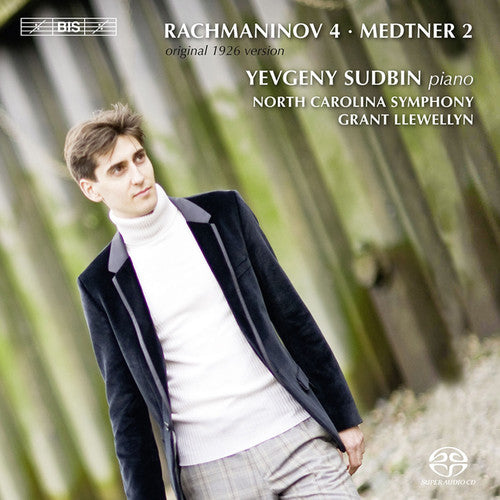
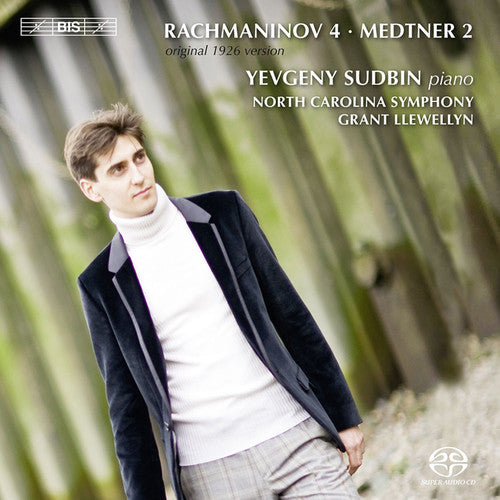
Medtner: Piano Concerto No 2; Rachmaninov / North Carolina Symphony Orchestra
BIS
$21.99
October 01, 2009
With his second concerto disc, Yevgeny Sudbin celebrates the close relationship between two great Russian composers: Sergei Rachmaninov and Nikolai Medtner. Medtner would encourage his more famous colleague during the latter's recurring bouts of self-doubt, while Rachmaninov early on recognized Medtner's unique gifts, pronouncing him the 'greatest composer of our time'. The most sincere testament to their friendship is embodied in these two concertos, which the composers dedicated to one another. Both works were composed in the mid-1920s, with Medtner referring to works by Rachmaninov in his final movement and Rachmaninov worrying in letters to his fellow-composer about the length of his own concerto. Rachmaninov's concerto was first performed in 1926, but was panned by the critics - in part because of its duration - and the composer immediately began to make revisions and cuts. Never completely happy with the revised version, published in 1928, he made another attempt in 1941, cutting a tenth of the original work, mainly from the final movement. Having chosen to record the rarely heard original 1926 version, Yevgeny Sudbin makes an eloquent case for it in his own liner notes, calling it 'a truly epic work' with the addition 'and much more insanely difficult than the revised version.' In his advocacy for Medtner's even more expansive and all but ignored Second Piano Concerto, Sudbin is equally forthright: 'Why this concerto is not performed more often remains a mystery and is nothing short of scandalous: it offers everything a pianist, or a conductor, can wish for.' An avowed Medtner champion, Sudbin has previously recorded the composer's First Piano Concerto, combined with that of Tchaikovsky, on a disc which received a number of distinctions, including the nomination to a 2007 Gramophone Award. Reviewers described the release as 'another step in Sudbin's inexorable progress to the forefront of his generation of pianists' (Gramophone) and the soloist as 'one of the most exceptional musicians of his generation' (Le Monde de la Musique). On the present disc Sudbin receives the expert support of North Carolina Symphony conducted by Grant Llewellyn.
{# optional: put hover video/second image here positioned absolute; inset:0 #}
BIS
Medtner: Piano Concerto No 2; Rachmaninov / North Carolina Symphony Orchestra
With his second concerto disc, Yevgeny Sudbin celebrates the close relationship between two great Russian composers: Sergei Rachmaninov and Nikolai Medtner. Medtner...


 {# optional: put hover video/second image here positioned absolute; inset:0 #}
 {# optional: put hover video/second image here positioned absolute; inset:0 #}
BIS
{# optional: put hover video/second image here positioned absolute; inset:0 #}
BIS {# optional: put hover video/second image here positioned absolute; inset:0 #}
BIS
{# optional: put hover video/second image here positioned absolute; inset:0 #}
BIS {# optional: put hover video/second image here positioned absolute; inset:0 #}
BIS
{# optional: put hover video/second image here positioned absolute; inset:0 #}
BIS {# optional: put hover video/second image here positioned absolute; inset:0 #}
BIS
{# optional: put hover video/second image here positioned absolute; inset:0 #}
BIS {# optional: put hover video/second image here positioned absolute; inset:0 #}
BIS
{# optional: put hover video/second image here positioned absolute; inset:0 #}
BIS {# optional: put hover video/second image here positioned absolute; inset:0 #}
On SaleBIS
{# optional: put hover video/second image here positioned absolute; inset:0 #}
On SaleBIS {# optional: put hover video/second image here positioned absolute; inset:0 #}
BIS
{# optional: put hover video/second image here positioned absolute; inset:0 #}
BIS {# optional: put hover video/second image here positioned absolute; inset:0 #}
 {# optional: put hover video/second image here positioned absolute; inset:0 #}
BIS
{# optional: put hover video/second image here positioned absolute; inset:0 #}
BIS {# optional: put hover video/second image here positioned absolute; inset:0 #}
On Sale
{# optional: put hover video/second image here positioned absolute; inset:0 #}
On Sale {# optional: put hover video/second image here positioned absolute; inset:0 #}
 {# optional: put hover video/second image here positioned absolute; inset:0 #}
 {# optional: put hover video/second image here positioned absolute; inset:0 #}
BIS
{# optional: put hover video/second image here positioned absolute; inset:0 #}
BIS {# optional: put hover video/second image here positioned absolute; inset:0 #}

 {# optional: put hover video/second image here positioned absolute; inset:0 #}


 {# optional: put hover video/second image here positioned absolute; inset:0 #}

 {# optional: put hover video/second image here positioned absolute; inset:0 #}


 {# optional: put hover video/second image here positioned absolute; inset:0 #}


 {# optional: put hover video/second image here positioned absolute; inset:0 #}

 {# optional: put hover video/second image here positioned absolute; inset:0 #}

 {# optional: put hover video/second image here positioned absolute; inset:0 #}


 {# optional: put hover video/second image here positioned absolute; inset:0 #}

 {# optional: put hover video/second image here positioned absolute; inset:0 #}

 {# optional: put hover video/second image here positioned absolute; inset:0 #}

 {# optional: put hover video/second image here positioned absolute; inset:0 #}

 {# optional: put hover video/second image here positioned absolute; inset:0 #}

 {# optional: put hover video/second image here positioned absolute; inset:0 #}
 {# optional: put hover video/second image here positioned absolute; inset:0 #}

 {# optional: put hover video/second image here positioned absolute; inset:0 #}