

Brilliant Classics
1405 products
-


-


-
 {# optional: put hover video/second image here positioned absolute; inset:0 #}
On SaleBrilliant Classics
{# optional: put hover video/second image here positioned absolute; inset:0 #}
On SaleBrilliant ClassicsRheinberger: Choral & Organ Music / Noro, Il Polifonico Men's Choir
In his own lifetime (1839–1901), Joseph Rheinberger was more sought after as a professor of organ and composition than he was recognized...
April 21, 2023$13.99$6.99 -


-


-
 {# optional: put hover video/second image here positioned absolute; inset:0 #}
Brilliant Classics
{# optional: put hover video/second image here positioned absolute; inset:0 #}
Brilliant ClassicsElegy - String Orchestra Music / Taddei, Borzak, Roma Tre Orchestra
Hidden behind the late 19th century’s great symphonies, sumptuous ballets, and concertos with moving climaxes is something much more thoughtful and contemplative....
$13.99April 21, 2023 -


-


-
 {# optional: put hover video/second image here positioned absolute; inset:0 #}
Brilliant Classics
{# optional: put hover video/second image here positioned absolute; inset:0 #}
Brilliant ClassicsTiersen: Island
Yann Tiersen’s (b.1970) music traverses genres from French folk music and chanson to minimal, avant-garde and post-rock. The French composer and multi-instrumentalist...
$16.99March 24, 2023 -


-


-
 {# optional: put hover video/second image here positioned absolute; inset:0 #}
Brilliant Classics
{# optional: put hover video/second image here positioned absolute; inset:0 #}
Brilliant ClassicsFrescobaldi: Complete Keyboard Works / Loreggian
Definitive recordings by the leading Frescobaldi performer of our time, now more conveniently packaged than ever. In 2007, Roberto Loreggian embarked on...
$58.99April 07, 2023 -


-


-
 {# optional: put hover video/second image here positioned absolute; inset:0 #}
On SaleBrilliant Classics
{# optional: put hover video/second image here positioned absolute; inset:0 #}
On SaleBrilliant ClassicsNardini: Complete Music for 2 Violins
A feast of first recordings to celebrate the art of one of the greatest violinist-composers in 18th-century Europe. ‘I have heard a...
March 24, 2023$18.99$14.99 -


-


-
 {# optional: put hover video/second image here positioned absolute; inset:0 #}
Brilliant Classics
{# optional: put hover video/second image here positioned absolute; inset:0 #}
Brilliant ClassicsBottazzi: Choro et Organo
Choro et Organo by Bernardino Bottazzi (1560–1614) may be considered the most extensive and best-known collection of Italian organ works from the...
$16.99March 24, 2023 -

-


-
 {# optional: put hover video/second image here positioned absolute; inset:0 #}
Brilliant Classics
{# optional: put hover video/second image here positioned absolute; inset:0 #}
Brilliant ClassicsSammartini: Sonatas for Cello & Bass Continuo / Ensemble Dolci Accenti
The essential contribution that Milan-born Giovanni Battista Sammartini (c. 1700–1775) made to the history of music is universally recognized. He laid the...
$13.99March 24, 2023 -


-


-
 {# optional: put hover video/second image here positioned absolute; inset:0 #}
On SaleBrilliant Classics
{# optional: put hover video/second image here positioned absolute; inset:0 #}
On SaleBrilliant ClassicsLauro: Guitar Music
Born in Venezuela to Italian parents, Antonio Lauro (1917–1986) was very young when he began taking music lessons from his father. At...
March 24, 2023$16.99$12.99 -


-


-
 {# optional: put hover video/second image here positioned absolute; inset:0 #}
Brilliant Classics
{# optional: put hover video/second image here positioned absolute; inset:0 #}
Brilliant ClassicsVivaldi: La Stravaganza / Scandali
This CD presents Violin Concertos from Vivaldi’s La Stravaganza Op. 4, transcribed for organ. These are contained in the collection known as...
$13.99March 24, 2023 -

-

-
 {# optional: put hover video/second image here positioned absolute; inset:0 #}
Brilliant Classics
{# optional: put hover video/second image here positioned absolute; inset:0 #}
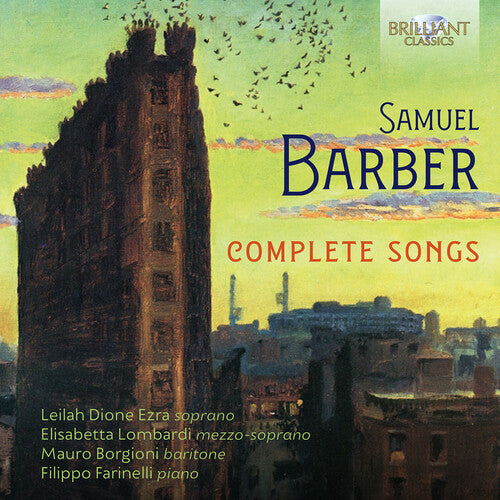
Brilliant ClassicsBarber: Complete Songs
The songs of Samuel Barber offer the beauty of his output in microcosm. ‘Complete’ in this context used to mean the 47...
$18.99March 24, 2023 -


-


-
 {# optional: put hover video/second image here positioned absolute; inset:0 #}
Brilliant Classics
{# optional: put hover video/second image here positioned absolute; inset:0 #}
Brilliant ClassicsMannelli: Trio Sonatas, Op. 3
The forgotten art of a 17th-century Roman master, in the hands of a dynamic period ensemble with a string of acclaimed rarity...
$16.99March 24, 2023 -


-


-
 {# optional: put hover video/second image here positioned absolute; inset:0 #}
Brilliant Classics
{# optional: put hover video/second image here positioned absolute; inset:0 #}
Brilliant ClassicsMozart: Divertimento, K. 563 / Nuovo Trio Italiano d'Archi
In September of 1816, Schubert began writing a string trio that he would leave unfinished. All that survives is the first movement,...
$13.99March 24, 2023 -


-


-
 {# optional: put hover video/second image here positioned absolute; inset:0 #}
Brilliant Classics
{# optional: put hover video/second image here positioned absolute; inset:0 #}
Brilliant ClassicsSlavic Rhapsody / Gasteren, Ciconia Consort
The soul of Bohemia: familiar masterpieces and little-known gems for string ensemble by the five most famous Czech composers of the 19th...
$13.99February 03, 2023 -


-


-
 {# optional: put hover video/second image here positioned absolute; inset:0 #}
On SaleBrilliant Classics
{# optional: put hover video/second image here positioned absolute; inset:0 #}
On SaleBrilliant ClassicsBoulevard des Femmes / Pineda, Bayón
The 19th century salon was a major vehicle for the spread of culture and the transmission of new artistic and literary trends...
February 03, 2023$13.99$6.99 -


-


-
 {# optional: put hover video/second image here positioned absolute; inset:0 #}
On SaleBrilliant Classics
{# optional: put hover video/second image here positioned absolute; inset:0 #}
On SaleBrilliant ClassicsDevienne: 6 Flute Duets, Op. 2 / Pavan, Ballardini
François Devienne (1759–1803) was a contemporary of Mozart and one of the few virtuosos who didn’t have to flee his own country...
February 03, 2023$13.99$6.99


Rheinberger: Choral & Organ Music / Noro, Il Polifonico Men's Choir
In his own lifetime (1839–1901), Joseph Rheinberger was more sought after as a professor of organ and composition than he was recognized as a great composer. His roll call of students at the conservatoire in Munich was long and impressive, including Humperdinck, Wolf-Ferrari and Furtwängler. However, Rheinberger produced a significant catalogue of sacred music in particular, concentrated on choir and organ. Sometimes unfavourably compared to Brahms, he is more usefully regarded as a south-German Fauré – for the gentle contours of his melodies and the softly rounded quality of his choral writing.
The principal work on this new album is the Mass for four-part men’s chorus which he composed in 1898, and which has become a staple of the male chorus repertoire around the world. By no means as staid or sober as its scoring might suggest, the Mass is a work of resonant beauty and sweetness, a concise and elegant demonstration of Rheinberger’s melodic gifts and his embodiment of Catholic values in the secular musical culture of late 19th-century Germany.
This newly recorded album makes an ideal introduction to the world of Rheinberger through its diversity. The Mass is complemented by a radiant partsong, Abendfriede, and a setting of the Ave Maria all the more affecting for its devotional simplicity, close in spirit to the early motets of Bruckner. Finally, Manuel Tomadin plays the grandest and best-known of the 20 organ sonatas composed by Rheinberger throughout his career. Cast in three movements, No. 19 opens with an imposing Allegro, while the intimate central Provenzalische finds Rheinberger at his most beguiling as he taps into the folkloristic culture of German Catholicism. Prefaced by a broad introduction, the chromatic counterpoint of the finale approaches Reger for hard-won transcendence, played here on the organ of the Church of Maria Ausiliatrice in the Slovenian town of Vipava.
Josef Rheinberger (1839-1901) was a German romantic composer of mainly works for the organ, his own instrument. He was one of the leading figures in the “Cecilian Movement” which, in a world of increasing secularization, propagated the return to religious values of the past, expressing itself in a renewed interest in Gothic architecture and polyphony. Rheinberger’s works are a happy blend of the Romantic spirit of his time and a healthy dose of polyphony and counterpoint, in this he was a worthy successor of Felix Mendelssohn. This new recording presents a selection of choral music and organ works, the two genres in which Rheinberger excelled and for which his fame is undisputed. Included are the Mass for Male Choir and Organ Op. 190, Ave Verum, the popular Abendfriede for organ and the mighty Organ Sonata No. 19 in G minor.
Music of great warmth and sensitivity, quintessentially romantic, played by organist Manuel Tomadin on the 1897 Goršic organ at the Church of Maria Ausiliatrice, Vipava, Slovenia, the specifications of which are included in the booklet. The male choir “Il polifonico” is conducted by Fabiana Noro.
 {# optional: put hover video/second image here positioned absolute; inset:0 #}


Elegy - String Orchestra Music / Taddei, Borzak, Roma Tre Orchestra
Hidden behind the late 19th century’s great symphonies, sumptuous ballets, and concertos with moving climaxes is something much more thoughtful and contemplative. This secret landscape comes courtesy of a few precious pieces for string orchestra by three Russian composers, all active at approximately the same time.
The extremely simple theme in 3/4, from Glazunov’s Theme and Variations in G Minor, Op. 97, has the feel of a solemn, ancient dance, simultaneously nostalgic and sombre. In another example of Glazunov’s crystal-clear yet expressive writing, the string orchestra provides the backdrop and conversation partner for a solo instrument that was a rarity in concertos at the time: the saxophone. Overall, despite the explosive counterpoint in the work’s final movement, it is a dreamy composition, never overly dramatic, and subdued and melancholy in places: almost elegiac, in other words.
The two elegies Tchaikovsky composed for string orchestra are highly refined works that reveal another side to the famous composer. In the same period that Tchaikovsky was writing his elegies, between 1880 and 1885, the composer and chemist Alexander Borodin was drafting his second Quartet. The third movement, a Nocturne, is one of Borodin’s finest works. It was therefore not only written at the same time as Tchaikovsky’s elegies, but also shares their gracefulness.
REVIEW:
Sieva Borzak (b. 1997) serves as the Conductor-in-Residence of the Roma Tre Orchestra, a collegiate ensemble that, when founded in 2005, became the first of its kind in central Italy.
The young musicians play with an artistic maturity and sensitivity well beyond their age; and the entire program bathes the listener in the timeless and contemplative romantic soundscape of the pre-Soviet school. Even so, this remains a student ensemble; and moments of stunning beauty are sometimes followed by shaky intonation and patchy teamwork. Taddei has all the tools for a solo career, executing the Glazounov concerto with splendid poise, expressive phrasing, and superb technique; but his free-blowing set-up always seems on the edge of spreading, even if his control is very good. Nevertheless, this is a fascinating preview of what the next generation of Italian talent has to offer.
-- American Record Guide
 {# optional: put hover video/second image here positioned absolute; inset:0 #}


Tiersen: Island
Yann Tiersen’s (b.1970) music traverses genres from French folk music and chanson to minimal, avant-garde and post-rock. The French composer and multi-instrumentalist is primarily known for writing the music for the film Amélie. In 2016 he made the album EUSA, then in 2021, he ventured a step further towards electronic music with his new album Kerber (2021). The latter is a beautifully structured, immersive and thoughtfully constructed electronic world, composed on the island of Ushant where Tiersen now resides. The title of each track on these two albums refers to a specific place on Ushant. Kerber, for example, is named after a chapel in a small village on the island. Some offer the perfect soundtrack for contemplation on a long walk or staring out of a window on a train journey. Others seem predestined to be background music for study or relaxation. With each song, your imagination can easily conjure a scene from a movie: a breakup after a fight in a cosy café or a nature documentary showing two baby birds opening their eyes for the very first time. After a frightening experience with a mountain lion in California, Tiersen came to a realisation. He needed to discover himself more intimately, and to do that, he needed to better know his home, Ushant. In order to understand his home and discover himself, he decided to draw a musical map of the island, of which EUSA is volume one; it contains ten piano works about ten places on Ushant. ‘I think there is a similarity between the infinite big and the infinite smallness of everything,’ explains Yann Tiersen. ‘It's the same experiment looking through a microscope as it is a telescope.’ This exploration of the micro and the macro has permeated much of Tiersen’s career, and Kerber once again shows the vast expansiveness and intricate detail of his work. This isn’t a collection about isolation; it is more an expression of being conscious of your immediate environment, and your place within it. For Tiersen, this approach extracts the same degree of profundity as spending the evening studying the stars – which he himself does. ‘You can look at things that are thousands of light years away and relate your own existence to this really cosmic element,’ he says. ‘But you get that same feeling with the things all around you.’ ‘A leading exponent of minimalism today’ (Fanfare). Pianist Jeroen van Veen has selected to perform the principle 17 works from these two of Tiersen’s albums for his own Island album. ‘The result here is a fresh and rather naked version of Eusa and Kerber that I will play in public quite a bit,’ Van Veen relates, ‘especially for my lie-down concerts, and the music makes a nice addition to my other existing programmes. In these works you can hear the emptiness of the island; although I’ve never been to Ushant, I can imagine the beauty of nature and the music ebbing and flowing like the ocean’s tide, low and high, day in, day out.’ French composer Yann Tiersen (born 1970) is one of the most popular and successful film music writers of today. His soulful and melancholic music finds its traces in folk music, French chansons, musette waltzes, street music, but also in the minimalism of Satie, Glass and Nyman. His international breakthrough came with the music for the French blockbuster “Amélie”. Later followed “Goodbey, Lenin!” and others. The composer’s two new albums, “Eusa” and “Kerber” are inspired by the small island of Ouessant, where he currently lives. Less than 16 square kilometers in size, it lies off the coast of Brittany in northwestern part of France boasting little apart from meadows and granite rocks. “Eusa” is the Breton name for Ouessant, “Kerber” is a little chapel on the island. Tiersen perfectly expresses the isolation of the island, its barren and wild landscape, but also its place in the vast universe when looking into space and its stars. Dutch pianist, pioneer and champion of Minimalism Jeroen van Veen plays the piano in his inimitable way: focused, serene and hypnotizing. A worthy successor of Van Veen’s successful recordings for Brilliant Classics of piano music by Glass, Pärt, Yiruma and many others.
 {# optional: put hover video/second image here positioned absolute; inset:0 #}


Frescobaldi: Complete Keyboard Works / Loreggian
Definitive recordings by the leading Frescobaldi performer of our time, now more conveniently packaged than ever.
In 2007, Roberto Loreggian embarked on a project that would see him record every published work by Girolamo Frescobaldi. Issued as a box in 2011, the Frescobaldi Edition was widely recognised as establishing a new standard of textual authority and interpretative understanding for a composer whose own works have never been as appreciated as much as their influence on his successors. Then, in 2022, came a new set which committed to disc for the first time all the surviving unpublished music composed by Frescobaldi and recovered from obscure sources by Etienne Darbellay and Costanze Frey. All these recordings are now coupled with the keyboard collections from the earlier set, to present the most complete collection ever issued of Frescobaldi’s works for harpsichord and organ, both sacred and secular.
This CD set presents the complete organ works and complete harpsichord works by Frescobaldi, an immense collection of Ricercars, Toccatas, Canzoni, Fantasias and Capriccios, played on historic instruments or copies of these.
Played by the eminent Italian Roberto Loreggian, an Early Music specialist with an impressive discography to his name. The recordings in this set were previously issued separately.
 {# optional: put hover video/second image here positioned absolute; inset:0 #}


Nardini: Complete Music for 2 Violins
A feast of first recordings to celebrate the art of one of the greatest violinist-composers in 18th-century Europe. ‘I have heard a certain Nardini, Leopold Mozart once wrote, ‘and regarding beauty, purity, and equality of tone and in the singing taste nothing more beautiful can be heard.’ The inveterate traveller and collector of culture Charles Burney was no less certain in his judgment of Nardini: ‘he seems the completest player on the violin in all Italy; and, according to my feelings and judgment, his style is delicate, judicious, and highly finished.’ We may judge for ourselves through the medium of his works, presented here in superbly stylish new recordings by a Dutch-based period ensemble with a track record of success in reviving lesser- known names from the golden age of the Baroque violin. Modern luminaries of the violin including Grumiaux, Milstein and Ricci used to perform Nardini’s ‘Sonata in D’, and modern-Baroque virtuosos such as Giovanni Guglielmo and Giuseppe Carmignola have recorded his ornately wrought concertos, but this is the most comprehensive collection ever made of the composer’s chamber-music output. To begin with, there are the Six Sonatas for two German Flutes or two Violins and a Bass, published in London in 1768. The Six duos pour deux violons, published in Paris around 1765, are very similar to the trio sonatas, but they feature typical violin idioms such as double stops and the use of lower notes than the flute would allow. The third of them brings a lively sequence of bird and animal sounds, from the cuckoo to the frog. The 14 New Italian Minuets for two Violins and a Bass, published in London around 1760, are short, unpretentious pieces, but skilfully composed and a joy to listen to. Born into a humble family in 18th-century Italy, Pietro Nardini’s (1722-1793) talent for violin playing led him to Livorno to study with the celebrated Giuseppe Tartini, where he reportedly became as good a violinist as his teacher. He travelled throughout Europe and was resident musician at several of its major courts – notably Tuscany, where he was Director of Music at the court of Grand Duke Leopold in Florence and worked there until his death. Such was his reputation as an extraordinarily expressive technician that he was asked to play in the presence of King Ferdinand IV and Queen Maria Carolina in Naples as well as Wolfgang and Leopold Mozart. Nardini left behind an extensive musical oeuvre, largely focused on the violin. All genres in which the violin plays an important role are represented in it. His style follows that of his time: melodious, uncomplicated and intended to be enjoyed by the listener. This new recording presents the complete works for two violins, with and without Basso Continuo, music of great charm, beauty and instrumental warmth. Igor Ruhadze’s Brilliant Classics recording of sonatas by Locatelli (94736) won warm praise from Gramophone. ‘The playing is elegantly supple, the string tone warm, and the architecture of individual movements thoughtfully worked out. All this makes for a pleasant mood and enjoyable listening. The more exuberant pieces are brilliantly and at times breathtakingly performed.’ Fanfare extended an equally enthusiastic welcome to Ruhadze’s album of concertos by Jean-Marie Leclair (95290): ‘The playing… is really top-notch… the group’s robust sound belies its small numbers… it’s hard to argue with playing as good as this.’ On this recording he plays with Daria Gorban (baroque violin), Jacopo Ristori (baroque cello) and Alexander Puliaev (harpsichord).
 {# optional: put hover video/second image here positioned absolute; inset:0 #}


Bottazzi: Choro et Organo
Choro et Organo by Bernardino Bottazzi (1560–1614) may be considered the most extensive and best-known collection of Italian organ works from the early 17th century. In the beautiful edition printed by Giacomo Vincenti, the musical notation used relates to a tradition that is more Renaissance than early baroque: namely, Italian tablature for organ (in this case, with an eight-line stave for the left hand and one of five lines for the right). There are 22 hymns in Choro et Organo. For some of these, Bottazzi’s organ verset is identical, for example Christe Redemptor omnium, whose melody is the same as that sung for the feast of All Saints although with a slightly different text. We know for certain that vocal forces and organ followed a pattern of alternation which, in Bottazzi’s case, seems fully in line with the practices as evidenced by analogous works from the same period: 5 versets for the Kyrie, 9 for the Gloria, 2 for the Sanctus and just 1 for the Agnus Dei, given that – according to Adriano Banchieri (1608) – the last of the three Agnus Dei would be replaced by an organ composition, generally a canzona. It is possible that a collection of canzonas, as well as a number of Magnificats and ricercars, might have formed the basis of a hypothetical second book of Choro et Organo, given that the title on the frontispiece incorporates the standard term of ‘Libro Primo’. Regrettably, we have no information, either on such a follow-up publication, nor indeed about Bottazzi’s own life, other than his self-description as coming from Ferrara (which may only have been a city he resided in or where he took his religious vows rather than where he was actually born). Before each of the organ versets, the beautiful edition of Choro et Organo always presents the melody in cantus firmus, written on a five-line stave. In his introductory text (‘To the gentle reader’), Bottazzi states that he ‘was resolved to have this part of the cantus firmus printed’ so as to circumvent the organist from playing the verset in question at such a pitch as to impede the choir from singing their own melodic part well (‘[…] if the cantus firmus is at one pitch, & the Organist plays it at another, it is impossible for the Chorister to find the correct note’). This unusual feature has allowed the cantus firmus part to be reconstructed with historical accuracy and for it to be sung according to the performance style that emerges from the vast instructional literature on cantus firmus that was produced in Italy during the 17th century. For the number of pieces and the completeness of the repertoire gathered in a single volume, the Choro et Organo by Bernardino Bottazzi (Venice 1614), can be considered the largest and best known Italian collection of organ works intended explicitly for the liturgy of the first three decades of Seventeenth century. Bottazzi's intentions are based on the directions by the Council of Trent which lay out the new rules and specifications of Liturgical Music. To the anthology of organ works the Choro et Organo prefaces an introduction and eighteen Avvertimenti that illustrate the principles of canonical counterpoint (with the intention of educating the organist on the method of composing and improvising from still chant) and offer some suggestions on how to diminish certain melodies and add embellishments. This new recording presents choral works and organ works written by Bottazzi, all splendid examples of Italian sacred music in the transition from Renaissance to Baroque. Played on a rare historic organ: The organ at the church of S. Bernardino da Siena. Played and sung with total dedication and deep knowledge of the style by organist Federico Del Sordo and Nova Schola Gregoriana conducted by Alberto Turco, who already successfully recorded similar repertoire for Brilliant Classics: Organ Alternatim Masses by Merulo, Fasolo and Salvatore. The scholarly written liner notes are by the artists.
 {# optional: put hover video/second image here positioned absolute; inset:0 #}


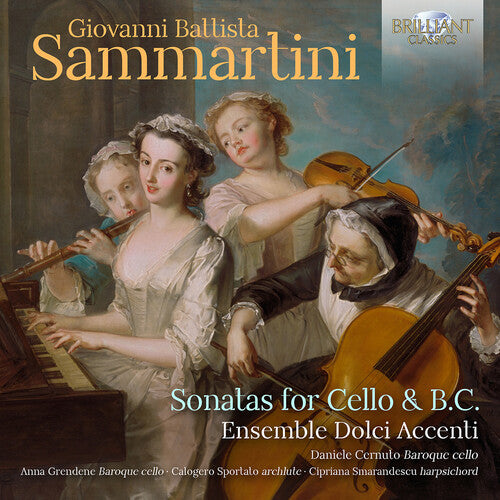
Sammartini: Sonatas for Cello & Bass Continuo / Ensemble Dolci Accenti
The essential contribution that Milan-born Giovanni Battista Sammartini (c. 1700–1775) made to the history of music is universally recognized. He laid the foundations for the Classical symphony: he helped establish the standard composition of the orchestra and promoted independence and individual timbres in his part-writing, while Baroque customs (most notably the basso continuo) gradually gave way to sonata form. In terms of repertoire and recordings, however, Sammartini is still a relative rarity; if you set aside his symphonies and start investigating his chamber music and works for solo instruments, for example, it is soon apparent that many enthralling compositions remain silently filed away in libraries and archives, waiting patiently for the recognition they deserve.
The program on this record ventures into this very partially unexplored terrain, showcasing a selection of sonatas for cello and basso continuo: the collection of six from his Op. 4, published in Paris in 1742, and two sonatas of uncertain date, one in G major and the other in G minor. Although more modest than the symphonies, the cello sonatas display a similar penchant for succinct and elegant writing. Often simple in form, their brilliance stems from the inventiveness of the melody and rhythm and moments of particularly intense and expressive lyricism that are not reliant on excessive ornamentation.
However, it is important to note the confusing history behind the authorship of the cello sonatas on this album. Op. 4 is almost certainly by Sammartini; the ‘almost’ is advisable only for Sonata No. 6, which some scholars believe to be of doubtful authorship. The two sonatas in G major and G minor are less certain. Despite these caveats, the cello sonatas presented here remain an excellent example of the transition from the Baroque to the Classical period and particularly of a singularly elegant compositional style that expertly applies cello technique to imaginative and spontaneous invention. Partly for this reason, the performers on this recording have chosen to further enhance the individual character and freshness of each sonata by using different instruments for the basso continuo line, chosen freely but with strong historical foundations: as well as the more predictable harpsichord, they also make use of the archlute, theorbo, and baroque guitar, in addition to melodic bass passages entrusted to a second cello.
The Cello Sonatas presented here mark the transition between Baroque and Classicism, music full of charm, gracefulness, cantabile melodies and instrumental flourish. Played by the Italian ensemble Dolci Accenti, with Daniele Cernuto (Baroque cello), Calogero Sportato (Baroque guitar, theorbo, archlute), Cipriana Smarandescu (harpsichord) and Anna Grendene (Baroque cello).
 {# optional: put hover video/second image here positioned absolute; inset:0 #}


Lauro: Guitar Music
Born in Venezuela to Italian parents, Antonio Lauro (1917–1986) was very young when he began taking music lessons from his father. At the age of 9, Lauro, against his family’s wishes, began lessons in piano and composition at the Academia de Música y Declamación. However, after he encountered the music of Agustín Barrios Mangoré, Lauro gave up his violin and piano studies to dedicate himself completely to the guitar, moved as he was by Mangoré’s music. Lauro went on to become an exceptional guitarist, as well as a composer. Politically engaged, Lauro was a fervent nationalist, and it was his political convictions that drove him to celebrate, and make in-depth studies of, the origins and heritage of Venezuelan music. In 1951, Lauro was imprisoned by General Marcos Pérez Jiménez on account of his democratic convictions; Lauro would later describe his prison experience as a normal part of life for a Venezuelan man of his generation. However, imprisonment did not deter him from organising a series of concerts, as well as continuing to compose wonderful pieces that would later win him the National Music Prize, Venezuela’s highest artistic award. And it was during his time in prison that he wrote two of his most important pieces: the Sonata for guitar and the famous Suite venezolana, followed by his Concerto for guitar and orchestra. His music, and particularly his pieces for guitar, transcended the confines of Venezuela’s musical scene to become a hugely important benchmark for subsequent generations of players worldwide. His compositions for guitar aimed to create a synthesis of Venezuelan popular music with elaborate forms from the European tradition. He took inspiration firstly from popular and folk-inspired pieces such as the Venezuelan waltzes (valses venezolanos) and pieces written in traditional styles; secondly, from demanding works deploying the most sophisticated aspects and features of the Western compositional tradition, such as the Sonata and the Suite venezolana; and thirdly, contrapuntal styles. Lauro is a composer whose greatness is deserving of recognition above and beyond his accomplishments in the reinterpretation of music from the popular and folk traditions, hugely successful though these were. His great achievement as a composer was to absorb and synthesise, in an entirely idiosyncratic and personally creative manner, a range of highly distinct elements and to bring them to life in compositions of real substance. This recording aims to bring together all the different facets of Lauro’s musical personality, while attempting to avoid the cliché of a folk-based, instinctual interpretation, instead approaching his music in a more structured manner. The son of two Italians, a barber and a musician, Antonio Lauro (1917-1986) was born in Ciudad Bolívar, Venezuela. He began at an early age to take music lessons from his father. The family moved to Caracas, a city with many stimuli and full of opportunities and he started taking music lessons, studying piano and composition at the Academy of Music and Declamation. It would be his encounter with the music of Agustín Barrios Mangoré, who was giving a series of concerts in Venezuela at the time, that he decided to abandon the study of the piano and violin to dedicate himself completely to the guitar, becoming an exceptional guitarist and composer. Antonio Lauro was, in 1938, the first Venezuelan to complete formal studies in classical guitar, while at the same time cultivating a career as a popular musician and performing in a trio for voice and guitars with which he toured all of South America. Lauro was politically committed and a fervent nationalist. This inspired him to celebrate and explore his Venezuelan origins and musical heritage: he was particularly attracted to the Venezuelan Waltz form, characterized by its brilliant, rhythmic melodies and frequent use of the hemiola and changes of metre and tempo. In 1951, Lauro was imprisoned, because of his democratic convictions, by General Marcos Pérez Jiménez, this however did not stop his composing activities, it was during his time in prison that he wrote two of his most important works: the Sonata for guitar and the famous Venezuelan Suite, followed by the Concerto for guitar and orchestra. In his compositions for guitar Lauro aimed to unite popular Venezuelan music with complex forms of the European tradition. They are highly attractive, melodious works, full of spirit, charm and brilliant writing for the instrument. Beautifully played by Cristiano Poli Cappelli, one of the leading Italian guitarists. He already recorded several successful albums for Brilliant Classics with music by Gangi, Tansman, Carlevaro and Castelnuovo-Tedesco.
 {# optional: put hover video/second image here positioned absolute; inset:0 #}


Vivaldi: La Stravaganza / Scandali
This CD presents Violin Concertos from Vivaldi’s La Stravaganza Op. 4, transcribed for organ. These are contained in the collection known as Anne Dawson's Book and kept at the Henry Watson Music Library in Manchester (UK). The collection, compiled around 1720, contains, in addition to arias for voice and basso continuo, a number of compositions for keyboard instrument along with several transcriptions of concertos by various composers, including 10 by Vivaldi. They are closely related to the original score and show an evident process of adaptation to the possibilities and idiom of the keyboard instrument.
Organist Luca Scandali is one of Italy’s foremost scholars and keyboard players. For Brilliant Classics he recorded the complete organ works by C.P.E. Bach (nominated for the Preis der deutschen Schallplattenkritik), Galuppi, Pasquini, Pellegrini and Padovano. He plays the Gaetano Callido organ from 1774 at the Church of San Venanzo, Albacina, Italy.
 {# optional: put hover video/second image here positioned absolute; inset:0 #}


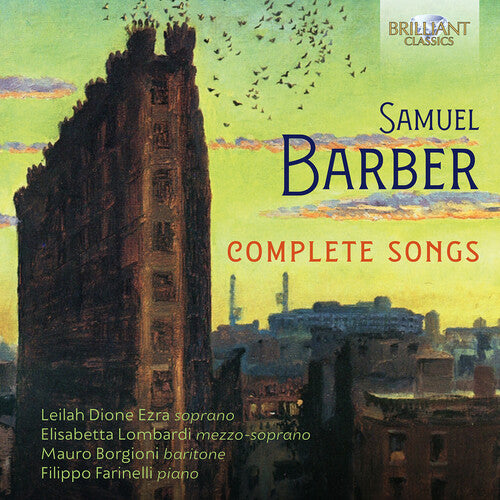
Barber: Complete Songs
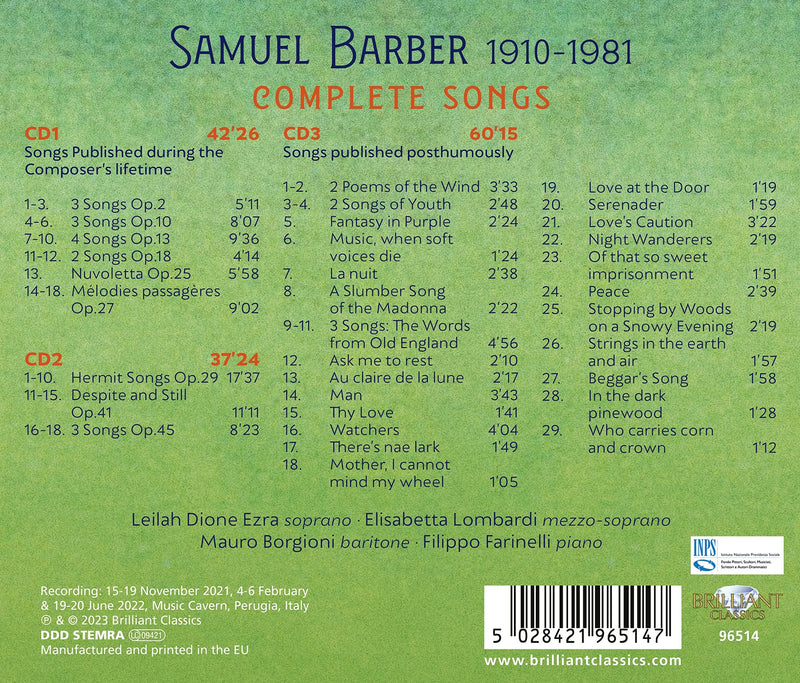
The songs of Samuel Barber offer the beauty of his output in microcosm. ‘Complete’ in this context used to mean the 47 songs gathered in a Deutsche Grammophon 2CD set from 1994, but there are 65 songs here, making it the most complete survey yet recorded.
Most of the lesser-known and unpublished songs on CD3 date back to Barber’s student years, but he took up composing young, and was always inclined towards writing for voices and responding to poetry. He made his matchlessly evocative setting of Matthew Arnold’s Dover Beach when he was just 21 years old. However, by the time of the Op. 10 Songs, Barber’s harmonies have thickened in texture and expressionist harmony: these are heroic numbers demanding an interpreter of heroic projection, another world away from the almost painfully confessional mood of the music which has made his name such as Knoxville: Summer of 1915. Nevertheless, they paint a vivid portrait of Barber himself, who had a fine baritone voice and would delight in performing his songs while accompanying himself at the piano.
Barber could read Proust in French, Goethe in German, Dante in Italian and Neruda in Spanish, and his erudite choice of poets and poems reflected facets of his complex character: a restless melancholy on the one hand, and an impish wit on the other. His part-Irish ancestry drew him towards Joyce, Yeats and James Stephens, and his interest in his Celtic heritage prompted the writing of his best-known song-prompted the writing of his best-known song-cycle, the Hermit Songs Op. 29. Much later in life, he returned to song (and to Joyce) with Despite and Still Op. 41 and the Three Songs Op. 45. Both collections are coloured by introspection and resignation, but they are masterpieces of the song-writer’s art.
Few composers in the history of “art song” can compare to the figure of Samuel Barber (1910-1981), whose innate gift for lyricism found expression in his exceptional baritone voice, and who would perform any number of his songs accompanying himself at the piano.
Performed by three excellent Italian singers, Mauro Borgioni (baritone), Leilah Dione Ezra (soprano) and Elisabetta Lombardi (mezzo soprano), who won their spurs on the most important international stages. This project is another triumph of Filippo Farinelli, indefatigable pianist and promotor of prestigious recording projects, such as the complete songs by Jolivet, Berg, Dallapiccola and Ravel, and instrumental projects by Koechlin, Jolivet, Hindemith and Debussy.
Among his many recordings for Brilliant Classics, the pianist Filippo Farinelli has made complete surveys of the song output of Berg, Ravel, Dallapiccola and Jolivet, in conjunction with colleagues who have immersed themselves in the idiom. Here he is likewise joined by a trio of Italian singers who show themselves at home with the wistful, changeable moods of Barber the song-composer.
 {# optional: put hover video/second image here positioned absolute; inset:0 #}


Mannelli: Trio Sonatas, Op. 3
The forgotten art of a 17th-century Roman master, in the hands of a dynamic period ensemble with a string of acclaimed rarity albums to their credit.
The Baroque trio-sonata repertoire still yields up plenty of undiscovered treasure lying in libraries across Italy. The Ensemble Giardino di Delizie has been diving into it and coming up with polished gems on Brilliant Classics by Stradella (96079), Colista (96033) and Lonati (95590). Like Colista, Carlo Mannelli (1640-1697) was Roman by birth and training. He sang and played the violin for ensembles at both church and court, and was permitted to dedicate his Op.2 collection to Cardinal Benedetto Pamphilj. Perhaps it was the patronage of this influential family that opened doors to his training with Michelangelo Rossi, and to distinguished musical societies in Rome. Another noble Roman family was the recipient of Mannelli’s Op.3 collection of trio sonatas, with its dedication to Prince Domenico Rospigliosi. Much of the composer’s output is now lost, and we can only surmise at the riches deprived to us by time, given the fresh melodic invention of what survives here. Compared to Stradella and co, Mannelli cuts an eccentric, highly individual figure, musically speaking, and he has no interest in the orderliness of Corelli. The arrangement of slow and fast movements is unpredictable: the four-movement No. 10 begins with three separate Adagios! The six-movement No.9 cuts a sequence of four slow movements in half with a fugue, and so on. Three of the twelve sonatas feature a ravishing aria for the violin, who takes on a soloist’s role. When Mannelli writes quick music, he pushes his musicians to the limits, as in the finale of the First Sonata. Counterpoint is subordinate to the kind of highly elaborate violin writing at which Ewa Anna Augustynowicz has already shown herself to excel in previous albums, making this new recording an essential acquisition for Baroque-music aficionados. Carlo Mannelli (Rome, 1640-1697) spent the major part of his life in Rome where he also worked during the opera performances and religious events. As a violinist nicknamed Carlo del Violino and Carluccio di Pamfili, he played the first violin in the most famous Roman musical ensembles of the period. Arcangelo Corelli, who often played under Mannelli, described him as one of his most influential teachers. For several years, Mannelli was leader of the famous Congregetione di S. Cecilia. The Trio Sonatas Op.3 consists of twelve Sonatas. Seven of them are in four movements, two are in six movements and only one (the last) is in three movements. They display a freshness of melodic invention and sometimes daring harmonic surprises, a great tonal richness and unexpected, highly expressive chromatic phrases. The ensemble Giardino di Delizie is a Roman female Baroque group, founded in 2014 by the violinist Ewa Anna Augustynowicz, researching and performing forgotten treasures from the Italian and Polish Baroque. They played in such ensembles as Europa Galante, Les Eléments, Quatuor Mosaïques and others. Their previous recordings of instrumental works by Lonati, Stradella, Colista and Leonarda met with enthusiast critical acclaim in the international press: ‘The performance sounds completely natural, full of spontaneity and bursting energy. It’s clear the group really likes this music and does not merely try and lecture it.’ (Lonati, 95590 theclassicreview.com). ‘Giardino di Delizie… take an energetic and imaginative approach to this fine music… playing with sensitivity and considerable musicality.’ (Colista, 96033, earlymusicreview.com). ‘A garden of delights, sensitively and beautifully performed, perfect for any lover of the Baroque.’ (Gems of the Polish Baroque, 95955, MusicWeb International).
 {# optional: put hover video/second image here positioned absolute; inset:0 #}


Mozart: Divertimento, K. 563 / Nuovo Trio Italiano d'Archi
In September of 1816, Schubert began writing a string trio that he would leave unfinished. All that survives is the first movement, an Allegro, plus the first thirty-nine bars of an Andante sostenuto. The writing reveals a glimmer of the orchestral sound of the great chamber works of the last period, but nevertheless it remains linked to the elegant style of the late 18th century.
Mozart’s Divertimento KV563 requires of both its performers and listeners a commitment equal to that for the great instrumental works. Each of the three musicians must be high-level virtuosos to play their parts, which explore the full register of each instrument in a dialogue intertwined with contributions at the same level from the three participants. The only link with the traditional genre is the high number of movements (six), including two minuets.
 {# optional: put hover video/second image here positioned absolute; inset:0 #}


Slavic Rhapsody / Gasteren, Ciconia Consort
The soul of Bohemia: familiar masterpieces and little-known gems for string ensemble by the five most famous Czech composers of the 19th and 20th centuries. The affection and vigor of Dvořák’s Serenade for Strings has kept its freshness while many other works from the same era have receded into obscurity. This performance by the Ciconia Consort lends it a new lease of life: as rhythmically springy and attentive to detail as the ensembles previous, critically acclaimed explorations of the string-orchestra repertoire of France, England, the US and Germany in beautifully curated themes. Janáček’s Suite for Strings is an early work, Romantic in character and recognizably descended from the String Serenades of Dvorák and Tchaikovsky, but nonetheless characteristic of the composer’s quirky language with its adoption of Czech speech rhythms. In 1931, Martinů was also inspired by Czech folk melodies when writing his Partita as a Czech émigré in faraway Paris. However, Martinů develops these melodies in a modern style reminiscent of Béla Bartók. Without slow movements, intimacy, or a poetic character, the character of the suite as a whole is spicy, tough and extrovert: inimitably Martinů. Smetana scored his tone-picture Rybár (The Fisherman), for harmonium, harp, and strings: it is a musical ‘tableau vivant’ after Goethe’s poem Der Fischer, which describes a fisherman who is overpowered by the mysterious and magical pull of the water. The theme of Rybár and Smetana’s haunting translation into music also make it a kind of study for his evocation of the river Vltava in Ma Vlast. A little more familiar is the grave Meditation on the Hymn to St Wenceslas by Dvorák’s student and son-in-law, Josef Suk, in which the old melody is treated like a family heirloom.
REVIEW:
CD Slavic Rhapsody begins at a high level and very excitingly with Dvořák’s String Serenade, which Dick van Gasteren and his Ciconia Consort, the string orchestra from The Hague, present not as a soft-boiled egg, but as a lively and energetic piece of music.
Very expressive, and rhetorically sharpened, with powerful gestures, the fast movements of the Suite for String Orchestra by Leos Janacek are also played, while the two Adagios become effective with great sensitivity.
Suk’s Wenceslas Meditation also benefits from this dynamic, its chorale possessing a moving depth.
The Czech composer Bohuslav Martinů (1890–1959) composed his Partita Suite in 1931. It is a neoclassical work in which the underlying folk-musical tone cannot be ignored. The Chamber Orchestra from The Hague enlivens the somewhat academic form with gripping and urgent playing.
Smetana’s short portrait of a fisherman with strings, harmonium and harp closes this CD with which the Ciconia Consort celebrates its 10th anniversary.
-- Pizzicato
 {# optional: put hover video/second image here positioned absolute; inset:0 #}


Boulevard des Femmes / Pineda, Bayón
The 19th century salon was a major vehicle for the spread of culture and the transmission of new artistic and literary trends in Europe, as well as being a space overtly dominated by women. Aiming to recreate the musical atmosphere of a 19th-century salon, this recording revolves around two fundamental objectives. The first, to perform music by women who, as composers, performers and hostesses, were absolute cornerstones of these spaces. Second, to perform the songs, originally accompanied by piano, with newly made guitar arrangements.
The arrangements on this album have been made following a scrupulous transcription from the piano parts, retaining the harmonic essence whilst capturing the full polyphonic interplay. Several guitar effects have also been incorporated (tambora, harmonics, strumming, etc.), bringing a fresh twist to the original versions. All this contributes not only to expanding the guitar repertoire, but to the discovery of unfamiliar works.
Pauline Viardot (1821–1910) was born in Paris to a highly musical Spanish family and enjoyed an illustrious career as a singer. Returning to Paris in 1870, she established one of the most important musical salons of the time. Viardot’s songs have palpable Spanish roots, and her later pieces, like ‘Caña española’, were likely influenced by her father’s compositions. María Malibrán (1808–1836), Viardot’s elder sister, is most famous as an illustrious Spanish opera diva. Isabel Colbrán (1784/5–1845) was a Spanish opera singer and the first wife of composer Gioachino Rossini. In the early years of her career, she composed 24 short Italian arias which bear a certain Rossinian stamp. That said, as those arias were written before she met Rossini, it must be queried who influenced whom.
Pauline Duchambge (1778–1858) is perhaps the least known of these composers, and this album showcases a number of her songs that have never previously been recorded. A pianist, singer and guitarist, Duchambge studied composition with Cherubini and Auber, mainly composing romances on idealised romantic or historical themes (for example, ‘Celle qui voudrait m’aimer’).
Fanny Hensel (1805–1847) was the elder sister of Felix Mendelssohn. Although she received a thorough musical education, Fanny’s father barred her from publishing her compositions. Several of her songs were published under Felix’s name, including ‘Die Nonne’, but she later published the set containing ‘Schwanenlied’ under her married name. She hosted the so-called ‘Musical Sundays’, soirées attended by leading artists and intellectuals of the day, including Clara and Robert Schumann, Heine, Paganini, and Gounod.
The life of Clara Wieck (1819–1896) was demanding, given that she had to be the bread-winner for her eight children as a concert pianist, owing to her husband Robert Schumann’s mental illness. The two lieder on this album are from Clara and Robert’s jointly published Zwölf Lieder song cycle.
 {# optional: put hover video/second image here positioned absolute; inset:0 #}


Devienne: 6 Flute Duets, Op. 2 / Pavan, Ballardini
François Devienne (1759–1803) was a contemporary of Mozart and one of the few virtuosos who didn’t have to flee his own country to get noticed. Born in Joinville, France, the youngest of the 14 children of a saddle maker, Devienne received his formative musical instruction as a choirboy in his hometown and quickly developed into a flute player of formidable gifts, studying with Felix Rault. He was active in Paris as a flautist, bassoonist and composer and played bassoon at the Paris Opera. He was also a sergeant and member of the Military Band of the French Guard, where he was given the responsibility of teaching his military band colleagues’ children in its Free School of Music. After the Revolutionary period, when the Free School became the National Institute of Music, later chartered as the Paris Conservatory in 1795, Devienne was appointed as flute professor, where he taught from 1795 to 1803. He also wrote the Méthode de Flûte Théorique et Pratique (1793), which was reprinted several times and did much to improve the level of French wind music in the late 18th century.
His output includes opera, extensive educational work, and approximately 300 instrumental works that were mostly written for wind instruments. There are about 20 flute concertos, mainly written for his own use, and many of his works are still popular today in standard flute repertoire. His VII Concerto in E minor, for example, contains all the poetry and aesthetics of his music – it is quintessentially beautiful, charming, melodious and witty. Devienne's compositions for flute, revived by Jean-Pierre Rampal in the 1960s, became well-known among flutists. Unfortunately, Devienne’s fortunes declined suddenly in the new century and he died in 1803, four months after being committed to the Charenton insane asylum.
The Six duos Op.2 were written in 1786 for the captain of the guard of the Artois Count. They are a collection of six duos for two flutes, each of them divided into two movements. The general atmosphere exuded throughout the set is playful, fresh and bright, possibly because of the absence of the slow and thoughtful second movement that traditionally would have been placed between the first and last allegros. There is no shortage of singable and lyrical melodies, though: the Gracioso con Variatione, the second movement of the third duet, is a prime example. The movement markings chosen by Devienne are primarily Allegro, Rondeau, Gracioso and Menuetto. Every tempo mark is set between a moderate and a fast, lively tempo, in order to develop either the lyrical themes or display the shimmering virtuosity of the flutes. In fact, it seems that the composer’s aim was to make the listener feel like there is only one flute playing instead of two: the sound, the articulation and the phrasing of each must be as similar to one another as possible. Needless to say, these are the greatest difficulties to deal with for the musicians. Furthermore, the pieces were written to accompany the lives of the aristocracy, for example celebrations and tea parties, which is why this kind of music is also called ‘salon music’. The two flutists made their recording using the first edition sheet music published by Sieber in Paris, c.1786.
 {# optional: put hover video/second image here positioned absolute; inset:0 #}