

Chandos
1709 products
-


-


-
 {# optional: put hover video/second image here positioned absolute; inset:0 #}
Chandos
{# optional: put hover video/second image here positioned absolute; inset:0 #}
ChandosBartók: Divertimento; Janácek: Idyll, Suite For Strings
REVIEWS:American Record Guide (7-8/00, p.86) - "...[T]he Chandos sound gives the strings plenty of body and a strong edge (partly the conductor's...
$21.99March 01, 2000 -


-


-
 {# optional: put hover video/second image here positioned absolute; inset:0 #}
Chandos
{# optional: put hover video/second image here positioned absolute; inset:0 #}
ChandosWeber: Clarinet Concertos 1 & 2, Concertinos / Collins, Stirling, City Of London Sinfonia
Clarinetist Michael Collins, plays three works for clarinet and orchestra by Weber, as well as conducting the City of London Sinfonia. The...
$21.99January 31, 2012 -


-


-
 {# optional: put hover video/second image here positioned absolute; inset:0 #}
Chandos
{# optional: put hover video/second image here positioned absolute; inset:0 #}
ChandosParry: Orchestral & Choral Works / Jarvi, BBC NO of Wales
One of the most important Parry issues for many years, this is a credit to all the performers, not least the warmly...
$21.99October 30, 2012 -


-


-
 {# optional: put hover video/second image here positioned absolute; inset:0 #}
Chandos
{# optional: put hover video/second image here positioned absolute; inset:0 #}
ChandosNobuya Sugawa Plays Yoshimatsu, Honda, Ibert, Larsson / Sado, Bbc Po, Et Al
I’ve noticed quite a few new saxophone discs filtering into the classical market place recently which, given the previous dearth of decent...
$21.99May 27, 2008 -
 {# optional: put hover video/second image here positioned absolute; inset:0 #}
-


-


-
 {# optional: put hover video/second image here positioned absolute; inset:0 #}
Chandos
{# optional: put hover video/second image here positioned absolute; inset:0 #}
ChandosPiano Works by the Mighty Handful / Fisher
"The Mighty Handful, or Mighty Five as they are sometimes called, are Mussorgsky, Balakirev, Borodin, Rimsky-Korsakov and César Cui. Together they embody...
$21.99May 31, 2011 -

-

-
 {# optional: put hover video/second image here positioned absolute; inset:0 #}
Chandos
{# optional: put hover video/second image here positioned absolute; inset:0 #}
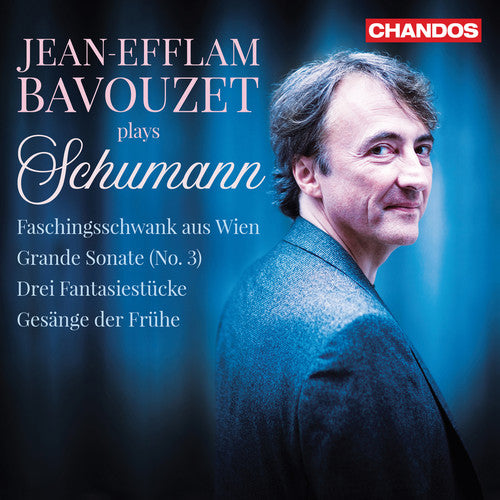
ChandosBavouzet Plays Schumann
Following his recent acclaimed recordings of Haydn and Beethoven Sonatas, Jean-Efflam Bavouzet turns from the Classical to the Romantic era, and the...
$21.99February 01, 2019 -


-


-
 {# optional: put hover video/second image here positioned absolute; inset:0 #}
Chandos
{# optional: put hover video/second image here positioned absolute; inset:0 #}
ChandosWagner - Arr. Henk De Vlieger: Parsifal - An Orchestral Quest / Jarvi, Royal Scottish National Orchestra
This is a hybrid Super Audio CD playable on both regular and Super Audio CD players. Neeme Jarvi conducts the Royal Scottish...
$21.99May 25, 2010 -


-


-
 {# optional: put hover video/second image here positioned absolute; inset:0 #}
Chandos
{# optional: put hover video/second image here positioned absolute; inset:0 #}
ChandosProkofiev: Complete Works for Violin / Ehnes
This two-CD set offers all the works that Prokofiev wrote for the violin as solo instrument. One of the most sought-after and...
$43.99September 24, 2013 -


-


-
 {# optional: put hover video/second image here positioned absolute; inset:0 #}
Chandos
{# optional: put hover video/second image here positioned absolute; inset:0 #}
ChandosThe Film Music of Bernard Herrmann - Citizen Kane & Hangover Square / Gamba
Chandos once again notch up a lavish production in every single aspect. This is a very generously timed and magnificently performed and...
$21.99February 23, 2010 -


-


-
 {# optional: put hover video/second image here positioned absolute; inset:0 #}
Chandos
{# optional: put hover video/second image here positioned absolute; inset:0 #}
ChandosRachmaninoff: Moments Musicaux, Etudes-tableaux, Variations on a Theme of Corelli / Wang
A disc of exceptional quality. 3620242.aa_Conversation_Pianist_Xiayin_Wang.html RACHMANINOFF Moments musicaux. Etudes-tableaux, op. 33. Variations on a Theme of Corelli • Xiayin Wang (pn)...
$21.99June 26, 2012 -


-


-
 {# optional: put hover video/second image here positioned absolute; inset:0 #}
Chandos
{# optional: put hover video/second image here positioned absolute; inset:0 #}
ChandosThe Film Music Of Constant Lambert, Lord Berners / Gamba
A generous selection of largely unknown film music done with conviction and style. This is the first in the Chandos film music...
$21.99May 27, 2008 -


-


-
 {# optional: put hover video/second image here positioned absolute; inset:0 #}
Chandos
{# optional: put hover video/second image here positioned absolute; inset:0 #}
ChandosBeethoven: Complete String Quartets / Borodin Quartet
Chandos is proud to present the complete series of Beethoven String Quartets performed by the legendary Borodin String Quartet. The quartets which...
$54.99October 27, 2009 -


-


-
 {# optional: put hover video/second image here positioned absolute; inset:0 #}
Chandos
{# optional: put hover video/second image here positioned absolute; inset:0 #}
ChandosLe Divin Arcadelt: Candlemas In Renaissance Rome / Musica Contexta
With excellent performances and a fine recording this comes with a warm stamp of approval. Chandos’ recordings of Palestrina’s Music for Maundy...
$21.99May 31, 2011 -

-

-
 {# optional: put hover video/second image here positioned absolute; inset:0 #}
Chandos
{# optional: put hover video/second image here positioned absolute; inset:0 #}
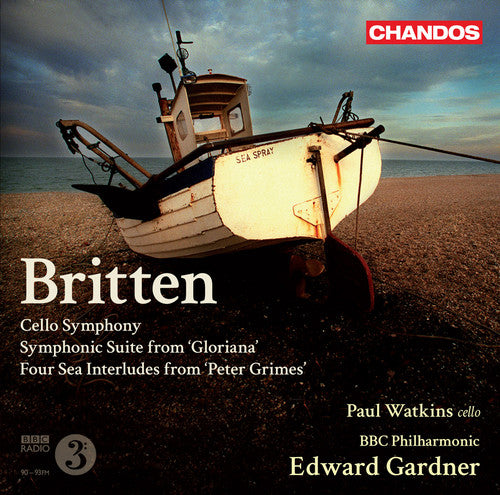
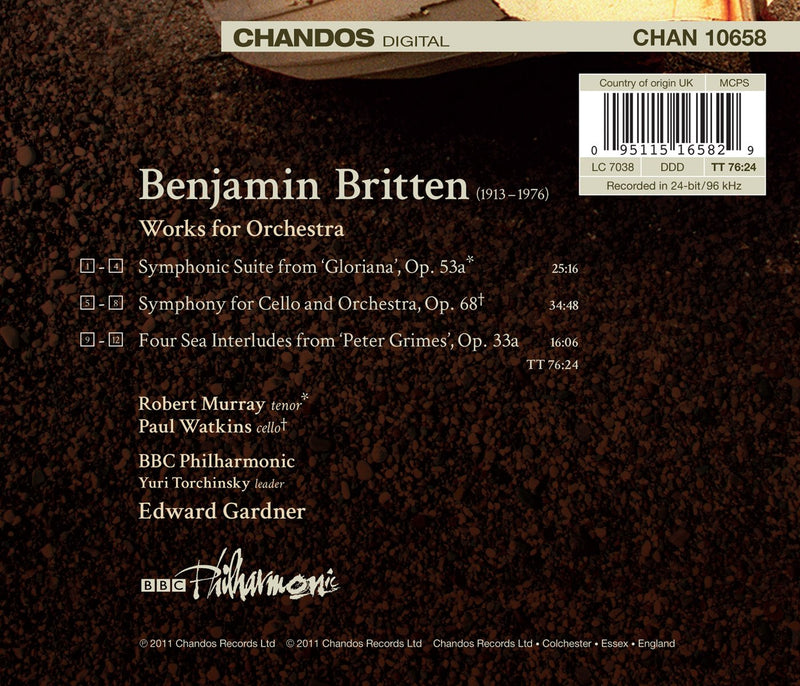
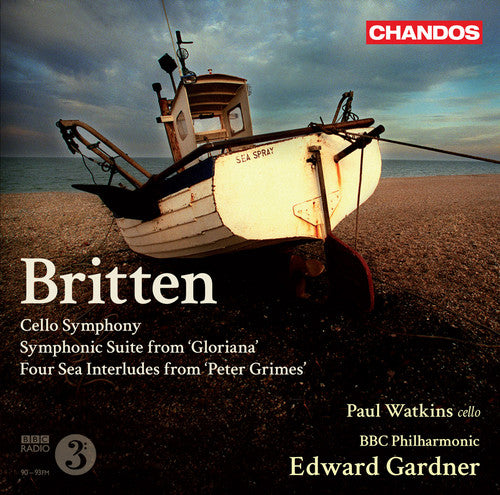
ChandosBritten: Cello Symphony; Symphonic Suite From Gloriana; Four Sea Interludes From Peter Grimes
These are outstanding performances, as good or better than the composer's own. Edward Gardner tears into the Four Sea Interludes with uninhibited...
$21.99March 29, 2011


Bartók: Divertimento; Janácek: Idyll, Suite For Strings
American Record Guide (7-8/00, p.86) - "...[T]he Chandos sound gives the strings plenty of body and a strong edge (partly the conductor's doing, of course) and color...it's rich and still incisive, and it puts the music across....[T]his disc is well worth hearing and owning."
 {# optional: put hover video/second image here positioned absolute; inset:0 #}


Weber: Clarinet Concertos 1 & 2, Concertinos / Collins, Stirling, City Of London Sinfonia
The two concertos and the concertino for clarinet and orchestra are considered among the repertoire cornerstones for today’s clarinettists. Weber wrote the works for his personal friend Heinrich Bärmann, the principal clarinettist of the Munich court orchestra, whose own embellishments of the works (changes of articulation, extra grace notes, and even an added accompanied cadenza in the first concerto) have been incorporated in the performances recorded here. Michael Collins suggests that these changes ‘do not make the music any easier to play, but they do make it more thrilling’.
Each of the works displays a well-balanced mix of virtuosity, daring, humour, and sheer beauty, and throughout, the role of the orchestra is much more than a mere accompaniment. The woodwind solos, a trio of horns, blaring trumpets, and dashing violins contribute greatly to making these works so captivating.
Written in 1806, when Weber was just nineteen years old, the virtuosic Horn Concertino pushed known horn techniques to new limits, requiring the soloist among other feats to produce a ‘four-note chord’, the technique known as multiphonics. The work is today considered a gem in the horn repertoire, and our soloist, Stephen Stirling, is ‘a player gifted with the utmost sensitivity and imagination, which is shown through the beautiful way he shapes musical phrases and the extraordinary range of colours he employs’ – in the words of the late Richard Hickox.
 {# optional: put hover video/second image here positioned absolute; inset:0 #}


Parry: Orchestral & Choral Works / Jarvi, BBC NO of Wales

One of the most important Parry issues for many years, this is a credit to all the performers, not least the warmly committed conductor, Neeme Järvi, drawing the whole ensemble together.
– Gramophone [12/2012]
-----
A moving tribute to one of Britain great composers.
When I showed this CD to a friend they responded by suggesting that it would be right up my street. Unfortunately, this comment was barbed. ‘My street’ in this case meant ‘over-blown’ ceremonial music of the kind that uncritically lauded Empire, glorified war and insisted that the ‘rich man [was] in his castle, The poor man at his gate’. Before the reader runs off with the idea that I am politically slightly to the right of Sir Oswald Mosley, I wish to make three comments. Firstly, Parry and Elgar were men of their time so their choice of poems to set and ideas to compose were different to someone living in the post-Colonial, ‘liberal’ and cosmopolitan society of the early part of the 21 st century. Secondly, not all ‘ceremonial’ music is bad. For example, while I have never been a fan of Elgar’s The Crown of India, I do love Walton’s coronation marches. By definition, this style of music tends to celebrate the life and times of the Royal Family or matters of ‘state’. However, it need not be ‘tub-thumping’ or ‘jingoistic’. Often it can be reflective and contain profound thoughts on mankind’s adventure. One need only consider the ‘Cortege’ by Cecil Coles - ideal for Remembrance Sunday yet full of the ‘horror of war’.
Thirdly, there is a tendency to present Parry as a caricature of a ‘Tory’ squire who was into all the trappings of the feudal society. Nothing could be further from the truth. This is not the place to analyse the composer’s political or moral views, however it is fair to say that he was liberal - possibly even a ‘radical’. His religious views were typically agnostic in spite of Delius’ suggestion that if he lived long enough he would have set the entire Bible! H.R.H. Charles, Prince of Wales has noted in his introduction to the CD liner-notes that Parry, in spite of his ‘hugely energetic personality’ revealed a ‘nervous, melancholy, even depressive temperament which infuses the inspiring and noble sentiment of much of his music with a darker, complex hue.’
The listener to this CD will be surprised. In spite of the cover photograph of a grand royal procession, much of this music is introverted and deeply moving. Some of it may have been written to celebrate national or royal events - but all of it has a thoughtful disposition. There is nothing here for the ‘jingoist’ expects possibly the Prom favourite Jerusalem. However, this hymn setting has been accepted by people of all political persuasions and none as a great national treasure.
A good place to start is the setting of John O’ Gaunt’s verse England. This song has occasionally been mentioned in the same breath as the well-known Jerusalem yet they could not be more different in their musical nature.
The story goes that after the success of the Blake setting, Gilbert Murray, the classicist and Ernest Walker, the composer, asked Parry to make a setting of John O’ Gaunt’s famous monologue from Act II of Shakespeare’s play Richard II. (This royal throne of Kings, this sceptred island). There is nothing bombastic about this beautiful unison song. If anything it is undemonstrative and reflective, with a greater emphasis being on the final words ‘Grant, Lord, that England … May be renown’d through all recorded ages / For Christian service and true Chivalry’. Jeremy Dibble has noted that England is about more than just flying the flag - ‘its rousing tune expresses a sense of vision, self-sacrifice and hope, typical of Parry’s own outlook.’
Jerusalem is given a largely thoughtful performance here. This song, beloved by the vast majority of the nation, is usually heard in the opulent Elgar orchestration. The original Parry song has slightly fewer grand aspirations. The composer suggested that the first verse ought to be sung by a soprano solo with the second sung by ‘all available voices’. Formerly composed as a ‘choral song’ with only a piano accompaniment, Parry orchestrated it right at the end of his life for a Suffrage Demonstration Concert on 13 March 1918 at the Queen’s Hall. My only complaint is the excessive length of the final word (Land) sung by the choir. This is at variance with my score of the work.
The nation collectively heard the Wedding March from Parry’s incidental music to the Greek comedy, The Birds by Aristophanes at the wedding of the Duke and Duchess of Cambridge; it was played just before the arrival of Her Majesty the Queen. For Parry enthusiasts this extract had been available on Lyrita featuring Sir Adrian Boult and the London Philharmonic Orchestra. As far as I know, until now there has been no recording of the entire score. The present performing edition has been prepared for performance by Philip Brookes.
The Birds was produced by the Cambridge University Amateur Dramatic Club in November 1893. Jeremy Dibble has suggested that this music is full of ‘humour and light-heartedness’ and notes that the score is ‘rich in artifice and invention’. I enjoyed it. I guess that knowledge of the Aristophanes play may be of some help to listeners but all these numbers stand well on their own account. I was especially attracted to the gentle Entr’acte, the cheeky waltz, and the beautiful Intermezzo. All these display Parry’s skills at musical design and orchestration at their best.
The piece that gave my friend the greatest cause for concern about political correctness was the short ode entitled The Glories of Blood and State. He must have imagined Parry indulging in some idealist ‘Brooke-ian’ ‘pro patria mori’ sentiment. Nothing could be further from the truth. This is an early work dating from 1883, written some three years after the composer broke the mould of dissipation in English music with his Wagnerian cantata Prometheus Unbound. This ground-breaking work probably does not represent the ‘renaissance’ of British music - just the realisation that it was equal to the German hegemony. The present work is a setting of a poem by the English author James Shirley (1596-1666). Charles Lamb summed up this writer’s career with ‘[he] claims a place among the worthies of this period, not so much for any transcendent genius in himself, as that he was the last of a great race, all of whom spoke nearly the same language and had a set of moral feelings and notions in common.’ The funeral dirge from his play ‘The Contention of Ajax and Ulysses’ was regarded as a meditation on the fact that death is a leveller - kings and peasants are subject to the same laws of nature - ‘There is no armour against fate.’ The exposition of the music is excellent. There is a Brahmsian feel to this music that reflects Parry’s love of the Deutsches Requiem: Wagner’s ghost has (almost) been laid to rest. Perhaps anyone still worried about Parry and his ‘tub-thumping’ should meditate on the last line of the poem - ‘Only the actions of the just/Smell sweet, and blossom in their dust’.
Sir Henry Wood wrote in his fascinating My Life of Music (1938) that ‘one work we produced I thought was going to live - Parry’s Magnificat - but it has now dropped out of the concert repertoire. I have never been able to understand why’. It is a sentiment with which I strongly concur: I believe that the Magnificat is a masterpiece. It was composed for the 1897 Three Choirs Festival and was duly performed there on 15 September. It has one primary exemplar: Bach’s Magnificat of 1732-35; however, the listener will feel that much of the strength of this music is similar to the massive contrapuntal constructions of Blest Pair of Sirens which was completed ten years earlier. They may also consider that there are hints of Brahms. The work is conceived in five sections: the first and last being composed for soprano, chorus and orchestra, the second and fourth for soloists alone with the middle section being composed for chorus.
The listener will find this setting extremely satisfying for Parry has managed to balance his forces in a near-perfect manner. The ‘aggressive’ parts of the text are balanced with exquisite introspective moments. Lyrical music is counterpoised with ‘contrapuntal fertility and rich choral textures’. Some of the soprano soloist’s music is reminiscent of Brahms’ German Requiem and certain passages have more of an operatic, rather than a liturgical, mood to them.
It is interesting that Parry drew the text from the Vulgate Latin Bible rather than use an English translation such as the Book of Common Prayer. It would be instructive to know why. After the first performance, Parry dedicated the work to Queen Victoria.
In 1911, Hubert Parry was commissioned to compose a liturgical Te Deum for the Coronation of King George V. This was in addition to the well-known anthem I was Glad. This work displays the ‘pageantry, ceremony and grandeur’ of an important national occasion. This mood was reinforced by the use of the same six trumpets that were required for the anthem. Yet throughout, a more serious note is struck: tenderness and solemnity are never far away. Parry seems to be well-aware of the more profound and numinous qualities of the Coronation Service. He weaves the well-known tunes St Anne and Old 100 th into the texture. This is now a ‘concert’ piece: I do not believe that it could be used in the context of a religious ceremony - no matter how ‘high.’ It is worthy and I find it both exhilarating and moving.
The CD is an ideal production. From the highly imaginative and packed programme eloquently communicated through superb performances. The sound quality is excellent. The liner-notes are exemplary, however that is only to be expected from the champion of Parry and Stanford, Professor Jeremy Dibble of Durham University.
When I look at the catalogue of Parry’s music and encounter works like the great Fourth Symphony, the delightful evocation of childhood in the Shulbrede Tunes and the celebration of the composer’s yacht in the ‘Wanderer’ Fantasia and Fugue for organ, I see a composer, who, far from revelling in any false ‘my country right or wrong’ attitude was a thoughtful man: The Prince of Wales notes that he took ‘a wide interest in politics, the Arts, science and the most current philosophical discussion of his time…’ Parry was a complex character: this complexity is revealed in this CD.
Finally, my friend was wrong. This is not a CD of ‘jingoistic’ music: there is no sense of ‘tub-thumping’ or what current-day political correctness would find abhorrent. It stand as a moving tribute to one of Britain great composers. It is good that we are now beginning to appreciate that fact again.
-- John France , MusicWeb International
 {# optional: put hover video/second image here positioned absolute; inset:0 #}


Nobuya Sugawa Plays Yoshimatsu, Honda, Ibert, Larsson / Sado, Bbc Po, Et Al
The present release is very nicely programmed, starting with two premiere recordings of works written for him by fellow countrymen, and concluding with two repertoire pieces with strong links.
The two familiar works were written within a year of each other and both come from that heady 1930s period of Stravinskian neo-classicism. Both were commissioned by Sigurd Rascher and both featured in the repertory of the influential French teacher and pioneer Marcel Mule. There are textural and rhythmic similarities but both have their own stamp of individuality. The Ibert is actually for soprano sax and 11 instruments, giving it a transparent, occasionally jazz-like feel. It’s a short, engagingly colourful work typical of its composer, and it’s no surprise that it crops up many times in competitions and student practical exams. The dreamy central larghetto is memorable, especially given Sugawa’s honeyed tone and supple phrasing.
The Larsson Concerto has a bit more backbone and sinew, though still only accompanied by string orchestra. The spirit of France hovers again here, with a Poulenc-like first subject and a motoric allegro scherzando finale that is thrillingly played by all here. It’s a slightly more serious work, but still full of life, vigour and contrast.
The two other concertos maybe of more interest to the curious and both explore the familiar traits of the instrument as well as taking it to further boundaries. In the booklet note written by the respective composers, fellow-saxophonist Honda writes that he was ‘entrusted with the task of writing a concerto that would represent a tribute to jazz…’vent’ is the French word for wind, so please think of the Concerto du vent as a Concerto of the wind’. It does have a pleasingly ‘open air’ quality to the melodic line, with Sugawa given plenty of opportunity to play ‘around’ the phrase – not strictly improvising but using portamento and blue note phrases to embellish the chords in a jazzy fashion. It works quite well, linking nicely with the older pieces, and is again given stunning advocacy, but I’m not quite sure Honda knows what sort of piece this is, so maybe we don’t. It’s certainly undemanding listening and doesn’t particularly outstay its welcome.
Sugawa has collaborated with Yoshimatsu before on the 1994 Cyber Bird Concerto, and Chandos continue their championing of this composer with this latest premiere. Using once again soprano sax, this strikes me as an eclectic work, having a moody, post-Takemitsu Impressionistic first movement - which clearly suits this instrument’s timbral character - some wilder, Berio-like improvisatory shrieks around 3:45 and 7:50 into track 2 before going off into some fairly predictable blues/ jazz doodlings around 6:05 –a homage to Brubeck’s ‘Take Five’? – before dissolving into Garbarek territory towards the end. Again, it cleverly explores the instrument’s unique and versatile sonorities without being especially memorable or groundbreaking; in fact, at times we seem to be in a world of background mood music, but it is superbly performed and recorded.
Altogether, an interesting survey that will be welcomed by those with a liking for this sort of repertoire.
-- Tony Haywood, MusicWeb International
 {# optional: put hover video/second image here positioned absolute; inset:0 #}

Don Lusher Big Band (The)
 {# optional: put hover video/second image here positioned absolute; inset:0 #}


Piano Works by the Mighty Handful / Fisher
- The Guardian, London
On his first solo recital disc for Chandos, Philip Edward Fisher performs piano works by members of the so-called ‘Mighty Handful’, a group of five Russian composers – César Cui, Alexander Borodin, Mily Balakirev, Modest Mussorgsky, and Nikolay Rimsky-Korsakov – who in the 1860s banded together in an attempt to create a truly national school of Russian music, free of the perceived stifling influences of Italian opera, German lieder, and other western European forms.
The Mighty Handful were all self-trained amateurs. Borodin combined composing with a career in chemistry; Rimsky-Korsakov was a naval officer; and Mussorgsky had been in the Guards, then in the civil service, before taking up music. They tried to incorporate in their music what they heard in village songs, in Cossack dances, in church chants, and the tolling of church bells; in short, the music of the Mighty Handful was brimming with sounds that echoed Russian life. From the more traditional, Chopin-esque Nocturne by Cui through to the technical innovations and strong Caucasus folk elements of Balakirev’s Islamey, the works here all show the composers’ strong connections with the past and the compositional innovations that would come to influence the likes of Prokofiev and Stravinsky, and help change the course of Russian music for years to come.
A graduate of the Royal Academy of Music and The Juilliard School, the pianist Philip Edward Fisher is widely recognised as a unique performer of refined style and exceptional versatility. He has performed across Europe, Africa, and North America where he made his New York debut at Alice Tully Hall in 2002, performing Rachmaninoff’s Third Piano Concerto, and has also appeared at the Merkin Concert Hall and the Avery Fisher Hall at Lincoln Center.
At home he has given performances at the Purcell Room, Wigmore Hall, Barbican Centre, and Royal Festival Hall in London, Usher Hall in Edinburgh, Glasgow Royal Concert Hall, and Symphony Hall in Birmingham. He has appeared as a soloist with the Royal Scottish National Orchestra, Copenhagen Philharmonic Orchestra, Toledo Symphony Orchestra, and Juilliard Symphony Orchestra, and worked with performers such as exclusive Chandos artist bassoonist Karen Geoghegan, the tenor Robert White, pianist Sara Buechner, and violinists Elmar Oliveira, Philippe Graffin, and Augustin Hadelich. In 2001, Philip Edward Fisher received the Julius Isserlis Award from The Royal Philharmonic Society in London. - Chandos
 {# optional: put hover video/second image here positioned absolute; inset:0 #}


Bavouzet Plays Schumann
 {# optional: put hover video/second image here positioned absolute; inset:0 #}


Wagner - Arr. Henk De Vlieger: Parsifal - An Orchestral Quest / Jarvi, Royal Scottish National Orchestra
Neeme Jarvi conducts the Royal Scottish National Orchestra in the second of four albums featuring the bold arrangements of Wagner by Henk de Vlieger. Of the first album, Classic FM magazine wrote ‘Dutch composer Henk de Vlieger builds a penetrating symphonic poem that reflects the dramatic depths of The Ring.’
In Parsifal, an orchestral quest, commissioned by the Netherland Radio Philharmonic Orchestra and dedicated to the musicians of this orchestra, Henk de Vlieger has compiled the musical and emotional highlights of Wagner’s opera, and whenever necessary he has stitched these into a new context. Thus De Vlieger retells the story of Parsifal with Wagner’s music. In order to do so he has kept the symmetry in the opera: 1. Vorspiel, 2 Parsifal, 3. Die Gralsritter I, 4. Die Blumennadchen, 5. Karfreitagszauber, 6. Die Gralsritter II, 7. Naschspiel.
This arrangement is coupled with Wagner’s arrangements of Overture and Venusberg Ballet Scene from Tannhauser and the concert version of Prelude to Act III of Lohengrin.
Chandos releases this album is surround-sound hybrid SACD to maximise the audio quality of the performance.
 {# optional: put hover video/second image here positioned absolute; inset:0 #}


Prokofiev: Complete Works for Violin / Ehnes
Reviews
Orchestral Choice "... James Ehnes’s particular combination of matchless virtuosity, sweet tone, flowing tempi and interpretative restraint suits all this music down to the ground... the contribution of the BBC Philharmonic is distinguished throughout ... Strongly recommended." David Gutman - Gramophone magazine - October 2013
“Wow. Everything works here. James Ehnes rarely disappoints, and the playing on this beautifully recorded two-disc set is immaculate. It’s not just the musicality, the remarkable ability to give shape and colour to the thorniest solo writing, but his modesty – he’s a player who knows exactly when to step back and let collaborators take the spotlight… Unmissable.” Graham Rickson – theartsdesk.com – 28 September 2013
"... Ehnes and his pianist give performances worthy of the giants (Oistrakh and Richter) for whom their parts were conceived." Hugh Canning - The Sunday Times - 8 September 2013
Classical CD of the Week "... Ehnes is joined by Amy Schwartz Moretti for an electrifying performance of the duo sonata... In their mix of lyricism and sharpe-edged rhythmic and harmonic piquancy. Ehnes and Moretti are absolutely spot on in defining the music’s character. This is playing that truly grabs you by the scruff of the neck and commands attention... For the two concertos Ehnes teams up again with an orchestra and conductor he knows well - the BBC Philharmonic and Gianandrea Noseda - who yield apt, complimentary shades of colouring, both brilliant and pungent, to match Ehnes’s superb artistry." ***** Geoffrey Norris - The Daily Telegraph - 28 September 2013
"... the sound is terrific, and given the excellence of the performance throughout, and the convenience of having all of these works ’under one roof’. as it were, there’s no reason to put off acquiring this set..." Raymond S Tuttle - International Record Review - October 2013
"... Prokofiev wrote tuneful music, rich and rhythmic, and James Ehnes is outstanding in bringing this attractive music to life." Peter Spaull - Liverpool Post - 19 September 2013
 {# optional: put hover video/second image here positioned absolute; inset:0 #}


The Film Music of Bernard Herrmann - Citizen Kane & Hangover Square / Gamba
This is a very generously timed and magnificently performed and recorded disc. It’s a red letter event for the Herrmann literature.
The last few years have been exciting ones for Herrmann fans. Sad to say this has not involved a new recording of the opera Wuthering Heights; nor even a reissue of the rather one-dimensional sounding Unicorn Souvenir set (UKCD2050-52). However the following pallet-full is not to be sniffed at. Decca Eloquence (Australia) will reissue Herrmann conducting The Planets with the LPO (1970). Tribute’s Rolls Royce revivals look likely to include a new and typically resplendent Stromberg-Moscow collaboration though no one is saying which score yet. Andrew Rose’s Pristine are resurrecting what I fervently hope will be the first of a series of radio acetate transcriptions of Herrmann’s CBS Symphony Orchestra years. From 1945 they have Handel: Water Music Suite (arr. Harty); Vaughan Williams Oboe Concerto and Elgar Falstaff caught on Sunday 9 September 1945 PASC202. From the Prometheus label The Seventh Voyage of Sinbad is conducted by “Kurt Graunke and his orchestra” in 1958. It’s a 2 CD issue with the complete original score in mono mixed with the album stereo cues and the original soundtrack album. By report it’s suspected to be conducted by Herrmann with a pickup orchestra in Shepperton although Kurt Graunke certainly existed. There’s also a rare Twisted Nerve/The Bride Wore Black from Bruce Kimmel’s Kritzerland label. It includes The Twisted Nerve LP and The Bride Wore Black 45 rpm on CD – rare items both. The CD runs 28 minutes and is limited to 1200 copies. Now if only Varese-Sarabande could be persuaded to issue a boxed set of their often inspired RSNO/McNeely/Debney re-recordings of scores such as Marnie, Sinbad, Trouble With Harry, Vertigo and The Day The Earth Stood Still. Perhaps Eloquence will follow up their Planets with a reissue of the three Phase Four Film Spectaculars that Herrmann made with the National Phil in the 1970s.
The present Chandos issue is a compelling purchase for Herrmann fans and even for neophytes. It’s recorded with aching clarity and the music-making has a vibrant feel for the idiom. That’s typical of Gamba who taps direct into the fleshy, decaying, sinister, nocturnal, romantic milieu that bridges these two scores.
In much the same way as Chandos and Gamba have made their two Korngold discs compulsory acquisitions so the Herrmann constituency will have to have this one. It’s the first revival of the Hangover Square music as arranged by Stephen Hogger. You may know his name already as he has done so much work for the RVW film score revivals on Chandos. I know about the 1972 revival of Concerto Macabre by Joaquin Achucarro on that iconic Herrmann RCA Classic Film Scores collection (now available from Archiv Music). Others, apart from Achucarro, also recorded the Concerto as part of various film music piano concerto medleys. The Concerto appears here in a new edition which we are told incorporates the composer’s revisions for concert performance. It’s a Lisztian effusion from the same left-field as Totentanz but blended with the lichen and fog so gloriously typical of Herrmann. The marriage of Herrmann’s music-melodrama with the Laird Cregar/Linda Darnell film is made in heaven – or possibly somewhere hotter. In any event it’s a totally apt alliance and the music rewards attention. If the Concerto and the Hogger sequence overlap the listener will not feel cheated. It’s all classic Herrmann and you are hearing music not heard before or at least not in this form. Even in the film music sequence the piano plays a prominent part rather as it does in Rachmaninov’s Symphonic Dances.
Citizen Kane was Herrmann’s first cinema partnership with Orson Welles. It’s a revered film with many starkly imaginative images which are intensified by Herrmann’s music. The extended score here is way beyond the compact suite featured on the RCA Classic series as master-minded by Charles Gerhardt/George Korngold. It has been recorded before, though not with such Manchester immediacy and allure, by Label X/Prometheus and by Varese-Sarabande (RSNO/McNeely).
The score is very varied. Wild frilly frivolous galops - not a stone’s throw from Offenbach - jostle with romps glaring with Prokofiev-like psychological subtext. Music of piercing regret is heard alongside Romeo and Juliet-inflected (could Herrmann have known the ballet at that time?) poignancy. As illustration take the irresistibly gentle Kane Meets Susan (tr. 8). There’s even some Weill-style sleaze (tr. 11). There’s also that grand operatic aria (complete with full words and translation in the booklet) in which Orla Boylan delivers the goods in a way that Kane’s poor Susan never could. That aria transcends the cod-Grand Siècle idiom and has one wishing that Herrmann had had the luxury of time to write a full opera in this unblushing uber-Lakmé toxic-exotic idiom. It’s clearly the sort of flamboyance that might have featured in Act I of Phantom of the Opera. Boylan puts up a completely credible and ripely enjoyable challenge to the young and unspoilt Kiri Te Kanawa in the aria as recorded by Gerhardt back in 1972.
Chandos once again notch up a lavish production in every single aspect.
-- Rob Barnett, MusicWeb International
Hopefully this will be the first disc in an extended Herrmann project--even if the results aren't quite perfect, they're still very fine. Citizen Kane has been recorded several times, of course, most notably by Joel McNeely and the Scottish National Orchestra (O/P), but this edition gives us basically all of the same music (it runs for nearly fifty minutes), very well played, and in excellent sound. In the fake aria, Orla Boylan is no match for Kiri Te Kanawa on Charles Gerhardt's sumptuous Herrmann collection, but otherwise there's very little to take issue with here.
While Herrmann fans will be delighted to have an extended chunk of his music from "film noir" Hangover Square (some 18 minutes' worth), it would be idle to pretend that the bits that he did not use to create the Concerto Macabre represent him at his best. The music is mostly dark, lugubrious, muted, and obstinately unmemorable (after the flashy opening), nor do the various brief cues string together all that convincingly for continuous listening. The Concerto, though, is definitely entertaining, and very well performed by Martin Roscoe. It will be fun to see how this series (if it is one) develops.
--David Hurwitz, ClassicsToday.com
 {# optional: put hover video/second image here positioned absolute; inset:0 #}


Rachmaninoff: Moments Musicaux, Etudes-tableaux, Variations on a Theme of Corelli / Wang
RACHMANINOFF Moments musicaux. Etudes-tableaux, op. 33. Variations on a Theme of Corelli • Xiayin Wang (pn) • CHANDOS CHAN10724 (69:18)
When I reviewed Xiayin Wang’s solo debut for Marquis ( Fanfare 31: 3), I praised her “youthful confidence.” It was, I continued, “not arrogance, not self-importance, not haughtiness”; rather, it was “a sense of poise that gives [her performances] unpretentious clarity.” It will be no surprise to anyone who has been following her career (capped, so far, by her widely celebrated Wild collection on Chandos, 34:5) that five years later her playing has become, if anything, even more assured.
What’s most arresting is her range of color and mood. Try, for instance, holding the supple melancholy of the first of the Moments (dissolving in soft raindrops of color at the end) up against the implacable solidity of the last of the Moments . In a blind listening test, you’d be hard-pressed to guess you were listening to a single pianist. Likewise, her prismatic Corelli Variations highlights the music’s mercurial shifts rather than its structural rigor. Yes, there is a certain consistency here: The technique is solid (listen to the evenness of the 16th-note triplets in the second Moment ), but never self-aggrandizing; the textures are always lucid, but never glaring in their clarity; the lyrical effusions are sumptuous, but never gushing; the rhythms are elastic, but never slack (try the climax of the G-Minor Etude-tableau ). But while that description might seem to imply a certain moderation (certainly, she is not a pianist who revels in excess), her composure is not allied to any sense of inhibition. I suggested in the earlier review that hers is the kind of discipline that leads to freedom, rather than restriction—and in the end, it’s the responsiveness, not the temperance, that most marks this recital. The soaring lines of op. 33/2; the delicious wit of the third of the Corelli Variations, which throws you dexterously off balance; the exuberance of the 20th variation; the inward pain of the third of the Moments ; the hard-bitten steeliness of the last of the Etudes-tableaux : From first note to last, Wang offers up playing of kaleidoscopic imagination.
To put it simply, this is one of the most engaging Rachmaninoff solo collections to come my way in years—equally recommendable to seasoned pianophiles and to those just beginning to explore Rachmaninoff’s output. Even without Chandos’s excellent engineering, this would be a top priority.
FANFARE: Peter J. Rabinowitz
Pianist Xiayin Wang’s previous outing for Chandos so impressed me I made it one of my 2011 discs of the year. No surprise therefore that I should be looking forward to another disc from the same creative and technical team and a pleasure to report that all my hopes and expectations are fulfilled. This new offering is a superb disc on every front; well-programmed, excellent engineering and production values all backing up piano playing and music-making of stellar quality.
From the very first listen it was clear that this was a very good disc indeed but its exceptional quality impinged on me with each repeated hearing. This is because Wang does everything so very very well that at first the sheer technique and musicianlyness of her playing slips you by. There are many valid approaches to Rachmaninoff’s glorious keyboard music and although Wang embraces the grand and rhetorical passages to full effect her great strength is not to overstate the big gestures or beat her instrument into submission. She wears her phenomenal technique with such unassuming ease that is only when you compare her playing to other major international artists you realise that where they bluster and fudge she is all clarity and layered control. Time and again throughout the programme this is clear but take one simple example – the E minor Presto movement, the 4 th of the Op.16 Moments Musicaux. This is a fascinating and transitional set with the twenty-three year old Rachmaninoff beginning to create a sound world uniquely his own. He moves from music of a – albeit sophisticated – salon nature to passages that presage the brooding dark-hued tone paintings of his maturity. This Presto is a surging, stormy showpiece with streams of running figurations over which the melody heroically sings. Wang is totally at ease with the subtle ebb and flow this music requires but the real brilliance is in the clarity of the inner lines with every note perfectly etched, balanced and articulate. I have a not wholly rational attachment to Michael Ponti’s traversal of the complete Rachmaninoff piano works from their Vox-Turnabout LP days. I still enjoy the sheer drama of his playing but he sounds musically generalised and technically challenged in ways that Wang brushes away. Even such formidable players as Dmitri Aleexev on Virgin wrestle with the complexity of Rachmaninoff’s unforgiving writing. Taken together this Op.16 set is substantial running to nearly half an hour’s music. Wang gives the most convincing performance of this highly enjoyable set that I have ever heard.
Praise at this point too for the programme playing. Presenting three significant works (or sets) which span nearly forty years of the composer’s life in chronological order does give the listener a fascinating sense of the creative arc from salon-pictorial to cerebral abstraction via the high romance of the Études-tableaux Op.33. David Nice in his liner note is predictably insightful on both musical and psychological levels. By title alone this Op.33 set of eight pieces – although numbered up to nine, number four was removed and reworked as number six of the companion Op.39 set – would seem to imply some kind of pictures in sound. Rachmaninoff’s progression as a composer is evidenced in the way this shorter cycle – just twenty three or so minutes in Wang’s performance – feels like a substantially ‘bigger’ work than the discursive Moments musicaux. Wang has power to spare but the real pleasure to be had here again is in the beauty and control of her playing. Take the very opening on the first Étude; the left hand accompaniment is little short of a masterclass in voicing contrasting lines from stomping strong beats to brightly bouncing ‘off’ beats supporting a long-breathed lyrical melody. Counter melodies and subtleties of the contrapuntal writing emerge as rarely before but without any sense of clinical dissection. Competition here is of course even stronger than in the slightly rarer early cycle and to single out any performance as the best of all seems both foolish and pointless. Suffice to say Wang takes her rightful place in the very highest echelons of excellence. Possibly, just possibly, I might choose to turn to performances longer on sheer theatrical splendour but that is my own personal taste.
All of the qualities previously mentioned are of particular value in the relatively late Variations on as theme of Corelli Op.42. The great stock-pot of Rachmaninoff’s inspiration has been reducing down ever further the sheer fecundity of his writing. The composer might have apologised to an early listener that “when I sit down to write, it does not come to me as easily … as in former years” but what we have instead is writing pared back to emotional and musical essentials. Performing time is further condensed to the sub-eighteen minute mark. Yet into this Rachmaninoff crams a theme, some nineteen variations, an Intermezzo and a Coda. With the longest – Variation XV – just managing to scrape past the minute and a half point, this is Rachmaninoff at his tersest yet still with a remarkable range of keyboard colour and emotion. The brevity, however, is why they have never gained the popularity his longer more verbose, sometimes indulgent works have. Again Wang is a remarkable guide. Rather than fragmentary, the through line of groups of variations are brilliantly defined and the range of expression from surging Variation VII to water-colour miniaturist of Variation IX is encompassed without contrivance or artifice. Credit to the piano – a Steinway one assumes since Wang’s biography says she is ‘a Steinway Artist’ - for having an action that allows Wang to articulate the repeated note groups of Variation XIII – another example of her staggeringly clean technique. Super fine though the rest of the disc is, this set of Variations crowns the lot with a rendition where every element of the performance seems near ideal.
As mentioned earlier, the engineering here is very good – the piano is caught with a warm yet clear sound in an ideal acoustic using Chandos’ now standard 24-bit resolution recording techniques. Playing time is generous and the liner informative. For all their comprehensive editions, curiously Chandos have never produced a coherent collection from a single pianist of Rachmaninoff’s solo piano works. I suppose the fact that Hyperion rather stole the march on them by recording house pianist Howard Shelley in just such a cycle means that the project never took wing. In Xiayin Wang they might just have found the player to do justice to it. A disc of exceptional quality.
-- Nick Barnard, MusicWeb International
 {# optional: put hover video/second image here positioned absolute; inset:0 #}


The Film Music Of Constant Lambert, Lord Berners / Gamba
This is the first in the Chandos film music series to have two composers share a single disc. There are compelling reasons for this. It’s necessitated because neither composer wrote enough to be allocated a single disc and the music warrants recording. Also the friendship of the two composers provides the glue if cohesion is necessary. Do not expect the music to be similar though. Berners is zany, harum-scarum, polished yet volatile and welcoming of voices from popular culture. Lambert is the master in this company writing touching and consistently rewarding music for a dispensable genre.
The score for Merchant Seamen represents one aspect of Lambert's war work. The trumpet-emphasised fanfares are as strident and rebellious as those in Horoscope. The score's first movement also has cross-currents from Vaughan Williams despite Lambert’s execration of the cowpat style. After a very moody and Baxian Convoy in Fog with little flurries from Ravel comes a fast and furious Prokofiev-accented storm for Attack. This depicts one of the merchant ships being torpedoed. Safe convoy is perfectly peaceful and in its contented Celtic lull reminds the listener of parts of Bantock’s Hebridean Symphony and, more plausibly, of Malcolm Arnold's Third Scottish Dance - Arnold was a trumpeter in the orchestra when the suite was premiered by them on 15 May 1943. It may even have been a contributor to the inspiration behind Eric Fogg's orchestral miniature Sea-Sheen. The final March goes through the motions but seems empty for Lambert.
Vivien Leigh and Ralph Richardson appeared in the 1948 film of Anna Karenina. This is represented by another five movement score magically recorded by the Chandos team. Far from catching any Russian flavour the first movement sounded a mite like Malcolm Arnold, complete with alcoholic slurs - Lambert was no stranger to the grain. The second movement, Anna and Vronsky's first meeting has links with Vaughan Williams' score for The 49th Parallel. Anna and Vronsky on the Train might well have drawn on his earlier Aubade Heroique; in fact dedicated to RVW on his seventieth birthday. The Seance Scene and Anna's Illness take us back into creaking and aching Bax territory and does so as strongly as in the Convoy in Fog movement. The Anna's Garden movement returns us to the Ravel inflections of Convoy in Fog. The rocking and entrancing rustle of Forlana was later recycled in the Tiresias ballet.
Lord Berners was a very different, brilliant and eccentric creature and the change in the music is something of a crashed gear-change. Mary Carewe deserves an Oscar for her music-hall pin-sharp Come on Algernon from Berner's film score for Champagne Charlie. It's rife with innuendo. Come on Classic FM start playing this track - people will love it. The Polka from the same film score is elegant and full of haute-couture sensibility rather like Barber's Souvenirs suite.
The ten minute suite from Nicholas Nickleby is in a single continuously-played track yet with recognisable episodes. This is more in the nature of a medley yet following the plot sequence. Ravel's La Valse jostles with the Polka of Champagne Charlie. The six movements of Berners' score for Halfway House are much more serious and passionate than the zany Champagne Charlie and Nicholas Nickleby. The Drowning Scene is suitably occluded and dank. Philip Lane's adaptation of the Seance Waltz drifts in a hazed focus between Barber's Souvenirs and Sondheim. This is flouncy music in the grand manner. In the finale there is romance and birdsong. The vocals merge nicely with the other orchestral lines and the piece ends with a technicolour sunrise.
The notes are by Philip Lane and are an exemplar of their type.
The recording throughout is wonderfully palpable yet manages eerieness and the quieter moods with as much conviction as the demonstrative heroism.
This disc is generously full and very few of the tracks are anything less than engaging.
I will keep mentioning the need for a complete Chandos disc of the film music of Brian Easdale – until then enjoy this latest entrant.
-- Rob Barnett, MusicWeb International
 {# optional: put hover video/second image here positioned absolute; inset:0 #}


Beethoven: Complete String Quartets / Borodin Quartet
Chandos is proud to present the complete series of Beethoven String Quartets performed by the legendary Borodin String Quartet. The quartets which contain some the greatest, most enigmatic music ever written, are in the capable hands of one of the world's finest ensembles. The Borodin String Quartet was formed in 1945 in Moscow. Cellist Valentin Berlinsky was with the quartet since its earliest days and violinist Andrei Abramenkov joined in 1974. Igor Naidin learnt the art of quartet playing from several of the Borodins including the Quartet's violinist, Dmitri Shebalin, whom he eventually replaced. Leader Ruben Aharonian won prizes at several international competitions, including the Enescu, Montréal and Tchaikovsky. These artists provide a unique insight to these works. The individual volumes were highly acclaimed by the critics and this praised series is now released as a complete box set, at a competitive price and in attractive packaging. Some reviews of the individual volumes: 'Valentin Berlinsky, cellist and founding member of the quartet in 1945, has been waiting to make this set his whole career, and calls it 'the great dream of my life: to play all Beethoven's quartets from first to last'. A worthwhile dream. Each of the volumes in the set thus far have been invested with palpable love... the playing here is uniformly committed - and a joy.' American Record Guide Vol.3 'This redoubtable Russian group plays with all the powerful, focused tone you'd expect and brings out the entire wealth of Beethoven's colour in these fiery performances.' Classic FM Magazine on Vol.2 'We are given the feeling of a voyage of discovery, and of the players own enjoyment of the music.' Gramophone Vol.4
 {# optional: put hover video/second image here positioned absolute; inset:0 #}


Le Divin Arcadelt: Candlemas In Renaissance Rome / Musica Contexta
Chandos’ recordings of Palestrina’s Music for Maundy Thursday (CHAN 0617), Music for Good Friday (CHAN 0652) and Music for Holy Saturday (CHAN 0679), performed by Musica Contexta directed by Simon Ravens were all described as ‘excellent performances’ in Brian Wilson’s download roundup of April 2009. If you have happened upon any of these releases you will have some idea of what to expect in this programme.
This is described as taking us on ‘a journey of Renaissance Rome on a February day at the end of the sixteenth century [on] Candlemas, the Day of the Purification, [and] at each church along the way we stop and listen to a piece of music.’ There are no special effects involved in this trip, and with no change in the acoustic there isn’t really any idea of different churches – presumably occupied by different choirs. I for one am however prepared to suspend disbelief and become completely absorbed in what is quite a special programme, filled as it is with music which sees its recorded appearance for the first time.
Not a huge amount is known about Jacques Arcadelt, or at least, the booklet notes don’t go into his life in great detail. The central work which threads this programme together is his Missa ‘Ave, Regina caelorum’ which used Andreas de Silva’s motet Ave, Regina caelorum as its basis. The whole sense of historical flow, from de Silva though Arcadelt to Palestrina, who arrived in Rome in the year Arcadelt left to go back to France, is as strong as the sense of flow through an imaginary Candlemas day of music, and the music has a seamless feel of unity and connection, one piece to the other. The warm accompaniments of The English Cornett and Sackbut Ensemble enhance a few of the works, with de Silva’s remarkably spare and modern sounding Inviolata, integra et casta es Maria providing something of a highlight in this regard, a solo female voice rising from among the rounded brass sounds as the contrapuntal lines intertwine through slow moving, sometimes somewhat enigmatic sounding harmonies. The choral richness of the Missa is cleverly dosed throughout the disc, the Agnus Dei delivering a climax which makes the entire journey all the more worthwhile.
Musica Contexta is not a huge vocal ensemble, and while their 12 voices, three to each part, can create a full and convincing choral sonority, the overall impression is one more of rather intimate music making than the grand-scale productions associated with Venice and the later fashions of the high Baroque. The singing is restrained, but by no means shorn of vibrato or expressive warmth, though there is something of a consistency of sound which can make everything sound a bit samey. A little more contrast might have been more inviting, and I have to admit this does sound more like Hampstead Garden Suburb than raunchy renaissance Rome, but this is after all not the kind of music which of its nature promises high drama and extremes of exotic expression. With only two out of 15 tracks not première recordings this is the kind of CD which is self-recommending in its field, and with excellent performances and a fine recording it comes with a warm stamp of approval.
-- Dominy Clements, MusicWeb International
 {# optional: put hover video/second image here positioned absolute; inset:0 #}


Britten: Cello Symphony; Symphonic Suite From Gloriana; Four Sea Interludes From Peter Grimes

These are outstanding performances, as good or better than the composer's own. Edward Gardner tears into the Four Sea Interludes with uninhibited excitement. It's great to hear the high violins and flutes in "Dawn" swooping and soaring like the gulls that they're supposed to be evoking. "Sunday Morning" has an infectious bounce, while "Moonlight" casts a rapt stillness abruptly shattered by perhaps the most vicious storm on disc. It's one of those versions you will listen to and say, "Finally, that's the way it should go!"
The suite from Gloriana is still a comparative rarity, which is a pity, as the music really is first-rate Britten. But then, so is the opera; why anyone cares that it flopped at its premiere is beyond me (the Queen allegedly was not amused, as if her opinion matters). The Lute Song is very nicely sung by Robert Murray, but the version for oboe rather than voice strikes me as more appropriate within the context of the symphonic suite as a whole. Granted, Britten used Peter Pears, but that was an opportunity for him to give his partner something to do while on tour.
Finally, there's the Cello Symphony: a tough, somewhat gnarly work that receives a performance every bit as fine as Britten/Rostropovich, which still remains the benchmark version. Paul Watkins and Gardner somehow make music out of the low, grotty opening, pacing the movement as unerringly as did Britten himself. The finale works its way up to a wonderfully life-affirming conclusion, and Watkins does a wonderful job with the lengthy preceding cadenza. In short, this release is a major entry in the Britten discography, and the sonics are every bit the equal of the interpretations.
--David Hurwitz, ClassicsToday.com
 {# optional: put hover video/second image here positioned absolute; inset:0 #}