Composer: Ernst von Dohnanyi
8 products
Dohnányi: Piano Works (Original Bösendorfer, 1910) / Gülbadamova
Ernst von Dohnányi was interested in various inventions throughout his life, so it is not surprising that around 1909–1910 he became one of the main promoters of pianos with a semi-circular keyboard. At that time, they had long been experimenting with creating the most comfortable keyboard possible, with all its parts being at the same distance from the pianist, and being able to play it with the same body and hand position at the bottom, middle or top of the keyboard range. It seems that the Viennese Ludwig Bösendorfer started making pianos with a concave keyboard (Bogenklaviatur) only in 1910, and Dohnányi used them exclusively in the territory of the Austro-Hungarian Monarchy. After Dohnányi moved home to Budapest at the end of 1915, one of his own pianos was the short Clutsam-Bösendorfer, which is currently owned by the Budapest Museum of Music History. This CD offers the first recording of this special instrument after a long time restoration.
Dohnányi: Symphony No. 2; Songs / Jiménez, Florida State University Symphony Orchestra
Much Ado - Romantic Violin Masterpieces / Danbi Um
Much Ado, the solo debut album by Korean American violinist Danbi Um is as striking for the young musician’s choice of “old world” repertoire as her virtuoso interpretations and the sumptuous sound she draws from her 1683 “ex-Petschek” Nicolo Amati violin. Danbi conjures memories of a musical Golden Age, a sensibility instilled in her by a roster of internationally renowned tutors.
The title track, from Eric Korngold’s Shakespeare-inspired suite, sits alongside arrangements of works by fellow Austro-Germanic composers Fritz Kreisler and Richard Wagner. Hungarian Romani music infuses compositions by Johannes Brahms, Jeno Hubay and Erno Dohnányi, juxtaposed with music by Jewish composers Ernst Bloch, Joseph Achron and Leo Zeitlin.
A multiple award winner – Danbi has taken top prizes at the Yehudi Menuhin and Naumberg International Violin Competitions, and Astral Artists’ Auditions – she has been praised by The Strad as an “utterly dazzling” artist with a “marvelous show of superb technique.” A resident of New York City, Danbi performs regularly with the Chamber Music Society of Lincoln Center, and further afield with the Chamber Orchestra of Philadelphia, Washington D.C.'s Phillips Collection, and the Rockport, Moab, Saratoga Performing Arts and Santa Fe Music Festivals.
REVIEWS:
“Technically assured, passionate, involved playing…there’s always a good feeling for the shape and direction of the melodic lines.”
-- BBC Music Magazine
Dohnanyi, Moór & R. Strauss: Sonatas for Cello & Duplex Piano / Stromberg, Uhlig
With the project "The Duplex Coupler Grand Piano" Florian Uhlig and David Stromberg breathe new life into a forgotten idea. The composer Emanuel Moór, whose works combine wonderful melodies and surprising harmonic twists, developed the "Duplex Coupler Piano" with a double keyboard. The coupled, octavated notes help the works achieve special shades of sound. In the recording of the cello sonatas by Moor, Richard Strauss and Ernst von Dohnanyi by David Stromberg and Florian Uhlig, this unique instrument now comes into focus.
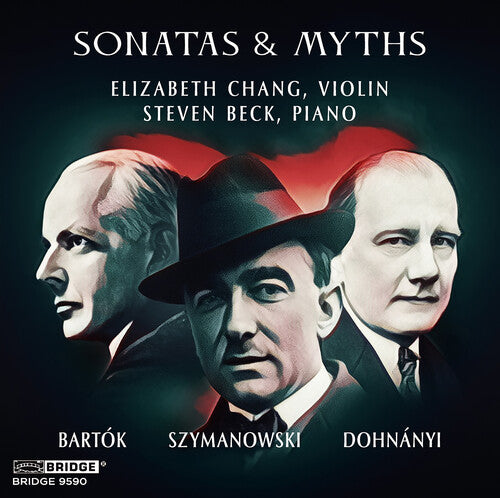
Bartók, Dohnanyi & Szymanowski: Sonatas & Myths / Elizabeth Chang, Beck
This fascinating recital features three works composed during a short period of tremendous upheaval in the world of music. Szymanowski's Mythes: Trois Poèmes, op. 30 was composed in 1915, Dohnányi's Sonata, op. 21 in 1912, and Bartók's Sonata No. 1 in 1920-21. Violinist Elizabeth Chang writes that "the crosscurrents of multiculturalism and the pursuit of a national identity separate from the prevailing Germanic legacy, are topics with searing relevance to the early 21st century. Probing the connections among the densely intertwined web of musicians of this time yields insight into an inflection point in musical history that unleashed the wildly divergent paths that music composition took as the twentieth century unfolded." This recording presents beautifully detailed performances of three important pieces, performed by two leading virtuosi.
Dohnanyi: Symphony No. 1 & Symphonic Minutes / Paternostro, German State Philharmonic Rheinland-Pfalz
The Symphony No. 1 in D minor op. 9 belongs to Dohnányi’s early years of success. Among all the influences of the late Romantic tradition, that by Brahms’ music can be discerned here once more. From it, Dohnányi forms a kind of early Neo-Romanticism that can be viewed as a continuation of the 19th century while avoiding the Expressionist, sprawling violence of the beginnings of Modernism in the 20th century. Reminiscent of Mahler and Strauss is the sovereign treatment of the large orchestra, in which many details stand out, making a major contribution towards the quality of the work. The Symphonic Minutes op. 36 was written in 1933 in the context to compose a Hungarian dance game.
With this release Capriccio started a new Edition with recordings of these still less well-known but powerful music from the hungarian Composer Ernst von Dohnányi.
REVIEWS:
The First Symphony in D minor was composed in 1901 and contains five movements. The first movement is in sonata form. Immediately, one is struck by a lush romantic sound, and interesting harmonies. One certainly can hear the influence of both Brahms and Bruckner here, but Dohnányi’s is very much an individual voice.
The symphony is followed by the five-short-movement Symphonic minutes, Op 36, written thirty odd years later. This work is cheerful, colourful, has a national flavour and colour, and ends the disc in style. The writing is dazzling and virtuosic, and it certainly makes me wish that the composer had written more.
-- Classical Music Daily
I wasn’t prepared for this brilliant reading of Dohnányi’s First Symphony. I haven’t heard the Botstein recording, but comparison with the Bamert results in a toss-up: Paternostro is a bit broader in most movements, but the playing is equally incisive and Capriccio’s recording is wonderfully clear and full, with marginally more audible detail than Chandos gives Bamert. The only clear advantage for Bamert is his more energetic Scherzo, although even here Paternostro’s rhythms are a bit clearer. Solo woodwind work and the brasses altogether are truly distinguished. If you don’t yet have a recording of the Symphonic Minutes, Paternostro scores over Bamert in the choice of fillers; Bamert gives us the American Rhapsody, a less important work from Dohnányi’s last years.
In short, this is a real treat.
-- FanfareBach, Bartók, Kodály, Dohnányi & Liszt: Harmonies Hongroises / Fenyő, Okruashvili
"Throughout the dozen years I spent in Weimar, one great idea kept me in suspense - the renewal of music through a more intimate connection with poetry," wrote Franz Liszt in an 1860 letter to his close piano student Agnes Street-Klindworth (1825-1906). But Liszt's entire artistic life oscillated even more between art and religion, between freedom of expression and the strictness of dogmatic limitations. This artistic credo becomes clear not least in his piano cycle Harmonies poétiques et religieuses p.273. This very varied cycle, which dates back to 1835, combines grand concert pieces (such as Bénédiction de Dieu dans la solitude or Funérailles) with simple and shorter compositions, some of which incorporate Gregorian chants, with reference to a collection of poems by the French poet Alphonse de Lamartine (1790-1869). This cross-section of a poetic-religious artistic life inspired the two musicians on this recording, pianist Julia Okruashvili and cellist László Fenyo, to create this CD Harmonies Hongroises, which combines music by Franz Liszt, born in 1811 in the Kingdom of Hungary, with music by Hungarian composers from the first half of the 20th century.
J.S. Bach, Dohnanyi, Enescu, Francaix & Sibelius: Passion
Three extraordinary musical personalities from several nations meet and let the string trio literature blossom in multi-layered sound and intelligent dialogue. When the Leipzig String Trio was founded, violinist Adrian Iliescu, violist Atilla Aldemir and cellist Rodin Moldovan were already internationally successful soloists who had won multiple awards. Their chamber music passion brought them together in 2019. After several joint concerts and chamber music festivals, their first CD is now available, whose repertoire selection (Ernst von Dohnányi, String Trio "Serenade" C major, Op.10 - Jean Françaix, String Trio - Johann Sebastian Bach, Chaconne for solo violin, arrangement for string trio by András von Tòszeghi - Jean Sibelius, String Trio in g minor, JS 210 and George Enescu, Aubade C major, demonstrates the artistic maturity and virtuosity of this ensemble.