Composer: Stefan Wolpe
4 products
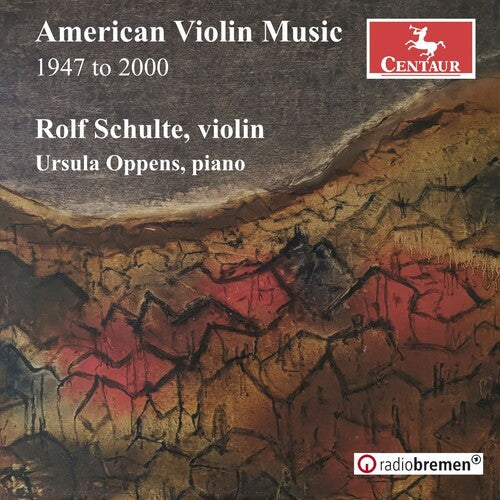
American Violin Music 1947 to 2000 / Schulte, Oppens
Violinist Rolf Schulte presents a program of great American violin works composed between 1947 and 2000. He is joined in two of them by pianist Ursula Oppens.
American Classics - Wolpe / Group For Contemporary Music
Includes work(s) by Naoko Akutagawa. Ensemble: Group for Contemporary Music. Conductor: Harvey Sollberger.
Music Of Stefan Wolpe, Vol. 6 / Holzman
This excellent series of music by Stefan Wolpe, whose life spanned the first three quarters of the last century, continues both to perplex and to delight. To perplex because the musical character of German exile to Palestine Wolpe was so complex, enigmatic and diverse. To delight because of the very high quality both of that intriguing music and its playing.
Indeed, David Holzman's first CD in the series (BRIDGE 9116) in 2003 was nominated for 'Best Solo Instrumental Performance' in that year's Grammys and did in fact go on to win AFIM's INDIE award as 'Best Classical CD'. The current recital has all the vigour, perception and delicacy of his earlier success. The music played here was written between 1926 - before Wolpe and Irma Schoenberg (1902-1984) emigrated to Palestine, in 1934 - and 1959 only just over a decade before his death.
Particularly noteworthy is the first complete recording of Wolpe's huge Four Studies on Basic Rows (1935-36). It occupies almost half this CD and includes the composer's most frequently-recorded piano piece, the 'Passacaglia' [tr.4], which is in turn the longest single movement here at getting on for a quarter of an hour.
Music representing Wolpe's time in Germany, Palestine and America is included. It varies in complexity and scope from the experimental to music written for his students. So you're getting a mixture, a taster, of Wolpe's output for the instrument. You're also getting it played by undeniably the greatest interpreter of Wolpe's keyboard music alive today.
In his essay for the CD's liner notes, Holzman describes how he has come to know Wolpe so intimately that he can detect the composer's most minutely expressed moods and feelings in his music. Although this is evident from Holzman's control of tempi, phrasing and timbral nuance, the pianist is never permissive to the exclusion of the true musical essence which he's gently intent on conveying. It's insight and interpretation first, and any hint of special understanding second. The playing of the 'Passacaglia', for instance, is approached with great confidence and all the necessary familiarity; Holzman unshowily brings to the performance his ability to anticipate and to pace the music yet is as fresh and full of surprises as can be.
Holzman reveals and commends the depth and breadth as well as the engaging beauty of these works: Wolpe's fascination with the colours (literally) of intervals was never mechanical, forced or self-indulgently indecisive. Holzman quietly and effectively communicates with great conviction and confidence the gentle and at times understated loveliness in music whose titles sound as though they were mere exercises. They're not. Their range and originality are impossible to miss thanks to Holzman's perception and dedication.
His playing is alert and alive. It continually presents new delights. Listen to the juxtaposition of the 'Pastorale' then 'Con fuoco' of the Two Pieces for Piano from 1941 [trs. 9, 10]. It's not that they could be by different composers (Berg then Webern perhaps); nor that the same composer is as versatile as he clearly is. The playing succeeds because it's conversant with the wealth of resources on which Wolpe draws at any one time. These include moods, light, invention, ties to other formats, references and original topoi in which Wolpe is so evidently at home. As a result, what does emerge in contrasts and parallels somehow has its own logic.
Technically Holzman is flawless. The piano is recorded nicely forward yet with enough space to allow full air to the many timbres and palettes it's required to evoke. The notes, which are nicely informative - especially for someone new to Wolpe's world - explain the somewhat relaxed circumstances under which this recital was prepared and executed. Indeed, there's a spontaneity and lack of deliberateness to the playing, to the order in which the pieces are heard and consequently to the listener's overall delight in this slice of a very intriguing composer. But this is a freedom which not for a minute even hints at sacrificing the rigour necessary for music as demanding as this. The result: an hour and a quarter's sheer enjoyment and inspiration.
This sixth volume in Bridge's series fulfils the promise of the others released so far. It's a great introduction to Wolpe's piano music for those unfamiliar with it. Since most of the pieces here presented are not available elsewhere, Holzman's recital will also satisfy collectors of Wolpe. Don't hesitate.
-- Mark Sealey, MusicWeb International
Various: Fantasie von übermorgen - Songs in Exile / Huber, Heller
This release commemorates four German composers who had to flee Germany during the Nazi era because they were Jewish: Paul Ben-Haim, Paul Dessau, Kurt Weill and Stefan Wolpe. Transylvanian-born Alexander U. Boskovich, who was also forced in 1938 to flee his homeland because he was Jewish, has been included in this programme because of his significance. The songs written by these composers in exile have so far largely remained unknown. The texts they were set to are to a great extent taken from the works of Hebrew poets and are presented here for the first time in German translation by Dagmar Nick. The evocative and sometimes shocking lyrics that seem so prescient even today range from the 7th century BC to the present day, from the prophet Isaiah through Chajim Bialik, Schalom Asch and Erich Kästner to the words of warning from Albert Einstein regarding the H-bomb. Dagmar Nick (Intertext, Explanations & translation) was born in 1926 in Breslau, and grew up in Berlin and is one of the most important German-speaking poets after 1945. She studied graphology and psychology in Munich. In addition to radio plays, short stories, travel guides and three narrative monologues, she has published a collection of thirteen poetry books since 1947. She is a member of the PEN and the Bavarian Academy of Fine Arts and has received several literary awards. Dagmar Nick, who lived in Israel for over four years, wrote both the intertexts and the biblical and historical explanations and - with the kind assistance of Eitan Levi, Uri Shani and Assaf Levitin - translated the 25 Hebrew song texts into German.