Alan Hovhaness
12 products
-
Hovhaness: Concerto No. 2; Works for Violin and Piano
$19.99CDNaxos
Jul 25, 20258559957 -
-
-
-
-
-
-
-
-
-
-
-
Hovhaness: Concerto No. 2; Works for Violin and Piano
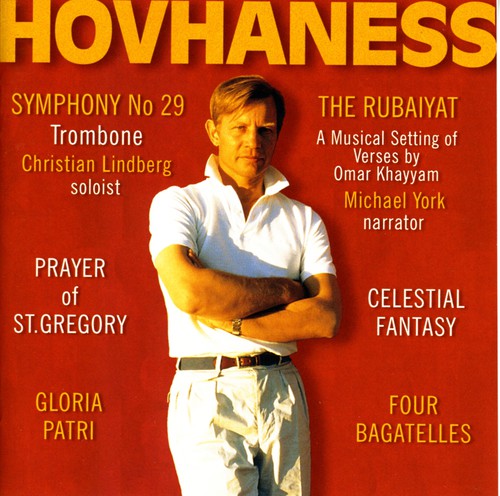
HOVHANESS, A.: Symphony No. 29 / 4 Bagatelles / Rubaiyat / P
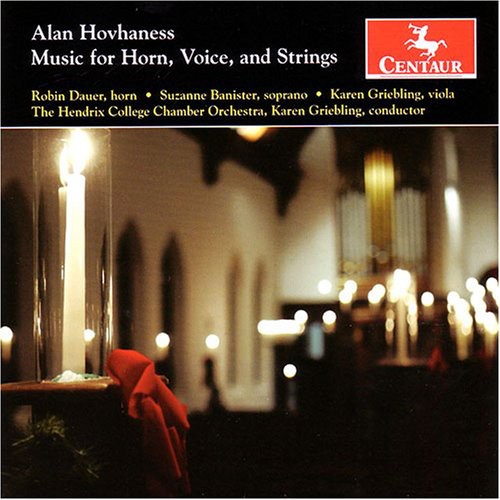
Hovhaness: Music For Horn, Voice & Strings / Dauer, Et Al
Includes work(s) by Alan Hovhaness. Soloist: Robin Dauer.
Hovhaness: From the Ends of the Earth / Patterson, Gloriae Dei Cantores
HOVHANESS Cantata Domino. Immortality. Unto Thee, O God. Triptych: Ave Maria. Simple Mass. From the End of the Earth. 3 Motets. Psalm 143 . I Will Rejoice in the Lord. Why Hast Thou Cast Us Off? The God of Glory Thundereth. O Lord God of Hosts • Elizabeth C. Patterson, dir; Gloriæ Dei Cantores; David Chalmers, James E. Jordan, Jr. (org); Kathy Schuman (sop); Phoenix Marcela Catlin (alt); Richard Cragg (ten); G. Luke Norman (bs); Lydia Ingwersen, Stephen Velie (ob); Marianne Wierzbinski, Daniel Pfeiffer (hn) • GLORIÆ DEI CANTORES 52 (75:33 Text and Translation)
This CD of religious music by Alan Hovhaness is of such a high quality in performance that it virtually transcends the form of his pieces. In other words, the performers are all so completely wrapped up in this music, and it is sufficiently interesting to maintain one’s attention even if one is not inclined toward religiosity in music, that it commands and holds your attention from first note to last.
A great deal of the credit for this high quality goes to Elizabeth Patterson and her choir, Gloriæ Dei Cantores, the resident choir of the Church of the Transfiguration in Cape Cod. Their blend is clear and well tuned but not creamy-smooth and perfect, and for that I am highly grateful. I’ve had my fill of choirs that sound like their tone was produced on an organ pipe. I like to hear humanity in my choruses, and Gloriæ Dei Cantores fulfills that expectation. (I should also point out that clarity of lines in the chorus also translates, especially here, to clarity of diction, which I also appreciate.) Neither of the two organists on this recording is identified with any specific piece of music, so I cannot tell you who is playing what (there also appear to be unidentified brass players on O Lord God of Hosts ), but the organ-playing as a whole is on a very high level.
Hovhaness’s music employs a number of dissonances and chromatics, yet is never purposely abrasive in a way that shuns the understanding of an average listener. Of course, what audiences of the 1940s wanted and expected to hear and what Hovhaness gave them was not always the same thing, and as the liner notes point out, he faced harsh public judgment of some of his most cherished pieces. Happily, as time went on even the most astringent passages in a Hovhaness piece came to sound almost romantic by comparison. Perhaps one reason for the disparity in acceptance between the 1940–50s and today is at least partially explained by the changes that took place in jazz during the late 1950s and early ’60s. Jazz at that time moved away from strictly tonal chord patterns (and, sometimes, chord patterns in general) and toward modes, stacked chords, and atonality in a highly diverse and sometimes “unpopular” style. Public acceptance and acclaim for such highly developed musicians as John Coltrane, Dave Brubeck, Miles Davis, Ornette Coleman, and Bill Evans helped to make listening to Hovhaness an enjoyable and accessible public experience.
Certainly, most of the Simple Mass is very tonal and highly expressive and the Three Motets, sung by a cappella choir, even more so. Here, the music almost floats above the ground, an effect Hovhaness creates through his use of higher chord positions that almost never include the root tonic or heavy low notes for the basses (these chord positions also allow him to move either chromatically or modally within chords). Sister Phoenix Marcela Catlin’s alto solo in the second motet is beautifully phrased. I should also give special recognition to the excellent soprano of Kathy Schuman in Immortality and the Simple Mass. Another unaccompanied chorus, I Will Rejoice in the Lord, contains modes and harmonies that sound almost Hebraic.
These appear to be the only available recordings of these works. Whether or not they are first recordings, I cannot say. But if you are inclined toward religious music in general, and/or Hovhaness in particular, you cannot fail to be moved by this disc. It is, quite simply, terrific.
FANFARE: Lynn René Bayley
Hovanhess: Celestial Fantasy / Stratton, Slovak Radio Orchestra
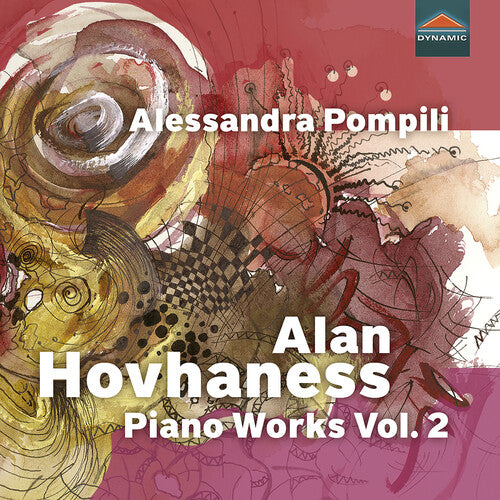
Hovhaness: Piano Works, Vol. 2 - Journeying over Land & through Space / Pompili
American-Armenian composer Alan Hovhaness was a significant representative of 20th-century music – a composer who sought a path independent to the fashions and trends of his time. He avoided the European avant-garde, instead embracing Armenian and oriental traditions as well as Medieval and Renaissance music. This second volume includes the sonic atmospheres of Hermes Stella, dedicated to the poet-philosopher-mystic Francis Bacon, and the complex and fascinating Piano Sonata ‘Journey to Arcturus’ which takes us to one of the most visible stars from Earth. MusicWeb International considered Alessandra Pompili “a splendid young exponent of Hovhaness's music” in Volume 1 of this edition.
REVIEW:
Komanchi, Op. 249 was inspired by the legendary Japanese poetess of the same name, and by nature. This seven-movement piece has a simple delicacy. The texture is very thin – often just a single-line melody. Hovhaness manages to capture the essence of Asian music while still writing in his own voice.
Greek Rhapsody No. 1, Op. 63 is an early work. Hovhaness completed it in 1944 when he completely reinvented his style. The melody sounds Grecian and is given a mostly monophonic treatment. This free-flowing rhapsody entices with its improvisatory beauty.
Hovhaness’ 1981 Piano Sonata, Op. 354 is a major work and is over twenty minutes in length. But don’t expect a traditional sonata-allegro four-movement structure. The subtitle “Journey to Arcturus” provides the context. This is about moving from one destination to another. As the work does over the course of its six movements.
Hovhaness was a pianist, but one with a unique idea of what piano music should be. Alesandra Pompili gives us Hovhaness’ vision in her performances. Her playing is expressive and fluid. An excellent recording. Highly recommended for anyone wanting a fuller understanding of Alan Hovhaness’ music.
-- WTJU-FM, 91.1 (Univ. of VA)
Hovhaness: Symphony No 60, Guitar Concerto / Leisner, Schwarz

Hovhaness has found a strong advocate in Gerard Schwarz, and about time too. This prolific and at times prolix composer's music, with its expressively limited mixture of bell sounds, modal and Eastern harmonies, and simple counterpoint, can sound naïve and even irritating in large doses. What is so often missing from many performances is committed playing, giving the music the strength, beauty, and confidence that so often makes all the difference between "getting through the notes" and the quality of response that these pieces need and deserve. This disc, all premiere recordings, does the latter, and even if you dislike Hovhaness you might well be impressed by the results.
Khrimian Hairig is a short, pretty work for solo trumpet and strings much like the composer's Prayer of St. Gregory. It makes a very nice program opener even though it tells us nothing especially new. That certainly isn't true of the larger works. The Guitar Concerto must be numbered among the more successful works in its genre. It has all of the composer's hallmark fingerprints, but it also reveals an astutely judged understanding of how to pit such a weak-toned instrument against a large orchestra. In terms of color, texture, and contrast, the music is wholly beguiling and never overstays its welcome.
The same holds true for Symphony No. 60. At a bit more than half an hour, this is a long work for Hovhaness, but the inclusion of some American folk music makes an interesting contrast with his usual Eastern modes, while the four movements once again offer an unusually broad range of contrast and sonority. Best of all, the entire program is extremely well played, from guitarist David Leisner on up. This isn't difficult music technically, but it must never sound tired or lazy, and here it doesn't. The disc offers what in effect is an entire mini-concert--overture, concerto, and symphony--and you can listen to the whole thing straight through without fear of monotony. Sensitive and coherent notes by the late composer's wife add to the overall appeal, as does the excellent sound, particularly in the difficult-to-balance Guitar Concerto.
– David Hurwitz, ClassicsToday.com
Hovhaness: Symphonies No 1 & 50 / Schwarz, Seattle
With over 500 works to his name Alan Hovhaness may well be the most prolific American composer as well as one of the most fascinating. His music cannot be pigeonholed since he drew influences from so many varied sources. That said, above all, he insisted on melody, having roundly rejected the path of ‘modernism’ that many others followed in the 20 th century. Among those influences was his Armenian heritage inherited through his father. These are very much to the fore in his First Symphony subtitled Exile which references the plight of Armenians who were forced to flee in their millions in the face of an onslaught by Ottoman Turks during the First World War. Lovers of big tunes will revel in the lush sonorities on display. They’re in evidence right from the first notes. These are given to the clarinet which introduces a plaintive tune taken up by other woodwind with the orchestra continuing the Middle Eastern-sounding scales and the music becoming disturbed and agitated. The second, short movement marked Grazioso is further demonstration of the melodies for which Hovhaness is rightly renowned. Woodwind sings out against a background of pizzicato from strings and harp. This allows for an interlude of calm before the third and final movement brings us back to agitation. Driving strings and winds recall the opening theme in chorale form which then becomes the main focus of the orchestra. The powerfully expressed message is that a whole people cannot be suppressed. Its spirit will reassert itself and prevail against all the odds.
One of the other influences Hovhaness exploits is his love and reverence of the music of the Far East, particularly Japan and Korea, having studied both. The second work, Fantasy on Japanese Woodprints, has a title that allows him to explore his own impressions of the music from this part of the world. It involves extremely creative ways of approximating the sounds of Japan through clever and inventive use of the instruments of a Western orchestra. The marimba is the instrument of choice to carry the main theme against a background of orchestral experimentation creating a convincing and effective ‘Japanese’ sound for Western ears.
Yet another influence which has shown itself in many of Hovhaness’s compositions are mountains. He once wrote “Mountains are symbols, like pyramids, of man’s attempt to know God. Mountains are symbolic meeting places between the mundane and spiritual worlds”. It was a natural thing therefore to have been moved to write a symphony that expresses those ideas following the huge explosion of Mount Saint Helens in Washington State in 1980. The first movement sets the scene and pays reverence to the majesty and mystery of the mountain through use of gorgeous harmonically and melodically rich tunes. These emphasise the mountain’s imperious eminence over its surroundings and its naturally serene nature prior to its being geographically changed by the explosion. The second movement is also calm since it describes the fabulous Spirit Lake in whose waters the mountain was often magically mirrored. Once again Hovhaness uses Japanese-sounding melodies to create the air of mystery and natural beauty of a place which was obliterated by the explosion. The finale opens with an almost hymn-like theme from the strings with tubular bells in the background. A sole flute precedes a representation of the cataclysmic events that rent the mountain asunder, and which continues for much of the movement’s 14 minutes. This musical depiction of the destructive power of nature is extremely potent with plenty of work for bass drums and gong as wave after wave of explosions tear the very fabric of the ground on which the mountain stood. Finally the opening hymn returns to re-establish a measure of calm. Hovhaness doesn’t end the symphony there. Instead he creates a coda to signify the “youthful power and grandeur of the Cascades Mountains” that, as he said, renews the vitality of “our peaceful planet, the living earth, the life-giving force building the majestic Cascades Mountains (,) rising, piercing the clouds of heaven”. This symphony represents an extremely satisfying journey that shows the composer’s unique view of how to use music to describe nature in all its creative as well as destructive power. The disc as a whole is a wonderful introduction to this amazing composer’s music that I for one am only beginning to discover. More of Hovhaness’s works are being recorded all the time. With 67 symphonies alone there’s plenty left to record and to discover and that’s an exciting prospect. Gerard Schwarz is a great advocate of American music and he and his orchestra help do the kind of justice Hovhaness deserves. Ron Johnson does a sterling job on the marimba in the disc’s second work. These recordings were originally made by Delos and they offer an extremely rewarding experience for a whole new audience to discover and revel in.
-- Steve Arloff , MusicWeb International
Hovhaness: Wind Music, Vol. 3 / Central Washington University Wind Ensemble
-----
REVIEW:
The value of the Naxos label’s ongoing American Classics series has never been so aptly demonstrated as with the success of this release from the able but hardly well-known Central Washington University Wind Ensemble. A few pieces here have gained exposure: October Mountain is a fixture of percussion ensemble concerts in the U.S., at least, but several are world premieres. This is all to the good, and there’s not a dull moment to be had here. This is both a wide sampling of Hovhaness’ music and a valuable close focus on his music for winds.
– All Music Guide (James Manheim)
American Mystic - Music of Alan Hovhaness
Heralded by a New York Times article honoring the centenary year of Hovhaness’ birth, Delos celebrates this wonderfully eclectic “American Mystic’s” glowing niche in the pantheon of American musical history from a new angle: Hovhaness as a composer of what we now call “World Music” though on a more exalted plane than most of that genre’s content.
We call Hovhaness a “mystic” largely due to his insatiable curiosity about pan-global musical traditions: primarily exotic sounding middle- and far-Eastern modes, scales and rhythms that, owing to their alien impact upon Western ears, tend to convey mystically spiritual impressions. On top of his own Armenian musical roots, he compulsively explored the music of other Arabic regions as well as the traditions of India, Japan, Korea and Indonesia, absorbing them all into his overall musical consciousness, to be tapped at need to suit his unique creative designs. Accordingly, Delos has combed through its many distinguished previous recordings of Hovhaness’ music to find the individual works that best support such a World Music classification. And everything fits: Like that of many current world music artists, the music of Hovhaness blends disparate musical influences and impulses in musical fusions that are framed by Western contexts of sound, form and instrumentation. - Delos
R E V I E W S:
"This year [2011] is the centennial of Hovhaness’s birth, and for the occasion Delos Records just released a commemorative CD of some of his most important orchestral and chamber works, called “American Mystic: Music of Alan Hovhaness...from childhood Hovhaness had been immersed in the work of Komitas Vartabed, an Armenian priest and musicologist of the late 19th century who specialized in the medieval liturgical and folk music of his homeland in the Caucasus. In the world of mainstream American classical music, however, Hovhaness, who died in 2000, was —and remains an outlier. At a time when dissonance, serialism and other styles were in vogue and many of his colleagues were writing works meant to be both modern and specifically American, Hovhaness embraced tonality and also showed a fondness for archaic elements like the polyphony of Renaissance music and the counterpoint of Baroque fugues...his music could also be deeply spiritual, a quality on display in well-known works like his Symphony No. 2, called “Mysterious Mountain,” and his “Prayer of St. Gregory,” both of which feature soaring trumpet and meditative string parts."
- Larry Rohter, New York Times
American Classics - Hovhaness Symphonies 4, 20, 53 / Brion, Et Al

Three of Alan Hovhaness' six symphonies for wind ensemble are included on this Naxos release. After hearing these, I'm eagerly waiting for the label to get to the other three. All of the ensemble playing is flawless, the many solos are ravishingly beautiful, and conductor Keith Brion's grasp of the music results in performances I can't imagine being bettered, surpassing even the classic Mercury Living Presence recording by the late Frederick Fennell and the Eastman Wind Ensemble.
The symphonies are separated by two of the composer's works for trumpet and band, the solo part played by Scotland's great trumpeter John Wallace. He soars ecstatically above his colleagues in the Prayer of Saint Gregory, and his more varied part in Return and Rebuild the Desolate Places (the most aggressive music on the disc) achieves a threatening quality without ever losing beauty of tone.
Hovhaness' style is so distinctive, and his oeuvre so vast, that it's easy to tag him as having written the same piece over and over. And it is true that these works share many of the same elements: long, arching modal melodies, rich triadic harmonies laced with non-harmonic chiming notes, "spirit murmurs", and fluent, noble fugues. But there is enough difference in the inspiration of these works, and enough stylistic development, that you don't really get an impression of sameness. And there are many passages that haunt the memory: the flowing oboe and harp duet at the heart of the Fourth Symphony; the crossing trombone portamentos in the same work; the gorgeous fugue for all of the bell-like instruments in "Star Dawn"; the emergence from the frightening eruption that represents the "Desolate Places".
The recording was made in a church in Paisley, Scotland, and the venue contributes just the right mixture of spaciousness and intimacy to suit the music. If you are the sort of record collector who keeps alert for good new releases of unusual repertoire, this is a disc with the musical values and production quality that you always are hoping for. [1/4/2006]
--Joseph Stevenson, ClassicsToday.com
American Classics - Hovhaness: Symphony No 22, Etc
The coupling, the only available recording of the early (1936) Cello Concerto, is new to CD and features the redoubtable Janos Starker as soloist. It's not a great work, but it is an extremely pleasant, interesting, even important one. All of the Hovhaness fingerprints that we observe in the symphony are also present in this piece. Two lengthy slow movements frame a very short central Allegro, and the 25-year-old composer's writing for the cello doesn't sound all that grateful to play--although the soloist does get a lot to do. But what makes this piece so fascinating, and so deserving of your attention, is the fact that it does everything that we expect of music by, say, Arvo Pärt or John Tavener, and yet it was composed nearly 70 years ago! Hearing this, it's no wonder Hovhaness is only just coming into his own, and it's a fitting historical irony that a composer once denigrated as backward looking should in fact turn out to be a prophet of important musical trends.
It's also worth noting that about two seconds of this piece sounds 10 times better than anything by "spiritual opportunists" such as Tavener. Yes, the outer movements go on too long, but as with most of Hovhaness' music, the results fall easily on the ear, and Starker, despite a couple of moments of iffy intonation toward the start of the work, plays eloquently. The sonics in both works are also first rate. It was certainly a coup for Naxos to secure this recording of the Cello Concerto, and listening to it is more than just enjoyable in and of itself: it's cause for reappraisal of Hovhaness' historical position, and it's a useful commentary on the work of some important contemporary musical voices. Do try to hear it.
--David Hurwitz, ClassicsToday.com