Alban Berg
82 products
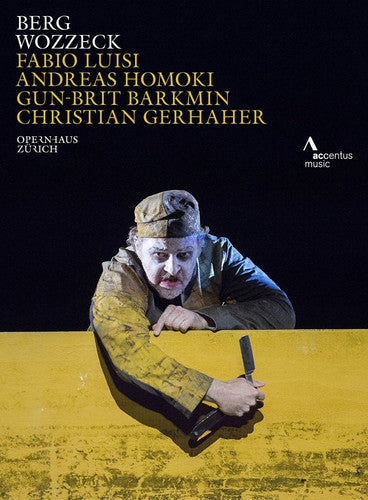
Berg: Wozzeck (Live)
Sailors Fighting in the Dance Hall
Berg: Wozzeck, Op. 7 (Sung in Italian) & Violin Concerto
Berg, F.J.: Flute Mystery / Warning Zero / Pastorale / Vicin
Berg: Wozzeck
Gunnar Berg: Chamber Music Works With Piano / Balk-Moller, Ehde, Ullner, Snekkestad
Berg, G.: Ar Goat / Triedra / 9 Duos / Melos I
BERG, G.: Eclatements
LULU: STEINGRUBER, KMENTT, WIE
Refractions
Schoenberg, Berg: Piano Music / Pöntinen
This final disc in our trilogy of the chamber music of Schoenberg and his disciples is dedicated to the works for piano solo. Covering almost all of Schoenberg's output in his genre - including two fragments never previously recorded - the programme also includes Alban Berg's Sonata No.1, composed at the age of 23 under the influence of his teacher's Chamber Symphony. There is also a first recording of a fragment by Berg, originally intended for a sonata but later used almost unchanged in his opera Wozzeck. The previous two instalments in this series have received great acclaim. 'An impeccable balance between precision and expressivity' the critic in Le Monde de la musique wrote in reviewing 'Schoenberg: Works for Violin and Piano' (CD1407) and Klassik Heute gave 'Schoenberg/Webern Chamber Music (CD1467) top marks: 10/10/10. Eminent pianist Roland Pöntinen participated on both of these discs, and now he closes the trilogy with this solo programme.
Scandinavian Choral Music
Lunds Studentsangare Sjunger In Varen
Wolf, H.: Italienisches Liederbuch (Excerpts / Morike Lieder
Vocal Recital: Kuhse, Hannelore - WOLF, H. / BERG, A. / REGE
Vocal Recital: Kuhse, Hannelore - WAGNER, R. / STRAUSS, R. /
Natanael Berg: Symphonies No 1 & 2 / Rasilainen, Et Al
Tango Libre
Berg / Eisler / Schoenberg / Ravel: Early Piano Music
Berg: Lulu
Berg, Brahms, Poulenc & Schumann: Clarinet Sonatas / Portal, Dalberto
This album takes us on a journey through several different eras of Romanticism, from its origins to its twilight, from Schumann to Poulenc by way of Brahms and Berg. It is also the story of a long friendship and artistic collaboration …
A declared enemy of anything that smacks of routine, the clarinettist Michel Portal looks after his unpredictability the way an astronaut looks after his oxygen supply. His almost organic curiosity, his need for exchange, reacts here to an exciting encounter with the pianist Michel Dalberto.
The clarinet sonatas by Brahms and Poulenc, Schumann’s Phantasiestücke and Berg’s Four Pieces are all seen in a new perspective at La Dolce Volta. Every Michel Portal recording is a passport to wisdom, a term that for him goes hand in hand with speed, joy and exultation. Eternal youth!
Schoeck, Berg at al: Songs / Mitsuko Shirai
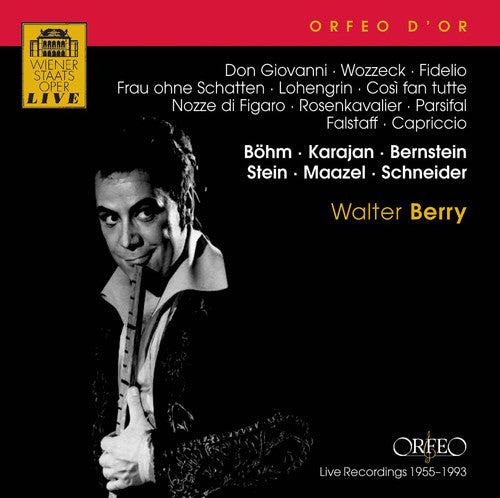
Mozart, Berg, Beethoven, Strauss, Wagner / Walter Berry
There is hardly a singer who has sung so many and such varied (main) roles as Walter Berry - both tragic and comic, German and Italian, and with such well-loved singing partners and conductors. All this can be heard in our selection from his fifty-year career at the vienna State Opera.
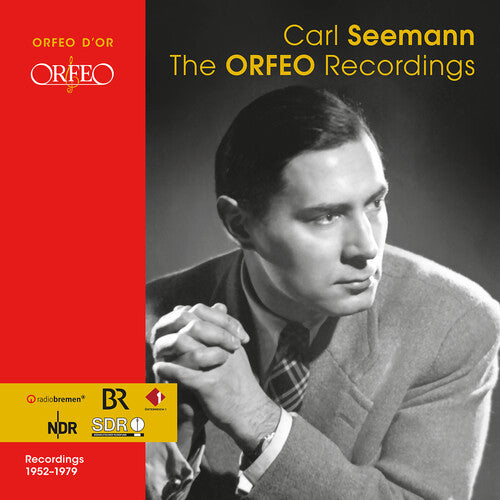
Carl Seemann: The Orfeo Recordings
Carl Seemann – The ORFEO recordings – Carl Seemann was the kind of pianist who didn’t try to impress audiences with brilliant virtuosity. Instead, he understood the piano as his ideal medium for revealing a polyphonic structure on a single instrument. After his death on November 26th, 1983, at the age of 73, in Freiburg, it took some 25 years before the recordings of his studio and concert performances began to be re(dis)covered and today he is once again regarded as one of the leading German pianists of the post-war era. On the occasion of his 40th year of death, ORFEO releases this 7 CD anniversary box with all his recordings on the label and an additional booklet that highlights Carl Seemann’s artistic background and his pianistic environment.
REVIEW:
Pianist Carl Seemann (1910-1983) largely specialized in the Viennese classics, and tended to shine more in collaborations than when under the solo spotlight.
His 1965 Bach Partitas, for example, range from workaday (Nos. 2 and 6) to sensitive and cultivated (No. 3 and No. 5’s outer movements). By contrast, his 1964 recital with frequent partner violinist Wolfgang Schneiderhan features congenial and inspired readings of the Bach E major, Beethoven E-flat Op. 12 No. 3, Mozart B-flat K. 454, and Schubert A major D. 574 sonatas.
The 1979 Mozart C major concerto K. 503 with the NDR Symphony Orchestra under Wilfried Boettcher is sluggish and heavy in the outer movements compared alongside Seemann’s 1950 DG studio recording, which wasn’t all that great to begin with. However, the 1972 E-flat K. 449 captures Seemann on fine form in a work he otherwise did not record. Here his energized and poetic solo work is complemented by Leopold Hager’s shapely orchestral framework.
Seemann’s boring and heavy-handed Beethoven Piano Concerto No. 2 precedes a stylishly flexible 1962 performance of that composer’s Sonata No. 9 in E major Op. 14 No. 1. The 1952 broadcast of Beethoven’s Bagatelles Op. 126 is basically a sonically drab replica of Seemann’s engaging, vibrant, and better engineered 1951 DG studio version. As I listened to cellist Enrico Mainardi’s 1956 Bach Viola da gamba Sonata in D major BWV 1028, I was struck by how the pianist’s tone seemed unusually mellifluous and nuanced. Then I looked at the booklet, and it turned out that the pianist was Carlo Zecchi, not Seemann! No wonder! Yet the real Carl Seemann holds more interest throughout a 1973 Reger Sonata No. 4 than Mainardi, who was way past his prime by that date.
The collection’s final disc focuses on Paul Hindemith conducting the Bavarian Radio Symphony Orchestra. They are not so polished as The Philharmonia Orchestra in Hindemith’s EMI recording of the Symphony for Concert Band, yet they bring more urgency and surface excitement to the fugal finale. The Bavarian musicians rise to the occasion in The Four Temperaments, where I prefer Clara Haskil’s limpid and sparkling fingerwork to pianist Hans Otte in Hindemith’s DG Berlin Philharmonic recording.
Considering that Berg’s Chamber Concerto was hardly a repertoire staple in 1955, Hindemith obtains impressive ensemble cohesion and discipline. Seemann handles the difficult piano part cleanly and securely, capably complementing violinist Wolfgang Marschner’s expressive agility. That said, Marschner comes more alive partnered alongside Paul Jacobs’ fleeter, more incisive pianism in a 1959 Köln Radio broadcast featuring Hermann Scherchen’s volatile podium presence.
At the very least I’m happy to have Seemann’s recital with Schneiderhan, his Mozart K. 449, and his more successful Bach Partita movements in my permanent collection, together with the Zecchi and Haskil selections. Christoph Schlüren’s annotations provide useful biographical information about Seemann and his career.
-- ClassicsToday.com (Jed Distler)
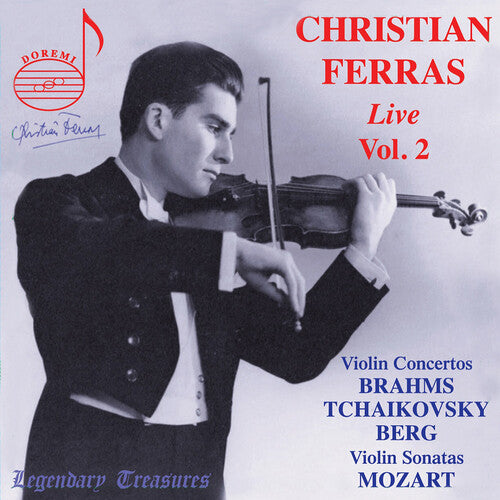
Christian Ferras Live, Vol. 2
When Christian Ferras died at age 49. his friend and colleague Yehudi Menuhin wrote that Ferras was"possessed by music, immensely talented, and of both a generous and intense temperament."
Christian Ferras was one of the greatest violinists of the 20th century. Born in 1933, he was a guest soloist of the Nice Symphony orchestra in1942. In 1948 he won the First Prize at the International Scheveningen (Holland) Violin Competition and in 1949 won the top prize at the International Long-Thibaud Competition. Thereafter, he pursued a successful career as soloist with many of the world’s leading orchestras and in recitals with his long time accompanist, pianist Pierre Barbizet. He recorded for EMI and from 1964 for DG where he recorded the four main repertoire violin concertos, Brahms, Sibelius, Beethoven and Tchaikovsky, with Herbert von Karajan and the Berlin Philharmonic Orchestra.
Fortunately, Christian Ferras left behind a rich recorded legacy, that enable us to continue to enjoy his great artistry.