Alfonso Ferrabosco
4 products
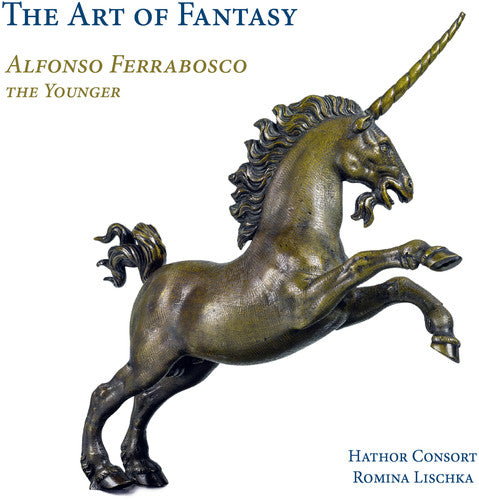
The Art of Fantasy
Ferrabosco: Lessons for Solo Lyra Viol / Biordi
Alfonso Ferrabosco Jr was the son of an Italian musician who had worked at the court of Elizabeth I, where he composed mostly madrigals but also sacred pieces and instrumental works. He received an English upbringing and a full musical training, and he too held an official position at Court. Like his father, he composed madrigals and sacred music and among his collaborators was notable playright Ben Johnson. He gained a solid reputation as a violist and as a composer of instrumental works for viol and consort of viols. Alfonso Ferrabosco Jr. was the first to compose music which was entirely dedicated to the lyra viol. The lyra viol was a typical English instrument of the viola da gamba family mounted with six gut strings; more than fifty different tunings are documented, Ferrabosco using three of them. Among these pieces rank the Lessons for 1, 2 and 3 viols, which include the works for solo lyra viol here collected for the first time as a monographic edition and recorded by Paolo Biordi.“His style is effective and satisfying.” (American Record Guide)
Ferrabosco: Music to Hear - Music for Lyra Viol from 1609 / Boothby, Morikawa
Recorded during the 2020 lockdown, Richard Boothby explores the solo and duo Viol music of Alfonso Ferrabosco the younger. The lyra viol and its music is one of the last undiscovered gems of music, and Alfonso Ferrabosco is its greatest exponent. It is in the category of ‘hard to define, easy to recognise’: it is at once an instrument, a style of playing and a genre of instrumental music, and, while not exclusively English, by far the largest part of its repertory is from these isles. A composer favoured by Queen Elizabeth I and James I, Ferrabosco also wrote music for stage works by playwright Ben Jonson, some of which would by heard in performance at Shakespeare's Globe. Added to this he was a renowned player of the viol – a visiting court musician declaring that there was no player of ‘La lyre’ in Italy: “who was fit to be compared with the great ‘Farabosco d’Angleterre'."
Richard Boothby has been playing the viol ever since David Fallows handed him a tenor viol in 1977. After further study with Nikolaus Harnoncourt in Salzburg, he helped to found The Purcell Quartet in 1984 and Fretwork in 1985. He has endeavoured to enrich the viol-consort repertory with new music from today’s finest composers, from Elvis Costello to George Benjamin, from Alexander Goehr to Nico Muhly. With the Purcell Quartet, he recorded nearly 50 albums for Hyperion and Chandos; and with Fretwork over 40 albums for Virgin Classics, Harmonia Mundi USA and most recently, Signum Classics.
REVIEW:
These are intimate performances of intimate music, yes; but the writing and the playing are such that chordal and contrapuntal textures, beefy bass lines and flute-like cantabiles just about do the job of an entire consort of viols.
-- BBC Music Magazine
Ferrabosco: The Soule of Heaven / Eynde, B-Five Recorder Consort
Barcelona, 2003. Five recorder students almost blow their teacher away. “This sounds so good,” he says, “you have to keep playing together.” That’s what they do. Hailing from four different countries, they continue to visit each other after their studies. They buy an insanely beautiful set of Renaissance instruments, they mold their sound, and they start looking and keep looking. Today B-Five has become one of the best recorder ensembles in the world. Their organic sound, their superior craftsmanship, but especially their intense musicality, convince the press and public everywhere. Renaissance consort music is at the heart of B-Five’s artistic soul. But just as often, B-Five takes on contemporary works composed to match their beautiful flutes. The players of B-Five set the standard for what a recorder ensemble can be concert after concert. Unique and intimate. Often melancholy, sometimes light-hearted and always deeply moving. On their latest recording B-Five present pavans and almaines by Alfonso Ferrabosco I & II.