Alfred Schnittke
52 products
-
Alfred Schnittke: Piano Music, Vol. 1
$21.99SACDBIS
Sep 19, 2025BIS-2797 -
-
-
-
-
-
-
-
Alfred Schnittke: Piano Music, Vol. 1
BIS
Available as
SACD
$21.99
Sep 19, 2025
Pianist Nicolas Stavy, who has already made recordings devoted to works by Boris Tishchenko (BIS-2189) and Dmitri Shostakovich (BIS-2550), now presents the first instalment of a complete survey of Alfred Schnittke's compositions for solo piano. This recording presents works from various periods of the Russian-German composer's career - from the 1950s, which the composer described as the 'years of obscurity', to the 1990s, a time shaped both by world fame and serious illness. While Schnittke wrote relatively little music for the piano, each work reflects - or sometimes anticipates - the phases of the composer's creative development. The Five Preludes and Fugue and the Prelude and Fugue belong to Schnittke's first creative phase, when he was still under the influence of Shostakovich. The Little Piano Pieces, composed for the composer's six-year-old son, are an example of his 'polystylism', juxtaposing and combining music of various styles from the past and present. The Sonata No. 2 and the Five Aphorisms, both from 1990, return to a more ascetic and abstract language, with a bleaker tone, no doubt echoing his serious health problems.
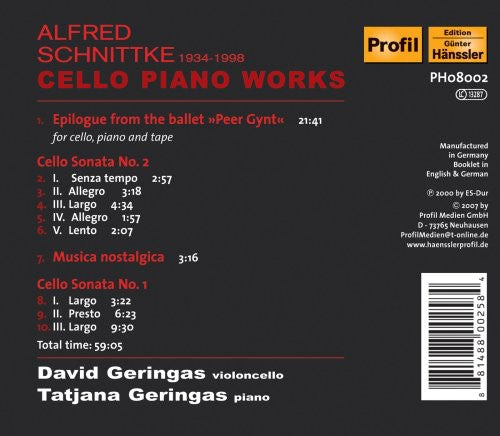
SCHNITTKE: Cello Sonatas Nos. 1 and 2 / Epilogue / Musica no
Profil
Available as
CD
$10.99
Sep 25, 2007
SCHNITTKE: Cello Sonatas Nos. 1 and 2 / Epilogue / Musica no
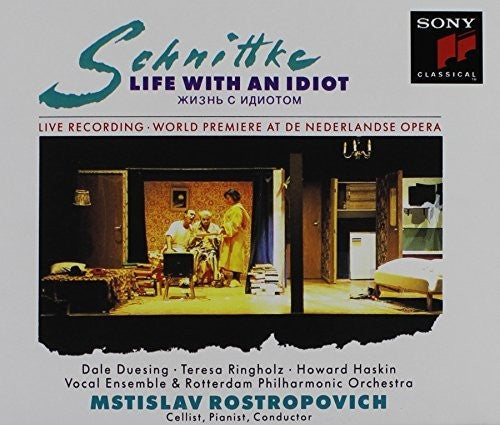
Schnittke: Life With An Idiot / Mstislav Rostropovich
Sony Masterworks
Available as
CD
$34.99
Oct 08, 2009
What a wonderful title. The absurdist libretto of Schnittke's opera by the former 'dissident' writer Victor Erofeyev is based on his own short story and is partly a satire on Soviet life under Communism ('Vova' was Lenin's nickname, and Howard Haskin — the creator of the role — was made up to look like the former leader). Clearly, for Schnittke and other post-Soviet artists, there are still scores to setde with the past. Whether that will tell against the opera's long-term success remains to be seen.
At its worst it recalls a superior cabaret act, Schnittke's frequent recourse to parody as part of his 'polystylistic' approach sounding a touch glib. But other moments suggest wider resonances. The opera was premiered in Amsterdam last April, when this recording was made. Rostropovich, who was instrumental in the project from an early stage, conducts a brash but vital performance (he also plays the cello and piano) and the cast enters fully into the spirit of the piece. The sound has a curiously hollow quality.
-- George Hall, BBC Music Magazine
At its worst it recalls a superior cabaret act, Schnittke's frequent recourse to parody as part of his 'polystylistic' approach sounding a touch glib. But other moments suggest wider resonances. The opera was premiered in Amsterdam last April, when this recording was made. Rostropovich, who was instrumental in the project from an early stage, conducts a brash but vital performance (he also plays the cello and piano) and the cast enters fully into the spirit of the piece. The sound has a curiously hollow quality.
-- George Hall, BBC Music Magazine
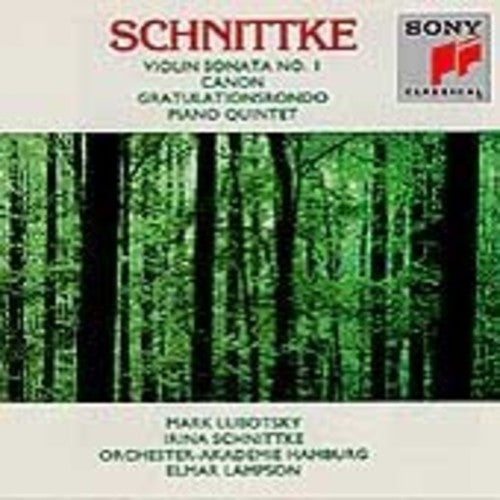
Schnittke: Violin Sonata No 1, Canon, Piano Quintet
Sony Masterworks
Available as
CD
$17.99
Oct 11, 2007
SCHNITTKE: VIOLIN SONATA NO 1,
Modern Portraits II - Schnittke, Shchedrin, Gubaidulina / Krainev, Spivakov
RCA
Available as
CD
$17.99
Jul 10, 2008
Here is a neat conspectus of Soviet music for chamber orchestra forces in the immediate post-Shostakovich years. Schnittke in 1979 was already on his way out of his familiar Gothic-horror juxtaposition of styles. His Concerto for Piano and Strings may still confront emblems of religious ritual with a demented waltz, a thumping toccata, or a lacerating cadenza, but on the whole its concern is with a single-minded, in-bred intensity. Whether it is any the better for that I am still not sure; but Krainev and Spivakov certainly respond whole-heartedly to its alternation of the hypnotic and the trenchant.
Since the flurry of interest in his music in the late 1960s Rodion Shchedrin has failed to capture Western imaginations to the extent of his younger colleagues. Yet his musical personality has always been blessed with a distinctive brand of rhythmical poise and wit, and even if Music for the City of Cothen (composed in 1984 for the Bach tercentenary the following year) comes across as little more than watered-down neo-classical Stravinsky — Dumbarton Oaks, above all — it has more than a few moments of attractive pungency.
Gubaidulina's Seven Last Words of 1982 could hardly be more different. Modelled to some extent on Schütz's and Haydn's settings of the last words of Christ on the Cross, it is shot through with mystical symbolism, not least in its deployment of the bayan (a Russian accordion) and cello to represent the human and spiritual spheres respectively. Again the performance is first-rate.
-- Gramophone [5/1993]
Since the flurry of interest in his music in the late 1960s Rodion Shchedrin has failed to capture Western imaginations to the extent of his younger colleagues. Yet his musical personality has always been blessed with a distinctive brand of rhythmical poise and wit, and even if Music for the City of Cothen (composed in 1984 for the Bach tercentenary the following year) comes across as little more than watered-down neo-classical Stravinsky — Dumbarton Oaks, above all — it has more than a few moments of attractive pungency.
Gubaidulina's Seven Last Words of 1982 could hardly be more different. Modelled to some extent on Schütz's and Haydn's settings of the last words of Christ on the Cross, it is shot through with mystical symbolism, not least in its deployment of the bayan (a Russian accordion) and cello to represent the human and spiritual spheres respectively. Again the performance is first-rate.
-- Gramophone [5/1993]
Schnittke: Concerti grossi Nos. 1 & 2
ALTO
Available as
CD
$12.99
Aug 24, 2020
This is a special work. It begins with a dialogue between the soloists, cello and viola which seems very elaborated. Then starts a Handel-like concerto grosso sound which is in that context very mad. Soon join drums and electrical guitar to the orchestra. This is a great fun and could be called a remix of old classical music with modern parts... Orchestra, Soloists and Conductor are the best of that time in Russia (Discogs).
Schnittke: Violin Sonata Nos. 1 & 2
Bridge Records
Available as
CD
$18.99
Feb 27, 2001
Classical Music
Cello Sonatas, Klingende Buchs
Kontrapunkt
Available as
CD
$22.99
Jan 01, 1993
Cello Sonatas, Klingende Buchs
Schnittke: Film Music, Vol. 6 - Little Tragedies
Capriccio
Available as
CD
$21.99
Oct 04, 2024
Alfred Schnittke's film music encapsulates almost everything that characterises the Russian composer's compositional style. A self-described polystylist, he began writing for film in the 1960s, penning 66 film scores between 1962 and 1984 for Soviet film companies. His method of drawing on the past was rejected by the avant-garde but embraced by filmgoers and concertgoers too. Volume six in this CD Edition of Schnittke's film music presents music from the film series "Little Tragedies" (1979) based on popular novels by Alexander Pushkin. After longtime research conductor Vladimir Jurowski also recorded all parts of the score which have been cancelled at the end for the final Film Version.
Schnittke, A.: Cello Sonatas Nos. 1 and 2 / 5 Aphorisms / Im
Thorofon
Available as
CD
$24.99
Nov 13, 2001
Classical Music
Schnittke: Complete Piano Music, Vol. 1
Stradivarius
Available as
CD
$18.99
Dec 01, 2007
Classical Music
Schnittke: Discoveries
Toccata
Available as
CD
$20.99
May 11, 2010
Classical Music
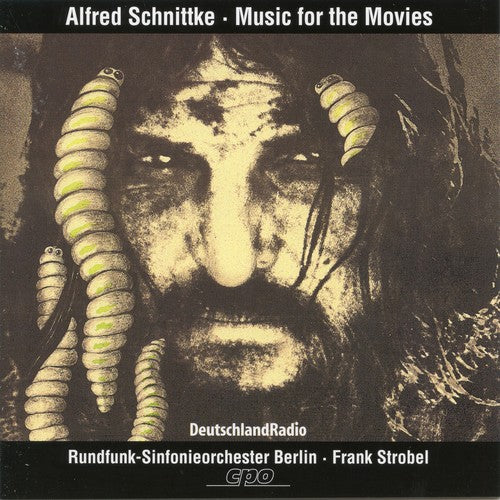
Schnittke: Music For The Movies / Frank Strobel, Et Al
CPO
Available as
CD
$18.99
Nov 01, 2001
Schittke's music for these four films sounds just like Schnittke, big surprise. Leaving out his late works, most of which are just plain miserable, his eclectic poly-stylistic mode of composition makes him a "natural" composer for the cinema, and all four of the suites on display here show him in vintage form. There are those wonderful pastiche pieces of fake "classical" music, several tangos, foxtrots, and the like, all fertilized by Schnittke's slightly twisted way of looking at such things, and there's plenty of very creepy mood music. He gets tremendous mileage from simple effects: the sound of the harpsichord in unexpected places, sparing touches of percussion, persistent rhythmic ostinatos, snatches of popular tunes (there's a particularly pungent setting of the Marseillaise here), and the eerie wordless chorus in My Past and Thoughts.
The most remarkable thing about all of this music is its economy and sureness of touch: there's not a note too much. Every mood expresses itself immediately, with no preliminaries. If I haven't gone into the specifics of the four suites that extensively, it's because they have so much in common with each other, and sound so typical of what we already know of the composer, that they are really best considered together. Frank Strobel leads the Berlin Radio Symphony Orchestra and Chorus with a sure hand, and he's very atmospherically recorded too. This is a major addition to the discography of a very remarkable composer, and great fun. Don't miss it.
--David Hurwitz, ClassicsToday.com
The most remarkable thing about all of this music is its economy and sureness of touch: there's not a note too much. Every mood expresses itself immediately, with no preliminaries. If I haven't gone into the specifics of the four suites that extensively, it's because they have so much in common with each other, and sound so typical of what we already know of the composer, that they are really best considered together. Frank Strobel leads the Berlin Radio Symphony Orchestra and Chorus with a sure hand, and he's very atmospherically recorded too. This is a major addition to the discography of a very remarkable composer, and great fun. Don't miss it.
--David Hurwitz, ClassicsToday.com
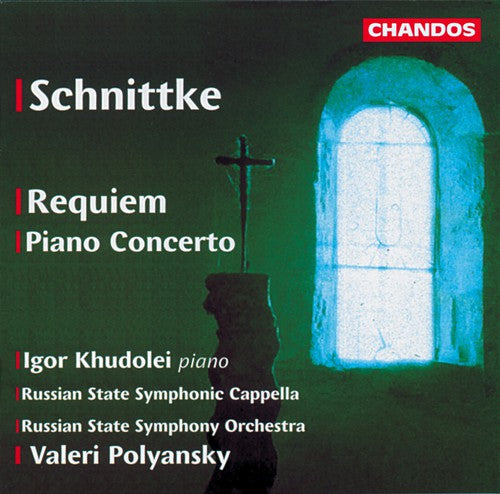
Schnittke: Requiem, Piano Concerto / Khudolei, Polyansky
Chandos
Available as
CD
$21.99
Oct 01, 1997
Producer(s) Igor Veprintsev Sound Engineer(s) Elena Buneeva Vladimir Kisselev Recorded in: Mosfilm Studio, Moscow May 1996 Recorded in: Grand Hall of Moscow Conservatory June 1996
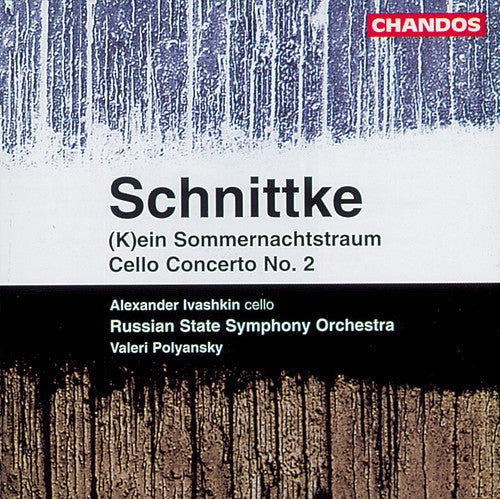
SCHNITTKE: Cello Concerto No. 2 / (K)ein Sommernachtstraum
Chandos
Available as
CD
$21.99
Apr 01, 1999
Classical Music
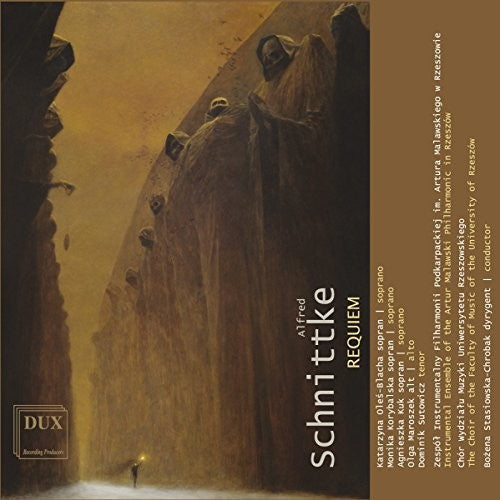
REQUIEM
DUX
Available as
CD
$21.99
Feb 02, 2018
The tradition of composing a funeral mass dates back to the times of the late Middle Ages, but it was brought to artistic perfection by later composers. Alfred Schnittke initially wore the intention of writing a small instrumental Requiem, which was to be one of the parts of the Piano Quintet. Eventually, however, he rejected this idea and created a fourteen-part Requiem. The work is expressive and full of dramatic contrasts. The instrumental parts of electric guitars of a set of drums surprisingly refer to the composer’s polistylist interests. Composed in the same stream, the three religious songs refer to Orthodox church music, introducing a mood of contemplative reflection and prayer reverie.
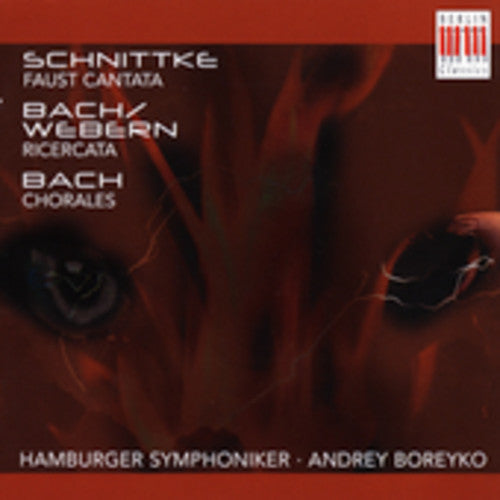
Bach, J.S.: Wenn Wir in Hochsten Noten Sein / Herr, Ich Habe
Berlin Classics
Available as
CD
$21.99
Jan 03, 2005
Classical Music
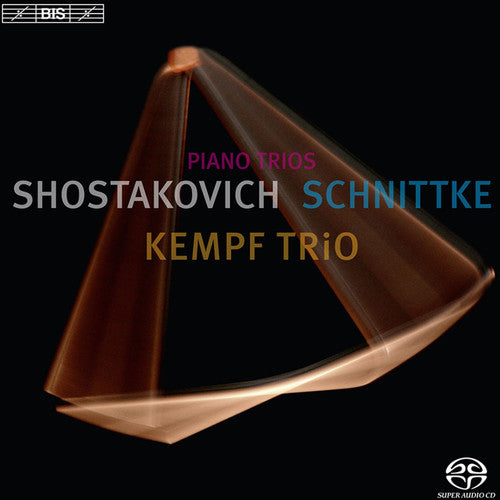
Shostakovich, D. / Schnittke, A.: Piano Trios
BIS
Available as
SACD
Import Hybrid-SACD pressing.
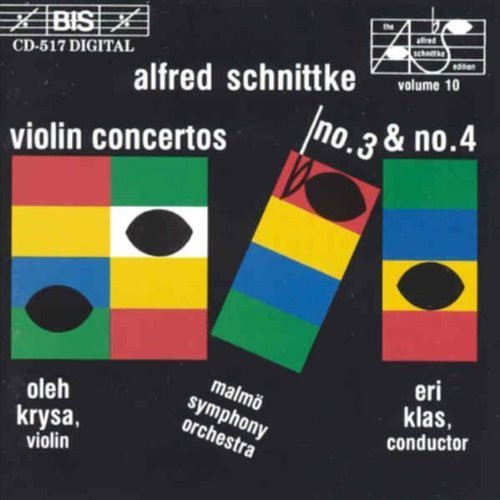
Alfred Schnittke: Violin Concertos Nos 3 & 4 / Krysa, Klas
BIS
Available as
CD
$21.99
Jun 01, 1991
Classical Music
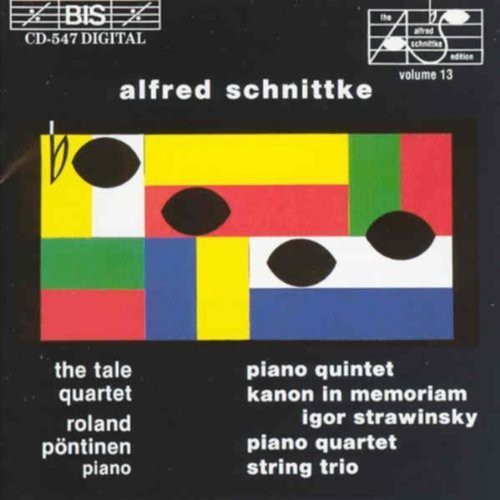
Schnittke: Piano Quintet, Kanon, Piano Quartet, String Trio
BIS
Available as
CD
$21.99
Jan 01, 1992
Classical Music
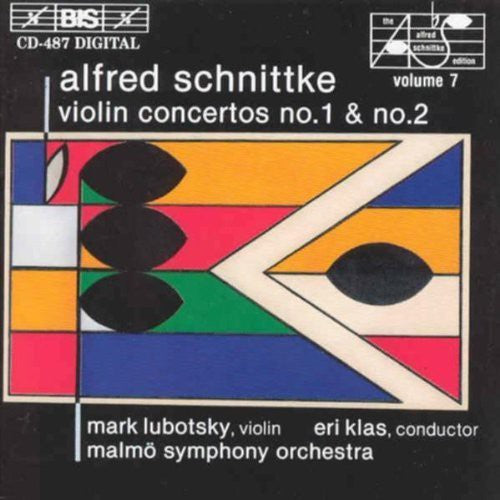
Schnittke: Violin Concertos No 1 & 2 / Lubotsky, Klas
BIS
Available as
CD
$21.99
Nov 01, 1990
Classical Music
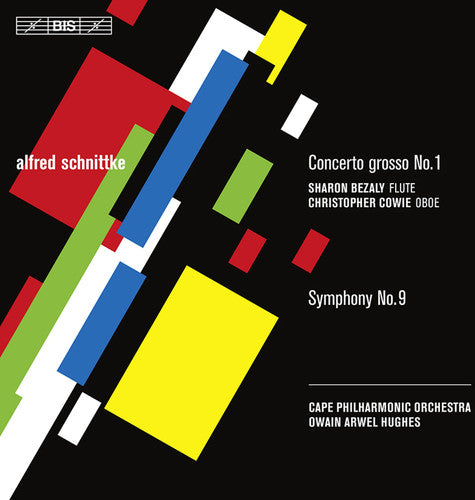
Schnittke, A.: Concerto Grosso No. 1 (Version For Flute And
BIS
Available as
CD
$21.99
Jun 01, 2009
Classical Music
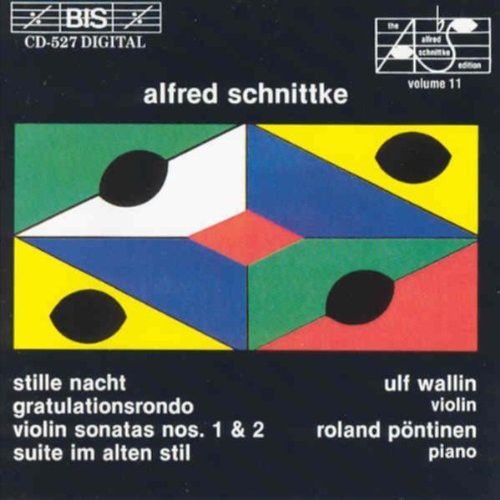
Schnittke: Violin Sonatas
BIS
Available as
CD
$21.99
Oct 01, 1991
Classical Music
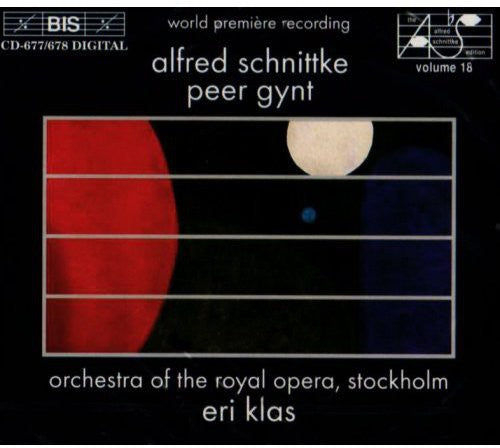
Schnittke: Peer Gynt
BIS
Available as
CD
$42.99
Sep 01, 1994
Classical Music
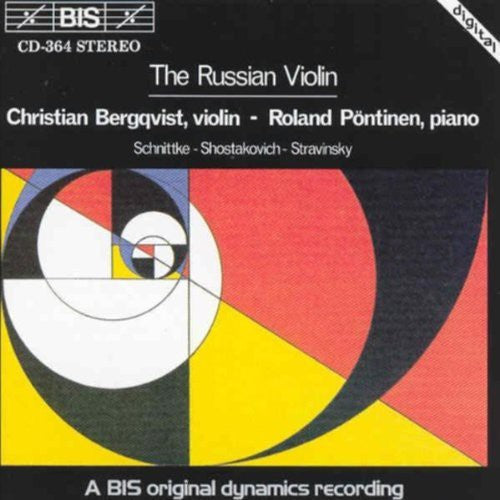
Shostakovich: Violin Sonata / Stravinsky: Dithyramb / Schnit
BIS
Available as
CD
$21.99
Jan 01, 1987
Classical Music