Anton Webern
12 products
Webern, Gielen: Works For String Quartet / Artis Quartet
-- BBC Music Magazine Reviewing Nimbus 5668
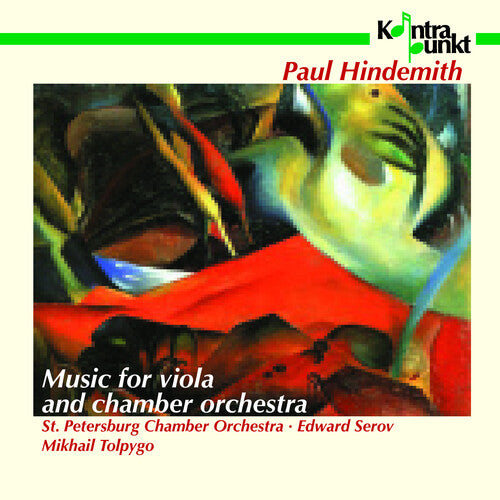
Music for Viola
Webern: Lieder
Webern.: Vocal Music / Mitsuko Shirai, Holl
WEBERN: Passacaglia / Symphony / Five Pieces
If you’re new to the music of Anton Webern, this superb budget CD is just the introduction you need. Until now, there’s been nothing much to tempt those unwilling to pay top price for Herbert von Karajan’s seminal recordings, or the equally engrossing and sometimes more revelatory DG remakes with the Berlin Philharmonic under Pierre Boulez. In contrast, Takuo Yuasa isn’t a household name, and his Ulster Orchestra isn’t in the big league, but don’t let those factors deter serious evaluation of this release alongside the best available alternatives.
Yuasa’s account of the Op. 1 Passacaglia affords striking evidence of the high quality of his ensemble. The playing is fine-grained and exact, and the cumulative effect of the performance is mightily impressive, with the vehement 16th variation especially telling. Webern’s Symphony Op. 21 may only last seven minutes or so, but Yuasa manages to pack a terrific wealth of detail and vast emotional range into its diminutive time-frame. There are some superb moments in the performance, none more shattering than the fearsome outburst from the first horn during the second section.
Equally shocking is the whip-crack violence Yuasa unleashes in the third of the Five Pieces Op. 10, played very fast and with impressive precision by this accomplished team. The awesome funeral march (No. 4 of the Six Pieces Op. 6) hasn’t quite the impact of Karajan’s, and Boulez’s is more monstrous yet; but Yuasa’s skill at building angst-ridden crescendos comes into its own in one of the finest of many outstanding moments on this recording. The muted trumpet solo in No. 5 (with celesta and glockenspiel) has the required eerie quality, and the uneasy stasis of the close is persuasively attained.
In sum, although the Ulster Orchestra’s solo and ensemble work is of high order, the principal benefit of the Karajan and Boulez recordings is that the Berliners produce playing of unrivalled tonal beauty side by side with those moments of near-seismic disturbance that are the true essence of Webern’s music. By choice, I’d opt for Boulez, whose more recent recordings are finer than DG’s earlier ones with Karajan; but Yuasa’s accounts have the spare, skeletal feel and expressive economy that makes them very rewarding indeed. An outstanding achievement.
— ClassicsToday.com (David Hurwitz)
WEBERN: Complete Songs with Piano
Webern: Vocal & Chamber Works
Vocal Recital: Oelze, Christiane - Schubert, F. / Schumann,
Webern: Symphony, Six Pieces, Etc / Craft, Philharmonia
Webern: Vocal and Orchestral Works / Craft, Arnold, Booth, Et Al
WEBERN Ricercata from Bach’s “Musical Offering.” 5 2 Songs, op. 19. 4,6 5 Movements for String Orchestra. 6 2 Songs, op. 8. 1,5 5 Pieces for Orchestra, op. 10. 6 4 Songs, op. 13. 1,5 6 Songs, op. 14. 1,5 5 Sacred Songs, op. 15. 1,5 Das Augenlicht. 4,6 Variations for Orchestra. 5 Second Cantata 2,3,4,6 • Robert Craft, cond; Tony Arnold (sop); 1 Claire Booth (sop); 2 David Wilson-Johnson (bs); 3 Simon Joly Ch; 4 20th Century Classics Ens; 5 Philharmonia O 6 • NAXOS 8.557531 (79:32)
Craft was the first to record Webern’s “complete” works, back in the 1950s. His four- LP monaural Columbia album was a revelation—and a tribute to the commercial daring of Columbia’s Goddard Lieberson. Although there had been four or five earlier recordings of single Webern works, Craft’s set joined only one other Webern piece in the 1957 Schwann catalogs. It was to remain available for more than two decades, until succeeded by Boulez’s stereo remake in 1979, dubbed—at the last minute—Vol. 1 because a trove of previously unknown works had been discovered. While the stereo LPs were a great improvement, both for their sound quality and their performances, the latter were due to the singers and players more than to the conductor. Webern had gained respect—indeed, had become the guru of musical academia—and musicians were leaning how to perform his works. The learning curve continued well into the CD era; an appropriate punctuation being the 1992 appearance of a superb Webern disc by the Netherlands Ballet Orchestra (nla). Now everyone could play Webern (if not yet sing him), not just the avant-garde specialists. Listeners of my generation learned Webern from that first Craft set, and we are forever in his debt. If he could not then convince us of the music’s beauty, he drew our attention and piqued our interest.
The Twentieth Century Classics Ensemble is a group contracted for Craft’s recordings, its players handpicked by cellist Fred Sherry. Personnel listings for each piece show it to include the best of free-lance American musicians—I am almost afraid to name some, for fear of slighting equally superb colleagues: Charles Neidlich, William Purvis, Paul Neubauer, and Sherry are so well known that I don’t even need to list their instruments. Soprano Arnold, professor of voice at SUNY Buffalo, is a renowned new-music specialist; she sings Webern with glorious panache. These recordings were made during 2007 and 2008—the Philharmonia sessions at EMI’s Abbey Road Studio No. 1, the American ones at SUNY Purchase, New York, and at the American Academy of Arts and Letters in New York City. The solo songs (at SUNY) are clean and clear, but the chorus (at Abbey Road) is set in a reverberant acoustic that denies us the exact words, even with libretto in hand. As usual with Naxos, librettos are posted on the Internet, but the texts of Das Augenlicht and of the Second Cantata are missing.
One of the pleasures of any Craft release is reading his feisty, superbly informed, damn-the-torpedoes program notes. As usual, he insists that these performances are the only correct ones: “[W]e can blame the failure to understand this piece [the op. 30 Variations] on the ignoring of Webern’s admonition to follow his metronomic markings. The present recording is the first attempt to play the work at metronomic speed. Thus, the DGG [Abbado? Boulez?] trudges along at about 116 for the fast pulsation, as against the required 160, and continues at nearly the same 116 for the slow beat.” In addition to his chutzpah, Craft is usually right. Despite that statement, Craft’s Webern performances are generally softer and more listener-friendly than either Abbado’s sophisticated, highly polished renditions or Boulez’s careful but often stolid performances. Although dubbed the BBC Singers, Boulez’s chorus is also directed by Simon Joly; with the Webern œuvre now doubled, Boulez’s DG recordings fill six CDs and are currently distributed only in a complete set. For the op. 30 Variations , however, I recommend the vibrant, superbly recorded performance by Jac van Steen on a surround-sound SACD, MDG 901 1425.
FANFARE: James H. North
Webern: Complete Works For String Quartet, Piano Quintet
Includes work(s) by Anton von Webern. Ensemble: Leipzig String Quartet.
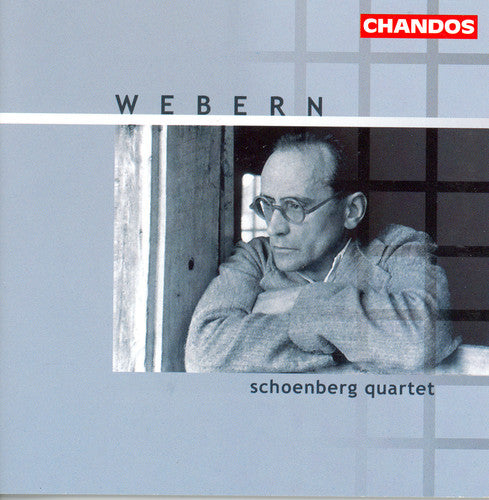
Webern / Schoenberg Quartet
The Schoenberg Quartet continues its traversal of the chamber music of the Second Viennese School (plus certain of their contemporaries) with this very well filled survey of the music of Anton Webern. Having found their Berg disc to be rather cool and under-powered for some of that composer’s overheated textures, it’s good to report a much more satisfying result here.
To have all this music on one single disc makes this excellent value anyway, regardless of quality of performance. There are other good discs of Webern’s chamber music, but none are as comprehensive as this. It gives the listener a virtually complete picture of the composer’s output, from the early Romantic pieces right through to his maturity. The posthumously published works are well worth hearing, even if the composer himself disregarded them and may well have been uneasy about them being included. In fact the longest work on the disc is the String Quartet from 1905 which, at over 17 minutes, is one of the longest pieces in the entire Webern canon! Its lush harmonies and wandering melodic lines clearly indicate an affinity with early Schoenberg (himself still under the spell of Wagner) and one can detect Verklärte Nacht at many turns. But though the tonal centres are clear and the harmony recognisable, there is a hint of things to come, particularly in the way that the main melodic motif’s angular quality signals its serial potential.
The gorgeous little Slow Movement from the same year has many of the same characteristics, and here the use of the turn makes one think directly of Tristan, even if the bitter sweet tonality is entirely Viennese.
The Six Bagatelles of 1911-13 begin to show the sort of thumbprints that Webern became famous for, notably brevity of utterance and an aphoristic style that he was to perfect over the ensuing years. They are beautifully crafted little jewels, where the silence between the notes becomes as important as the notes themselves. The Schoenberg’s seem to understand this perfectly, making sure that weight of attack is crisp and handling of texture and dynamics is clean and clear. Most of these minuscule works last under a minute, so every note has to count.
The experienced pianist Sepp Grotenhuis joins in for a number of other works, the most interesting of which seemed to me to be the Three Little Pieces of 1914, typical Webern. Extreme brevity is again apparent (the pieces are 9, 13 and 10 bars respectively), but he still manages to convey emotion and feeling into his microcosmic world.
The Schoenberg’s utter refinement and feeling for these special textures pay real dividends in the mature Trio and Quartet, possibly the best known pieces (certainly the most oft-recorded) on the disc. The Op.28 Quartet seems to inhabit a more sober world of serialism (it became a calling card for the post-war avant-garde), and the terse, spare movements are riddled with codes and patterns which still make for demanding, concentrated listening. Only in the finale do we get a feeling of longing, of harking back to old Expressionistic tendencies, of something approaching emotion.
The whole disc is a great success. Recording quality is first rate, with the necessary clarity tempered by warmth and just the right amount of resonance. Excellent notes are by Dr. Christopher Hailey. Recommended, even if you still find Webern hard work.
- Tony Haywood, MusicWeb International