Antonio Soler
45 products
Soler: Sonatas For Harpsichord Vol 13 / Gilbert Rowland
This disc is announced as the final instalment of Gilbert Rowland’s Naxos cycle of the complete Sonatas for Harpsichord by Padre Antonio Soler. I haven’t heard all of the earlier volumes, so I won’t attempt any kind of comprehensive statement about the project as a whole, but my impression, for what it’s worth, is that the series has got better and better as it has gone on. I agree with Patrick Waller (see his review of Volume 12) that the recorded sound has improved in later volumes; it was rather clattery and echoing on some of the early discs, but there are certainly no problems with the sound on this final volume. My sense is also that Gilbert Rowland has come to sound more and more at home with the music, his playing increasingly relaxed, his phrasing more flexible and his range of tonal colours more various. Whether or not these (remembered) impressions are correct, what I can say with some confidence is that this final disc is full of exciting and exhilarating music, played with considerable panache.
Spanish musical traditions are, of course, a central element in Soler’s harpsichord music; traditional Spanish dance rhythms are very clearly audible in the almost seven minutes of the central allegro (marked ‘assai spiritoso’) of Sonata 66, played here with sympathetic (and technically assured) flair; Spanish idioms are also very much to the fore in the opening Cantabile of Sonata 60. At times (as in Sonata 76) the influence of Domenico Scarlatti, Soler’s erstwhile teacher is evident. But Soler clearly listened rather more widely - at times the music prompts one to think of C.P.E. Bach.
Elsewhere, Soler’s fugues would satisfy all but the most pedantically rigorous of Germanic theorists. The fugal third movement of Sonata 66 is a delight, though some of its modulations might perhaps upset that hypothetical pedantic theorist; surely even he (or she?) would find little to complain about in the ‘intento a 4’ which closes Sonata 68, beautifully worked out and technically very accomplished.
But if Soler could be ‘correct’, he could also be somewhat shocking. The allegro in 6/8 of Sonata 60 is full of unexpected leaps and begins with some unconventional harmonies (“almost Bartókian” says Rowland in his characteristically useful booklet notes) that even now retain some of their power to startle.
Rowland responds to the range of this music and, on this disc at any rate, plays it with real innerness. At times here, as on some of the earlier volumes, I wondered whether one or two of the pieces might not work better still on the organ, but that is a quibble which shouldn’t detract from our gratitude to Rowland and to Naxos for the completion of this substantial project. I believe that the only sonatas by Soler which were ever published during the Eighteenth Century were those which appeared as XXVII Sonatas para clave, published around 1796 by Richard Birchall of London. So there is an aptness in the choice of a British (Rowland was born in Glasgow) harpsichordist as the protagonist for this series. In this final disc he plays a two manual instrument by Andrew Wooderson, made in 2005 and modelled on 1750 instrument from the Goermans workshop in Paris – and with its bright (but not excessively so) sound and clear articulation it enables Rowland to do something like full justice to this engaging music.
-- Glyn Pursglove, MusicWeb International
Soler: Sonatas For Harpsichord Vol 12 / Gilbert Rowland
Includes sonata(s) for keyboard by Antonio Soler. Soloist: Gilbert Rowland.
Soler: Sonatas For Harpsichord Vol 11 / Gilbert Rowland
Given all this, it is not surprising that Soler’s output is a little uneven. I haven’t heard all ten previous volumes of Gilbert Rowland’s Naxos series, but on some of the ones I have heard this was very marked . In volume 11 the general level is pretty high, most of the sonatas, in their different ways, showing Soler at something like his best.
In many of the sonatas – like much in the music of Scarlatti (with whom Soler studied) and Boccherini – one can hear the influence of the syncopated dance rhythms of Spain. This is true, for example, of the second subject in the C major sonata which opens the present programme (and which has no Rubio number, not being included in Father Samuel Rubio’s great edition) and of sonatas 45 and 51. There are places, too, where some of Soler’s melodic materials sound as though they may be derived from Spanish folk music, as in the first two movements of Sonata 65.
Yet, for all his ‘Spanishness’, Soler can sometimes surprise one by writing in idioms which one wouldn’t readily think of as Spanish. So, for example, the Rondo, marked ‘andantino con moto’, which opens the four-movement Sonata 62 sounds more like a piece of Viennese classicism, like Haydn or Mozart, for example, than anything else – if one heard it played on the fortepiano the resemblance would, I suspect, seem even greater. This is really only to say that Soler is a good deal more various than he has sometimes been thought to be, that he is far more than merely an imitator of Scarlatti. His sonatas in several movements – this CD includes no. 65 in three movements, as well as Sonata 62 – attempt things quite different from the work of his early master, for all the many echoes of Scarlatti.
Gilbert Rowlands has a sure-fingered understanding of Soler’s idioms and a clear-sighted sense of the differences between the sonatas (evident in his useful booklet notes as well as in his performances). I enjoy his playing, except perhaps in some of the louder climaxes, though this may be the fault of a not especially attractive sounding instrument – described as a "Concert Flemish harpsichord from the Paris Workshop, prepared and tuned by Andrew Wooderson". But this is a relatively small blemish on a generally interesting and enjoyable recital.
-- Glyn Pursglove, MusicWeb International
Soler: Sonatas For Harpsichord Vol 10 / Gilbert Rowland
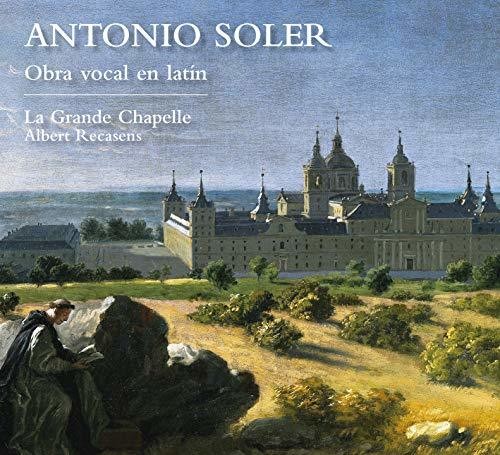
Soler: Obra vocal en latin / Recasens, La Grande Chapelle
Antonio Soler is the 17th century’s Spanish composer with the greatest international projection. His fame is due to the celebrated sonatas for harpsichord and his chamber music. However, Soler also produced an extensive oeuvre of vocal music thanks to the more than thirty years he spent at the Monastery of San Lorenzo de El Escorial, where he was organist and maestro de capilla. This album gathers a carefully selected group of compositions in Latin written for two choruses and instrumental ensemble, some of which have never been recorded. Based on the technical procedures involved in polychoral writing, these works are made up of imposing choral sections- of both homophonic and contrapuntal textures- and sections for soloists with either a cantabile or virtuoso character closer to a theatrical style, all of which shows his mastery throughout an admirable stylistic spectrum. This pioneering initiative reveals the abundant imagination, the vocal writing skill and the ample scope of expressive resources employed by the great Catalan musician.
Soler: Keyboard Sonatas, Vol. 8 - Nos. 75-86 / Ann
For the last 25 years of his life Antonio Soler occupied the distinguished positions of maestro di capilla and organist at the Escorial palace. He wrote around 150 keyboard sonatas, which remain his best-known achievement, a body of music that reveals the subtle influence of Domenico Scarlatti on the Catalan composer, as well as prevailing Viennese trends. Volume eight of the complete sonatas shows Soler’s cultivation of expressive melancholy in No. 77 in F sharp minor, a virtuosic use of the full range of the keyboard in No. 85 in F sharp minor and characteristically vibrant Spanish motifs in No. 86 in D major. Soo-Jung Ann has had great success at international piano competitions, receiving first prize at the International Telekom Beethoven Competition in Bonn in 2013, the Arturo Benedetti Michelangeli Prize of the Piano Academy in Eppan in 2013, and first prize at the Maria Canals International Music Competition. She has performed widely and appeared as a concerto soloist with the finest orchestras of Europe.
Soler: Keyboard Sonatas Nos. 57-62 / Colic
In 1757 the young Catalan composer Antonio Soler was appointed to a distinguished position at the Escorial, the palace of the Spanish Court. The keyboard sonatas he wrote there, many specifically for the son of King Carlos III, Don Gabriel, constitute his best known achievement as a composer. The Sonatas heard on this fifth volume once again reflect the influence of Domenico Scarlatti and the latest central European models but Sonata No. 57 also draws inspiration from Spanish folk music while Sonata No. 61 ends with use of the Scotch snap rhythm.
Soler: Keyboard Sonatas, Nos. 67-74 / Chernychko
Antonio Soler's training as a chorister, organist and composer equipped the young Catalan for the prestigious position of maestro di capilla at the Escorial palace. Here he was strongly influenced by domenico Scarlatti in his writing o fkeyboard sonatas for the young prince Don Gabriel, son of Carlos III. The inventive and ingenious works heard in this volume of the complete set of sonatas reveal his command of the medium, from the fugal brilliance of No. 67 in D major and the virtuoso elements of No. 69 in F major to the delightfully Spanish flavor encountered in No. 74 in D major.
Soler: Keyboard Sonatas Nos. 42-56 / Mateusz Borowiak

The fourth installment in Naxos’ Soler keyboard sonata cycle introduces 25-year-old pianist Mateusz Borowiak, who has begun to make a name for himself on the competition and European festival circuit. While his playing is sensitive and stylish with regard to ornaments and phrasing, Borowiak is not afraid to exploit the modern concert grand’s dynamic range and potential for tone color. Listen, for example, to the effective crescendos and sudden contrasts in the C minor No. 48’s introductory measures, to the cross-rhythmic accents that punctuate the G major No. 45’s broken octaves, or to the shaded precision of the C major No. 50’s two-handed unison passages. Sample the A major No. 53’s differentiated detached and sustained articulation, not to mention those impressively calibrated trills. The intimate yet full bodied sonics are remarkably lifelike, as if Borowiak is working his magic just a few feet away from you. In short, this disc, along with numerous live performances posted on YouTube, clearly positions Borowiak as a piano talent to keep on your radar.
-- Jed Distler, ClassicsToday.com
Soler: Keyboard Sonatas Nos. 28-41 / Denis Zhdanov
Antonio Soler’s eminent position at the eighteenth-century Spanish court led to a series of important works, both sacred and secular. Of them, the best known are his keyboard sonatas, many of which were written for the young prince, Don Gabriel, son of Carlos III. The sonatas manage to absorb the influence of Domenico Scarlatti but also exude the prevailing modernist trends of Vienna. Some are designed in pairs, and many employ subtle echo effects, syncopation and exciting, athletic leaps that show his delight in repetition and contrast. This is Volume 3 of the complete Soler Keyboard Sonatas.
Soler: Keyboard Sonatas No 16-27 / Vestard Shimkus
This collection completes the 27 sonatas by Padre Antonio Soler which make up his contribution to the Fitzwilliam manuscript. Nos 1–15 are available on Naxos 8.572515. These bipartite sonatas contain prime examples of Soler’s theories of modulation, from elegant “slow” passing between notes to “agitated” extremes of contrast. The result is constant surprise, both in spectacular technique and expressive depth. Award-winning pianist Vestard Shimkus has been described as “a phenomenon” (conductor Paavo Järvi), “superb” (American Record Guide) and “inspired” (BBC.co.uk website).
Soler: Keyboard Sonatas No 1-15 / Martina Filjak
Soler was music master to the princes of Bourbon in El Escorial, the palace of the King of Spain. It’s probable that most of his keyboard sonatas were written for Prince Gabriel and these essentially private works—around 150 have survived—bear comparison with the works of Domenico Scarlatti and C.P.E. Bach. Soler was fond of dance rhythms and guitar imitations, as well as infectious and delightful modulations. These fifteen sonatas are heard here in the order proposed by Rubio’s catalogue. Pianist Martina Filjak—“brilliance, sensitivity and imagination” (New York Times)—is a much admired international artist.
Soler: Concerti For Two Organs / Shawn Leopard, John Paul
Soler: Complete Keyboard Sonatas; Six Concertos for Two Organs
This collection brings together all of Pieter-Jan Belder’s complete recordings of Soler’s keyboard works, which he has been releasing over the past eight years on the Brilliant Classics label, to great acclaim. Belder is a true scholar of Soler, and has used both the older Rubio edition of the works as well as Marvin’s more updated version, making this release stand out from previous Soler recordings. The collection benefits from the use of different instruments, such as the fortepiano, and the last disc features Soler’s truly extraordinary six concertos for double organ, which he apparently wrote for the Infante son of King Charles III. These are performed by renowned organists Maurizio Croci and Pieter van Dijk, who searched high and low for the perfect place to record these highly unusual works – to great effect.
As a bonus the recording is included of 6 sonatas for two organs, by renowned organists Maurizio Croci and Pieter van Dijk.
Soler: 6 Concertos for 2 Harpsichords / Alvarez, Fernandez-Villacanas
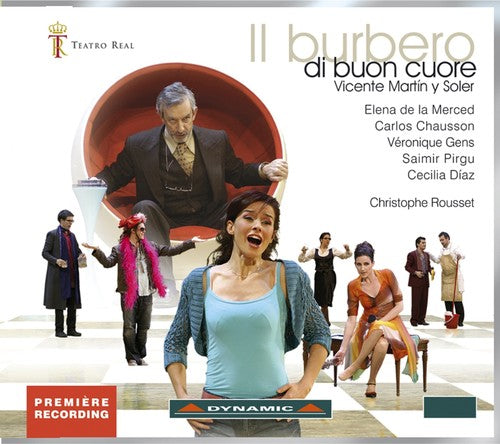
Martin Y Soler: Il Burbero Di Buon Cuore / Rousset, Madrid Teatro Real
MARTÍN Y SOLER Il burbero di buon cuore • Christophe Rousset, cond; Elena de la Merced ( Angelica ); Carlos Chausson ( Ferramondo ); Véronique Gens ( Madama Lucilla ); Saimir Pirgu ( Giocondo ); Cecilia Diaz ( Marina ); Juan Francisco Gatell ( Valerio ); O Sinfónica de Madrid • DYNAMIC 58801-2 (2 CDs 136:20) Live: Madrid 11/2007
This performance has been previously released on a Dynamic DVD and was reviewed in Fanfare 33:4 by Barry Brenesal. The opera opened in 1786, the same year as Mozart’s Le Nozze di Figaro , and both were revived in Vienna three years later. In the revival of Il bubero di buon cuore , since Martín y Soler was then in the court of Catherine the Great in St. Petersburg, Mozart wrote two new arias for Madama Lucilla. “Chi sa qual sia l’affano” and “Vado, ma dove, o Dei?,” which are beautifully sung on this recording by Véronique Gens, the first aria on CD 1, track 18, and the second on CD 2, track 4.
The libretto, by Lorenzo da Ponte, was taken from a 1771 play, Le bourru bien-faisant by Carlo Goldoni. The plot concerns two young lovers who after many intrigues and disguises finally receive the approval of their bad-tempered uncle Ferramondo. The booklet contains a well-written version of the complicated plot.
Carlos Chausson in the star role of Ferramondo has a resonant basso buffo, Pirgu and Gatell are both fine lyric tenors. Pirgu has a longer role and displays an attractive tonal quality. Diaz as Marina is the weakest member of the cast but her contralto is best at the bottom of her range. Roussett is a fine conductor, and the sound is fine.
As Barry Brenesal wrote in his review of the DVD of this production: “In short—with a few noted reservations—this is a fine cast in an unusually well–directed production of an entertaining forgotten opera.”
The booklet contains a list of the tracks, notes by Danilo Prefumo translated into English by T. A. Shaw as well as a plot synopsis. I have found that the DVD is not easily available today, and therefore recommend this interesting CD of what is an entertaining opera for all those who admire classical music.
FANFARE: Bob Rose
Soler: Keyboard Sonatas Nos. 87-92 / Avagyan
Soler: Keyboard Sonatas Nos. 96–98 / Liepinš
Like many Catalan musicians of his time, Antonio Soler received initial training as a chorister before his excellence as an organist ensured high appointment at the Escorial, Spain’s royal palace. Here he absorbed the influence of Domenico Scarlatti, and the keyboard sonatas Soler composed remain his most lasting contribution to musical history. The three sonatas in this volume reflect his awareness of trends in Viennese music and are notable for their vivid pastoral elements, refined delicacy and sizzling virtuosic demands.
20th Century Spanish Composer Series - J. Soler / Jordi Masó
Includes work(s) by Josep Soler. Soloist: Jordi Masó.