Antonín Dvořák
76 products
-
-
-
-
-
-
-
Piano Trios 3 & 4
$18.99CDCPO
Nov 07, 2025555688-2 -
Dvorak: Violin Concerto & String Serenade
$17.99CDCAvi-music
Oct 31, 2025AVI 4867795 -
Dvorak: Slavonic Dances
$17.99CDPENTATONE
Nov 28, 2025PTC5187414 -
Dvorak: String Quartet, Op. 96, String Quintet, Op. 97 & Hum
$20.99CDAudite Musikproduktion
Oct 24, 2025ADT97828 -
Symphonic Poems
$22.99CDProspero Classical
Jul 04, 2025PROSP0077 -
Mendelssohn & Dvorak: String Quartets
$20.99CDGenuin
Apr 04, 2025GEN 25897 -
Dvorak: Stabat Mater
$21.99SACDPENTATONE
Apr 04, 2025PTC5187222 -
-
Dvořák: Symphony No. 9 / Stutzmann, Atlanta Symphony
The first album from Nathalie Stutzmann as conductor features Dvořák's well known Symphony No. 9" From The New World" and the lesser known American Suite. Nathalie Stutzmann studied conducting with legendary Finnish teacher Jorma Panula, and has benefited from the mentoring of Simon Rattle and the late Seiji Ozawa. She holds two major posts in the USA - Music Director at the Atlanta Symphony Orchestra, and Principal Guest Conductor of The Philadelphia Orchestra - and has guest engagements with the London Symphony Orchestra, Orchestre de Paris, Bayreuth Festival amongst others. Simon Rattle told the NY times: "Nathalie is the real thing. So much love, intensity and sheer technique."
Four Hands - Alexandre Tharaud & Friends
This was something I'd had in mind for a long time..." says pianist Alexandre Tharaud, "to put together an album for the sheer pleasure of it, in collaboration with dear friends and paying tribute to the wonders of the piano duet repertoire." The aptly named 4 Hands offers 18 tracks, each just a few minutes in length, each featuring Tharaud sharing a piano keyboard with a different partner. The repertoire ranges wide - from Bach to Glass by way of such composers as Schubert, Tchaikovsky, Grieg, Fauré, Satie, Debussy, Ravel, Rachmaninoff, Ravel, and Piazzolla. 15 of Tharaud's fellow performers are celebrated pianists - among them the late Nicholas Angelich, Mariam Batsashvili, Bertrand Chamayou, David Fray, Víkingur Ólafsson, and Beatrice Rana. The other three, all stars in their musical fields, are shown in a new, pianistic light: cellist Gautier Capuçon, countertenor Philippe Jaroussky and singer-songwriter Juliette. "The piano duet is one of life's miracles," continues Tharaud. "First and foremost, it is the most intimate way of playing chamber music... It was a joy to record this album... If hearing these pieces prompts people to buy some sheet music and enjoy playing duets together - just as we did in the recording studio - then I will have achieved my aim.
Lars Vogt - The Complete Warner Classics Edition
Lars Vogt (1970-2022) early recordings collected here provide a document of an artist who always remained authentic, both to himself and to music. Lars Vogt never sought absolute truth, but truthfulness instead meant all the more to him. The man and the artist were always very close, never currying favour and never detached from the world. He was, instead, open and natural. "It's incredibly gratifying when you notice that you can perhaps light a little spark, a little flame for music in people, and when music helps you to find the path to your own soul."
Leif Ove Andsnes - The Warner Classics Edition 1990-2010
Wolfgang Sawallisch: Complete Symphonic, Lieder & Choral Recordings - Warner Classics Edition, Vol. 1
Antonio Pappano - Complete Santa Cecilia Symphonic,Concertante & Sacred Music Recordings
Pablo Casals - The Complete HMV Recordings 1926-1955
The Catalan cellist Pablo Casals (1876-1973) was first to bring to wider notice the works that open this set, J.S. Bach's solo cello suites. Thereafter we hear his celebrated partnership with Horszowski in Beethoven and the groundbreaking piano trio formed with Thibaud and Cortot in Haydn, Beethoven, Schubert, Schumann and Mendelssohn. From the symphonic repertoire come the concertos by Dvořák (with George Szell) and Elgar (Adrian Boult). Finally, an enchanting disc of encores and - with Casals's own street-band or cobla - seven examples of the sardana, the national dance of the great artist's beloved homeland.
Artemis Quartett - The Complete Recordings 1996-2018
Intense, passionate, and impeccable in its musical disciplines, the Berlin-based Artemis Quartet "consistently finds a balance between projecting musical structure and conveying immediacy." Confirming that verdict from the New York Times is this 23CD collection, encompassing all the recordings the ensemble made between 1996 and 2018.
The Artemis Quartet began life in 1989 and developed a particular reputation in the central Austro-German repertoire. If Beethoven justly asserts a powerful presence, the scope of this collection extends as far as Eastern Europe and South America and well into the 20th century. Over the period of nearly a quarter of a century documented in this box, there were changes in the Artemis Quartet's lineup, but as founding cellist Eckart Runge explains, this "brought new inspiration - an opportunity to broaden horizons and introduce fresh ideas."
The ensemble suffered a tragic loss with the untimely death of violist Friedemann Weigle in 2015. Just days earlier, the Artemis had completed a recording of Dvořák's lyrical and poignant 'American' Quartet; it is now released for the very first time. This landmark box is completed by a comprehensive booklet which includes reminiscences from members of the Artemis Quartet and from sound engineers who collaborated with them.
Suk, Dvorak & Janacek: Orchestral Works
Dvorak: Cello Concerto
Dvorak: Songs
Bohemian Legacy
Piano Trios 3 & 4
Dvorak: Violin Concerto & String Serenade
Dvorak: Slavonic Dances
Dvorak: String Quartet, Op. 96, String Quintet, Op. 97 & Hum
Symphonic Poems
Mendelssohn & Dvorak: String Quartets
Dvorak: Stabat Mater
Dvorak & Suk: String Serenades
Dvorak: Cello Concerto & Pieces
Vaclav Neumann Conducts Dvorak & Smetana
Dvorak: Stabat Mater, Op. 58
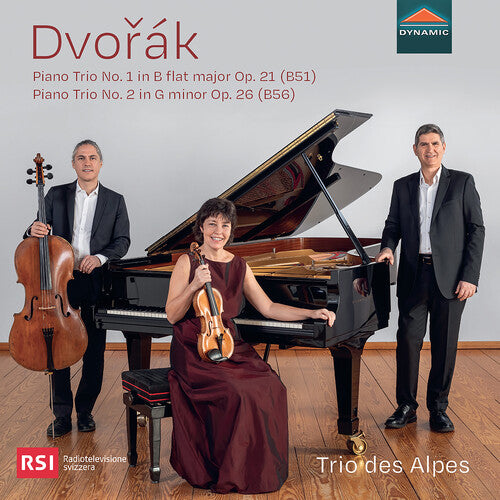
Dvořák: Piano Trios Nos. 1 & 2 / Trio des Alpes
Dvořák’s chamber music is amongst the most extensive and significant of the 19th century, and the four surviving piano trios embody his command of the form. The first two were written in rapid succession, with No. 1 in B flat major marrying Schubertian lyricism with Slavic inflexions, serenity with joy. No. 2 in G minor is rather more classically conceived, though it shares the same formal structure as No. 1 and exudes a similar quotient of lyric beauty.