Baldassare Galuppi
17 products
-
-
-
Wonder in Venice - Galuppi: Sonatas & Concertos for Harpsich
$20.99CDArcana
May 23, 2025A579 -
-
-
-
-
-
-
-
-
-
-
-
-
-
-
-
Wonder in Venice - Galuppi: Sonatas & Concertos for Harpsich
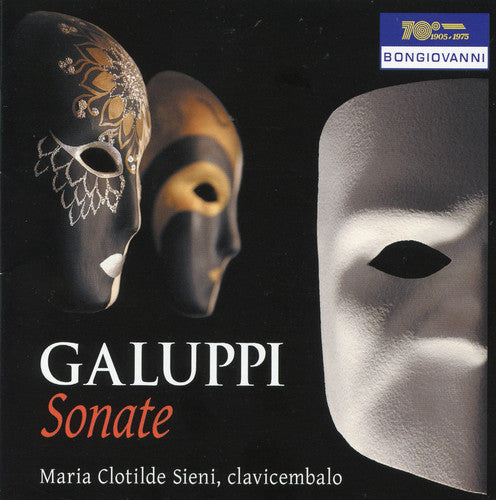
Galuppi: Sonate
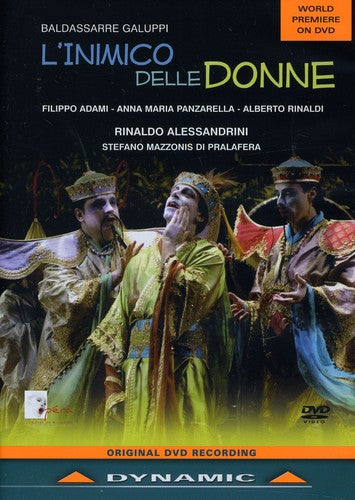
L'INIMICO DELLE DONNE
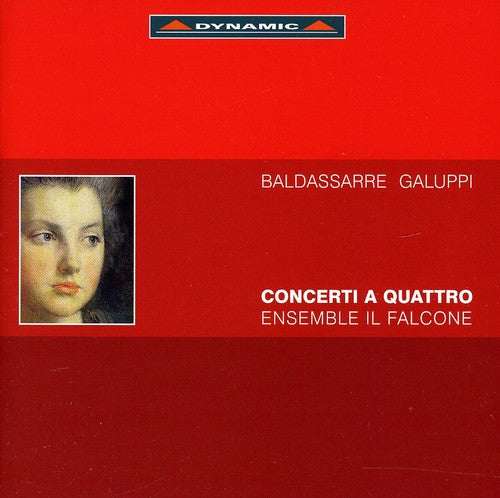
GALUPPI: Concerto a 4, Nos. 1-7
COUNTRY PHILOSOPHER
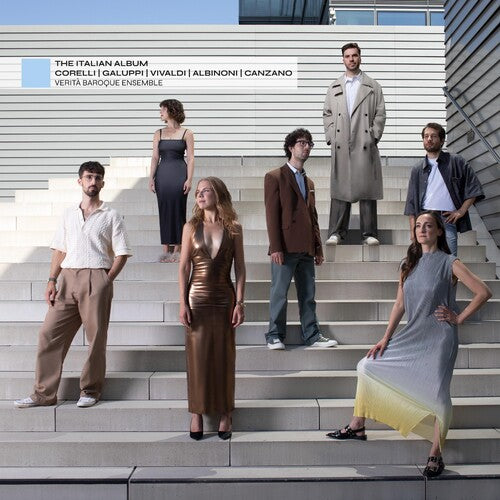
Galuppi, Vivaldi, Albinoni & Corelli: The Italian Album
Following their debut album, The German Album, the ensemble presents the second album of the series: The Italian Album. Featuring a repertoire of baroque compositions by Corelli, Vivaldi, Albinoni, and Galuppi, Verità invites listeners on a captivating journey through time. The tracks on this album were recorded in four different baroque castles. This baroque repertoire is played on historical instruments and recorded in halls for which is was originally composed for. Creating an authentic atmosphere.
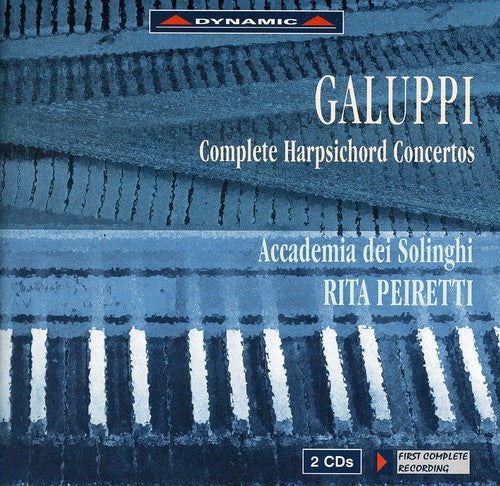
Galuppi: Complete Harpsichord
Galuppi: Sonatas for Harpsichord / Alvise de Piero
172 pieces, 400 movements, 3, or more, compositional decades: those are the main features at the basis of the corpus of the keyboard Sonatas of Baldassare Galuppi, known as “il Buranello”. The indeterminacy of a specific instrument and the cultural influence of several European countries give to his music a heterogeneous character both in formal and stylistic terms, following that movement of ideas so typical among the best composers of the time. The Sonatas included in this Album come from different manuscripts and their musical language seems almost a sampler of Buranello’s different compositional modes.
Galuppi: Sei Sonate A Tre A Due Violini E Basso Continuo
GALUPPI 6 Trio Sonatas • Accademia dei Solinghi • DYNAMIC 694 (54:05)
Venetian composer Baldassare Galuppi wrote his six trio sonatas, according to Danilo Prefumo’s notes, in 1760, and with their homophonic textures, relatively simple melodic patterns diced into relatively short, often repeated phrases, and their division into three movements each (fast-slow-fast), they look forward to the Classical era rather than back toward the Baroque, despite their being composed in the venerable genre of the trio sonata (it’s a case of new wine in old bottles rather than old wine in new bottles). William S. Newman treated Galuppi’s works (primarily his keyboard sonatas) in his book on the Classical era rather than in his volume on the Baroque: He deemed Galuppi a preeminent pre-Classical composer. The sonatas surely aren’t without affecting sentiment, as the First Sonata’s slow movement or especially the sighs from the Second Sonata’s corresponding movement show (in addition, in the Second Sonata, to the dialog pitting the two violins against the harpsichord). The first movement of the Second Sonata bustles with a kind of energy that even Antonio Vivaldi’s sharply chiseled concerto subjects don’t always evince. It may not be surprising to find all these concertos written in the major mode (in this case, A, F, D, G, B?, and E) in light of Newman’s estimate that Galuppi wrote more than 80 percent of his sonatas in major.
In general, the sonatas’ first movements crackle (many listeners, cueing a random track, might relatively easily identify it as a first movement or a finale); the second movements, as noted above, include sensitive turns of phrase and harmonic subtleties (some even recalling Mozart, though Newman dismisses the suggestion of a direct influence on the later composer); the finales, though often marked Allegro , frequently glide elegantly rather than drive forward (with occasional exceptions, like the finale of the Fifth Sonata, the jaunty figuration of which spans both manners). Prefumo notes the title given the Sixth Sonata’s slow movement, Dialogo tra Pasquino e Marforio , perhaps referring to two Roman “talking statues.” In any case, this brief movement, subtitled Recitativo instrumentato , features passages that Galuppi, as a noted opera composer, may have delighted to transfer to this instrumental genre; the sonata’s finale also bears a title, in this case, Ritornello , though the device hardly suggests the one by the same name that characterized Vivaldi’s concertos. The Accademia dei Solinghi (Claudio Adriani playing an Andrea Guarneri violin from 1675, Franco Simeoni playing a violin made in 2007 by Franco Simeoni, Alessandro Peiretti playing an anonymous late 18th-century cello, and Rita Peiretti playing a harpsichord made by Davide Peiretti in 1986) endows these sonatas with a brusque energy that brings to vivid life Charles Burney’s remarks, after he’d encountered Galuppi’s music in Italy, about the composer’s youthful imagination. Dynamic has provided a close up portrait of the ensemble, yet surrounds the instruments with enough reverberation to fuse their crunchy textures into a pleasingly mellifluous amalgam. On the basis of the sonatas’ lively and ingratiating melodic imagination and of the energetic and sympathetic performances by the Accademia, Dynamic’s release should appeal more widely than to specialists.
FANFARE: Robert Maxham
---------
For some centuries Venice was one of the main centres of music-making in Italy. In the early 18th century Vivaldi was the key figure in the music scene, composing numerous operas, sacred works and instrumental pieces. After his death in 1741 his place was taken by Baldassare Galuppi, who soon became the most fashionable Italian master. His popularity was such that pieces by other composers were sold as written by Galuppi. One example is a setting of the Dixit Dominus which was purchased by the court in Dresden as a composition by Galuppi. Only fairly recently the true identity of the composer was discovered: Antonio Vivaldi.
Galuppi was born in Burano which explains his nickname 'Buranello'. His father was a violinist, who worked as a barber for a living. Galuppi's main teacher was Antonio Lotti. The English journalist Charles Burney visited Galuppi in 1770 and wrote: "Signor Galuppi was a scholar of the famous Lotti, and very early taken notice as a good harpsichord player, and a genius in composition. (...) He certainly merits all that can be done for him, being one of the few remaining original geniuses of the best school perhaps that Italy ever saw. His compositions are always ingenious and natural, and I may add, that he is a good contrapuntist, and a friend to poetry."
Galuppi has mainly become famous as a composer of operas, both serious and comic. His output in this genre is huge. In addition his work-list includes a large number of serenatas, oratorios and liturgical music. The largest part of his instrumental music is for keyboard. His oeuvre for instrumental ensemble is relatively limited: eight concertos for harpsichord and strings, seven concerti a quattro and the six trio sonatas which are the subject of this disc. They probably date from around 1760; they were not printed but have been preserved in a manuscript which is kept in the library of the University of Uppsala.
The judgement of Charles Burney that Galuppi was a "good contrapuntist" is affirmed by these sonatas which are written in the galant idiom. They are also an expression of the ideal of naturalness which was propagated by the Italian violin virtuoso and composer Giuseppe Tartini. All the sonatas are in three movements: fast - slow - fast. Although the two violins are basically treated on an equal footing, in several movements the first violin dominates, like the the first and last from the Sonata No. 1 in A and in the largo from the Sonata No. 3 in D. The adagio from the Sonata No. 2 in F is notable for its expression, partly through the use of general pauses. One of the most exuberant and technically brilliant movements is the closing allegro from the Sonata No. 4 in G.
The Sonata No. 6 in E has a remarkable middle movement, which is called Dialogo tra Pasquino e Marforio, in the form of a recitative. This is explained in the liner-notes: "Pasquinio and Marforio are names still used today in Rome for two statutes [=statues] from the Roman age, on which in past centuries the inhabitants of the Eternal City used to place mocking epigraphs and messages (called 'Pasquinate') referring to the establishment or public personalities. The statues were also called 'talking statues'; in Rome there were no fewer than six statues of this type, though Pasquino and Marforio were the most famous. Galuppi's short recitative may then be a playful allusion to some fact or event witnessed at the time of composition, or it might bear cryptic references to his time which, at the moment, we cannot clarify". This can only become clearer if we knew for sure the exact date and place of composition.
These trio sonatas are late specimens of a genre soon to disappear to make way for trios in which all parts were treated strictly equally, like the string trio. The Accademia dei Solinghi delivers good performances which may be a little less polished than we are used to hearing from the best ensembles of today. I have greatly enjoyed this disc, though, and if you decide to purchase it you certainly won't be disappointed. Music and performance make this recording well worth investigating.
-- Johan van Veen, MusicWeb International
Galuppi: L'olimpiade / Tucker, Rosique, Invernizzi
Mark Tucker; Ruth Rosique; Roberta Invernizzi; Romina Basso; Franziska Gottwald; Furio Zanasi; Filippo Adami
Venice Baroque Orchestra/Andrea Marcon
Dominique Poulange, director; Francesco Zito, scenes and costumes
Recorded in October 2006
NTSC All Region; 16:9; SS 5.1/LPCM 2.0; Approx. 210 mins.
Subtitled in Italian, English, German, French and Spanish
This production was recorded at the Teatro Malibran of La Fenice in Venice in occasion of the celebrations for the 3rd centenary of Galuppi’s birth. This is the first performance in modern times, and a World Premiere recording on DVD. The Orchestra Barocca di Venezia, conducted by baroque expert Andrea Marcon plays on original instruments from the 18th century. Olimpiade, was written for the opening of the carnival season of Milan’s Teatro Ducale on December 26, 1747. The only available score was kept in Milan, but it was not complete; maybe this explains why the opera was not staged again, even though it collected a huge success. Conductor Andrea Marcon, together with musicologist Claire Genewein had to look for the score’s incomplete parts. Finally the symphony of the opening was found in Regensburg’s library, whereas the final part was found in London.
R E V I E W:
A desirable acquisition for lovers of baroque opera.
Baldassare Galuppi was one of the foremost composers of Venetian comic operas – maybe even the foremost. He also wrote serious operas and composed music for the church. His popularity was great during his lifetime and his music has never fallen completely into oblivion. There are a few recordings around. I praised a recital of Forgotten Arias some years ago (see review). My bottom line of that review read: ‘Everyone interested in baroque opera or accomplished singing in general needs to hear this disc, which functions as a mental equivalent to a vitamin injection at the health centre.’
Naturally the opportunity to hear – and see - a complete opera by Galuppi made me bid for this issue, especially since an aria from L’Olimpiade was also included in the recital. A collection of isolated arias is one thing – a complete opera is quite another. Hearing and enjoying a number of arias out of context, performed by outstanding musicians, may give an overly positive impression. So it was with some trepidation that I pressed the Play button. Were my expectations too high?
Initially this production wasn’t very exciting. The beautiful pictures from Venice scattered through the introductory texts were certainly an attraction, but the playing felt rather staid and stiff – a tendency of baroque opera. We lack the cultural background and patience of 18 th century audiences. The Venice Baroque Orchestra played well in the three-part overture – fast-slow-fast. The stage picture was nice with a stage within the stage and enough space to allow action when the curtain was drawn. Not that there was much dramatic action. The singers were seen sitting on the floor or sitting on a chair, or standing behind it, or climbing onto a large block of marble. Sitting on the floor seemed a nice touch at first but eventually became more of a mannerism. In any event this deployment of the singers was a nice deviation from the historical mannerisms of 18 th century opera with a limited supply of poses and gestures.
The music was attractive but only gradually did it rise to a level of personal utterance. Secco recitatives and arias succeeded each other. Not until the end of the first act was there a duet. Where it differed from the average baroque opera was in the architecture of the arias. Da capo arias were the norm but more often than not the structure was not a mere A-B-A. In general they were five-part constructions: A-A-B-A-A. Galuppi wasn’t satisfied with plain repetition of the A-section, but presented it in an alternative shape the second time round. This resulted, naturally enough, in very long arias. While they didn’t lack musical interest, they still made the story very drawn out and since the literary contents of the arias was just as repetitive as in any other baroque opera, concentration can tend to flag. Thank God, the singing was on an altogether different level and one could for long stretches just lean back and enjoy the voices and the technical expertise in the singing. Though good singing is always something to savour – and it can never be taken for granted – one wants something more from an opera performance. Otherwise one could just as well go to a concert performance or just play the DVDs on the CD player.
But – lo and behold – a few arias into the first act things began to change. It wasn’t a matter of a sudden improvement in the music or the libretto or the direction. It was simply that the story started to make sense. I found an interest in the proceedings. It mattered whether the characters were happy or – mostly – sad and I bothered about the outcome of the story. By then I had also warmed to the direction, to a very specific humanity, where the characters in a way stepped out of their cardboard personalities. They became living creatures with life and blood and with feelings towards each other and against each other. The most striking feature of the direction was the closeness between the actors – no, wrong - the persons. I have seen so many opera performances on DVD and in the theatre, where alienation seems to have been the aim and purpose of the director. People in a hot erotic relation have been standing ten meters apart, declaring their mutual love while facing the wings of the stage. In Venice three years ago they were intimate, touched and caressed each other, eyes met, vibrations electrified the air and hearts opened. From then on I was in the story and part of it. I still thought the arias were too long and felt like zapping forward with the remote control – but I couldn’t. I wanted to see this enchanting interaction and inhale every second of the story.
Yes, the story – it really is too long and winding to relate in full and no one will be much wiser afterwards anyway. The conditions are as follows:
Megacle, a noble Athenian and several times winner of the Olympic Games – we are in Ancient Greece – fell in love with Aristea, the daughter of Clistene, the King of Sicione. He wouldn’t allow her to marry someone from Athens, so Megacle fled to Crete. There in a fight his life was saved by Licida, who was thought to be son of the King – but he wasn’t. (All this happened before the opera began). Back in Athens King Clistene had become president of the Olympic Games and promised his daughter Aristea to be the prize of the winner. Licida had now fallen in love with Aristea and wanted dearly to win. He was however a lousy athlete and asked Megacle to compete under Licida’s name … We are beginning to see the complications, aren’t we?
Thus far we are hardly half-way through the first of the three long acts – and many are the pains and strains the characters have to go through before everything is sorted out. It was about here that I was caught by the story, which no doubt has many similarities with other librettos of the period. Where it differs is that here the Olympic Games form the backdrop though, truth to tell, we are robbed of the competition proper! The librettist, Metastasio no less, followed common practice and had all the meaty events take place off-stage. We only see Megacle arriving at the beginning of the second act, crowned with a laurel wreath. Yes, the beginning of act II, which means that this is only the end of the beginning. What follows is a thriller far more substantial than any soap opera or horror series: suicides are being reported, revenge is proclaimed, swords and daggers are brandished, horrible truths are being revealed. If you want to know how it ends, without having to see the whole opera, you just choose the last chapter on the menu – but that would be a pity. The evening I had decided to start watching this opera I was so spellbound when the first disc was finished that I ignored the wall clock striking twelve and went on watching to the bitter end.
The sparse sets, the unobtrusive costumes – some kind of generalized 18 th century in stead of Ancient Greece – co-operate to make the characters come alive and the acting, physically, is rather restrained. The exception is the old Aminta, who sings his arias in a pose reminiscent of an Olympic skier putting on a spurt. No, it is very much the facial expressions, the postures and the sensual way the characters touch each other that make this one of the closest dramas I have seen.
The orchestral contributions are on a high level throughout and one has to admire Galuppi’s inventive use of orchestral effects to underline moods and feelings. Many of the arias are not only dramatically effective but have deeply intrinsic musical values as well. And so the singers!
Though several of the names maybe unknown to many readers – as they were to me – they are ideal for their roles. I suppose Roberta Invernizzi is the best known of them and she is absolutely gorgeous, but the same also goes for Ruth Rosique in the pivotal role as Aristea. Both sopranos are technically absolutely stunning but the feeling and the warmth of their acting is just as memorable. The two mezzo-sopranos in the trouser roles of Megacle (Romina Basso) and Licida (Franziska Gottwald) are on the same level of excellence and the men are equally accomplished. In particular Furio Zanasi impresses with his sonorous singing, true bel canto, and charismatic acting.
The production was recorded live but there are few signs of an audience being present; there’s no applause after arias (in the first act, that is), only at the end of the act. In the second act, where admittedly some of the best numbers are to be found, the onlookers couldn’t hold back; by then the ovations are well deserved. Good recording and discreet camera work should make this a desirable acquisition for lovers of baroque opera.
-- Göran Forsling, MusicWeb International
Galuppi: Keyboard Sonatas, Vol. 3
Known as Il Buranello after his island birthplace of Burano, opera composer Baldassare Galuppi was also admired as a keyboard player. His sonatas are quiet, refined gems of the utmost elegance and lyricism, with expressive contrasts ranging from poignant operatic aria style movements to the energetic influence of Scarlatti. This selection includes late works from the Passatempo al Cembalo. Matteo Napoli has been praised for his “enviable poise” (International Record Review) in volume 1 (8.572263) and “finely nuanced” playing (Fanfare) in volume 2 (8.572490).
Galuppi: Gloria, Etc / Frontalini, Kobzeva, Cioric, Et Al
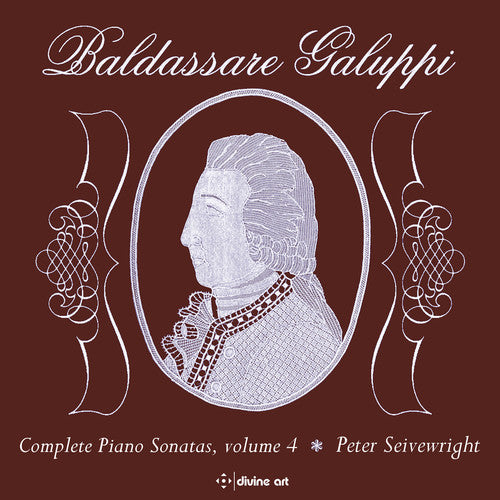
Galuppi: Complete Piano Sonatas, Vol. 4 / Seivewright, Scottish Baroque Soloists
Peter Seivewright was amongst the first musicians to seriously research (in 1994) the 100+ keyboard sonatas by Venetian composer Galuppi, also famed as a pioneer of opera buffa. While others have since come to appreciate and record the fine variety and novelty of these works, for many personal and career reasons, Seivewright’s series was held up after volume 3 was released in 2004 but is now back on track with this intermediate album which includes also the G major Piano Concerto. Many of the sonatas have had to be reconstructed from single movement manuscripts. They show amazing diversity, from single-movement works to two- and three-movement pieces, and from basic baroque style to a Romanticism prescient of Schumann. Seivewright strongly believes that the works were specifically written for the pianoforte rather than harpsichord due to their frequent need for sostenuto and other factors. Peter Seivewright studied at Oxford then at the Royal Northern College of Music. He has performed extensively as recitalist and concerto soloist and has taught in colleges around the world, from Scotland to Trinidad to Afghanistan and most recently in Phnom Penh, Cambodia.
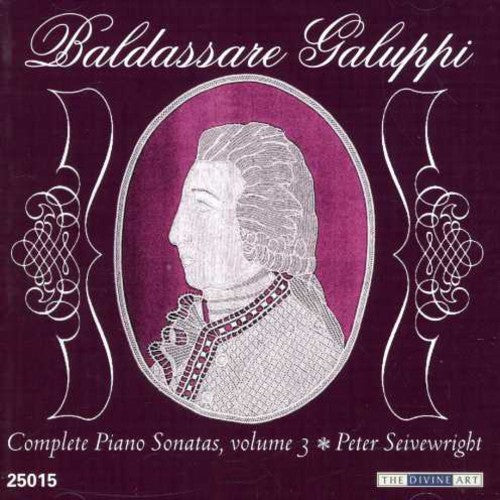
Galuppi: Complete Piano Sonatas Vol 3 / Peter Seivewright
Includes work(s) by Baldassare Galuppi. Soloist: Peter Seivewright.
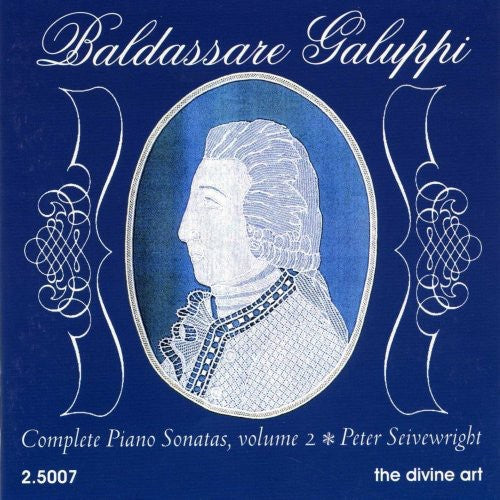
Galuppi: Complete Piano Sonatas Vol 2 / Pete Seivewright
"The music could not have a more sophisticated or dedicated advocate. In each sonata [Seivewright] unwraps a musical gift of exquisite beauty." – Michael Carter, Fanfare
"Absolutely immaculate execution matched by the clarity of the recorded sound... It is difficult to imagine this particular repertoire being presented to better advantage." – International Piano
"Seivewright is an enthusiastic and accomplished pianist... He plays with great conviction and flair... Pleasant listening from first note to last... A top class product... The recording is beyond reproach." – ClassicalNet
“Movements are built often quite imaginatively and always resourcefully... [Seivewright] is a sensitive artist and obviously enjoys this repertoire, and he communicates this enjoyment to us." – Penguin Guide to CDs (2005)
"Seivewright plays [the Sonatas] skillfully, and...they are pleasant to hear." – American Record Guide
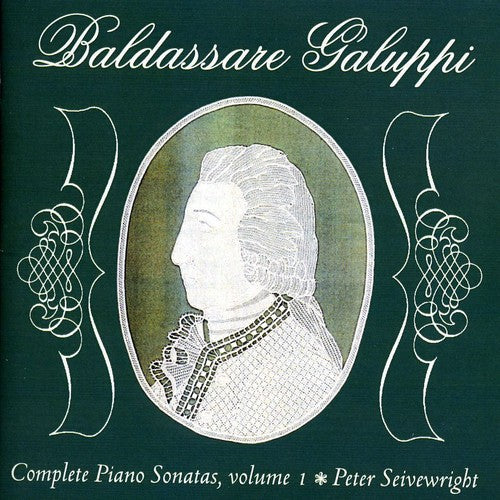
Galuppi: Complete Piano Sonatas Vol 1 / Peter Seivewright
“Peter Seivewright plays with style” – Northern Echo
“This is a fascinating disc... [Galuppi’s] music is very tuneful, unpretentious and untrammelled by 'early music fussiness.' They are far more appealing than Scarlatti sonatas. I have to commend the recording engineer who produces a close, intimate and crisp sound. Peter Seivewright gives us a splendid example as to how to play cantabile which all students and fellow pianists would do well to emulate. The sleeve booklet gives an excellent introduction to the life and times of this gifted composer and whets our appetite for further helpings. Highly recommended." – David Wright (Classical Music on the Web)
“A revelatory disc... Galuppi’s invention is rich and fresh, and Seivewright plays these wonderful pieces with a sense of delight in discovery. Highly recommended.” – Robert Cockroft, Yorkshire Post
“Movements are built often quite imaginatively and always resourcefully... [Seivewright] is a sensitive artist and obviously enjoys this repertoire, and he communicates this enjoyment to us." – Penguin Guide to CDs (2005)