Bruno Maderna
10 products
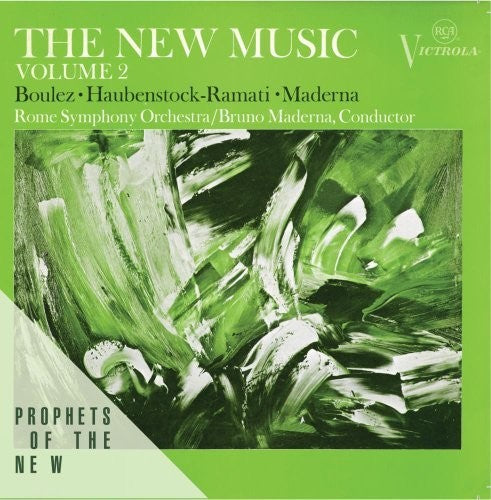
The New Music Vol 2 - Boulez, Haubenstock-Ramati, Maderna / Rome Symphony Orchestra
But the works of those composers who have come to the fore since Hiroshima seems to cut away violently from this pattern, as difficult as its acceptance had proved to be. So, for them the term “new music” is most appropriate.
The evolution which has led to today’s baffling results is governed by an inner logic. Once the use of the twelve-tone “series” was firmly established, the desire quite naturally arose to extend this serialization process to the other “parameters” of music, that is, to subject its rhythmic, timbral and dynamic aspects to the same laws governing the disposition of the pitch of the notes.
“Structuring” (the organization of musical material) by means of total serialization of parameters was the first step the new music took beyond Webern. This extension of the serialization process to all parameters brought about a heightening of interest and investigation into the qualities and components of sound. The increased concern for this “tone color” and other hitherto unstructured aspects of sound and the diminishing interest in pitch as the primary structural element made it necessary to alter traditional listening habits. Where pitch distribution had been the primary expressive unit, now the other parameters took on equal or greater importance.
The new music, like all other forms of contemporary art, may or may not be liked, but its consistency cannot be questioned. There is an inner logic which has determined the various phases described above and which is already creating others in more and more rapid succession. They must not be taken as gratuitous and unrestrained expressions of individual extravagance.
-- from the liner notes by Massimo Mila
GRANDE AULODIA
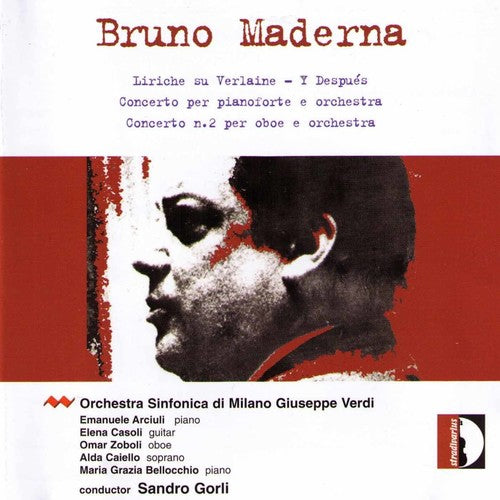
Maderna: Liriche su Verlaine, Y después & Piano Concerto
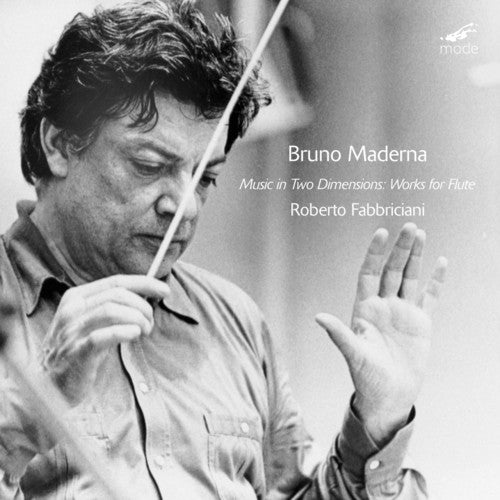
Music in Two Dimensions: Works for Flute
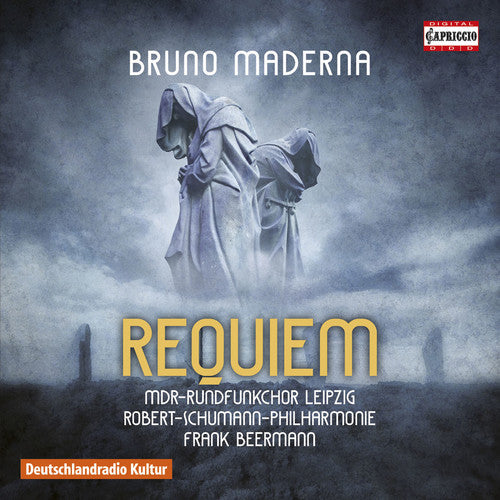
Maderna: Requiem
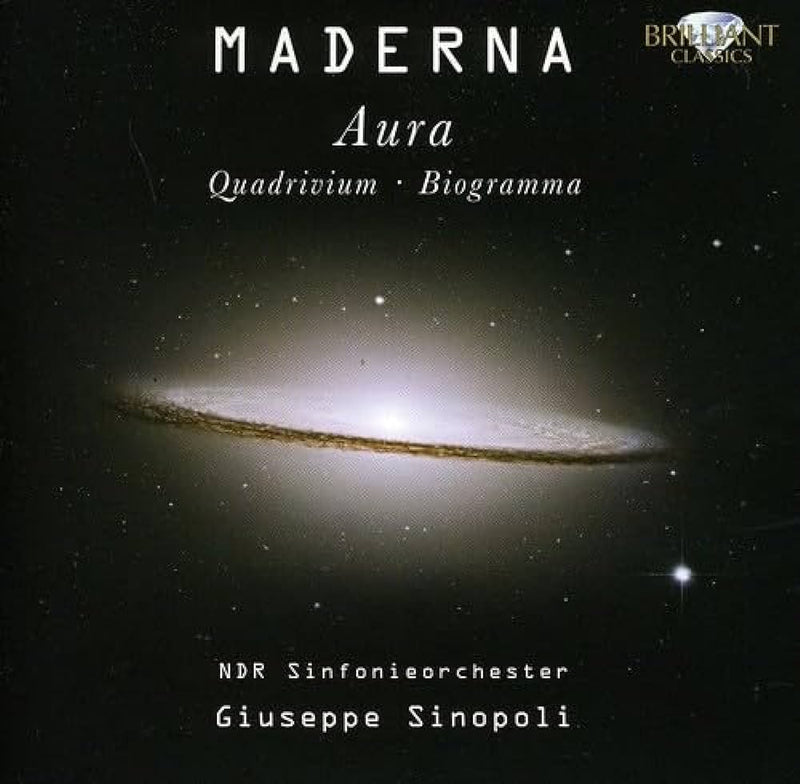
Maderna: Aura, Quadrivium, Biogramma / Sinopoli, NDR Sinfonieorchester
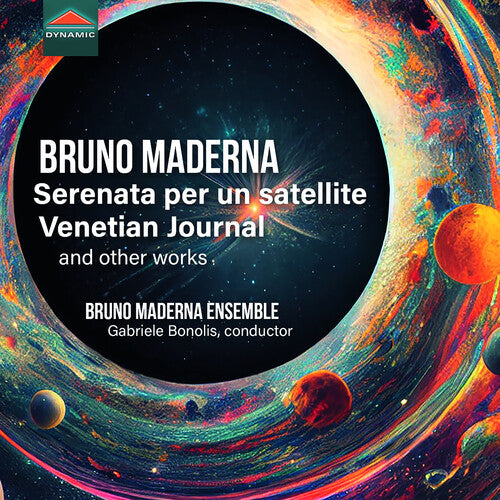
Maderna: Works / Bonolis, Bruno Maderna Ensemble
Unlike many modern composers of his day, Bruno Maderna did not renounce the memory nor the traditions of the past, seeing contemporary music as having the same expressive and linguistic goals as old music but organised in a different way. The works in this recording represent the important role melody had in Maderna’s aesthetic, the lyrical significance of Widmung and Aulodia per Lothar seeing their recurrence in later pieces. Serenata No. 2 recalls the spirit of Webern, Serenata per un satellite is like a musical game, and the multi-stylistic Venetian Journal is a merciless social, human and musical satire.
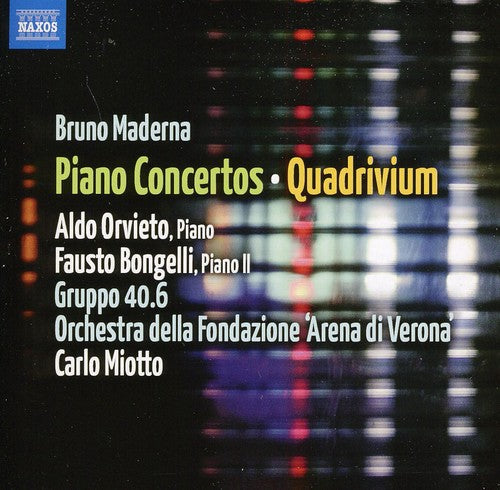
Maderna: Piano Concertos, Quadrivium / Orvieto, Miotto, Bongelli
MADERNA Piano Concerto. 1 Piano Concerto (version for 2 pianos 2 ) . Concerto for 2 Pianos 3. Quadrivium 4 • 1,2,3 Aldo Orvieto, 2,3 Fausto Bongelli (pn); 1,3,4 Carlo Miotto, cond; 3 Gruppo 40.6; 1,4 Arena di Verona O • NAXOS 8.572642 (66:32)
Bruno Maderna (1920–73) was an Italian postwar composer and conductor. He studied composition with Gian Francesco Malipiero in the early 1940s; it was Malipiero whom he felt was not only a great teacher, but who also gave to him an appreciation of earlier music. Around the same time he studied conducting with Guarnieri at the Accademia Musicale Chigiana, Siena; he proved to be gifted in this respect as well. He later attended an international course in conducting in Venice with none other than Hermann Scherchen, the great German conductor who was highly interested in contemporary music. During the 1950s Maderna worked to revitalize the musical scene in Italy. One of the major projects, which came to fruition in 1955, was the founding of the Studio di Fonologia Musicale of the RAI. This allowed both Maderna and Berio to work further in their experimentations with electronic forms of music-making. By the 1960s he was conducting more than ever. He worked with some of the most prestigious orchestras in the world at the time—New York, Chicago, Amsterdam, and Cleveland, to name just a few—conducting everything from contemporary works and Mahler symphonies to Mozart and Debussy operas. Compositionally, he remained equally interested in a wide range of music throughout his life—dodecaphonic, early Venetian and Flemish, electronic; everything was filtered through his keen mind. He died—too young—at the age of 53.
The first three works on the current recital (of which the two versions of the Piano Concerto are premiere recordings) are all short works—all between 11 and 12 minutes. The Piano Concerto (1942) is an early work. It sounds a bit like a mixture of Bartók, Berg, and perhaps Hindemith, though there is already a unique sound that shines through. The work is contrapuntal, well orchestrated, and highly melodic. It is above all else a pleasure to listen to. The version from 1946 for two pianos sounds almost like an x-ray of the music by comparison. It is fascinating to have these two versions side by side, as many of the details that get lost through the addition of numerous tone colors are all of a sudden brought to the fore; the piece sounds new. One can hear that the 1940s saw Maderna seeking new avenues of expression. The Concerto for Two Pianos (1948) is far away from the sound world of the previous two works. It begins with a mysterious air to it, using few notes and just the pianos to create its mood. It becomes more animato as the composition progresses, adding more and different percussion instruments into the mix, erupting at times, receding at others. It ends with a torrent of timbres. Quadrivium (1969) is a late work. Lasting some 31 minutes, it is the longest work on the recording. It is composed of four percussionists and four orchestral groups, symbolizing the four liberal arts—arithmetic, algebra, music, and astronomy. It is the most experimental of his works on the disc, featuring strict serial writing, aleatoric moments, and counterpoint, and is infused with a sense of exploration of sonorities. I can’t say that this type of music will be for everyone, but repeated listenings help in the appreciation and understanding of this music. I can only say that I have been rewarded in the process.
The musicians on this recording give the sense that they have studied and love this music—and there is much to be loved, even by the casual listener. The early works, in particular, are delightful in sound and conception, while the later works, though more complex, are also quite engaging; just be prepared for a good deal of writing for percussion instruments. The sound quality is excellent—each instrument literally pops out of the mix when required. The numerous changes in color on the piano are captured vividly here as well. Overall this is a very fine release of music that should be better known, more listened to, and in the end cherished.
FANFARE: Scott Noriega
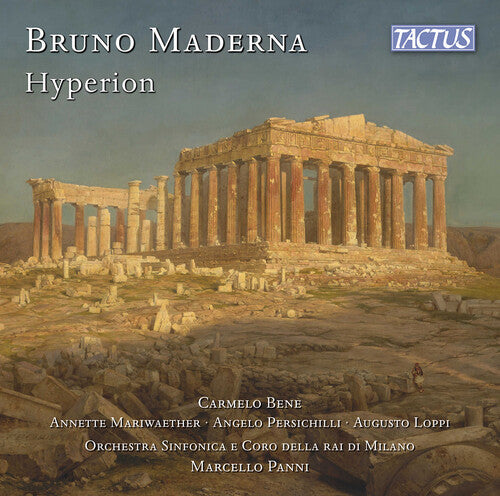
Maderna: Hyperion / Panni, Milan RAI Symphony Orchestra
Bruno Maderna always ascribed great importance to insight and imagination, even during the period in which he followed the most rigorous serial procedures. Maderna’s preference for concreteness in sound images, his practical approach to composition problems, and his receptiveness to language diversity explain the extraordinary ascendancy he had over the Italian composers who visited Darmstadt in the Fifties and Sixties, including Nono, Berio, Donatoni, and Clementi. But they also explain his gradual withdrawal from the most radical experiments of the avantgarde, and his tendency, during the last decade, to pursue a constant osmosis between different styles and materials (also through frequent overflows between his own compositions), often ending up in theatrical forms.
The Hyperion has been described as a “Lyric in the form of a show”. It was presented in its first version as a mobile cycle of vocal, orchestral and electronic pieces based on fragments of Friedrich Hoelderlin’s novel "Hyperion, oder der Heremit in Griechenland" (“Hyperion, or the Hermit in Greece”), the only novel written by the German poet. This book, an epistolary novel, was published in various versions, so it somehow could be regarded as a “work in progress” too. This recording represents an important document of the live version, reduced and adapted by the great actor Carmelo Bene, flanked by the RAI Symphony Orchestra from Milan, directed by Maestro Marcello Panni.
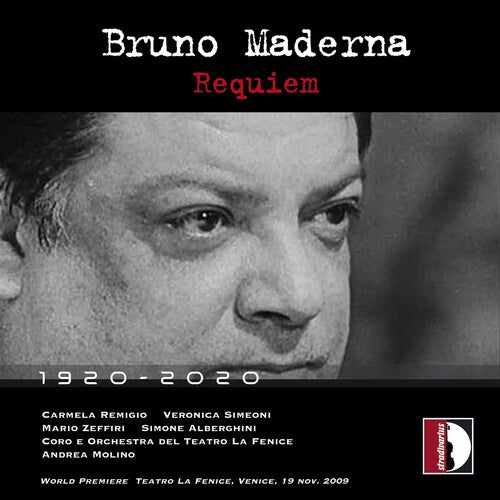
Maderna: Requiem / Molino, Teatro la Fenice Orchestra
A recording of the world première of a major early work, delayed by some sixty years, and thus an important document.
When buried masterpieces are rediscovered, they hardly succeed to rewrite history. However, Bruno Maderna’s Requiem per soli, cori e orchestra, unearthed sixty years after its disappearance, may well withstand the test, and quite successfully. With all its bulk, and its by no means derivative craftsmanship, it could perhaps be a candidate for the role of the ‘Riace bronze’ of Italian twentieth century music. At the very least – even with the aid of other rediscoveries, like the Concerto per pianoforte e orchestra of 1941-42 – this score sheds light on a character for long almost unknown: the pre-dodecaphonic Maderna, a young but perfectly formed and mature artist, whose known compositions were, until the 2000s, limited to just some minor works. For many years we had detailed yet frustrating information about the Requiem: an autograph fragment of the score had survived, consisting of sixteen pages in fair copy that included an introductory note, from which it was possible to infer the overall structure of the work, the arrangement of the choral group and the approximate number of pages, around ten times those that had survived.
REVIEW:
Not a world première recording, but a recording of the world première of a major early work, delayed by some sixty years, and thus an important document.
The magnum opus of his pre-dodecaphonic period finds the young composer writing in a very tonal, though harmonically individual, idiom. Throughout the work there are many magically imaginative timbres and sonorities, reminding us that Maderna was an outstanding conductor with an impeccable ear for orchestration and tone color. It is clear that had he continued to be this kind of composer, rather than radically shifting direction, then he would still have been a remarkable one, though the history of the European avant-garde would have been very different without his incalculable contributions.
The Requiem begins with an atmosphere of dignity and profound mourning. The extended Dies irae sequence, set in its entirety, is as apocalyptic as one might wish, with the presence of the bass drum and the dramatic character of the music and its impassioned vocal solos suggesting that the composer was looking back to Verdi, and the operatic approach to the concert requiem. The final sections, beginning with the exquisitely delicate Agnus Dei, sink progressively into the shadows of profound regret, echoing the sentiments of Wilfred Owen: "All a poet can do today is warn." The tormented closing Libera me - not for the first or last time the most terrifying part of a requiem setting - abandons all hope in a precipitous descent into the abyss.
-- Records International