Carl Orff
28 products
Wolfgang Sawallisch: Complete Symphonic, Lieder & Choral Recordings - Warner Classics Edition, Vol. 1
Carl Orff: Carmina Burana
CARL ORFF - 125TH ANNIVERSARY
CARMINA BURANA (BR)
CARMINA BURANA
CARMINA BURANA
Orff: Carmina Burana
Orff: Carmina Burana / Ormandy, Harsanyi, Petrak, Et Al
DIE KLUGE (VINYL)
CARMINA BURANA
Orff: Die Bernauerin / Eichhorn, Ostermayer, Lippert, Popp
ORFF: Carmina Burana (arr. for wind orchestra)
Orff: Carmina Burana
LIEDER & GESANGE
Orff: Carmina Burana
Orff, C.: Carmina Burana
Wind Band Classics - Orff, Bird, Reed / Parker, Peabody Wind Ensemble
I believe it was a Fanfare contributor who once wrote that if he ever had to listen to Orff’s Carmina burana again he would throw up. While the piece is not exactly an emetic for me, it’s not one I find to have many redeeming features. This arrangement for concert band by John Krance strikes me as the equivalent of a divide by zero error. It’s too bad that much brilliant playing has been spent on it, (therein lies the crime) when there are so many wonderful pieces, both original and arranged, for concert band.
Bird’s Serenade is one of them. Arthur A. Bird (1856–1923)—you will not learn from the enclosed booklet note—was born in Belmont, Massachusetts. In 1875, he was sent to Germany to study at the Berlin Hochschule für Musik; and except for brief visits home, he remained abroad for the rest of his life. He became a chess partner and close friend of Liszt, and wrote over 100 works. He was considered a “composer of promise” up until his marriage in 1888 to a wealthy widow, after which he apparently preferred to live the lazy life of the idle rich. Bird’s Serenade, here edited by Gunther Schuller, is a beautiful piece in late Romantic style that won the Paderewski Prize for best chamber work by an American composer in 1901. It was first performed in Boston by Georges Longy and his Woodwind Club in 1902. If you are familiar with and like the wind works of Richard Strauss, you will find much to enjoy here.
Herbert Owen Reed (b. 1910) in Odessa, Missouri, has quite an impressive calling card. Earning his baccalaureate and graduate degrees in music composition from Louisiana State University, he went on to the Eastman School of Music, where he studied with Howard Hanson, among others, earning his Ph.D. in 1939. At Tanglewood, he met and furthered his studies with Martin?, Copland, and Bernstein. Then, in Colorado Springs, he continued to study under Roy Harris, and eventually he took lessons from Schoenberg. That’s quite a diverse background, a lot of which, except for the Schoenberg, is reflected in his La fiesta mexicana, Reed’s best-known work. Reed has made a serious study of the Native American musics of Taos, New Mexico, and his scores derive much of their material, not just from Native North American cultures, but from Mexican and Aztec sources as well. La fiesta is a major composition that embraces a number of musical styles and evokes an ever-changing kaleidoscope of colors and moods. Particularly moving is the movement titled Mass. It is the centerpiece of this Mexican folk song symphony that depicts a religious festival dedicated to the Blessed Virgin Mary.
The Bird and Reed items are more than worth the price of this budget Naxos disc. And you are not likely to hear these pieces better played. Recommended.
FANFARE: Jerry Dubins
Orff: Carmina Burana (Chamber Version) / Rydinger-alin
Carmina Burana / Cooke, RPO
Orff: Ein Sommernachtstraum / Von Gehren, Andechser Orff-Akademie Des Munchner RO
ORFF Ein Sommernachtstraum • Christian von Gehren, cond; actors; Andechs Fest Ch; Munich Youth O; Munich Radio O Andechs ORFF Academy • CPO 777 657 (146:09) Live: Andechs 7/28–30/2010
Carl Orff’s incidental music for Shakespeare’s A Midsummer Night’s Dream grew out of the desire of the National Socialists—generally, but here specifically Frankfurt’s anti-Semitic Lord Mayor Friedrich Krebs—to produce an appropriately Aryan accompaniment to the play as replacement for the now inconveniently “Jewish” musical additions of Felix Mendelssohn. Orff, even as his scenic cantata Carmina burana was gaining popular acclaim in the new Germany, was concerned with his politically dubious reputation as a modernist and consorter with leftists during the Weimar years. So he took the commission despite warnings from his pragmatic publisher that he would never be able to “dispatch Mendelssohn.” In fairness, his interest in the Elizabethan comedy was real; he had been working on such incidental music since 1917. No doubt he also found the sizable advance attractive. But what had been politically expedient in 1938—he prospered during the Third Reich—was to haunt him after the war, however facile his explanations, and at the least diminishes any pleasure one might have in hearing what he has to offer.
Or maybe not. The audience certainly seems to enjoy this production from the 2010 Orff in Andechs Festival. It will be rougher going for anyone lacking fluent German. Though the story is well known, and the alert listener will be able to figure out what is happening some of the time, there is no text, translation, or synopsis, a serious failing shared with cpo’s other recording from this festival, the Orff/Monteverdi Orpheus . My admiration goes out to anyone who, textless, can happily attend for more than two hours and 20 minutes to heavily edited Shakespeare in German, with attractively dreamlike but inconsequential and repetitive music cues that cannot even be appreciated in context of the words they are to amplify.
Cynicism aside, one is left wondering what Orff did to earn his substantial commission. Many of the handful of independent pieces are adaptations of other compositions: The prelude is from Carmina burana (“Si puer cum puellula”) transformed into a fanfare, used again in full as a replacement for the wedding march. The Rustics are introduced (in this version of 1964) with music from the 1943 fairy tale opera Die Kluge, which, in this context, jars with its banality. Annotator Thomas Rösch suggests other sources: Carmina burana again (“Chramer, gip die varwe mir”) for Titania’s lullaby, and an allusion to the act II duet for Octavian and Sophie from Der Rosenkavalier for the moonrise scene. I suppose one could make a game out of identifying the remaining borrowed themes, but I’ll leave that to others.
There are magical moments; the playing of the trumpet to the moon has the same charm as the ending of Der Mond , the prelude to the ninth scene in Theseus’ palace recalls moments of repose in the famous cantata, and the wonderful midnight melodrama (though I would have wanted Puck’s speeches done less malevolently) and finale (name that source!) provide a fitting end. Would that it all had been so engaging. The youth orchestras, and the chorus in its brief outings, are able; the recording clear for those for whom German is not an obstacle. The birds chirping in the forest are a nice touch. In any case, though my curiosity has been only partly satisfied, at least now, thanks to cpo, the historical footnote is made tangible. You might want to check the samples online before buying. And find a translation.
FANFARE: Ronald E. Grames
Orff: Prometheus / Kubelik, BRSO
What Carl Orff created with the Prometheus score is neither an opera in the traditional sense nor an oratorio, but also not a play with music or even “authentic” classical tragedy: far more is it an extremely individual musical interpretation of Aeschylus’s tragedy that concentrates primarily on the symbolic imagery of the scenes, which – as Orff himself said – “is accentuated and visualized by the music” and the spectator and hearer thereby enlightened.
The work is sung in Ancient Greek; the booklet contains a plot synopsis in English and German languages, plus liner notes.
REVIEW:
This CD of Carl Orff's Prometheus, released on the Orfeo label, is based on live recordings by Bayerischer Rundfunk from October 1st and 2nd, 1975 in the Herkulessaal of the Munich Residenz. Two concert performances were recorded, which took place in honor of Orff's 80th birthday. Of all the events held in Munich to mark the composer's milestone birthday, these two were considered the greatest. But that's no wonder, because the work, which was successfully premiered on March 24, 1968 at the Stuttgart State Opera, is a real masterpiece. Here we are dealing with a real rarity.
The very informative booklet shows that Orff did not in any way claim that this was an educational theater for the initiated, but only drew the consequences from the mythical power of language of Aeschylus. Orff's decision was good. The ancient Greek language gives the whole, both sung and declaimed passages, an extremely strong, haunting expression that is typical of this type of musical theatre. Ultimately, Orff was concerned with capturing the spirit of ancient theater by evoking it again with thoroughly modern means, with the aim of interpreting it anew and for our time (booklet). Orff has completely succeeded in this. His intention has worked in every respect. The impact of Prometheus is even greater than that of his predecessors, Antigone and Oedipus, previously written by Orff. Particularly impressive are the fully sung prophecies of the eponymous hero chained to the rock as well as the choruses, which are only entrusted to women. These breathe enormous intensity and lead the listener away from a normal opera to a new form of music theater for which Orff was the godfather.
Although the orchestra with the brilliant percussion, which is only joined by wind instruments and double basses, is not very pronounced, its outbursts are nevertheless powerful...Rafael Kubelik succeeds in exploring the diverse and quite unusual musical structures. Under his proven leadership, the Bavarian Radio Symphony Orchestra has surpassed itself. The conductor relies on a distinctive, rhythmically concise and often almost violent sound that corresponds excellently to the content of the work.
The singers put themselves entirely at the service of this great piece. The first to be mentioned here is Roland Hermann, who impressively proves that even a modern game like Prometheus can be mastered with a fantastic Italian technique. His beautiful baritone manages the balancing act between expressive singing and pathetic declamation magnificently. In her own way, Colette Lorand comes up with a very complex portrayal of the role of Io Inachis.
Conclusion: An interesting recording of an unusual work, the acquisition of which is definitely to be recommended.
-- Das Opernfreund
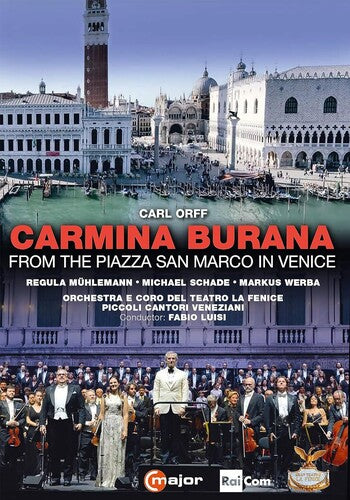
Orff: Carmina Burana / Luisi, Orchestra & Chorus of La Fenice
With Carl Orff’s Carmina Burana; one of the most popular pieces in music history and the most performed choral/orchestral work of the 20th century; Teatro La Fenice returns to the Piazza San Marco in Venice; in front of the magnificent façade of the Basilica di San Marco. Conducted by the great master Fabio Luisi; featuring the word-class singers Regula Mühlemann; Michael Schade and Markus Werba it was a magnificent event. "La Fenice’s orchestra and choir; in this case with the addition of the Piccoli cantori veneziani in the final part; have hit the mark“ (Il Gazzettino) with this concert and "it is noticeable overall the work made by the conductor Fabio Luisi; who managed to maintain the tension of the various historical pages with determination and energy." (Il Gazzettino)
Orff: Carmina Burana
Volume 5 of Profil's Günter Wand Edition is devoted to Carl Orff's massive and enormously popular cantata, Carmina Burana, in a stirring radio performance presented with the NDR Sinfonieorchester in 1984. (Profil)