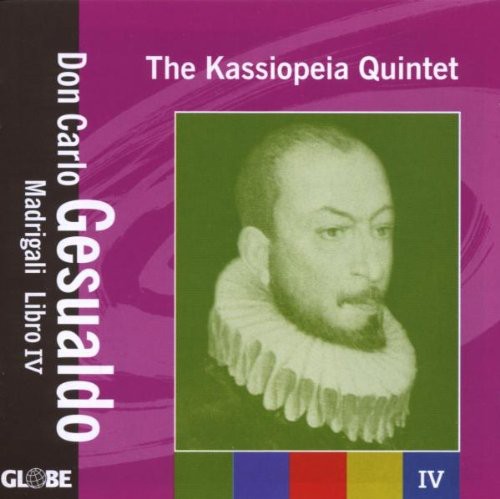
Gesualdo: Madrigali Libro Iv / The Kassiopeia Quintet
Globe Records
$18.99
March 08, 2007
GESUALDO Madrigals, Book 4 • Kassiopeia Qnt • GLOBE 5224 (45:01 Text and Translation)
The first disc in this traversal of Gesualdo’s six books of madrigals arrived a couple of years ago (29:3). Wondering about the latest record number (the first book was numbered 5221), I found that the intervening numbers containing the second and third books of madrigals have already been issued, but not submitted for review. Apart from the old complete set of Gesualdo’s madrigals (still available), Book 4 has been recorded by Francesco Cera on Tactus and La Venexiana (24: 3). Cera seems to share the short playing time of the new disc, while La Venexiana adds three bonus madrigals from the second and fifth books and the Canzon francese to fill out the disc. Kassiopeia’s Book 1 was up against the more economical layout of Harry van der Kamp’s first three books of madrigals on a pair of discs, similar performances by two Dutch ensembles. Kassiopeia continues to give a fine account of the madrigals, singing at normal pitch, a third higher than La Venexiana’s transposed rendering and considerably faster in every madrigal without exception; the overall difference is eight minutes. The more relaxed tempos allow La Venexiana to bring out the affect of the chromaticisms. La Venexiana also uses lutes and a harpsichord, while Kassiopeia uses only voices. Since the field is not crowded, there is room for Kassiopeia’s intelligent traversal of this collection.
FANFARE: J. F. Weber
{# optional: put hover video/second image here positioned absolute; inset:0 #}
Globe Records
Gesualdo: Madrigali Libro Iv / The Kassiopeia Quintet
GESUALDO Madrigals, Book 4 • Kassiopeia Qnt • GLOBE 5224 (45:01 Text and Translation) The first disc in this traversal of Gesualdo’s...
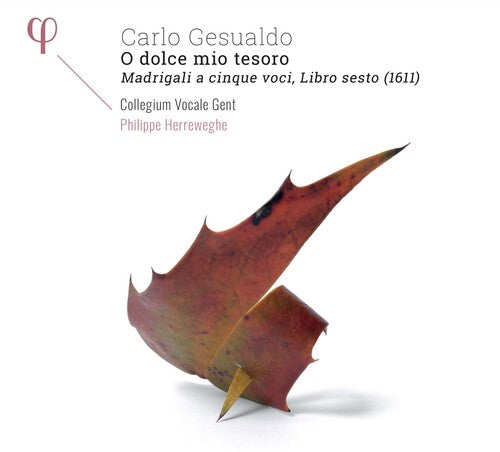
A personality has who provoked considerable controversy over the centuries, Carlo Gesualdo (1566- 1613), aristocrat, musician and murderer of his first wife, is no less a composer whose music is marked by subtlety and refinement. His innovative Sixth Book of Madrigals, written two years before his death, exploits all harmonic, chromatic, and textural possibilities to meet the texts’ expressive requirements and proves to be a veritable masterpiece of the genre. After a first release devoted to the Italian composer’s sacred works, the Tenebrae Responsoria, Philippe Herreweghe and his Collegium Vocale Gent invite us to (re)discover his secular music for the 450th anniversary of his birth. In masterful fashion, they propose a delicate, expressive reading of this complex music, doing justice to the modernity of the musical language of the Prince of Venosa. The acoustics of the church in the little Tuscan village of Asciano, where the programme was recorded in 2015, provides an ideal sound setting for this music.
{# optional: put hover video/second image here positioned absolute; inset:0 #}
PHI
Carlo Gesualdo: O Dolce Mio Tesoro
A personality has who provoked considerable controversy over the centuries, Carlo Gesualdo (1566- 1613), aristocrat, musician and murderer of his first wife,...
Carlo Gesualdo Da Venosa: Sacrarium Cantionum Quinque Vocibus
Ricercar
$20.99
June 24, 2014
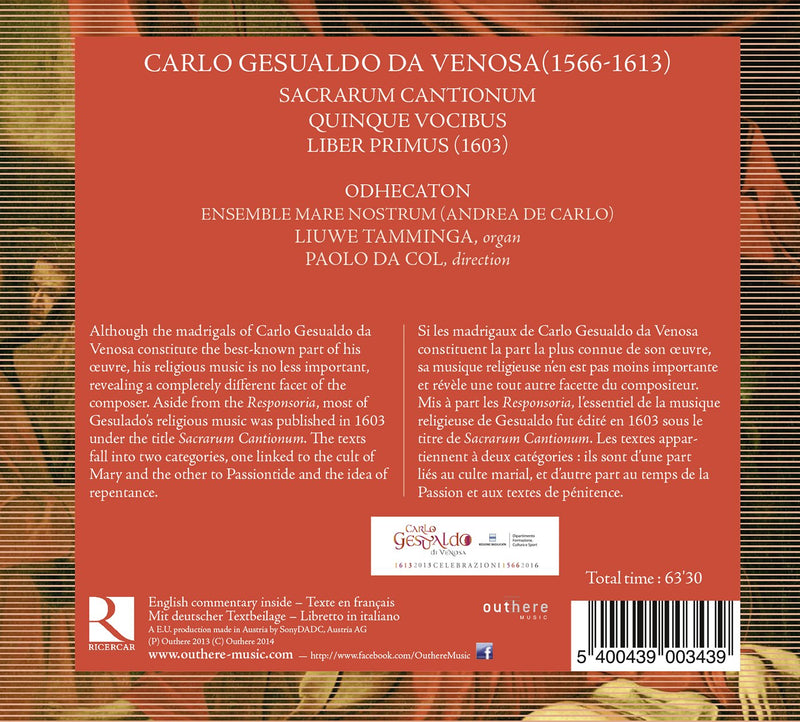
Although the madrigals of Carlo Gesualdo da Venosa constitute the best-known part of his oeuvre, his religious music is no less important, revealing a completely different facet of the composer. Aside from the Responsoria (1611), of which Philippe Herreweghe recently made a magnificent recording (LPH 010), most of Gesulado's religious music was published in 1603 under the title Sacrarum cantionum. Unlike the Responsoria, intended for Holy Week services, the motets of 1603 are settings of texts for all circumstances of the liturgical year. For this recording, made in the Santa Trinità abbey church in Venosa, ODHECATON has enriched the sound palette of its men's voices with a few instruments, including an ensemble of violas da gamba. Liuwe Tamminga counterpoints this programme with selected pieces by Giovanni Maria Trabaci and Giovanni de Macque on an historical organ of the Venosa region.
{# optional: put hover video/second image here positioned absolute; inset:0 #}
Ricercar
Carlo Gesualdo Da Venosa: Sacrarium Cantionum Quinque Vocibus
Although the madrigals of Carlo Gesualdo da Venosa constitute the best-known part of his oeuvre, his religious music is no less important,...
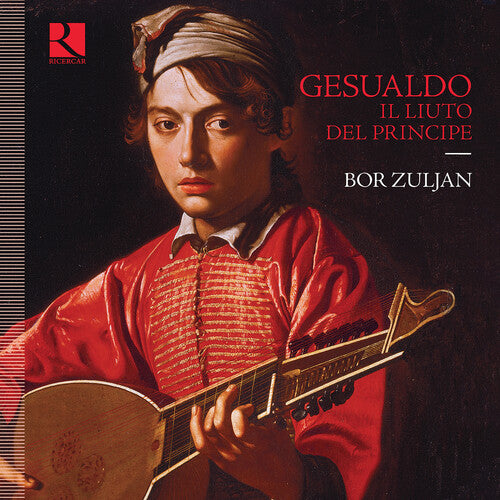
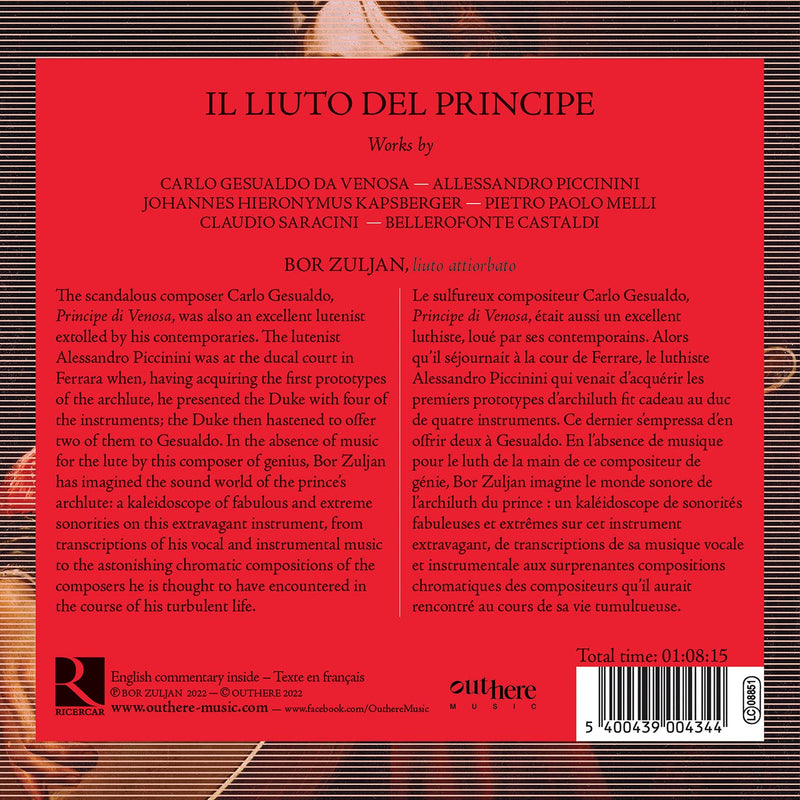
The murderous composer Carlo Gesualdo, Principe di Venosa, was also a lutenist extolled by his contemporaries. At the end of the sixteenth century he received the first two prototypes of the archlute from his colleague Alessandro Piccinini in Ferrara, one of which he kept. In the absence of surviving music for the lute by the composer himself, Bor Zuljan has imagined the sound world of the prince’s archlute: a kaleidoscope of fabulous and extreme sonorities on this extravagant instrument, from transcriptions of his vocal and instrumental music to the astonishing chromatic compositions of composers he is thought to have encountered, and whose work exerted an influence on his. Includes works by C. Gesualdo, A. Piccinini, J. H. Kapsberger, P. P. Melli, C. Saracini etc.
{# optional: put hover video/second image here positioned absolute; inset:0 #}
Ricercar
Gesualdo: The Prince's Archlute / Zuljan
The murderous composer Carlo Gesualdo, Principe di Venosa, was also a lutenist extolled by his contemporaries. At the end of the sixteenth...
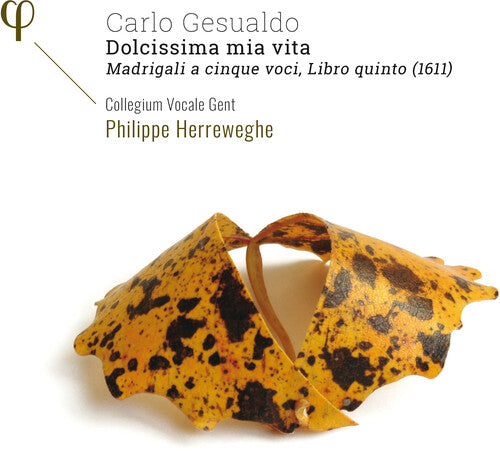
Gesualdo: Dolcissima mia vita. Madrigali a cinque voci, Libro quinto (1611) / Herreweghe, Collegium Vocale Gent
PHI
$20.99
September 24, 2021
Philippe Herreweghe records his third disc devoted to a controversial figure in the world of music and art in general: Carlo Gesualdo, who had his wife murdered and is suspected of having his son smothered. This time Collegium Vocale Gent performs his fifth book of madrigals (1611), published two years before his death. A collection that even today contributes to the eternal debate: to what extent does art become impregnated with reality, and how can it be appreciated when it emanates from a mind living so close to horror? Here the bold dissonances and sometimes tortured expressiveness that can be perceived in his harmonic language offer food for thought. Can we speak of redemption through art for a murderous composer in the twilight of his life?
{# optional: put hover video/second image here positioned absolute; inset:0 #}
PHI
Gesualdo: Dolcissima mia vita. Madrigali a cinque voci, Libro quinto (1611) / Herreweghe, Collegium Vocale Gent
Philippe Herreweghe records his third disc devoted to a controversial figure in the world of music and art in general: Carlo Gesualdo,...
GESUALDO Madrigals: Books I–VI. Canzon francese del Principe.1 Gagliarda del Principe di Venosa. Come vivi cor mio. All’ombra degli allori • Marco Longhini, cond; Carmen Leoni (hpd, 1clvd, org); Delitiæ Musicæ • NAXOS 8.507013 (7 CDs: 433:43 Text and Translation)
Here, at last, Marco Longhini’s complete set of madrigals by Don Carlo Gesualdo is available in a handsome box which includes a lavish (for Naxos) booklet containing Longhini’s liner notes and, wonder of wonders, full texts and translations for each piece. J. F. Weber reviewed Book I in Fanfare 34:1, Book II in 34:5, Book III in 35:3. Book IV in 36:2, and Books V and VI in 37:2. This boxed set includes the complete set. According to online sources, Books V and VI were issued in the spring of 2013 as a three-CD set (Naxos 8.573147/49), mostly because both books are too long to fit onto one CD each. The first two discs of this set have timings of 74 and 67 minutes respectively, while the third is 41:21. I’m not terribly upset by this, although in the early Books director Longhini filled out shorter CDs with some additional instrumental and vocal works (listed above).
Those unfamiliar with Gesualdo’s strange and perverted life are referred to other sources, such as Robert Craft’s most recent book; I won’t go into much detail here except to wonder how a pervert and murderer (and he is verified as being both, though Longhini’s notes only cover the murder) could produce such exquisite, moving, and remarkably inventive music. It is as if Wolfgang Mozart were really a combination of Ted Bundy and the Marquis de Sade.
Strictly from a technical standpoint, Gesualdo’s genius was best described by Andrew Parrott in his notes to his own album of Gesualdo madrigals. To paraphrase, Gesualdo’s powerful social position as a prince meant that he didn’t have to curry favor from anyone above him, but could simply write music that appealed to him, and what evidently appealed to him was to completely skip “transition” chords and instead jump into foreign harmonies without preparing the listener for the changes. In the first four books of madrigals these harmonic changes are less frequent and more subtle, but by the time of his last two books he was ignoring the rules of harmony with impunity. Three hundred and fifty years later, this harmonic daring caught the ear of both Igor Stravinsky, who wrote a remarkable piece synthesizing some of Gesualdo’s musical daring, and his amanuensis Robert Craft, who in 1958 and 1962 recorded albums of Gesualdo madrigals for Columbia.
As to the performance quality, it is first-rate. The singers of Delitiæ Musicæ, individually and collectively, are fascinating: not quite as individual in their timbres as the five remarkable singers that Robert Craft assembled for his groundbreaking 1958 album (a group that included the superb countertenor Richard Levitt and the then-unknown mezzo-soprano Marilyn Horne) or Alan Curtis’s Il Complesso Barocco as heard in the 1995 Werner Herzog film Death for Five Voices (much of their great clarity due to the fact that they performed, and were filmed, in a small library with enclosed acoustics), but certainly clear enough so that the harmonic movement within each chord can be discerned clearly, and with absolutely impeccable diction. My readers will know that these are the two banes of my existence when reviewing many modern choirs—a mushy, indistinct choral blend configured to achieve perfect roundness of tone but nearly always causing a loss of clarity in the individual lines of music and a severe loss of diction (regardless of the language being sung). What I found particularly interesting about Delitiæ Musicæ was that their tenors, particularly Fabio Fùrnari who is listed as “Tenor (quintus-altus),” have extraordinarily round, pure sounds that border on the quality of female mezzos; countertenors Alessandro Carmignani and Paolo Costa have surprisingly full tones and timbres reminiscent of Levitt in his prime; while basso Walter Testolin has an unusual voce with a bit of a “buzz” in the tone that nearly always makes it stand out, sounding simultaneously part of the ensemble and something like a viola da gamba. He also sounds very much like the bass in Levitt’s own group of the 1960s, the Vocal Arts Ensemble. The clarity of Delitiæ Musicæ’s diction is also enhanced by the recorded sound, which has just enough space around the voices to give them a nice ambience while still keeping them close enough to the microphone to let you hear every single word. I was also enormously impressed with their individual and collective vocal “attack”: The notes do not simply “appear out of the air,” but each has a distinctive and clear consonant beginning that, miraculously, does not disrupt the musical flow.
Now, here’s something interesting. Having never heard Craft’s recordings, I went out of my way to order a copy via interlibrary loan in order to compare it to the performances on this set. Vocally, there is no complaint, but the musical treatment sounds too strict in tempo. Everything is sung in a linear fashion, absolutely no rubato, no changes of volume, and phrasing that is as strict as a metronome. Heck, even Toscanini’s performances had more give-and-take than this! Moreover, even though certain voices within Craft’s group can be heard with their individual timbres, he doesn’t play the different lines of the music against each other clearly enough. After listening for about a half hour (the CD runs over 77 minutes), I had to take it off and return to the Longhini performances. That’s not necessarily a criticism of Craft—he just had no real feeling for directing early music, but instead applied the principles he brought to bear on Schoenberg, Stravinsky, and Webern—so much as it is a huge compliment to Longhini. Even in a specifically slow number such as “Io pur respiro,” which if course Longhini takes slower (4:42 compared to Craft’s 3:09), there is absolutely no feeling for the text in Craft’s performance; the treatment is linear and lacking any sense of modulation or dynamic changes. Under Longhini’s expert direction, the music lives and breathes, the words have meaning, and he varies the tempos in different sections of the piece.
Weber’s reviews of the earlier discs in this series indicated that Longhini’s group sings the music slowly, which he feels enhances the ability of the ear to catch all the unusual dissonances and other harmonic daring in Gesualdo’s work. This is so; comparing the pieces here also recorded by Curtis and Craft shows sometimes large differences in timing, but the interesting thing is that, if you are just listening to these Longhini recordings and not comparing them, most of the performances don’t sound too slow. I attribute this to the exceptional clarity of line they achieve as well as their proclivity to keep pressing the tempos forward. The real aesthetic question is, unless you are a Gesualdo scholar, do you really need to have this complete set? Based on both the high quality of the music as well as the performances, I would say yes; and at $41.25 for the whole set (at Presto Classical), that brings the cost down from $6.16 per disc for the three-CD set of Books V–VI to $5.89 per disc for the complete box.
FANFARE: Lynn René Bayley
{# optional: put hover video/second image here positioned absolute; inset:0 #}
Naxos
Gesualdo: The Complete Madrigals
GESUALDO Madrigals: Books I–VI. Canzon francese del Principe. 1 Gagliarda del Principe di Venosa. Come vivi cor mio. All’ombra degli allori •...


 {# optional: put hover video/second image here positioned absolute; inset:0 #}
 {# optional: put hover video/second image here positioned absolute; inset:0 #}
Globe Records
{# optional: put hover video/second image here positioned absolute; inset:0 #}
Globe Records {# optional: put hover video/second image here positioned absolute; inset:0 #}
 {# optional: put hover video/second image here positioned absolute; inset:0 #}
PHI
{# optional: put hover video/second image here positioned absolute; inset:0 #}
PHI {# optional: put hover video/second image here positioned absolute; inset:0 #}
Ricercar
{# optional: put hover video/second image here positioned absolute; inset:0 #}
Ricercar {# optional: put hover video/second image here positioned absolute; inset:0 #}
Ricercar
{# optional: put hover video/second image here positioned absolute; inset:0 #}
Ricercar {# optional: put hover video/second image here positioned absolute; inset:0 #}
PHI
{# optional: put hover video/second image here positioned absolute; inset:0 #}
PHI {# optional: put hover video/second image here positioned absolute; inset:0 #}
Naxos
{# optional: put hover video/second image here positioned absolute; inset:0 #}
Naxos {# optional: put hover video/second image here positioned absolute; inset:0 #}
Sony Masterworks
{# optional: put hover video/second image here positioned absolute; inset:0 #}
Sony Masterworks
 {# optional: put hover video/second image here positioned absolute; inset:0 #}
 {# optional: put hover video/second image here positioned absolute; inset:0 #}
 {# optional: put hover video/second image here positioned absolute; inset:0 #}
 {# optional: put hover video/second image here positioned absolute; inset:0 #}



 {# optional: put hover video/second image here positioned absolute; inset:0 #}


 {# optional: put hover video/second image here positioned absolute; inset:0 #}


 {# optional: put hover video/second image here positioned absolute; inset:0 #}

 {# optional: put hover video/second image here positioned absolute; inset:0 #}

 {# optional: put hover video/second image here positioned absolute; inset:0 #}