Christoph Willibald Gluck
65 products
-
Gluck Arias
$20.99CDSignum Classics
Sep 26, 2025SIGCD921 -
-
-
-
-
-
-
-
-
-
-
-
-
-
-
-
-
-
-
-
-
-
-
-
-
-
Famous Flute Concertos / Jean-Pierre Rampal
Gluck Arias
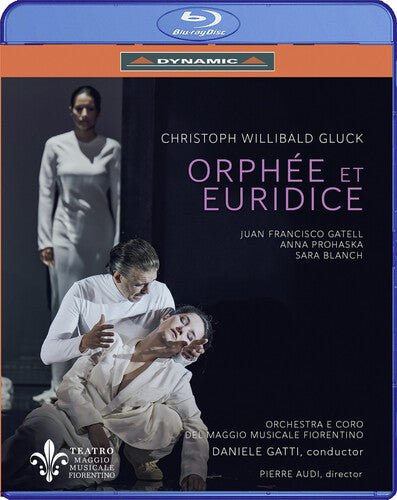
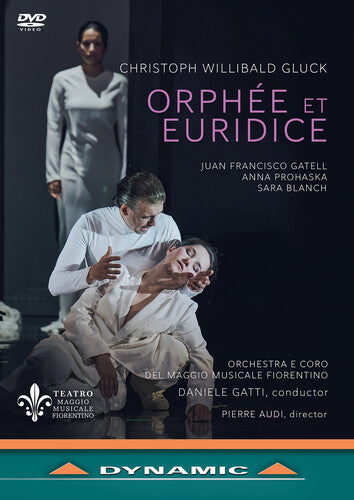
Orphee et Euridice
Orphee et Euridice
Gluck: Iphigénie En Tauride / Muti, Vaness, Allen, La Scala
GLUCK Iphigénie en Tauride • Riccardo Muti, cond; Carol Vaness ( Iphigénie ); Giorgio Surian ( Thoas ); Thomas Allen ( Oreste ); Gösta Winbergh ( Pylade ); Anna Zoroberto ( First Priestess ); Michaela Remor ( Second Priestess ); La Scala O & Ch • SONY 52492 (2 CDs: 116:34 Text and Translation) Live: Milan 3/1992
I have a personal criterion for judging sopranos in modern recordings of any role that Maria Callas excelled in: If you can beat Callas, you are gold. And despite her achievements in bel canto roles (most of which I find uninteresting, either dramatically or as music), I still think that Callas’s greatest gift to the world of opera, particularly opera in Italy, was to point out to the entire country and the world how much more there was in roles like Elvira in I Vespri Siciliani, Cheribini’s Medea, Iphigénie in this opera, and yes, even Lady Macbeth than had been previously thought. If you had given me a lie detector test in February 1992, a month before this recording was culled from its six live performances at La Scala, I would have told you that no soprano in the world would ever eclipse Callas’s reading of the title role in this opera.
Yet within the first five minutes of this recording, both Muti’s driving, insistent intensity and Vaness’s driving, soaring voice made me eat those words. And that is no disservice to Callas. Her live performance of this opera is still one of her finest moments, but as you continue to listen to the Vaness recording you realize how much more chameleon-like her performance was. Vaness had more colors in the voice, more changes of focus, volume and even changes of “face” than Callas did in her performance. Don’t ask me how she did it. I’m not sure if it was mostly her idea, Muti’s, or a combination of both. All I know is that it works.
Moreover, the rest of the cast here is superior to Callas’s, particularly the Pylade of Gösta Winbergh that is well-nigh flawless. Millions of opera lovers publicly mourned the death of tenor Franco Corelli, but not me. I mourned the untimely death of Winbergh, one of the finest yet most understated tenors of his time. What other tenor, in this era, so painstakingly built his career, rung by rung, from Mozart to Wagner with every stop in between? His technique was flawless, his tone warm and ingratiating, his interpretations among the finest I’ve ever heard in the varied roles that he sang, and this recording is one of his finest moments.
This recording is also one of Muti’s finest moments. How I wish he’d had this cast when he performed Spontini’s La Vestale.
FANFARE: Lynn René Bayley [5/2012]
Gluck: Orfeo Ed Euridice / Fasano, Verrett, Moffo, Raskin
The set is conducted by Renato Fasano, whose pacing of the score shows a very sure touch. The dance music has a grace and lightness, and a stylistic command, that one might not have expected from an orchestra which in those days seemed to be fed chiefly on a diet of Vivaldi. Their Gluck playing is first-rate; nowadays we tend to phrase this music in less long-breathed a way, but this performance is of its time and represents its time persuasively. There is an excellent chorus, singing in their native tongue—a real advantage.
Anybody wanting a traditional mixed text of Orfeo should, I think, consider this version very seriously. The immediate competitor is of course the recent Haenchen set, with Jochen Kowalski (Capriccio/Target), whose smooth yet passionate singing is undeniably impressive; but taken all round I am inclined to recommend the Verrett on the strength of the direction and supporting cast to anyone wanting this text and certainly to anyone who is not happy with a male alto as Orfeo. My own preference, among all current performances, remains with the Kuijken set on Accent, on period instruments and offering a 'pure' text, but I realize that it will not be to everyone's taste.
-- Stanley Sadie, Gramophone
BACH, RAMEAU, HANDEL, GLUCK, H
Arias And Songs / Eva Gustavson
Includes song(s) by various composers. Soloist: Eva Gustavson.
Amoretti: Arias by Mozart, Gluck, Grétry
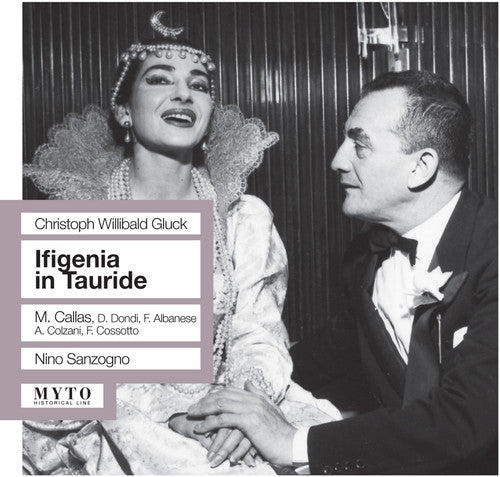
Gluck: Iphigenia auf Tauris (Sung in Italian) [Recorded Live
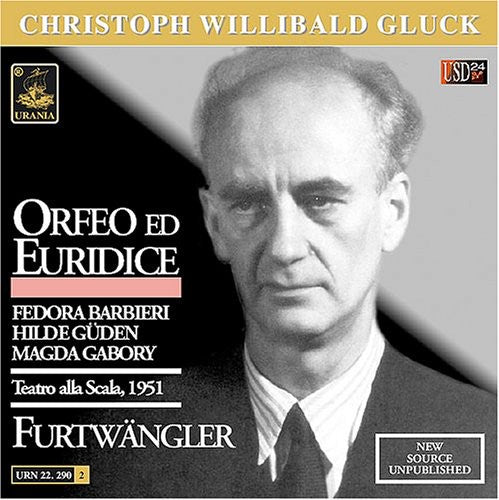
ORFEO ED EURIDICE
Gluck: Orfeo ed Euridice (Recordings 1957)
Gluck: Iphigenie en Aulide
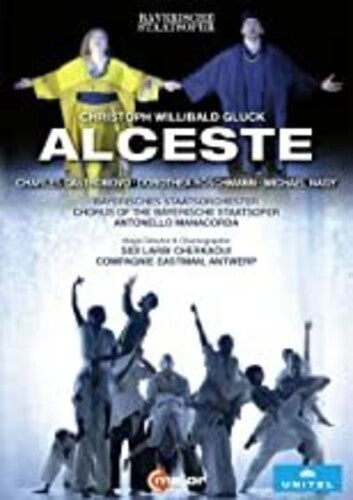
Gluck: Alceste (Paris version 1776) / Bayerische Staatsoper
This Blu-ray Disc is only playable on Blu-ray Disc players and not compatible with standard DVD players.
Also available on standard DVD
The Belgian dancer and choreographer Sidi Larbi Cherkaoui interprets Gluck’s late Baroque opera Alceste as an impressive symbiosis between dance and music. The opera “can be experienced here in all its existential power.“ (SZ) It is here performed in the revised Paris version from 1776 where Gluck has revalued especially the ballet music. Cherkaoui – director of the Royal Ballet of Flanders – has worked with top artists across disciplines like superstar Beyoncé. The superb dancers of the Belgian Compagnie Eastman, Antwerp perform Gluck’s score physically, creating a fine and stringent aesthetics of “beautiful images” (Opernwelt). Dorothea Röschmann with her “inimitable charisma” (Financial Times) and Charles Castronovo deliver a brilliant performance in the roles of the self-sacrificing royal couple. “Musically impressive.“ (NMZ)
Gluck: The Symphonies / Gaigg, L'Orfeo Barockorchester
-- David Hurwitz, ClassicsToday.com, [May 9, 2011]
"None of these works is ground-breaking exactly - in fact they are utterly conservative! - but they are all clearly written by a man, probably still young, who knew what he was doing, and how to achieve his desired effects with considerable imagination and audience-pleasing brio. The Overtures in particular are easy-going, but peppered throughout the programme there is some lovely writing, especially for the horn pair and, from time to time, the oboes. The two works in D - both in two movements only, incidentally - are probably the most memorable, Chen D6 for its concertante interplay, Wq 165.2 for its catchy simplicity.
Under Gaigg's assured violin-in-hand guidance, the Baroque Orchestra's playing is Classical: refined and restrained, with attention to detail, yet still light and bright. Period instruments and techniques are used to authentic effect."
-- Byzantion, MusicWeb International
Certainly the most stylistically advanced of the lot, the G-Major Symphony, points strongly to the influence of Johann Stamitz’s later symphonies of the early 1750s: great rhythmic energy, strong textural contrasts, half-cadence substitutions, orchestral intensification of short motto themes upon their immediate restatement, frequent and distinctive use of specific wind colors, cantabile themes over bass ostinatos, and that desire to avoid the expected—whose most telling monument can be found in C. P. E. Bach’s quirky later symphonies. By way of greatest contrast, there’s a D-Major Symphony (Chen D2) whose first of two movements, a complex but gracious Andante with potential operatic origins, is purest galant, as though it had stepped out of a work by Brunetti or Boccherini. Regardless of which individual or group of composers is responsible for these works, they make for fascinating and uniformly pleasurable listening.
Some of that is due, of course, to Michi Gaigg and her 22-person L’Orfeo Baroque Orchestra. The tonal bite to the strings that was present in their recording of Rebel’s Les Élémens (Phoenix Edition 110) is not as prominent, but that’s to be expected, as the music is from a different culture and period. Consistent, however, is their concern with clean articulation, firm rhythms, and a focus on instrumental tone. They are all technically expert—notably so the two hornists, Thomas Fischer and Christoph Beham, featured in the wince-inducing difficulties of the D-Major (Chen D6) Symphony’s minuet finale.
The sound is close and distinct, with none of the rich acoustical reverberance that may be meant on occasion to hide a period ensemble’s anemic string tone, but instead ends up swamping textural and rhythmic clarity. In short, whether this is Gluck or not, it’s well worth the consideration of any listener who enjoys fine examples of the mid-Classical period symphonic oeuvre.
FANFARE: Barry Brenesal
Gluck, C.W.: Orphee et Euridice
Gluck, C.W.: Ezio [Opera]
Gluck: Orfeo ed Euridice / Davies, Bevan, Bottone, Bates, La Nuova Musica

La Nuova Musica presents a new live recording of Gluck’s Orfeo ed Euridice, with countertenor star Iestyn Davies singing the title role. Once created to reinstate the “noble simplicity and calm grandeur” of ancient Greek culture, the opera continues to delight audiences with its direct and unpretentious appeal, epitomized by the world-famous aria Che farò senza Euridice. This live recording presents the original 1762 Vienna premiere version of the opera, with Gluck’s exquisite evocation of the Elysian Fields from his 1774 Paris version as a small addition. La Nuova Musica and its artistic director David Bates are among the most exciting young Baroque ensembles of our times. For their first PENTATONE recording, they work together with three exceptional vocalists: countertenor Iestyn Davies and sopranos Sophie Bevan and Rebecca Bottone.
-----
REVIEW:
The chorus has much to do, and I lost count of the number of times it ravished the ear. The orchestra, too, is extremely accomplished. The soloists are magnificent. Iestyn Davies sings smoothly throughout, while Sophie Bevan comes across powerfully, getting more and more stroppy as she rails at Orfeo for not looking at her. Rebecca Bottone has a perfect voice for Amore (Cupid), light and bright. High praise, then, for David Bates and his ensemble.
– Gramophone
Bates is, like Gluck, wonderfully radical. Where other directors smooth over disjunctions, he revels in rupture. This is directorship at its most alert, and aiding Bates is an optimal cast. Davies radiates Orfeo’s impassioned tenderness, changing vocal colours as the drama demands. Sophie Bevan’s Euridice swings, with blazing bravura and increasing intensity, from anguish to narcissism. It’s the stuff of Gluck’s dreams.
– BBC Music Magazine
Gluck: Demofoonte / Alan Curtis, Il Complesso Barocco
Demofoonte dates from the early ‘Milan years’ of Christoph Willibald Gluck (1714–1787), long before the radical ‘reform operas’ for which he is most famous and his break with opera seria and the librettos of Pietro Metastasio. Gluck arrived in the northern Italian city in 1737 and was mentored there by composer Giovanni Battista Sammartini. Though Sammartini primarily composed symphonies and music for the church, Milan boasted a vibrant opera scene, and Gluck soon formed an association with one of the city's up-and-coming opera houses, the Teatro Regio Ducal. His first opera, Artaserse, on a libretto by Metastasio, premiered there on 26 December 1741 and opened the Milanese Carnival of 1742. Gluck went on to compose an opera for each of the next four Carnivals at Milan, Demofoonte being the second of these and his third opera overall, premiering on 6 January 1743. In celebration of Gluck’s 300th birthday, the early music scholar and harpsichordist Alan Curtis (1934–2015), founder of Il Complesso Barocco and leader of the period music ensemble for nearly four decades, prepared Demofoonte for performance. All of the arias had been preserved, but nearly all of the secco recitatives were lost. Curtis composed new recitatives in Gluck's style, using Gluck’s earliest fully extant opera, Ipermestra, written less than two years after Demofoonte, as a model. This modern revival was given its first performance on 23 November 2014 in Vienna and was recorded with the same excellent cast of singers the week before, in Northern Italy.
LA CORONA LA DANZA