Christopher Rouse
7 products
Rouse: Odna Zhizn, Symphonies Nos. 3, 4 & Prospero's Rooms / Gilbert, New York Philharmonic
“Chris Rouse is one of the most important composers working today. He shapes the sound and the emotional flow of his music in a way that only great composers can... His music is very telling and thoughtful about the human condition in a way that is fairly unique today.” - Alan Gilbert
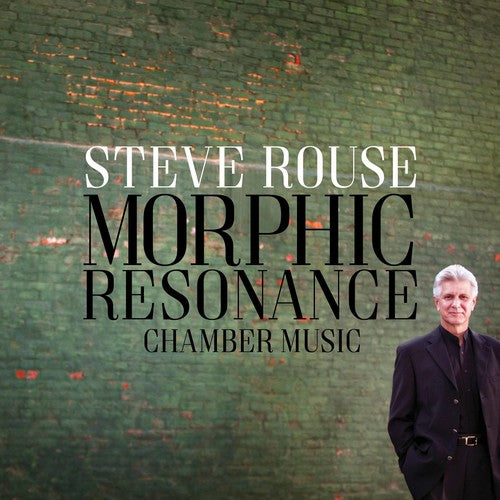
Rouse: Morphic Resonance
Composer Steve Rouse constructs unique and indelible sound worlds on his album MORPHIC RESONANCE, his first release with PARMA Recordings. The album is a revue of Rouse’s chamber music from the last two decades and beyond, and the works featured on MORPHIC RESONANCE demonstrate Rouse’s powerful gifts to create compelling and idiosyncratic musical statements. This quality is most prominent in the work Ten Little Things, a set of short movements for clarinet and percussion. More appropriately, Rouse uses the work to pair solo clarinet with different pitched and unpitched percussion instruments, and he succeeds brilliantly in blending the clarinet’s sound with unlikely partners, such as the tambourine and snare drum, among others. Ten Little Things is endlessly impressive, as each movement sounds like a new world, thanks to Rouse’s willingness to explore the full color palette of the clarinet, namely through microtones, and his disciplined construction of melodic and rhythmic material. Across MORPHIC RESONANCE, Rouse displays the highest level of compositional ability, particularly in the unexpected ways he bases seemingly complex passages on repeated melodic and rhythmic ideas. This technique is critical to the success of Ten Little Things as it further links the clarinet and percussion in the common purpose of the movement, underscoring their total partnership in the music. In Form Fades, for flute, clarinet, cello, violin, piano, and percussion, Rouse demonstrates a winning approach to ensemble writing. Scored for a notably disparate group of instruments, Rouse unites them, at first with a shared melody, throughout with brilliant orchestration. Rouse’s treatment of the ensemble not only connects its components, but also energizes and brings unexpected earthiness to the whole ensemble, which, in the history of twentieth and twenty-first century music, is most commonly associated with intricate, delicate, and erudite compositions. A hidden gem on MORPHIC RESONANCE is Nevolution, Rouse’s duo for corno da caccia – a historical brass instrument dating back to the Baroque period – and piano. Once again, Rouse succeeds in transcending the difficulties of unusual instrumentation and creates an entirely unique, entirely personal, and entirely compelling composition. Most stunning is Nevolution’s middle movement, which is slow and lyrical, showing the tenderness that is also part of Rouse’s musical language. This album is replete with unusual combinations of instruments, particularly in Ten Little Things and Nevolution. Consider how Rouse is able to exploit these pairings and ‘normalize’ them, as it were, into his regular musical language. Although Rouse’s music tends towards intricate and complex ideas, he often employs repetition to make his works more straightforward. Listen for this and consider how this disciplined approach helps to make his music more compelling.
Rouse: Chamber Music
Rouse, C.: Iscariot / Clarinet Concerto / Symphony No. 1
Christopher Rouse: Flute Concerto, Symphony, Rapture, Etc / Bezaly, Royal Stockholm Po
--David Hurwitz, ClassicsToday.com
Rouse: Symphony no. 5, Supplica & Concerto for Orchestra / Guerrero, Nashville Symphony
Winner of a 2020 GRAMMY Award for Best Contemporary Classical Composition
Champions of new American music, the Nashville Symphony and its music director Giancarlo Guerrero had premiered numerous works and received 13 GRAMMY Awards including two for Best Orchestral Performance. Among their award-winning recordings include works by Michael Daugherty (Metropolis Symphony on 8.559635; Tales of Hemingway on 8.559798), Stephen Paulus (Three Places of Enlightenment on 8.559740), and Jennifer Higdon (All Things Majestic and Viola Concerto on 8.559823).
Rouse's Concerto for Orchestra is a ‘hyper-concerto’ that gives each player a chance to shine, while the mournful intimacy and passion of Supplica unfolds somewhat like the slow movement of a Bruckner or Mahler symphony. Rouse’s Fifth Symphony fondly recalls Beethoven’s mighty Fifth but blurs the lines between tradition and modernity, transporting the listener from turbulence to serenity. It was described as “brilliant, exciting and at times hauntingly beautiful” in The Dallas Morning News.
REVIEW:
This latest issue of music by the late Christopher Rouse contains some really splendid music. Both the Fifth Symphony and the Concerto for Orchestra exploit Rouse’s ability to juxtapose music of supercharged turbulence and rhythmic bite with passages of deeply expressive lyricism. Both take the form of a single, continuous movement some thirty minutes long, but the internal structures are quite different. The symphony features two quick outer movements enfolding a mix of adagio and scherzo, while the concerto starts like a rondo with alternating fast and slow sections, before a genuine slow movement gradually gives way to a brilliant conclusion. Rouse’s music is always so effectively scored that you might call all of it “concerto for orchestra,” and both pieces are full of arresting ideas, both melodic and gestural.
Supplica is relatively brief (twelve minutes) slow movement that sounds exactly like its title suggests: supplication, prayer, or entreaty. Its scoring is quite restrained: strings harp and brass, but Rouse’s imaginative handling of sonority is everywhere in evidence, proving conclusively that he was much more than a master of splashy instrumental effects (though he was that too). It’s a lovely, passionate piece whose lyricism never sounds trite or facile. All three works here receive excellent performances by the Nashville Symphony under Giancarlo Guerrero, and they are very well engineered. Rouse was an extraordinary composer whose career ended too suddenly (he died of renal cancer in 2019, and was only 70), but his work surely deserves to endure. This release does him proud.
-- ClassicsToday (David Hurwitz)
Rouse: Seeing; Kabir Padavali
-----
Review:
Trevigne is nothing less than sensational. She is assured in her presentation, and possesses a warm and, yes, voluptuous soprano that is perfectly matched to this material. Her performance shows a level of commitment to the composer’s intentions that only the best singers of contemporary music can command.
– Fanfare