Dora Pejačević
3 products
Dora Pejacevic: Complete Symphonic Works
Pejačević: Chamber Music / Trio RoVerde
The pianist Ekaterina Litvintseva won critical praise for her solo album on Piano Classics (PCL10226) of piano music by Dora Pejačević: ‘You owe it to yourself to make the acquaintance of Dora Pejačević if you haven’t done so already.’ (Fanfare, May 2022)
With her colleagues in Trio RoVerde, she now turns to the Croatian composer’s chamber music. The Cello Sonata dates from 1913, the same year as Pejačević wrote the first piano concerto by any Croatian composer. Like Brahms’s First Cello Sonata and Elgar’s Cello Concerto, it is cast in a moody E minor, with a yearning character are established from the outset by a long-limbed cantabile melody for the cellist. Pejačević proceeds to develop a passionate dialogue between cello and piano through an assured handling of sonata form.
The following sequence of miniatures for violin and piano evokes the world of the salon in their titles, but the Schumannesque warmth of the Romanze Op.22, from 1907, is replaced by a style at once more wistful and refined by the time of the Elegie, which she wrote in the same pivotal year (1913) as the Cello Sonata. From seven years later, the Meditation Op.51 makes no retreat into solipsism but paints a three-minute sketch of a new and uncertain world.
From 1910, the C major Piano Trio returns us to safer ground. Pejačević demonstrates a notable sensitivity in writing for a tricky combination of instruments: strong melodic writing for the string instruments counterbalances the weight of the piano part, which is in any case deftly pointed and touched by the composer’s experience as a performer. If Pejačević’s chamber music has not taken its place in the standard repertoire of late-Romanticism, it is our loss, and one that an increasing number of performances and recordings such as this one are belatedly redressing.
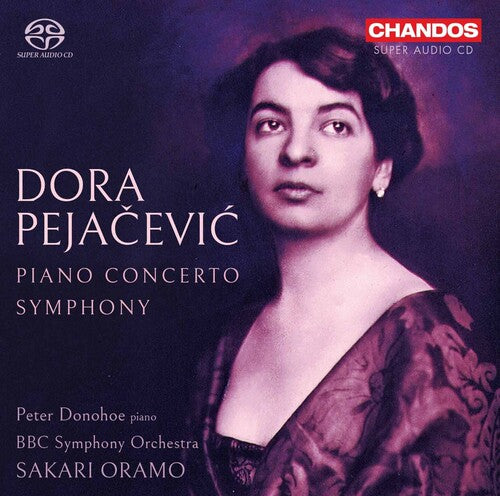
Pejačević: Piano Concerto, Symphony in F-Sharp / Donohoe, Oramo, BBC Symphony
Countess Mária Theodora (Dora) Paulina Pejačević was born in September 1885 in Budapest. Young Dora grew up with all the advantages of an aristocrat: a fairy-tale life of opulent palaces set in idyllic landscapes; privilege, comfort, leisure, and wealth. From an early age she defied convention and walked her own path, one that eventually led her to ‘despise’ the aristocracy. Her father, Count Teodor Pejačević, a lawyer, held several high posts, including that of Civil Governor of Croatia, Slavonia, and Dalmatia (1903 – 07). Her mother, Lilla Vay de Vaya, an ‘exceptionally beautiful’ Hungarian countess, was a gifted pianist and singer, and a fine amateur artist.
Her parents arranged private lessons with teachers at the Music School of the Croatian Music Institute, at Zagreb, which lead to further instruction in Dresden and Munich. Dissatisfied with the ‘limits’ of her formal studies, Pejačević pursued her own intensive course of self-instruction in composition. Having taken her music education into her own hands, she set off to enrich and broaden her intellectual horizons, travelling to cultural centres in Germany, Austria, Czechoslovakia, and Hungary. During these travels, she came to know the leading artists, poets, and intellectuals of the day. The Piano Concerto was her first orchestral composition, and the first piano concerto by any Croatian composer. She composed the Symphony in F sharp minor during the first world war, whilst also working as a volunteer nurse. For its first complete performance, in 1920, she revised the work, which is here recorded in this final version.
REVIEWS:
"[The Piano Concerto] boasts attractive melodies, warmly lush orchestration and technically demanding piano writing. Peter Donohoe revels in its manifold opportunities for virtuosic display, but also brings poetry and requisite tenderness to the beautifully lyrical writing in the slow movement. The Symphony is even more impressive…Sakari Oramo and the BBC Symphony Orchestra, supported by Chandos’s customary warm engineering, clearly believe in the works and deliver an extremely compelling performance."
– BBC Music magazine (Erik Levi)
Peter Donohoe’s barn-storming style suits the piano concerto and Sakari Oramo conducts as if these were repertoire works. The recording is rich and full, in the Chandos manner, even though I was listening in ordinary two channel stereo…
– MusicWeb International (Stephen Barber)
The beginning of Pejačević’s first—and only—symphony emerges like a Brahmsian cortege, garlanded with grand strokes and unusually expressive melodies that wouldn’t sound out of place in [Alexander] Borodin’s musical world. But it soon picks up the strange beauty of [Richard] Strauss’s unsettling textures and harmonies, along with his predilection for the cinematic.
Croatian musicologist and Pejačević biographer Koraljka Kos characterizes her work during World War I as 'vigorous,' and borne 'perhaps out of the need to fence herself off from some of the awful reality she witnessed daily.' What she witnessed wasn’t at a remove; despite growing up in an aristocratic family, Pejačević rejected the leisure of her class in favor of work and, during the war, volunteered as a nurse in her village of Našice.
...For all of the threads of music history that come together in Pejačević’s works, their real attraction lies in [a] Caravaggio-esque chiaroscuro, written with an assertive hand but designed to evoke in the listener a sense of precariousness and dispossession. Brahms and Strauss wield power. Pejačević remonstrates it.
--Van Magazine (Olivia Giovetti)