Édouard Lalo
18 products
-
-
-
Lalo: Symphonie Espagnole; Saint-Saens: Violin Concerto No.
$21.99CDChandos
Apr 04, 2025CHAN 20333 -
-
-
-
-
-
-
-
Antonio Pappano - Complete Santa Cecilia Symphonic,Concertante & Sacred Music Recordings
Edouard Lalo: Le Roi d’ys
Lalo: Symphonie Espagnole; Saint-Saens: Violin Concerto No.
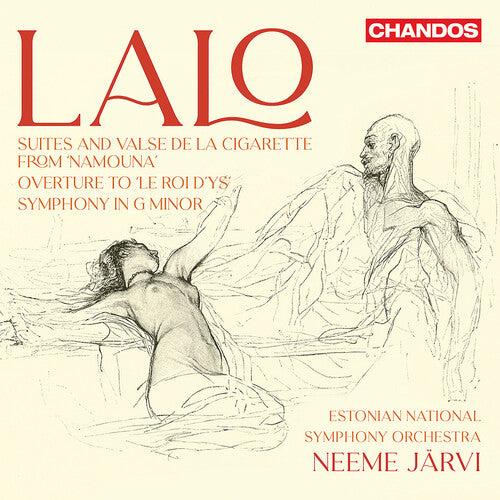
Lalo: Orchestral Works / Jarvi, Estonian National Symphony
Lalo considered himself to be first and foremost an opera composer, even though Le Roi d’Ys was his only opera to be performed in his lifetime. He is now best known for his symphonic and chamber music, largely because of the highly political musical establishment in France in his time. The Overture to the opera (which opens this album) is now the best-known music from the piece, which proved a considerable success in France. His ballet Namouna was commissioned by the Paris Opéra and, remarkably, was completed in just four months following extensive delays in agreeing the subject – part of the tales of Casanova. After a successful run of fifteen performances, Lalo parcelled the music up into three ‘rhapsodies’ for orchestral performance. The first two of these were published as Suites Nos 1 and 2. The third was not published, but the ‘Valse de le Cigarette’ was later issued separately. Lalo’s only surviving Symphony was completed in 1886, but somewhat overshadowed by Saint-Saëns’s Organ Symphony (1886) and Franck’s Symphony in D minor (1888), but it is a strong work that showcases Lalo’s melodic gift and forward-looking harmonic palette.
La Fl釦e Parisienne
Lalo: Le Roi d'Ys
Edouard Lalo
Lalo: Concerto Russe, Etc / Charlier, Tortelier, Bbc Po
Recorded in: New Broadcasting House, Manchester 9-10 February 1998 Producer(s) Brian Pidgeon (Executive) Brian Couzens Sound Engineer(s) Stephen Rinker
LALO: Cello Concerto in D minor / Cello Sonata
Lalo: Works For Violin And Orchestra / Kantorow, Bakels, Granada City Orchestra
In 1878 Édouard Lalo wrote to the Spanish violin virtuoso Pablo de Sarasate: 'Your arrival in my life has been my greatest artistic opportunity... without you, I would have continued to write insignificant odds and ends'. The three works gathered here all spring from this arrival, beginning with the Violin Concerto, composed in 1873. The melodious and charming concerto held a great significance for the composer, who regarded it as his first work truly worthy of the name. In the eye of the public it was soon to be overshadowed, however. The première of Symphonie espagnole, in 1875, was followed by performances all over Europe, always in the expert hands of Sarasate. Neither a symphony nor a concerto, it is rather a five-movement suite in which the soloist and orchestra converse as equal partners. First in a long line of Spanish-themed works by French composers (including Bizet's Carmen, Chabrier's España, Debussy's Iberia and Ravel's Rhapsodie espagnole), it may be regarded as a composer's tribute to his violinist's country of origin. Three years later the Scandinavian accents of Fantaisie norvégienne were possibly the result of an encounter with the Norwegian composer and violinist Johan Svendsen. There is no doubt that Lalo was once more composing with Sarasate in mind, however. He wrote to the violinist: 'I believe that I have succeeded in being amusing without being common... Feel free to add violinistic devilishness if you like.' Whatever liberties Sarasate may have taken with the solo part, the première, conducted by Max Bruch, was again a great success. So great, in fact, that Lalo soon transformed it into a purely orchestral work, without soloist, giving it the title Rapsodie norvégienne. Standing in for Sarasate on the present disc is Jean-Jaques Kantorow, whose recording (on BIS-CD-1470) of Saint-Saëns' Third Violin Concerto - incidentally another work dedicated to Sarasate! - was nominated for both a Gramophone Award and a BBC Music Magazine Award in 2008. Here he receives fine support from the conductor Kees Bakels, his collaborator on the Saint-Saëns disc, and the Granada City Orchestra, of which he himself was the artistic director during the years 2004-2008.
Lalo: Cello Concerto / Symphony In G Minor / Namouna
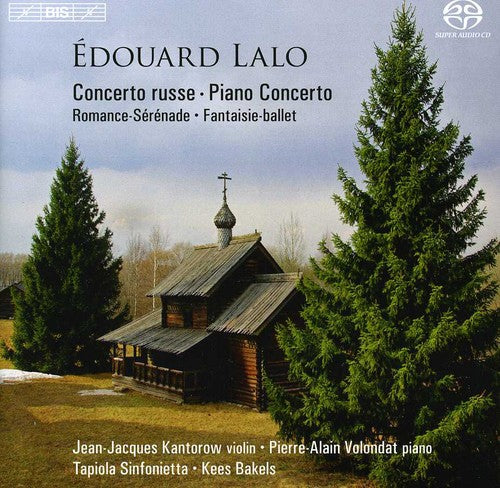
Lalo: Concerto Russe, Piano Concerto / Kantorow, Volondat, Bakels
'A disc without flaws, a true marvel' is how Jean-Jacques Kantorow's previous recording of music by Édouard Lalo was described in the Spanish magazine Scherzo. The disc in question included three works composed for the great violin virtuoso Pablo de Sarasate: the violin concerto, Fantaisie norvégienne and the perennial favourite Symphonie espagnole. In a review in Gramophone, the soloist was compared to his great predecessor: 'Kantorow, one of today's most individual players, has the measure of Lalo's Sarasate-inspired violin-writing - he's able to toss off the virtuoso passagework in a seemingly effortless manner and his distinctive tone lends a sensuous allure to Lalo's melodies.' On the present disc, Kantorow plays two other works intended for Sarasate, the brief Fantaisie-ballet on themes from Lalo's ballet Namouna, and the large-scale Concerto russe. The latter piece, in four movements, borrows themes from two wedding songs included by Rimsky-Korsakov in his collection 100 Russian Folk Songs. A typically expressive and virtuosic composition, it is also one of the first important French works to draw upon Russian music - many others were to follow. Two shorter violin works are included here, but the disc closes with another concerto, the Piano Concerto from 1888. It was the composer's final major work, and in it he seems to depart from the pattern of his violin concertos, with their prominent solo parts. Lalo rather chooses to integrate the piano into the orchestral texture, and although the writing is redolent of the great Romantic concertos, it offers few opportunities for the soloist to show off - a possible reason for the work's absence from modern concert programmes and its rarity on disc. Championing this solo part is Pierre-Alain Volondat, and as in the other works orchestral support is provided by the eminent Tapiola Sinfonietta, conducted by Kees Bakels.
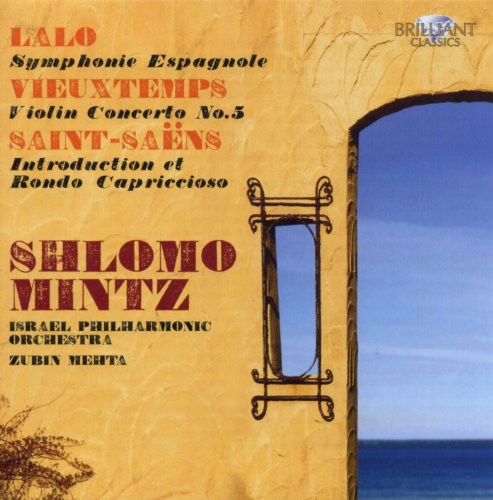
Lalo, Vieuxtemps, & Saint-Saens / Mintz, Mehta, Israel Philharmonic
Lalo: Symphony In G Minor, Etc / Andretta, Basler Sinfonie-Orchester
Lalo & Saint-Saens: Cello Concerto in D Minor; Cello Concerto No. 1
Saint-Saëns' First Cello Concerto was composed in 1873; Lalo's in 1876, meaning that they are both products of late French romanticism and, not by chance, both in minor keys. Maja Bogdanovic's interpretation is imbued with her Slavic background, emphasising the passionate and tragic character of both works. Thanks to the perfect chemistry between her and the Serbian conductor and orchestra, the result is a dazzling and unique performance, providing a brand new insight into two famous works and, most importantly, the feeling of attending a live concert.
Lalo: Symphonie Espagnole; Ravel, Et Al / Howard Zhang, Etc
Lalo: Cello Concerto, Symphony, Etc / Cohen, Haeck
Schifrin: Piano Works / Conti
Lalo Schifrin, the internationally renowned composer of classic film and TV scores such as Bullitt, Dirty Harry and Rush Hour, has collaborated with fellow Argentinian pianist Mirian Conti for this collection of his complete works for solo piano to date, including several world premières. A unique arrangement of the famous theme to Mission: Impossible is included, as well as his most recent compositions: the two richly sensuous tangos, and the powerful Jazz Sonata, composed especially for Conti.
-----
REVIEWS:
Conti’s performances connect well with the rhythmic vitality of Schifrin’s music, ably delivering the gorgeous melodic content and rich, extended jazz harmonies. The recording features a crisp, dry acoustic that allows for good clarity. Those listeners who love Schifrin’s film work but are less familiar with his other endeavors will likely find a lot to enjoy here as well.
– Film Score Monthly
Some of the music is extremely difficult to play but is played with panache and dexterity. I enjoyed most of the music; all of the pieces are engaging and interesting. For Schifrin’s fans this is a must. For the rest of us, it’s entertaining. The sound is excellent.
– American Record Guide