Einojuhani Rautavaara
31 products
-
Rautavaara: Complete Piano Works
$26.99CDPiano Classics
Jun 13, 2025PCL10331 -
-
-
-
-
-
-
-
-
-
-
-
-
-
-
-
-
-
-
-
-
-
-
-
-
-
-
-
Rautavaara: Complete Piano Works
Rautavaara: Summer Thoughts / Kuusisto, Jumppanen
Rautavaara has composed very little for violin and piano, or (in the case of Variétude) for solo violin. There are mostly occasional works, but they are no less finely crafted for that. The excitingly brief Dithyrambos and Notturno e danza deliver what their titles suggest, while the other pieces are all nostalgic mood-pieces, often very beautiful. The major work here is Lost Landscapes, a four-movement violin sonata in all but name, with each movement offering a portrait of one of the composer's youthful haunts: Tanglewood, Ascona, Rainergasse 11, Vienna, and West 23rd Street, NY.
Kuusisto, as we have every reason to expect, plays very well, with plenty of color in his tone; and as already suggested, Jumppanen also does an excellent job, whether as accompanist or taking over the spotlight. The sonics are generally excellent, well balanced, and perhaps just a bit bright in the violin's upper register. Ondine's Rautavaara recordings really are major additions to the contemporary music scene. This one is no exception.
--David Hurwitz, ClassicsToday.com
Rautavaara, E.: On the Last Frontier / Flute Concerto / Anad
Rautavaara: Songs
Rautavaara: Symphony No. 7 & Angels and Visitations / Koivula, RSNO
Angels and Visitations presents the composer in a more aggressive mood, a fact that leads some listeners to prefer it to the symphony's melancholy mellowness. Gorgeous string tone is also less of an issue here, and the orchestra's exciting brass and percussion sections make their presence felt to impressive effect. In fact, this coupling offers an excellent overview of Rautavaara's mature style, and even if you own one or all of the previous recordings of this music, you may well want to hear this disc as well. The important point is this: Rautavaara's music rewards the attention, and the fact that large works such as the Symphony enjoy multiple recordings speaks eloquently of their quality and of his importance in today's contemporary music scene. [2/15/2003]
--David Hurwitz, ClassicsToday.com
RAUTAVAARA: Thomas
Rautavaara: Book of Visions / Franck, National Orchestra of Belgium

This is a stunning disc. Rautavaara continues to operate at the peak of his form, despite suffering a serious heart attack in mid-composition of Book of Visions that kept him hospitalized for six months. It's a remarkable work in four movements (or "tales") lasting some 40 minutes. Each tale has a tantalizing title (Night, Fire, Love, and Fate) vague enough to leave the specifics to the listener's imagination, but full of musical possibilities that Rautavaara seizes with relish. You might call this new work a "Four Lemminkäinen Legends" for the new millennium, since as always that indefinable Finnish sensibility is quite audibly present but is always expressed in the composer's own personal idiom. The music is gorgeous: evocative, mysterious, luminously scored, and extremely well-crafted--and it practically goes without saying that dedicatee Mikko Franck does a spectacular job conducting this premiere. This is a major statement, make no mistake.
Rautavaara's First Symphony has often been revised, from a four-movement original, down to two movements, and back up to the present three, which, as the composer notes, provides a more balanced sequence than previously. It was written when Prokofiev and Shostakovich were major influences, but with the passing of time the lyricism of the first movement now seems fully characteristic of Rautavaara. Adagio Celeste is yet another example (there are many in Rautavaara) of how music based on a 12-note theme can still be very beautiful and approachable. In this regard he recalls Swiss composer Frank Martin. It's a lovely work scored for small orchestra (the "string orchestra" designation on the tray card is incorrect). Once again the performances of this work and the symphony are all that anyone could ask, and the sonics, whether in stereo or multichannel formats, are fully up to the quality of the interpretations. A knockout, not to be missed!
--David Hurwitz, ClassicsToday.com
Apotheosis: The Best of Einojuhani Rautavaara
I’m sure that this neatly selected series of works will whet the appetite of those yet to experience Rautavaara’s music. I think it’s right that if you’re going to present a compact work by him in toto it should be Cantus arcticus, which is one of his most popular. This Concerto for Birds and Orchestra, a beautiful title if ever there was one, evinces all his most personal and vital qualities - string wash of great, indeed magnetic, power and concentration, the quality of melancholy so often encountered in his music, and an accumulation of sound that reaches, at moments, almost a frenzy. For all his reflective qualities he has never been a dormant composer; rather he has managed to unleash moments of great power and energy that seem to have aggregated from the earlier material. Such, certainly, is the trajectory of this work, never for a moment gimmicky, always beautiful and, fortunately, the electronic song is expertly balanced in this recording.
The other works offer interesting perspectives too. The second movement of the Clarinet Concerto is played by the dedicatee Richard Stoltzman, who worked closely with the composer during its composition. Its lyric outpouring is as addictive as the third movement of Autumn Gardens, a nature portrait of powerful verdancy. The first part of Manhattan Trilogy is called Daydreams and its alternation of percussive power and refined lyricism is effectively realised, whereas the third movement of the Third Piano Concerto, called Gift of Dreams, is restless, passionate, bright edged and enshrines some truly portentous moments. Vladimir Ashkenazy plays and directs. The final two pieces are from symphonic works; Apotheosis is rapt and beautiful, whilst the segment from the Sixth Symphony is calm, dreamlike, reflective.
The majority of performances are by the Helsinki Philharmonic Orchestra under Leif Segerstam. All the performances are special and I hope they will lead appreciative and curious readers to the relevant Ondine box sets that house the symphonies and concertos.
– Jonathan Woolf, MusicWeb International
Rautavaara: Modificata, Incantations & Towards the Horizon
Modificata belongs to Rautavaara’s early, twelve-tone period (the late 1950s) and while it’s understandable that he takes pride in some of these early pieces, there is no point in pretending that they are as characterful or successful as his later works. Even here, though, Rautavaara fashions distinctive melodic material for each of the piece’s three movements–the quick finale is particularly exciting and successful. The first movement seems to owe a little something to the first of Berg’s Three Pieces for Orchestra, but especially in this context, it would be difficult to make the case for this music being as expressive and interesting as the two concertos. Still, it’s good to have this audible measure of the distance that Rautavaara has travelled over the course of his career. As with all the releases in Ondine’s ongoing series dedicated to this composer, the performances are excellent. Both concertos are performed by their dedicatees, while the Helsinki Philharmonic under John Storgards does its usual fine job. So, for that matter, do Ondine’s engineers. Very recommendable.
-- ClassicsToday.com
Rautavaara: Before the Icons & A Tapestry of Life / Segerstam

Here we have one of the greatest living composers working in the full inspiration of his mature style, performed and recorded with world-class passion and intensity. It really doesn't get any better. Before the Icons began life as a piano suite in 1955. In creating this orchestral version Rautavaara separated some of the individual numbers with interludes for string orchestra ("Prayers") and added a concluding "Amen". The music is wide-ranging and thoroughly approachable, though never cloying or cheap. Most of the "icon" movements feature the sound of bells as a unifying timbre, though the music isn't at all "churchly" in a conventional sense. It's a moving, even noble work, though it does have its lighter moments (the third movement: "Two Village Saints").
A Tapestry of Life (2007) has four movements lasting a bit more than 24 minutes. The second piece, "Halcyon Days", is stunningly lovely, while the concluding "Final Polonaise" builds to a powerful, ominous close. Each of the four movements is well contrasted and expressively affecting. It's great to have the opportunity to hear this music while it's still new, and as mentioned above the performance by the Helsinki Philharmonic under Leif Segerstam is first rate. If you care even mildly about contemporary music, or just good classical music, you owe it to yourself to hear this disc.
--David Hurwitz, ClassicsToday.com
--------------------------------------------------------------------------------------------------
RAUTAVAARA Before the Icons. A Tapestry of Life • Leif Segerstam, cond; Helsinki PO • ONDINE 1149-2 (49:37)
I have to tell you, at the outset of this review, that I moved to this CD immediately after reading Jack Reilly’s book The Harmony of Bill Evans, Vol. 2 (reviewed elsewhere in this issue) and listening to the accompanying CD, and that I found a great many similarities—more so than differences.
Einojuhan Rautavaara, who many probably do not know is the son of one of the greatest Mozart sopranos of the early 20th century (Aulikki, who sang the Countess in Le Nozze di Figaro on the old Glyndebourne recording conducted by Fritz Busch), has always written music in an amorphic style in which mood is as important as form. These works are no exception, and by doing so he allies his sparse melodic structures to the very sort of underlying density in chord progressions that were the heart of Bill Evans’s jazz pieces.
Before the Icons spans a full half-century of composition. Rautavaara wrote a set of six impressions on Byzantine icons for piano in 1955, immediately planned to orchestrate them, but did not get around to it until 2005! At that time, he wrote three “prayers” to go between the icons, scored for strings to reflect the voice of the individual. Some of the iconic pieces are agitated, powerful music, particularly the first ( The Death of the Mother of God ) and last ( Archangel Michael Fighting the Antichrist ), but not always, while the prayers are gentle and reflective. As usual, it’s a fascinating piece, and if he hadn’t revealed its genesis, one would have a hard time imaging a half-century between its two parts.
A Tapestry of Life is based on various poems or stories that influenced him. Again, as the music is impressionistic, it transcends the words to produce a feeling rather than a narrative. “Stars Swarming” was inspired by a poem by Edith Södergran, a surrealistic nightly vision where stars keep falling in the garden until the lawn is full of splinters. “Halcyon Days” uses the simple, monotonous repetition of a triplet, which gives rise to a slowly ascending cantabile melody (shades of Bill Evans again). Rautavaara’s coloristic effects derive from his very French-based style of orchestration overlaid on his Finnish musical sensibilities.
I’ve been a fan of Leif Segerstam since the early 1970s and saw him conduct both La Bohème at the Metropolitan Opera and his own works with the Cincinnati Symphony. For the life of me, I don’t understand why he is so undervalued (or, more often, ignored) as a conductor, as I consider him one of the greatest of the 20th century, but particularly in this music he gives his best because his own sensibilities are very close to Rautavaara’s. I urge you to get this record. It is a wonderful souvenir of both composer and conductor.
FANFARE: Lynn René Bayley
Rautavaara: Symphony No. 8, "The Journey" / Vänskä, Lahti Symphony Orchestra
Rautavaara: Symphonies Nos. 1-3 / Pommer, Leipzig Radio Symphony
Rautavarra: Symphony No. 6; Cello Concerto / Pommer, Helsinki Philharmonic
Rautavaara: Myth of Sampo
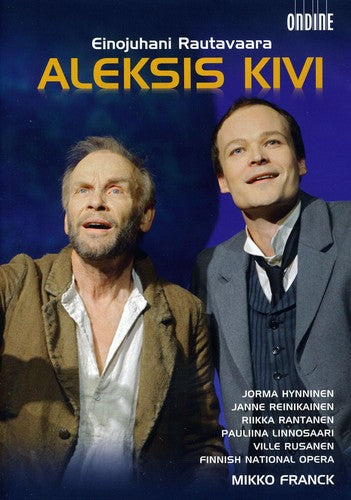
Rautavaara: Aleksis Kivi
Rautavaara: True and False Unicorn / Nuoranne, FRSO
Rautavaara: House of the Sun / Franck, Oulu Symphony
Rautavaara: Complete Works for Male Choir
Rautavaara: Aleksis Kivi
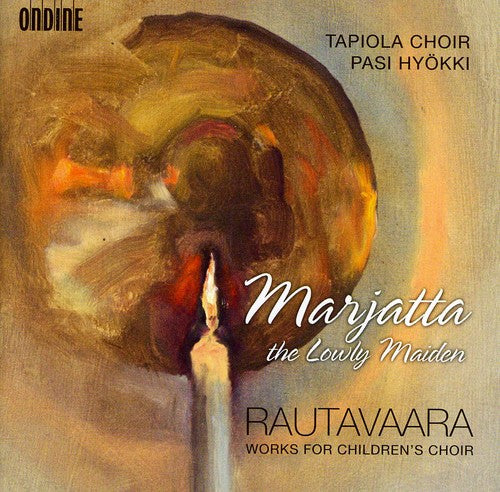
Rautavaara: Marjatta The Lowly Maiden / Tapiola Choir
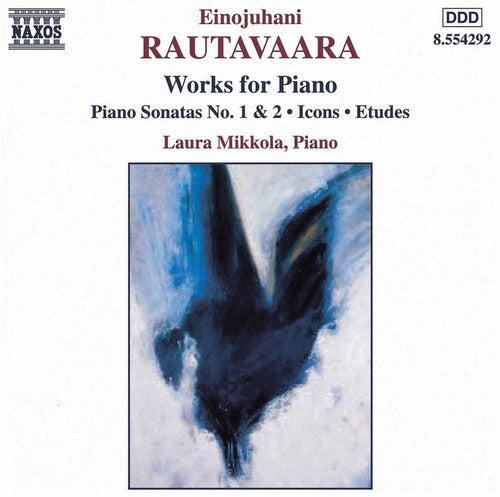
Rautavaara: Works for Piano / Mikkola
– ClassicsToday
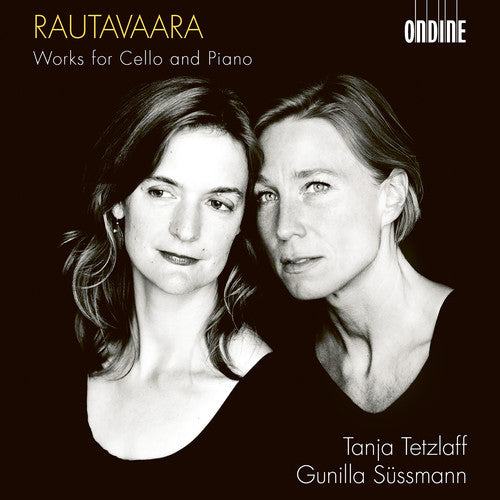
Rautavaara: Works for Cello & Piano / Tetzlaff, Sussmann
REVIEW:
As a mind-blowing display of technical accomplishment, I can only offer my congratulations to Tanja Tetzlaff who has a gorgeous Guadagnini cello of 1776 and an outstanding long-term piano partner in Gunilla Sussmann. Very good recorded quality and most highly recommended.
– David's Review Corner (David Denton)
Rautavaara: Vigilia / Nuoranne, Korhonen, Lehtipuu
The service of the Orthodox Church known as the All-Night Vigil has attracted many composers. Famous settings exist of parts or all of the service by Tchaikovsky and Rachmaninov among others. The service encompasses Vespers and Matins--the portions recorded here--interspersed with assorted prayers and chants. Among the traditions of the Orthodox Church are the complete absence of instruments, so for the music to be usable in a liturgical context it must all be for unaccompanied voices. In order to combat any potential monotony of sound, Rautavaara has deployed five soloists heard in various combinations with the large mixed choir that makes up the foundation of the music.
Rautavaara's music is audibly within the traditions of the Orthodox Church while retaining the stylistic traits common to his secular music. Although his rhythmic and harmonic usage ranges farther afield than might be associated with such music, actual traditional Slavic folk and liturgical music is rhythmically quite complex and startlingly dissonant, with much use made of seconds and sevenths. That said, little here would disturb any but the most conservative listener, and there is much of great beauty. The sound produced by the soloists and chorus is gorgeous.
REVIEWS:
BBC Music (5/98, p.59) - Performance: 5 (out of 5), Sound: 5 (out of 5) - "...If the prospect of an all-night vigil sung unaccompanied in Finnish doesn't enthrall you, don't worry: you're not alone. But give this disc a try, if you can: it delivers far more than it promises.
Rautavaara: Symphony No. 8 / Inkinen, New Zealand Symphony
Consisting of three movements—Daydreams, Nightmares and Dawn—Manhattan Trilogy (2004) does not constitute a symphonic piece as such. Its slow-fast-slow sequence equates to classical precedent, while the thematic working and textural elaboration follow directly from the composer’s practice in his last four symphonies.
Subtitled ‘The Journey’, the Eighth Symphony (1999) pursues its metamorphosis of ideas in ways similar to those of his previous three symphonies, but here the order of movements is nearly Classical; pointedly so in the second and third, whose contrast is emphasized by a lack of pause between movements.
The New Zealand Symphony Orchestra, founded in 1946, is the country’s leading professional orchestra. It has an establishment of ninety players and performs over 100 concerts annually. They tour extensively within their own country.
Music Director of the New Zealand Symphony Orchestra Pietari Inkinen is one of the most exciting talents of the new generation of conductors. He has collaborated with major orchestras and with soloists such as Vadim Repin, Hilary Hahn, and Pinchas Zukerman. His recording with the Bavarian Chamber Philharmonic has received outstanding reviews and was voted the BBC Music Magazine’s recording of the month.
Rautavaara: Song of My Heart - Orchestral Songs / Suovanen

The most wonderful thing about Rautavaara's songs is that no matter what the technical basis of his compositional method, he understands that "song" means an evocative text set to a singable melody. You may not go away humming all of the tunes here, particularly in the brief, powerful, and oddly disturbing cycle God's Way (to poems by Bo Setterlind), but there's no questioning the fundamental rightness of Rautavaara's reaction to the words, or his ability to project his feelings into an expressive vocal line. That's not something to be taken for granted nowadays, when grateful and effective writing for the voice is no longer the basis of most composers' techniques, whether writing for people or for instruments.
The remaining four sets of songs on this disc all employ texts of the highest quality, by Shakespeare (in English, by the way), Rilke, and Finnish poet Aleksis Kivi. The Rilke settings are particularly moving, nowhere more so than The Lovers, whose third song, "Woman Loving", ought to be a recital classic by now. The three songs taken from the opera Aleksis Kivi also deserve to find a life of their own away from the larger work. They stand among the most hauntingly beautiful of Rautavaara's latest creations. Baritone Gabriel Suovanen sings all of this music with warm tone and great musical intelligence, and he couldn't be better accompanied than by Segerstam and the Helsinki Philharmonic. Ideally balanced sound rounds out this most enticing picture of Rautavaara's generously lyrical art.
--David Hurwitz, ClassicsToday.com