Emilie Mayer
20 products
WHERE THE LIGHT IS: JOHN MAYER
ROOM FOR SQUARES
CONTINUUM (REVISED S
X2 (CONTINUUM / HEAVIER THINGS
HEAVIER THINGS
PARADISE VALLEY
BATTLE STUDIES (DELUXE EXPANDE
JOHN MAYER'S INDO-JAZZ FUSIONS: Ragatal
Dhammapada
John Mayer: Etudes & Radha Krishna
Mayer: Symphonies Nos. 3 & 7 / de Vriend, NDR Radio Philharmonic
Emilie Mayer was one of the very few female composers of her time to succeed in full view of the public. The Mecklenburg-born composer was also referred to as the 'female Beethoven'. On our second symphony album, Mayer opens up a new facet of her compositional spectrum by exhibiting classicistic tendencies: clear and transparent outlines, regular periods in the formation of themes, no formal experiments. The additional name "Militaire" refers to the use of piccolo, triangle, cymbals and bass drum in the final movement.
All we know about her seventh symphony is that it was probably composed by 1856. It is fair to say that Emilie Mayer draws in this symphony the sum of her previous experience with the composition of symphonies: large-scale tension-building, such as she practiced in the opening movement of her second symphony, with the classicistically clear formal language that her third symphony exhibits. At the same time, the motivic integration is so dense that the boundaries between thematic and non-thematic formal sections become blurred. More masterpieces by one of the most important female representatives of 19th century Central European music.
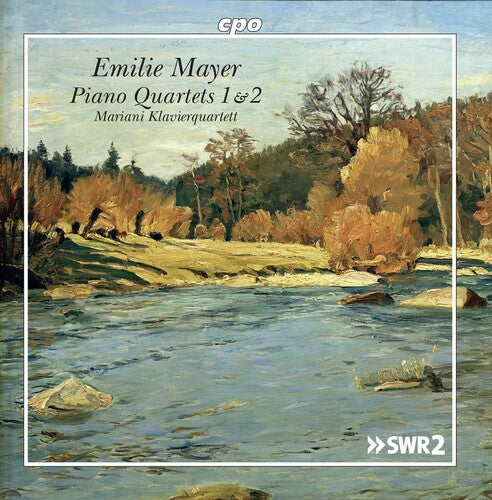
Mayer: Piano Quartets 1 & 2 / Mariani Piano Quartet
“Compositions that already on a first hearing leave behind a uniquely original impression.” This is what klassik-heute.com wrote after the release of our first album with piano trios by Emilie Mayer. Her extensive chamber oeuvre for piano also contains two piano quartets. She composed these two works, one in E flat major and the other in G major, at the end of the 1850s. At the time Emilie Mayer was an esteemed composer residing in Berlin: most of her works were performed with success, and she enjoyed broad recognition in music circles. Each of her quartets consists of four movements. Here her model in formal matters was not so much Mozart or Beethoven but Schumann, whose sole Piano Quartet op. 47 had been published a good fifteen years before. Considering her music as a whole, we may say that in her piano quartets, just as in her chamber oeuvre in general, Emilie Mayer was a compellingly independent composer with firm rooting in classical models who succeeded in developing a romantic musical language all of her own.
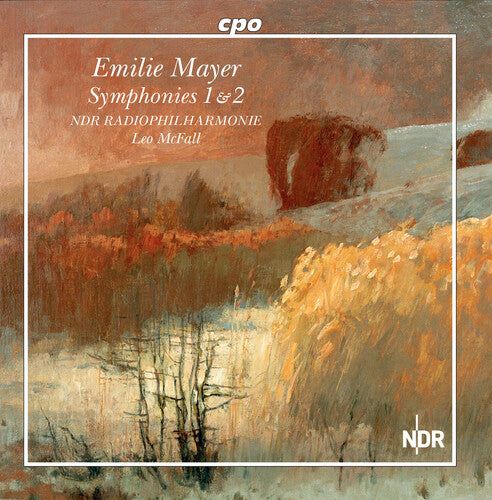
Mayer: Symphonies Nos. 1 & 2 / McFall, North German Radio Philharmonic
No woman composer of the time compiled an oeuvre as extensive as that of Emilie Mayer, who was born in Friedland, Mecklenburg, in 1812 and made contributions to a wide range of musical genres. She succeeded in doing what remained a mere wish dream for most women composers of her generation: she reaped great praise from the critics and pursued a successful career as a composer – and our three previously released albums featuring her piano and chamber music have confirmed her mastery. Emilie Mayer wrote her eight symphonies between 1845/46 and (at the latest) 1857. Her first two symphonies date from her Stettin study years with Carl Loewe. This period lasted from 1842 to the beginning of 1847, but she hardly would have ventured to write such works at the beginning of these study years with Loewe. The Symphony No. 1 very much leads one to believe that it may have been something like a final examination piece with which she concluded her instruction from him. She quite ostentatiously constructs classical models, displays her modulatory talent, demonstrates her rich formal imagination, exhibits her command of double counterpoint, and works through tonal intricacies with sovereign control (last movement) – and does it all with unrivaled mastery. In the Symphony No. 2 Emilie Mayer emancipates herself from models and pursues completely new paths, above all in dramaturgical development within the compass of the large form. This is immediately shown in the slow introduction of the first movement. With its forty measures it is unusually long, and in some respects it previews the structural idea of the first movement: the building and dismantling of long lines of suspense that are linked together by contrasting and intermittent passages.
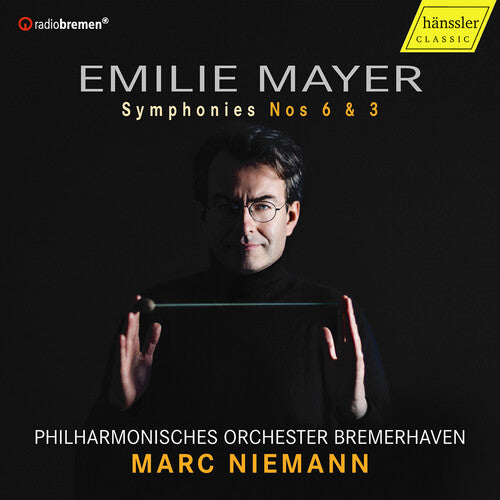
Music from the Shadows - Mayer: Symphonies Nos. 6 & 3
The long overdue rediscovery of Emilie Mayer naturally earns her the near-universal label of “female Beethoven”, which she was called even by her contemporaries. On the one hand that is a great honor, for Mayer is indeed considered the most successful symphonist among the composing women of the Romantic era. She was thus not content with the “domestic” genres of Lieder, piano works and chamber music, which is all that her female colleagues were generally allowed,Conductor:on the contrary, she designed symphonies on the grand scale. On the other hand, that label shows that people are still thinking along gender-specific lines – even if they have happily escaped the 19th-century mindset that hampered Emilie Mayer’s own career. As late as 1878, the “Neue Berliner Musikzeitung” was describing her as a “rare phenomenon” and an “exception” to the rule that the “Production” of orchestral works was solely the “Domain of the creative male intellect”. By that date, Emilie Mayer had already presented eight symphonies. And in 1850, almost 30 years earlier, a critic had exclaimed in the same paper: “Hitherto woman’s fair hand has mastered the Lied at most (...). What female powers, powers of the second rank, can attain – that is what Emilie Mayer has achieved and reproduced.”
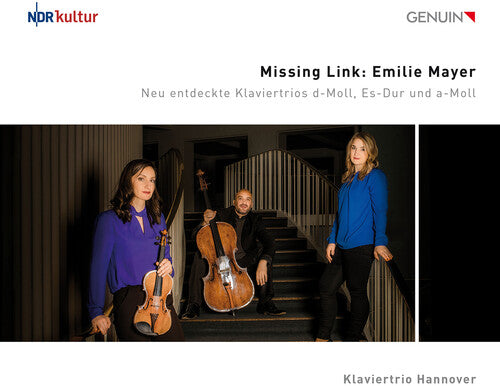
Emilie Mayer: Missing Link - World Premiere Recordings / Hanover Piano Trio
Mayer & Netzel: Trouvez les femmes! Vol. 1 - Female Romantic Composers / Terragni, Sarasin
Mayer: Overtures & Symphony no. 3 "Military" / Mecklenburg State Orchestra Schwerin
That's what happens when you let yourself be guided by prejudices: Emilie Mayer's contemporaries in the mid-19th century were unaware of the outstanding quality of her compositions because they only saw a woman rather than hearing the composer. You might think you missed something when you listen to the brand-new Super Audio album of the Mecklenburgische Staatskapelle: with chief conductor Mark Rohde on the podium, the musicians from Schwerin succeed in a salvation of honor that could not be more attractive.
Financially independent at an early age, Emilie Mayer was able to devote herself entirely to her passion for composing. Her misfortune: instead of salon music, thought of as the best women could hope to compose, she ventured into the grander forms. Eight symphonies alone came from her pen, as well as several overtures, of which only the "Faust" overture appeared in print during her lifetime. Interestingly, in her interpretation of Faust, Mayer places Gretchen at the center, the brooding seriousness receding in favor of Margareth's naivety and piety. In her earlier works, the composer orientates herself on classical models; the overtures No. 2 and 3 hint at memories of Haydn and Mozart. But she is also no stranger to the Romantic, and the D minor overture unfolds a world of sound reminiscent of Bruckner. The most extensive work of this commendable new publication is the "Sinfonie militair", whose genesis can perhaps be traced back to the influence of Mayer's teacher, the Prussian military musician Wieprecht. But here, too, Mayer finds a very individual approach: instead of triumphant sounds, an adagio of deep seriousness ends the half-hour opus - an ending that leaves room for far-reaching associations.
John Mayer: Violin Concerto No. 2 - Jonathan Mayer: Sitar Concerto No. 2
The first true cross cultural fusion of Indian and western music was back in 1957 with John Mayer’s Raga Music for Solo Clarinet and through the sixties, seventies, eighties and nineties his musical output reflected his Indian roots. This release celebrates John Mayer’s orchestral work and sees the further development from his son Jonathan Mayer, including three premiere recordings and one first commercial release. Included in this album is John Mayer’s Second Violin Concerto, originally commissioned for the late Erich Gruenberg in 1978, is it played by Sasha Rozhdestvensky who has a long standing relationship with First Hand Records. Mayer’s Concerto for the Instruments of an Orchestra had its premiere performance in 1976 by The London Philharmonic Orchestra and Bernard Haitink. Jonathan Mayer’s Pranam for sitar, tabla and orchestra is inspired by the Indian dance form Kathak and was premiere in the Czech Republic in 2017, it features the composer on sitar and Shahbaz Hussian on tabla. His Second Sitar Concerto was premiered again in the Czech Republic in 2019 and all works are under the baton of the Indian conductor Debashish Chaudhuri.