Erich Wolfgang Korngold
59 products
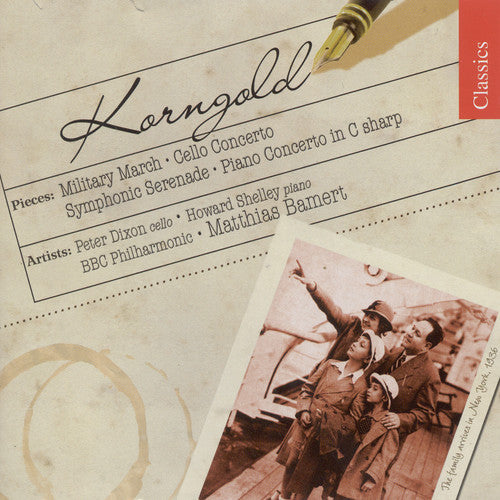
Korngold: Cello Concerto, Etc / Dixon, Shelley, Bamert
This disc offers four works, from several of Korngold's periods, including the 'Cello Concerto', an adaptation of a short piece Korngold composed in 1946 for the film 'Deception' and here performed by Peter Dixon. Dixon plays with elegance and a lyric understatement needed for this work. 'First-rate playing and opulent, well-balanced recording. Well worth exploring.' - The Penguin Guide, 3 stars
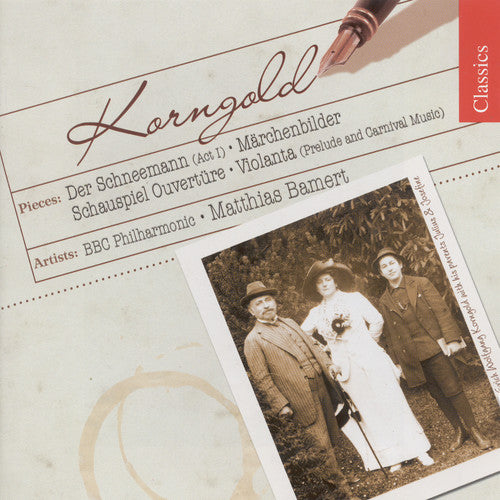
KORNGOLD: Schauspiel Overture / Marchenbilder / Der Schneema
Korngold: Das wunder der Heliane / Albrecht, Berlin German Opera [Blu-ray]
This Blu-ray Disc is only playable on Blu-ray Disc players and not compatible with standard DVD players.
Also available on standard DVD
Erich Wolfgang Korngold regarded Das Wunder der Heliane as his greatest work, but the opera has been neglected since its premiere in 1927. This 2018 production from the Deutsche Oper Berlin features the American soprano Sara Jakubiak as Heliane, and the American tenor Brian Jagde as The Stranger in the award-winning director Christof Loy’s acclaimed staging. The Orchestra and Chorus of the Deutsche Oper Berlin deliver the large forces required for this hyper-Romantic opera, under the baton of Dutch National Opera’s chief conductor Marc Albrecht.
-----
REVIEWS:
Das Wunder der Heliane is Korngold’s most extravagant stage work and one that he considered to be his greatest score. Written for a huge ensemble, masterfully used, the music possesses voluptuous sweep and hyper-Romanticism. Its intensity is emphasised through an intoxicating array of effects, propulsive rhythms and glorious vocal lyricism, its arc of climaxes building from one act to another. This revelatory new Berlin staging in 2018 enjoyed an unprecedented 20-minute ovation at its premiere.
– Opera Lounge
The performance is conducted with all the necessary full-blooded fervour by Marc Albrecht, and Korngold’s score emerges in all its richly chromatic, glittering tonality and overheated intensity.
– Telegraph (UK)
Korngold: Das Wunder der Heliane, Op. 20 / Bollon, Freiberg Philharmonic
Erich Wolfgang Korngold was at the height of his fame and technical mastery by the time he began work on his fourth opera in 1923. Prominent opera houses clamored to stage his works, and the Viennese premiere of Das Wunder der Heliane (‘The Miracle of Heliane’) featured Lotte Lehmann among its star cast. Its story is one of the redemptive power of love over injustice and adversity, expressed in music that is richly impressionistic and intensely dramatic. Korngold was criticized for resisting the tide of modernist atonality in this opulent score, but its symbolism and compelling romantic atmosphere can be appreciated today more than ever. This Freiburg Opera production has a strong cast topped by soprano Annemarie Kremer, one of the most successful singers in the lyric dramatic soprano repertoire. Award-winning baritone Aris Argiris has established an international career, performing regularly at the world’s most prestigious opera houses.
Korngold: Another Dawn, Escape Me Never / Stromberg, Et Al
Korngold: Tote Stadt (Die)
Korngold: Songs, Vol. 1
Korngold: String Quartets 1-3, Piano Quintet Op 15 / Sigfridsson, Aron Quartett
KORNGOLD String Quartets Nos. 1-3; Piano Quintet 1 • Aron Qrt; 1 Henri Sigfridsson • CPO 777 436-2 (2 CDs: 103:24)
“I feel it—and can’t comprehend it—can’t retain it—and yet can’t forget it; and if I grasp it all, I can’t measure it. … No rule would fit it, and yet there was no error in it.”
Hans Sachs’s rumination from the act II “Fliedermonolog” of Die Meistersinger is a perfect summation of Erich Wolfgang Korngold’s music. At once gay yet wistful, familiar yet elusive, inviting yet unsettling, it aurally distilled all the complex contradictions of fin de siècle Vienna, preserving it for generations to come and carrying it into exile in America after the debacle of World War I. If the waltzes of Johann Strauss Jr. embody a carefree present moment, the works of Korngold preserve and nurture nostalgic memories of a lost past, ardently clinging and seeking to re-create those, that it might still dwell in them rather than an alien present.
The four works in this set, spanning almost a quarter-century from 1921 to 1945, offer refractions of those memories over a generation. The Piano Quintet and First String Quartet, composed almost simultaneously, present two decidedly different faces. The Quintet acts as if nothing has been lost; it is gay and brilliant, with unabashed romantic ardor emphasized by sweeping runs in the keyboard part. The outer movements are energetic, while the lyrical second movement employs an utterly haunting, gorgeous theme from Korngold’s song “Mond, so gehst du wieder auf” (Moon, Thus Risest Thou Again) from his op. 14 song cycle Lieder der Abschied (Songs of Farewell); once heard, it simply won’t leave one’s head. The First Quartet, by contrast, is more introspective and even melancholic at points; its backwards longing has a certain assertive determination to it. A far greater reliance on chromaticism and freer employment of spicy dissonance give it a constantly edgy, unsettled character, with an antsy, off-kilter Intermezzo and quirky Finale that includes a jaunty, almost Vaughan Williams-like march fragment as a second subject (Korngold inscribed the movement’s opening page with a quote from Shakespeare’s As You Like It ).
The Second Quartet dates from the summer of 1933, near the close of a period of several years’ involvement by Korngold with operetta, and just before his first visit to Hollywood. It is a microcosm of melodic and harmonic devices that Korngold would employ so brilliantly in years to come as a composer of film scores. Given Hitler’s recent assumption of power in neighboring Germany, the first, second, and fourth movements would almost seem to be a perverse denial of reality. The opening Allegro epitomizes the skittish music of the Hollywood light romance; the Scherzo is all charming, gently smiling bustle; the Finale is, improbably, a witty, chatty waltz, but one of a decidedly un-Straussian character. All the more surprising, then, is the third-movement Larghetto, beginning with open harmonics like an icy chill (almost hinting at the Second Viennese School), eventually succeeded by a melody of melancholic yearning that seeks to cling to a wistfully remembered but unrecoverable comfort and security.
The Third Quartet dates from 1945, at a juncture in Korngold’s Hollywood exile when, dispirited by academic critical disdain and convinced his film scores were destined for oblivion, he had secretly decided to turn back to composition in more “serious” genres. Dedicated to a longtime friend and near neighbor in exile, the conductor Bruno Walter, it shows Korngold adopting a leaner, more astringent melodic and harmonic language. The melodic material is more fragmentary and questioning; the dissonances more frequent and unresolved. The scherzo has a jittery, almost neurotic character to its outer sections, as short, choppy interjections repeatedly disrupt an incipient moto perpetuo , from which a brief lyrical interlude provides only momentary relief. The slow movement bespeaks stifled grief and haunting bitterness over shattered hopes, with searing pain expressed by violins playing in the higher register as the viola and cello grind out clashing chords below. Only the finale, with its Stravinskian flavor and vigorously offbeat cascades of 16th notes, offers a somewhat hesitantly upbeat finale.
The only other complete set of the quartets is by the Flesch Quartet, originally recorded for ASV and now available on a budget reissue from Brilliant Classics. In Fanfare 23:2 Martin Anderson had high praise for its rendition of the Third Quartet and Sextet (the filler there instead of the Piano Quintet here). If those performances were more competitive, the budget price would tilt a recommendation toward the older set. However, the new cpo set completely outclasses its predecessor at every level, both interpretively and sonically. The Aron Quartet plays with immaculate ensemble and intonation, with far richer tone and irresistible zest and tenderness; the Flesch ensemble is almost lethargic in comparison, with its overall timings averaging almost 15 percent slower. (For example, the respective timings for the First Quartet movements are 7:26, 7:41, 4:42, and 8:07 vs. 8:47, 9: 56, 4:37, and 9:09.) Although its spirit may be willing, the Flesch is relatively weak. Henri Sigfridsson is a perfect teammate for the Aron players in the Quintet, which is likewise far ahead of rival versions such as the uninspired Marco Polo recording. The recorded sound is exemplary in every way. One complaint: This is shockingly short timing for a two-CD set. There is no reason that all three quartets could not have been put on a single CD, and another work such as the Piano Quartet included on the second disc. Nevertheless, this album is a stellar contribution to the ongoing and much needed Korngold renaissance, and is urgently recommended for all devotees of that once unjustly maligned but now belatedly appreciated master of late Romanticism.
FANFARE: James A. Altena
Korngold: String Quartet No. 1; Piano Quintet / Eckardstein, Alma Quartet
Second and last volume of Krongold’s complete String Quartets survey by the Alma Quartets. The disc contains the First Quartet (composed in 1923) and the Piano Quintet (1921). Music from Vienna raging Twenties in flawless performances by one of today leading string quartets. Ideal match between Alma Quartet and a specialist pianist as Severin von Eckardstein. Ritmo (SP) on first volume (CC 72869): The recording offered by Alma Quartet is the best available of these works for its understanding of the expressive world of Korngold; is perfect intonation and reading of these difficult works.
Korngold: String Quartets Nos. 1-3 / Tippett Quartet
Erich Wolfgang Korngold wrote a significant body of chamber music (the Piano Trio and String Sextet are on Naxos 8.574008). His three String Quartets reflect differing periods of composition. The First marries impetuousness with enticing harmonies and rapt eloquence. The Second dates from 1933 and has great clarity and rhythmic impetus, with a full complement of Korngold’s lyricism. The post-war Third is more relaxed, unexpectedly juxtaposing the archaic and modern with a joyful conclusion. The acclaimed Tippett Quartet can also be heard in works by Bax, Górecki, Panufnik, Penderecki, Rozsa and Michael Tippett.
REVIEWS:
What the album emphasizes convincingly are the links between these supposedly discrete incarnations, while giving equal weight to the quartets’ intriguing accommodation of high Romanticism and a more experimental tonality. Throughout, the Tippett ties these threads together with infinite diligence and love.
-- The Sunday Times (UK)
These three contrasting quartets cover more than twenty years of Korngold’s creative life, from his post-wunderkind years in Vienna to his time in the United States as primarily a composer of Hollywood film scores. String Quartet No. 1 in A major (1922-3) was written two years after his huge success with his operatic masterpiece ‘Die Tote Stadt’ and demonstrates his mastery of the quartet medium. The opening sounds terse and astringent Hindemith-like but within two minutes the textures become lusher and we are in Korngold’s familiar richly melodic world. There’s a similar mixture in the Quartet No. 2 in E flat Major (1933) with a lovely ‘Con moto sentimento’ slow movement and a deft waltz variation finale. The 1945 Quartet No. 3 in D is a delightful work with a witty and catchy folk tune slow movement. The Tippett Quartet are on top form throughout and the recording quality is first class.
-- Midlands Music Review
Korngold, Mahler, Strauss & Zemlinsky: Seelenubervoll (Brimming Souls) / Sieber
The debut album of pianist Friederike Sieber, Seelenübervoll is featuring lieder from the late Romantic period and works by Alma Mahler, Erich Wolfgang Korngold, Richard Strauss, and Alexander von Zemlinsky are performed. This production of five outstanding young singers resurrects the musical salon’s idea and gifts us a wealth of rarely performed songs. The turn of the century 1900 was a time “brimming” with sensation and an exuberant soul: the exceptional young performers enable us to feel extreme emotional states through their interpretations, which tell of an extraordinary and artistically fruitful epoch.
Laureate Series - Violin - Korngold / Lin, Loeb
Compared to Kiss, Lin sounds relatively sweet-toned, and the timings of his movements fall between those of Kiss and Waltman. But while those two-odd minutes may seem insignificant in a four-movement work, they also can represent a sort of general relaxation that makes the work sound more discursive, though Lin and Loeb play with plenty of energy and attack the more aggressive passages in the first movement, for example, with plenty of gusto and plenty of sharp-edged panache at the movement’s climax. The duo also takes command in the large-scale Scherzo (at 10:37 in this recording, that movement occupies almost a third of the Sonata’s duration), and though there may be a degree of roughness in Lin’s attack, he brings a sense of excitement to the movement. Lin’s purity of tone on the E string generates thrilling intensity in the slow movement, powering its leaps into the stratosphere. If the Sonata’s dedicatees inspired its seriousness, Korngold certainly rose to the occasion, and so do Lin and Loeb.
The shorter pieces begin with the Serenade from Der Schneemann, a rapt miniature that shows off Lin’s tonal command but also his wide and rather slow vibrato, which, for some listeners, may even threaten to grow annoying. From Korngold’s opera, Die tote Stadt, come the two short pieces, “Tanzlied” and “Marietta’s Lied,” the first a delicately wistful song that’s immediately ingratiating, and the second, an affecting lyrical outpouring that could vie successfully with the most popular works in the genre. The Caprice, subtitled “Wichtelmännchen,” or “Goblins” could similarly almost take the place of several similar pieces, like Bazzini’s Dance of the Goblins or Paganini’s “Witches’ Dance” on recital programs, though it’s more atmospheric than brilliant. Lin sounds a bit more polite in this miniature—and occasionally more ardent, by turns—than does Shaham, who plays it with more suggestive macabre energy.
Naxos’s issue offers yet another chance to ponder the question posed above: did Korngold’s work in Hollywood debase his musical coin or polish it? Lin and Loeb make a great deal of this repertoire, and their readings deserve a recommendation to anyone interested in it, in young violinists (the release appears as part of Naxos’s “Laureate” series), or in Korngold—or even to more general listeners. Recommended."
FANFARE: Robert Maxham
Korngold: Violin Concerto, Much Ado About Nothing, Etc / Philippe Quint, Carlos Miguel Prieto
KORNGOLD Violin Concerto. Overture to a Drama. Much Ado about Nothing: Concert Suite • Carlos Miguel Prieto, cond; Philippe Quint (vn); Mineria SO • NAXOS 8.570791 (53:40)
Erich Wolfgang Korngold’s Violin Concerto once seemed the almost exclusive domain of Jascha Heifetz, whose recording remained for a long time alone in the Schwann catalog. More recently, Itzhak Perlman (Angel 47746), Gil Shaham (Deutsche Grammophon 439 886, 18:3), and Anne-Sophie Mutter (Deutsche Grammophon 000352602, 28:5), to name only several of the most prominent violinists, have recorded it, and they’ve been joined in the last several years by Leonidas Kavakos, Hilary Hahn (both on DVD), Nikolaj Znaider (RCA 710336, 32:6), James Ehnes (CBC 5241, 32:3), Paul Waltman (Daphne 1032, also 32:3)—and now by Philippe Quint, so that the work at last boasts almost as many recordings as Bruch’s First Concerto did in the early 1960s. Heifetz’s white-hot inspiration would be hard for anyone to match; besides his studio recording, there’s another live one from March 30, 1947, with Efrem Kurtz on Music & Arts 766.
Like the more recent violinists to tackle the Concerto, Quint emphasizes its sweep and lyricism, soaring to moments of rapturous intensity that make their point unmistakably, even if Heifetz’s indelible performance lurks in the background. Quint makes the first movement cogent, never either stale or derivative—and certainly not as percussive to the bone as Heifetz’s crisp staccato made it seem. In fact, if it sounds like one of the great Romantic masterpieces in Naxos’s recording, that may be as much due to Quint, or to Prieto and the orchestra, who provide a sympathetic and, in the slow movement, a magical accompaniment, as to the composer’s virtuosity. Quint plays throughout with a silvery tone that’s warm even in the middle registers and with a great capacity for expressive nuance; while it’s clear that he’s thoroughly in command of the work’s abundant technical difficulties, he never lets them overwhelm the score’s essential melodiousness. Prieto presents the finale’s boisterous first theme with a robust energy that hearkens unmistakably back to its cinematic origins, and he reaches a stunning climax several minutes before the end. That so many recordings of Korngold’s Violin Concerto have achieved so great a stylistic success, though hardly all poured from the same mold—or even from similar ones—attests to the understanding Korngold must have had of the instrument and its expressive resources. Quint’s stands near the top (though all the recordings I’ve mentioned can be highly recommended), not least because of Prieto’s sympathetic accompaniment and the lively recording, which places Quint farther up front, than, say, RCA placed Znaider.
Korngold’s Overture to a Drama , from his 14th year, may not display the same maturity as his Violin Concerto, but it prefigures its sumptuous melodic style and its harmonic lavishness, if not the slickness of its brightly variegated orchestration. In fact, it may be a weakness in the orchestration itself rather than any aspect of Prieto’s performance that prevents the score from making a very deep impression. Korngold adapted the Concert Suite from Much Ado about Nothing for violin and piano, but the full score’s rich orchestral garb makes it even more effective in that more penetratingly witty original version. Prieto and the orchestra generously serve up the youthful and rambunctious good humor of the Suite. The recorded sound throughout combines depth and clarity, and places the soloist in a balance with the ensemble that’s natural if forward. Very highly recommended.
FANFARE: Robert Maxham
Philippe Quint turns in one of the most appealing, least "sticky" performances of Korngold's Violin Concerto yet recorded. If you usually find the piece too kitschy, then you really need to hear this. Like Heifetz, Quint adopts generally swift tempos, and this pays huge dividends in the opening movement--too often the piece sounds like it features two slow movements in a row. Here there is urgency along with passion, and a wonderful lightness in passagework that sustains the melodic thread even in the sections containing multiple stopping--and there are a lot of them. Quint's effortless technique also permits him to find all of the puckish humor in the finale. The tunes come from Korngold's film score to The Prince and the Pauper, after all.
A good bit of the credit for the success of this performance must go to conductor Carlos Prieto and his Mexican orchestra. It doesn't sound like a large ensemble, and that's all to the good. Korngold's orchestration doesn't need to be drowned in strings: it benefits greatly from the transparency on display here, both in terms of balance in the Violin Concerto and also in the Schauspiel Overture. Korngold was only 14 when he wrote the overture, and it's a fully mature and very enjoyable piece in its own right. The adorable suite from Much Ado About Nothing has plenty of charm, and some good horn playing in the finale. A slightly over-prominent, wheezy harmonium in the suite represents the only strike against this otherwise well-engineered production. Definitely recommended.
-- David Hurwitz, ClassicsToday.com
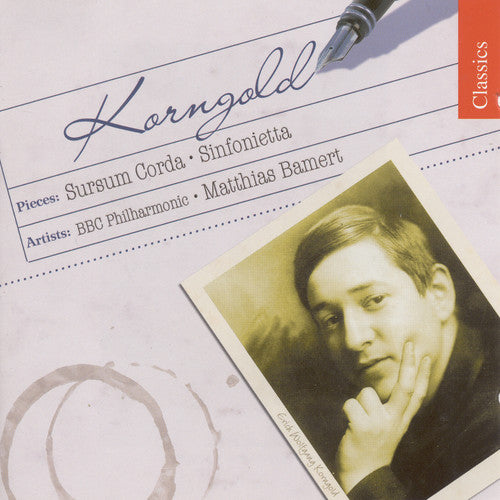
Korngold: Sursum Corda, Etc / Bamert, Et Al
Composed when Korngold was only 14, the four-movement 'Sinfonietta', portrays a phenomenal expertise both in organization of musical ideas and in the handling of the orchestra: exquisitely orchestrated and crafted with an idiosyncrasy of harmony and rhythmic manipulation. Coupled with 'Sursum corda', an early virtuoso showpiece, and extraordinarily sumptuous piece, reminiscent of 'Pines of Rome', some of it was later used as some of the material for Korngold's score for 'Robin Hood' for which he received an Academy Award. Bamert's performances of these compelling examples of Korngold's early orchestral output were well received by the critics on original release, and are welcomed onto the Classics label for the first time. 'Here are glorious performances of two of his early orchestral works.' - BBC Music Magazine
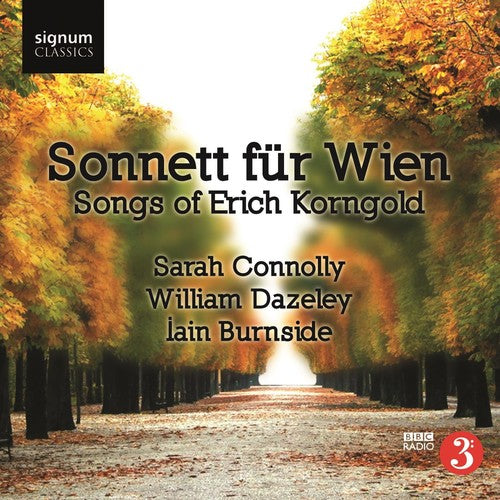
Korngold: Sonett Fur Wien, Songs / Sarah Connolly, William Dazeley, Iain Burnside
"Both singers respond magnificently to Korngold's testing vocal lines" BBC Music Magazine Erich Korngold is perhaps best known as the pioneering émigré composer whose grand orchestral scores defined the sound of film during the golden age of Hollywood. As well as this though, his output for voice in the form of Lieder and Song highlighted the strong bond that Korngold forever held with his homeland and the city of Vienna, a place inextricably linked to the High-Romantic style that Korngold so ably perfected. This collection of songs and lieder are beautifully performed by Sarah Connolly (mezzo-soprano) and William Dazeley (baritone), accompanied by renowned pianist and broadcaster Iain Burnside.
Korngold: Piano Trio Op 1, Etc / Trio Parnassus
Includes work(s) by Erich Wolfgang Korngold. Ensemble: Parnassus Trio.
Korngold: Much Ado About Nothing / Mauceri, UNC School of the Arts Symphony
Korngold’s music for Shakespeare’s comedy Much Ado about Nothing, premiered in Vienna in 1920, enjoyed instant success and soon spread around the world. But the music has not been heard as Korngold intended since the 1st production. For this recording, made in conjunction with a staged US premiere, Korngold’s complete score was reconstructed from the original Viennese materials and is played here by the chamber-orchestral forces for which it was written.
REVIEW:
This is indeed a worthy and welcome addition to the Korngold discography. At long last we have a further complete performance of the composer’s delightful incidental music to Shakespeare’s comedy. It joins the sequence recorded by Ondine with John Storgards conducting. The music was first performed in Vienna’s Schönbrunn Palace when Korngold was just 21. It was very successful and the composer would later go on to adapt the music for various chamber ensembles and as an orchestral suite. Now we have the music as it was performed at Schönbrunn together with choice dramatic overlays including Balthasar’s Song, ‘Sigh no more, ladies, sigh no more; Men were deceivers ever’, Beatrice’s soliloquy as she yields to love, and the two sets of lovers’ happy uniting in the final wedding scene.
The orchestra is the same size and specification as that at Schönbrunn with a string quartet rather than a string section so that proper balances with all the other instruments can be assured. With the string quartet are: solo flute/piccolo, oboe, clarinet, bassoon, trumpet and trombone with two horns, a piano, harmonium, harp and three percussionists plus solo timpanist. The original parts were available so that each player could replicate the bowings and articulations used in Vienna. Furthermore, all the composer’s own recordings of the work were made available too, so questions of tempo and portamento could be addressed. Conductor John Mauceri was a very apt choice for he has had much experience conducting Korngold and is a stalwart champion of film music, an asset that might well be regarded as not being far removed from the spirit of this work – in fact the March of the Watch could be considered a pre-echo of Korngold’s Sherwood Forest scenes from his The Adventures of Robin Hood. Mauceri also contributes the erudite notes for this album.
Korngold’s conception works very well in his chosen ensemble. It points up the comedy and irony such as that in March of the Watch and in the dreamy romanticism of the Garden Music. All those intimate glistening string-harp-and-harmonium figures, and rippling piano arpeggios, suggest birdsong and flowers nodding in zephyr breezes. It’s all in gentle romantic waltz time, plus the contrastingly intense almost Mahlerian Funeral Music. Although I would have thought it unnecessary, five of the pieces that have dialogue are repeated again in purely instrumental dress.
There have been a number of recordings of Korngold’s purely orchestral suite from Much Ado About Nothing. Of these I would unhesitatingly recommend Caspar Richter’s 2002 reading originally released on CD DCA 1131. This is not only because it included, for the first time, the enchanting Garden Music but also for the other items on this album which had great appeal especially Korngold’s divine Abschiedlieder Songs (Songs of Farewell). A delight for committed Korngold fans.
-- MusicWeb International (Aan Lace)
Die Toten Stadt
Korngold: String Quartets 2 & 3 / Alma Quartet [Vinyl]
| Erich Wolfgang Korngold (1897-1957) was a genius. Naturally he was most widely known and rewarded as one of the founding composers of Hollywood film music, but he is not a particularly well-known composer in the classical music world. His three string quartets are surely masterpieces and can be seen as modern tone poems imbued with beautiful melancholy and Viennese charm. A child prodigy, Korngold wrote some of the most heart-wrenching melodies, which are sure to leave any listener longing for more. His String Quartet No. 2, Op. 26 (1933) was written just before Korngold moved to Hollywood and is full of musical imagery of Vienna, with gestures towards the waltzes of Johan Strauss II as well as the intricate lyricism of Richard Strauss. A fierce anti-serialist, Korngold was determined that it was still possible to stretch the boundaries of tonality without adapting to the 12-tone technique. The String Quartet No. 3, Op. 34 (1945) is full of themes that he used in his film scores and was written when Korngold was suffering from deep depression. The quartet is much darker. Why did we choose to tackle Korngold’s music for this unique project of a direct-to-disc recording on vinyl? The music resonates deeply with us, as it represents the epitome of late romanticism and lyrical expression. We all have a profound love for romantic music and after listening to some recordings of his quartets we knew instantly these were the perfect fit for us. It was definitely a challenge to understand the idiom in Korngold’s writing. Our individual personalities as well as the Alma sound is clearly audible. |
Korngold: Die tote Stadt / Kaufmann, Petersen, Petrenko, Bayerisches Staatsorchester
Winner of a 2022 Gramophone Award!
The premiere of Korngold's Die tote Stadt at the Bayerische Staatsoper in 2019 was praised both by press and audiences. Marlis Petersen (Marie/Marietta) and Jonas Kaufmann (Paul) sang the main roles, with the Bayerisches Staatsorchester under Kirill Petrenko's baton, in the intense staging by Simon Stone. After opening night, Joshua Barone wrote in the NY Times: “[The] work's comeback may have reached its peak at the Bavarian State Opera. It’s difficult to imagine a better case for Die tote Stadt than was made in Munich.” The boundary between dream and reality dissolves as Paul, mourning his dead wife Marie, meets the dancer Marietta. With her looks so similar to Marie’s, Marietta becomes the object of the projection of Paul’s erotic desires. Following a nerve-wracking “vision”, Paul is finally reeled back to reality and he can leave Bruges as the place of his death cult.
The original title of the piece, “Triumph des Lebens”, is symbolic of the main character’s personal development. Just a few weeks before the successful world premiere of Die tote Stadt, none other than Puccini himself described Korngold as the “greatest hope of new German music”. Because of their melodic urgency, arias such as “Glück, das mir verblieb (Marietta's Lute Song)” and “Mein Sehnen, mein Wähnen (Pierrot's Song)” have found a home among the concert repertoires of many opera singers and radiate far beyond the fame of Die tote Stadt. This production is the first AV release on our newly launched label.
Korngold & Kreisler: From Vienna to Hollywood / Hegel Quartet
Strauss, Korngold & Schreker: Metamorphosen / Wilson, Sinfonia of London
One of the New York Times' 5 Classical Albums to Hear Now
Shortlisted for the Gramophone Awards
Perhaps nobody since John Barbirolli has been able to make strings sing like the brilliantly talented John Wilson.
Following their critically acclaimed album of English Music for Strings, Sinfonia of London and John Wilson turn to Germany and three outstanding works for string orchestra. Franz Schreker’s Intermezzo, the oldest piece here, was composed in 1900, before Schreker’s rise to fame in the opera houses of Germany and Austria, but shows strong indications of what was to follow. Korngold composed the Symphonische Serenade following his return to Vienna from Hollywood after the Second World War, and shortly before he wrote his Symphony in F sharp. Korngold effortlessly conjures a vivid range of colors and textures from his large forces (32 violins, 12 violas, 12 cellos, and 8 basses) in a work that explores the virtuosity of the players to the full. Composed in 1945, as a reaction to the horrors of the war, and the desecration of German culture, Richard Strauss’s Metamorphosen for 23 solo strings seems to look backwards to the German Romantic tradition (a trait even more evident in his Four Last Songs, of 1948). The moving final passage, marked ‘In Memoriam’, leaves the listener to contemplate in silence.
"Wilson’s release wins hands down. Part of the victory is due to the conductor and string players’ panache…whatever the mood, the Sinfonia’s tone stays full-blooded and refulgent, just like Chandos’s recording." -Times of London
REVIEW:
What a fine and stimulating recording this is. Perhaps nobody since John Barbirolli has been able to make strings sing like the brilliantly talented John Wilson. Franz Schreker’s “Intermezzo” here has a sheen to it that is intensely delicate one minute and impossibly sumptuous the next. Strauss’s “Metamorphosen” has rarely had such an agonizingly drawn out, lovingly burnished performance as this. Even better is the rarity that accompanies it: Korngold’s Symphonic Serenade, a disfigured, difficult recollection of all that poignantly easygoing light music in the Austrian tradition, written when he returned to Vienna from Hollywood. The hush that Wilson finds for its slow movement is indescribably haunting.
-- The New York Times
Korngold: Songs, Vol. 2 / Stallmeister, Fischer, Schenker-Primus, Simon
In his song settings, Korngold pursued the Romantic ideal and lavished considerable care and inventiveness on their composition. His seemingly effortless gift for melody is everywhere ap-parent in this second volume (Vol.1 is on 8.572027), whether in the early works or the songs from the 1940s, which would not sound out of place in an operetta or a Broadway musical. Also present, notably in the Drei Gesänge, Op.18, is an exciting, experimental approach to harmony that reflects the music of his most radical opera, Das Wunderder Heliane (8.660410-12).
REVIEW:
Already in the 1920s, as a young man, Korngold was composing in a powerfully vocal idiom, as can be heard in the four Lieder des Abschieds (Songs of Farewell). He did not become a prolific art song composer, but there are lieder dotted among his long list of compositions This second volume of his complete songs include Sonett fur Wien from 1953, just four years before his death. The mezzo, Sibylle Fischer, has the task of expressing so much sadness in the four Lieder des Abschieds, a mood she passes to the baritone, Uwe Schenker-Primus, in the Drei Gesange. He also has the task to hark on sorrow in the Lieder aus dem Nachlass, and we hear him to better effect in the forthright Five Songs. That Korngold wrote songs for the cinema surfaces with Morgen from the film The Constant Nymph, here recreated with a piano trio accompaniment, and sung with a smooth elegance by Britta Stallmeister. Together with the pianist, Klaus Simon, the vocal trio give us a rare chance to hear forgotten Korngold.
– David's Review Corner (SDavid Dento)
Korngold: Das Wunder der Heliane / Jakubiak, Jagde, Albrecht, Berlin German Opera
Also available on Blu-ray
Erich Wolfgang Korngold regarded Das Wunder der Heliane as his greatest work, but the opera has been neglected since its premiere in 1927. This 2018 production from the Deutsche Oper Berlin features the American soprano Sara Jakubiak as Heliane, and the American tenor Brian Jagde as The Stranger in the award-winning director Christof Loy’s acclaimed staging. The Orchestra and Chorus of the Deutsche Oper Berlin deliver the large forces required for this hyper-Romantic opera, under the baton of Dutch National Opera’s chief conductor Marc Albrecht.
-----
REVIEWS:
Das Wunder der Heliane is Korngold’s most extravagant stage work and one that he considered to be his greatest score. Written for a huge ensemble, masterfully used, the music possesses voluptuous sweep and hyper-Romanticism. Its intensity is emphasised through an intoxicating array of effects, propulsive rhythms and glorious vocal lyricism, its arc of climaxes building from one act to another. This revelatory new Berlin staging in 2018 enjoyed an unprecedented 20-minute ovation at its premiere.
– Opera Lounge
The performance is conducted with all the necessary full-blooded fervour by Marc Albrecht, and Korngold’s score emerges in all its richly chromatic, glittering tonality and overheated intensity.
– Telegraph (UK)
Korngold: Suite, Op. 23; Piano Quintet, Op. 15 / Spectrum Concerts Berlin
Erich Korngold was described as ‘arguably the most remarkable prodigy in history’, whose transition into artistic maturity was almost seamless. The successes of his youth continued with works such as the Piano Quintet, Op.15, in which the brilliant interplay of the instruments, songful expressiveness and dramatic power create a masterpiece of weight and sub-stance. The Suite, Op.23 is a highly virtuosic piece in which Korngold leads us on a monumental stroll through a gallery of European musical history, from Bach via Beethoven to the early 20th century. Spectrum Concerts Berlin has also recorded Korngold’s Piano Trio, Op.1 and String Sextet, Op.10 for Naxos.