Franz Ignaz Beck
17 products
Franz Ignaz Beck: 9 Symphonies / Schneider, La Stagione Frankfurt
BECK 6 Symphonies, op. 3. Symphony in D, op. 4/1. Symphony in B?, op. 4/2. Symphony in F, op. 4/3. La mort d’Orphée: Overture. L’isle déserte: Overture • Michael Schneider, cond; La Stagione Frankfurt • CPO 777 880–2 (3 CDs: 172:54)
CPO has decided to release as one set its three albums of Franz Ignaz Beck’s symphonies, recorded by Michael Schneider and La Stagione Frankfurt. It’s a long-running interest of Schneider, with the first album consisting of half his opus 3 works (CPO 999 390–2) reviewed in these pages in 1996, and the second half (CPO 777 034–2) in 2004. Our box adds the first half of his op. 4 (CPO 777 032–2), released in 2006, but never reviewed in Fanfare. Presumably it’s meant to whet interest for a future disc containing the rest of op. 4.
Several musicologists in the early 20th century saw Beck as a forgotten giant. He was lauded for originality, theatrical intensity, imaginative chromatic harmonic progressions, increasingly independent part-writing and thematic development, dual thematic (as opposed to monothematic) opening movements, and the use of wind instruments in his symphonies. Some of this is reflected by David Kirk in his review of CPO’s second release (Fanfare 28:3), where he states Beck’s symphonies were “moving in the direction Beethoven later developed,” while Michael Carter (Fanfare 28:2) quoted an unattributed statement of a musicologist that Beck was “a Romantic born a generation too early.”
On the other hand, Daniel Heartz, in his Music in European Capitals: The Galant Style, 1720-1780, merely compares Beck to Simon Leduc to show how much more modern the latter was in using chromaticism structurally. David Johnson (Fanfare 20:1) liked the theatricality of the two minor-key works on the first release, then wrote, “I hear the bold harmonic progressions … but the rhythms strike me as rigid and there is no duality of themes at all….” Jerry Dubins, reviewing Mallon/Toronto CO in several of the op. 3 symphonies (Fanfare 34:2; Naxos 8.570799), in turn writes, “Beck wears thin after a while….The works are well crafted and clever in invention, but they strike me as short on imagination and originality.” He then rightly points out that the so-called wind innovations attributed to Beck’s op. 3 were far exceeded in variety of instrumentation and timbre in the same year of their publication by Haydn.
My own estimation is closer to Johnson and Dubins, if less dismissive. Beck strikes me as a talented Mannheimer who retained some conservative Baroque features (such as independent part-writing and idiosyncratic harmonic progressions) from his older colleagues there, notably Franz Xaver Richter. These were subsequently viewed in the 20th century as innovative rather than what they were: part of a tradition Beck had learned in his youth that was gradually coming back into style. Opening movements with heavily contrasted pairs of themes were again pursued by Mannheimers before Beck used them in his 1762 op. 3 works: Johann Stamitz favored them in his last, highly regarded set of published symphonies, written in the early 1750s, as did Ignaz Holzbauer, later in that decade. Settling in Bordeaux brought Beck into contact with a set of Gallic influences, among them Mondonville and Gossec, the former notable for the length and intricacy of development in his works, and the latter for the irregular phrasing, harmonic piquancy, and imaginative use of instrumental color in his own symphonies. Put in perspective among his contemporaries, I think Beck is not the proto-Beethoven that Schneider extols to the skies in his liner notes, but a sophisticated and entertaining composer of the 1760s, mixing older and newer, Austrian and French influences; and that is enough.
Beck’s op. 4 collection of symphonies was published in Paris in 1766. No others were published by him after that point, though it is possible more existed, as much of Beck’s later music is thought lost. The Sturm und Drang that briefly interested symphonists in the 1760s, including Beck in his previous symphonic set, is completely missing from these pieces. Again, the influences are from all over the place, but I was particularly struck by his use of paired oboes in thirds as a galant 6/8 interruption (literally—it wrenches the movement out of any relevant harmonic progression) in the first movement of the D-Major Symphony, and again in the central section of the F-Major Symphony’s Minuet, that most strikingly recall the opéra-ballets of Rameau and Campra. Beck has a sense of humor, like his almost exact contemporary Haydn, and enjoys tossing the occasional stylistic surprise at his listeners. His French audiences, with their long cultural memories, would have caught on at once.
Schneider leads disciplined, spirited readings of all this music. The 16 string players of La Stagione Frankfurt perform without vibrato, but achieve a tone that is silky, if not varied in color, and less raw than in their release of Gaspard Fritz’s symphonies (CPO 777 696–2). He phrases carefully, and builds these works up from their strongly defined rhythms, which helps buoy his soloists along—oddly enough, reminding me in this respect of Pierre Monteux. In short, both for the complete op. 3 and first half of op. 4, recommended.
FANFARE: Barry Brenesal
Never Final, Never Gone
Wave
Pause and Feel and Hark
Beck: String Quartets
IonSound Project
Beck: Complete Music for Solo Piano
Reflections
From the Spirit
Sound Tapestries
Beck: Symphonies, Op. 3, Nos. 1-4
Beck: 6 Symphonies, Op. 2
Beck: L'isle déserte / Schneider, La Stagione Frankfurt
Franz Ignaz Beck is one of the most fascinating composers of the eighteenth century, a musical visionary as well as a “genuine European” with roots in Mannheim. His opera L’isle déserte, long regarded as lost, has resurfaced in a score manuscript in France and now is celebrating its recording premiere with La Stagione Frankfurt. Magnificent music and a magnificent text! Beck’s L’isle déserte is particularly interesting in the context of music history: first, because it is by a composer who continued to await discovery; second, because a composer active in France availed himself of an Italian libretto – which continued to be an exception before 1780, especially when Metastasio was the librettist. Beck’s L’isle déserte is thus a model example of a material and text-historical adaptation and even more so of a transfer to the music theater. In other words, in Beck’s version of “The Deserted Island” Italian libretto artistry and French music theater meet, while special appeal is generated by this composer from Germany, an émigré, so to speak, who was not operating with French as his genuinely native language.
Franz Ignaz Beck: Symphonies Op. 4, Nos. 4-6 & Op. 3, No. 5
The court at Manneheim, one of Europe’s great 18th-century musical centers, provided myriad opportunities for creative development. Having absorbed the ideas of his teacher, Johann Stamitz and other luminaries, Beck wrote a series of symphonies notable for their dramatic contrasts, breadth and sweep, the progressive inclusion of the woodwinds and a willingness to explore expressive intensity. His progressive use of woodwind instruments in the Symphony in G major, Op. 4 No. 5 is among the notable developments to be heard in this second recording of Beck symphonies by Marek Štilec and the Czech Chamber Philharmonic.
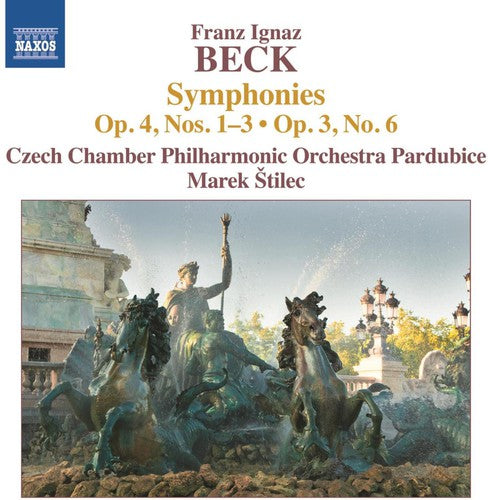
Beck: Symphonies Op 4 No 1-3... / Stilec
The principal competition for this release comes from CPO, and its set of Op. 3/4 played by La Stagione Frankfurt. Those performances employ period instruments, and these do not, but they are every bit as good. The strings play with appropriate rhythmic verve and (typically) smoother timbre, while the harpsichord continuo remains happily where it belongs–in the background. The oboes have a sweet tone characteristic of the Czech school of woodwind playing, and the horns blend well with them. Czech horn playing tends to be softer and more mellow in sonority then most modern schools, and I have to wonder if this is not in fact more “authentic” than the brassy, brazen tone typical of so many period instrument groups.
Whatever the reality, conductor Marek Stilec leads with well-jedged tempos and brings plenty of life to the music–energy without crudeness. This release will give a great deal of pleasure to anyone interested in the best symphonic works of the early classical period.
-- David HurwitzClassicsToday.com
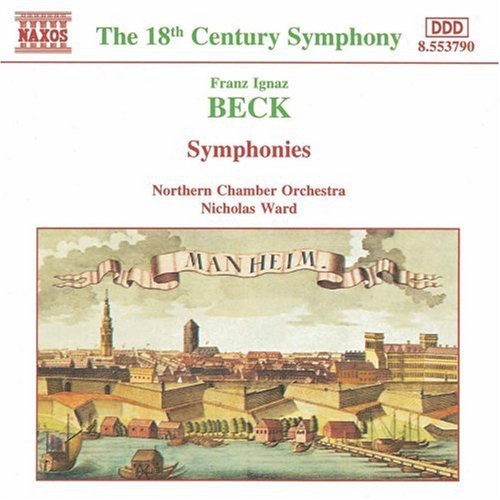
Beck: Symphonies / Nicholas Ward, Northern Chamber
This disc received the 1998 Cannes Classical Music award for "Best 17th/18th Century Orchestral Disc."
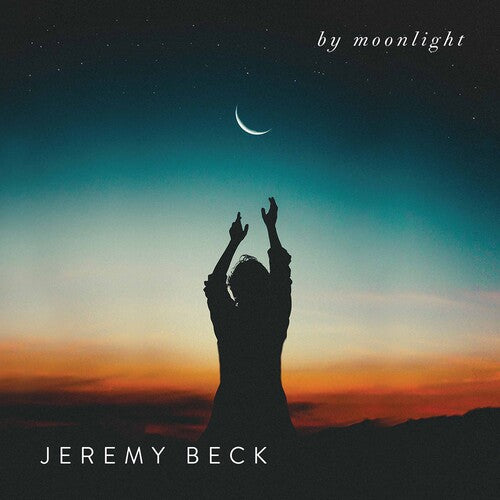
Beck: by moonlight / Various
“by moonlight isn’t just a collection of works - it also provides a certain overview of my compositional life,” says Jeremy Beck. Bringing together music of his present and past, this selection of orchestral, chamber, and vocal music opens a window into Beck’s sound world. From the celebratory Concertino for two cellos and strings to the pensive Serenade for orchestra, Beck’s musical language is direct and distinctly American. His music embraces a continuum of tonal compositional thought that organically embodies previous developments while moving forward in his own individual style. Beck’s music has been called “... forceful and expressive. ... concise in structure and generous in tonal language, savoring both the dramatic and the poetic” (Gramophone, 2013), while the critic Joshua Kosman has noted that “...novelty isn’t the only thing music can provide, and the moody expressiveness of Beck’s writing is its own reward.” (SF Gate, 2013). Through his music – by turns confident and vulnerable, outgoing and intimate – composer Jeremy Beck reaches out to the world, sharing his artistic vision of the beauty, struggle, and thoughtful wonder that reflects part of our human experience.