Franz Schreker
22 products
CHAMBER SYMPHONIES
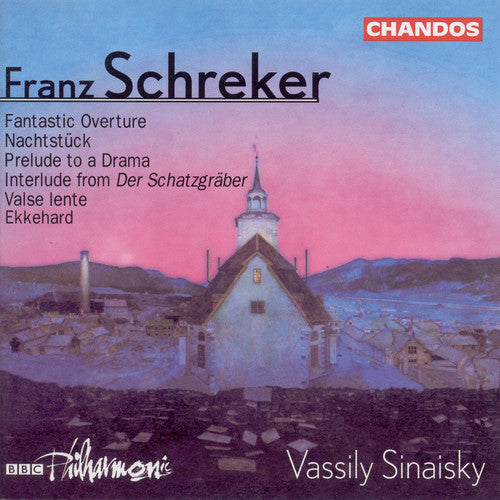
Schreker: Fantastic Overture, Etc / Vassili Sinaisky, Bbc Po
The pieces here range from symphonic overtures to small chamber orchestra pieces. The title composition, 'Prelude to a Drama,' billows in its immensity. This work, which Schreker later shortened and used in his opera 'Die Gezeichneten,' achieves its grandiose scale with sweeping melodies with a minimal focus on the underlying rhythms. Conversely, 'Valse lente' is a subtle, tightly scored piece full of bright color and delightful patterns. Written to be a dance score, it is unobtrusively pleasant. Most of the pieces included in this collection, however, are of a more symphonic nature, given to the soaring energy of the late Romantics. Like a Liszt or a Wagner, Schreker put power in his music.
REVIEWS:
International Record Review (4/00, p.41) - "...Schreker had a wonderful sense of fantasy, a feeling for colour and impressive mastery of the orchestra. Sinaisky and his fine orchestra are expertly served by the recording team, and whole disc serves to advance Schreker's cause..."
Schreker: Das Spielwerk und die Prinzessin (Live)
Songs of Franz Schrecker
Franz Schreker: Die Gezeichneten "The Stigmatized"
Schreker: Complete Orchestral Works, Vol. 2
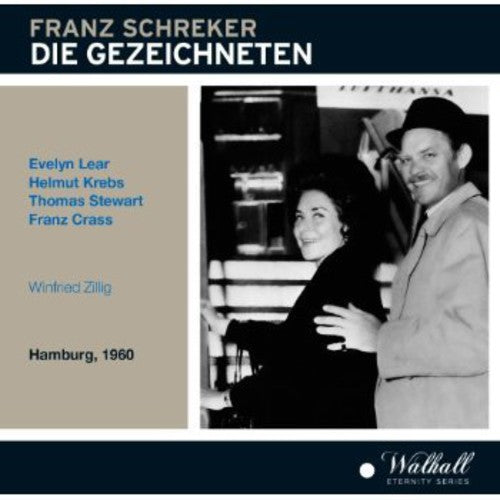
Schreker: Die Gezeichneten (Recorded 1960)
Schreker: Der ferne Klang (Recorded 1948)
Schreker: Die Gezeichneten / Edo De Waart
Schreker: The Birthday of the Infanta - Suite / Falletta, Berlin Radio Symphony
-----
REVIEW:
Falletta obtains excellent playing from the Berlin Radio Symphony Orchestra with enormous climatic moments, opportunities for which are readily at hand in his late-Romantic, opulent orchestral scores. The sound quality from the German Radio is way beyond today’s norm. Unreservedly recommended.
– David's Review Corner (David Denton)
Schreker, F.: 5 Gesänge / Ein Tanzpiel / Festwalzer Und Walz
Schreker: On Eternal Life, Fantastic Overture & Ekkehard / Ward, Wilson, Deutsche State Philharmonic
After the ban the Nazi rabble-rousers had imposed on him, it took a long time for Schreker’s oeuvre to be rediscovered, excavated from the archives, subjected to a re-appraisal and acknowledged as an indispensable element in one of the most fascinating periods of musical history. Although being taken for granted may bear the risk of renewed negligence, Franz Schreker’s status should no longer be challenged today. This makes it possible, apart from dealing with all of his main works also to consider what he himself perhaps did not deem his most ground-breaking works, ones permitting interesting insight into a musician’s workshop and displaying cross-references to his other works like you can hear on this recording. Valda Wilson is the featured soloist on this release. Initially trained at the Sydney Conservatorium of Music, the soprano went on to win Opera Foundation Australia’s scholarship to the National Opera Studio London. She is one of the most versatile, exciting and musically curious sopranos of her generation, and is currently singing at the Saarlaendisches Staatstheater in several productions.
Schreker: Christophorus, Oder Die Vision Einer Oper (Live) / Kiel Philharmonic Orchestra
Schreker: Der Schatzgraber / Albrecht, Protschka, Schnaut, Stamm
Strasfogel: Franz Schreker Book; Scherzo No. 1
Schreker: Der Schatzgräber (The Treasure Hunter) / Deutsche Oper Berlin
Franz Schreker’s career was cut short by the events of 1933 in Germany but he achieved real fame with his operas; and the huge success of 'Der Schatzgräber' (‘The Treasure Hunter’) in the 1920s was the high point of his career. In a complex and ultimately tragic tale of destructive greed; desire and toxic social hierarchy; the innkeeper’s daughter Els is forced to confront the consequences of her murderous intent in what conductor Marc Albrecht considers ‘a work of exceptional quality; concentration and significance’. Following the huge success of Korngold’s 'Das Wunder der Heliane' (Naxos DVD 2.110584-85 / Blu-ray NBD0083V); director Christof Loy continues his exploration of strong female characters and neglected 20th-century masterpieces with this highly acclaimed Deutsche Oper Berlin production.
Schreker: Orchestral Music from the Operas / Renes, Royal Swedish Orchestra
As for the recording, the huge climaxes are fearless: no detail goes unremarked and perspectives are very convincing indeed. Schreker’s more delicate touches are also well caught, and timbres are always true. The playing combines body with boldness, passion with polish, and Renes shapes it all like a seasoned pro. Yes, this large-scale performance – with sonics to match – belongs firmly in the concert hall rather than the theatre, but it’s none the worse for that.
Next up is the prelude to Die Gezeichneten (The Stigmatized), set in 16th-century Genoa. It centres on a lurid love triangle that wouldn’t look out of place in a Jacobean tragedy. This opulent opener also has the feel of a Hollywood blockbuster of the 1930s or 1940s. That’s not a criticism, for many of those great film scores were penned by Austro-German composers who fled to the US before the War. There’s surprising delicacy in this score – I revelled in the gorgeous harp writing – not to mention a Romantic blush that reminds me of Gurre-Lieder at times. If this piques your interest see Rob Barnett’s review of Gerd Albrecht’s complete recording.
Composed in 1933 Schreker’s Vorspiel zu einer großen Oper (Prelude to a Drama) is an expanded concert version of the prelude to Die Gezeichneten, which the conductor Felix Weingartner had commissioned 20 years earlier. At 22 minutes it’s the longest piece here. It’s also one of the most satisfying, as it combines a powerful sense of drama with a strong, tight musical structure. There are some startling things here, not least the extended passage in which the timpanist plays a quietly insistent two-note figure as part of a magical dialogue with the orchestra. The recording is especially effective at this point, the timps ideally placed in a deep, wide soundstage.
Although Schreker’s two-act opera Das Spielwerk und die Prinzessin (The Music Box and the Princess) failed miserably in both Frankfurt and Vienna the prelude to this fairy tale is delightful. Textures are wonderfully transparent and those warbling woodwind figures are a telling touch. Rhythms are subtly articulated, tuttis are always proportionate and it all hangs together very well. That said, there’s a rather dated feel to the score, which might explain its poor reception. Still, the playing is alert and refined, the recording warm and clear.
Nachtstu?ck (Nocturne) – the Act 3 interlude from Schreker’s opera Der ferne Klang (The Distant Sound) – was actually premiered three years before the work from which it’s taken. The opera tells the story of Fritz, a composer who loves one Grete Graumann but who can’t marry until he’s written a great piece and found the mysterious sound that haunts him so. The nocturne – which begins with a rocking theme underpinned by gentle tam-ram strokes – manages to be both refulgent and restrained, blending Straussian amplitude with an iridescent fan of ravishing colours.
I suspect most people who listen to operatic ‘chunks’ know little and care less about the narrative that surrounds them. One certainly doesn’t need to know the details of Wagner’s Ring to enjoy the splendid excerpts. That’s also true of these Schreker pieces, which work rather well on their own. Would this collection tempt me to try the full operas? Perhaps, but for all its craft and colour Schreker’s sound world seems at odds with the times – rather like the later novels of Thomas Hardy – his medieval/fairy-tale plots equally so. Music to relish, if not to love. The detailed liner-notes are by Horst A. Scholz.
Little-known repertoire, superbly played and recorded; go on, treat yourself.
– MusicWeb International (Dan Morgan)
Schreker: Irrelohe / Blunier, Sadnik, Greiner, Denschlag, Morouse, Rosenthal
After the great success of the Golem by Eugen d’Albert, the Beethoven Orchestra of Bonn under its conductor Stefan Blunier now presents with the opera Irrelohe by Franz Schreker yet another enthralling programme idea and a key work of musical modernity. The orchestra mightily enters the musical fray with six percussionists and lavishes in passion and nonstop dynamic power. MDG’s technicians have produced a fascinating live recording in the challenging acoustic architecture of the Bonn Opera House.
Schreker: Der Ferne Klang / Harper, Et Al
Franz Schreker und Ausdruckstanz / John Axelrod, Lucerne SO
Includes work(s) by Franz Schreker. Ensemble: AML Lucerne Symphony Orchestra. Conductor: John Axelrod.
Franz Schreker: Der Ferne Klang
Franz Schreker (1878-1934) is one of the many late romantic German and Austrian composers who became victims of the Nazi purge on 'degenerate art'. Schreker came in for abuse mostly because of some Jewish roots in his family and a penchant for lurid subject matter in his most famous operas. Musically, his operas are no more radical than Strauss' Elektra. But whereas Strauss retreated into a sort of polite neo-classicism tinged with Wagner in his later years, Schreker stayed a basically late-romantic expressionist and this expressionist aspect doomed his music. Der Ferne Klang debuted in 1912 in Frankfurt and launched Schreker into the top rank of composers of his time. The same year he was appointed to the faculty of the Vienna Academy of Music in the areas of counterpoint, harmony, and composition. The plot involves an artist who abandons his fiancé to go in search of 'the distant sound' which will allow him to produce the perfect work of art. As the opera progresses, the main character, Fritz, leads a life of gradually increasing desolation and eventually dies. On his death bed he finally hears "Der ferne Klang". The score is in fine expressionist mode, though basically tonal. Schreker was one of the most brilliant orchestrators of the early 20th century. The present recording arises out of highly acclaimed live performances of the opera given in the Augsburg Opera House (Germany) in spring 2010.
Der Ferne Klang / Jennifer Holloway, Ian Koziara
Der ferne Klang by Franz Schreker (1878-1934) premiered on August 18, 1912 at the Frankfurt Opera House. Schreker had already begun composing his first full-length opera in 1901, after the text he had written in just a few weeks. Now the work, which was initially considered impossible to perform, but which made Schreker suddenly famous, is returning to the location of it's premiere for the first time after 1945. Almost half of all operas by the Austrian, who with one exception was both composer and librettist for all of his stage works, performed or premiered in Frankfurt. The Choir of the Oper Frankfurt and Frankfurter Opern- und Museumsorchester perform under the direction of Sebastian Weigle.
"Oper Frankfurt is arguably the “right” company to produce this Der ferne Klang recording, because Austrian composer Franz Schreker (1878-1934) had a special connection with this opera house. It was here that he scored his first big success with this opera, followed by the premiere of his complete version of Die Gezeichneten, two of his most definitive works. His musical idiom is decidedly Late/Post Romantic, yet uniquely his own, beguiling in its lush and translucent tone colours. His style can also extend into an intensely expressionistic and harmonically adventurous, if unsettling, musical soundscape. At the height of his fame during the early years of the Weimar Republic, Schreker was the most performed opera composer after Richard Strauss. He was also a noted pedagogue, as director of Berlin’s Hochschule für Musik, and counted Berthold Goldschmidt and Ernst Krenek as his students. But by the late 1920s, with the rise of National Socialism and its inherent antisemitism, Schreker, who was Jewish, lost his academic appointments and his compositions were banned. Sadly he descended into obscurity, suffered a stroke and died at the age of 56. It was only in the 1980s, through Decca’s “Entartete Musik” series, that Schreker reemerged from a decades-long obscurity. His revival gathered momentum both in Germany and America. Salzburg Festival’s striking 2005 Die Gezeichneten garnered critical and audience accolades, reaffirmed by the more recent Warlikowski production in Munich, which made a powerful (if nightmarish) impression on me in 2017...
Thankfully, Oper Frankfurt’s production of Der ferne Klang was revived before COVID shut everything down, and it is now commercially available on CD. It features a strong ensemble cast led by tenor Ian Koziara and soprano Jennifer Holloway as the two lovers. Both sing beautifully, with Koziara taking top vocal honours for his free, beautiful, never stentorian, ringing tone. Holloway is equally impressive, a few fleeting moments of steely sound notwithstanding.
This recording includes no less than three Canadians— bass-baritone Gordon Bintner, baritone Iain MacNeil, and mezzo Julia Dawson—all members of the Oper Frankfurt Ensemble. Bintner, as the Graf, has the most music to sing, including a very nice aria, “In einem Lande,” which he handles beautifully, particularly at the top. MacNeil and Dawson have less to sing but both offer fresh voices and vivid imagination. All supporting roles are well taken, perhaps with one painful exception. I debated whether to mention it as it involves a singer I have admired in the past. I heard soprano Nadine Secunde (Alte Frau Mama) as a marvelous Sieglinde and Elsa 30 years ago. Here she is in shockingly poor vocal estate, afflicted by a painful wobble —perhaps in character for an ‘Old Lady’, but does it have to be this way? Sebastian Weigle shows his fine understanding of Schreker, leading the Frankfurt forces with strength and eloquence— the Zwischenspiel in Act III is a highlight. This piece might not delight everybody, but if you are fond of Strauss and early Schoenberg, and have an inclination to stories with a Freudian bent, you are in for a treat.
The opera’s story has little to do with logic, yet is strangely suited to Schreker’s lush and atmospheric score. As the listener, one takes a journey of poetic imagination that’s oddly satisfying. This is a perfect opera to illustrate that one should listen not with the head but with the heart. As with a lot of Schreker, the visual element is important, if not crucial, to the total enjoyment of the work, so it’s regrettable that this isn’t a DVD release. That said, it is still very enjoyable and an important addition to the discography of a much neglected composer. Highly recommended." —— Joseph So