Franz Schubert
492 products
-
-
-
-
-
-
-
-
-
Schubert: Variations
$20.99CDAnalekta
Nov 21, 2025AN956 -
-
-
-
-
-
-
-
-
-
-
-
-
Schubert: Piano Sonatas, Vol. 1
$29.99CDAlpha
Nov 28, 2025ALPHA1174 -
-
-
-
-
Schubert: Quintette imaginaire
$20.99CDAlpha
Sep 05, 2025ALPHA1157 -
-
-
-
-
-
Schubert: Fantasie in F minor - Sonata in C major / Farmer, Callaghan
John Boyden: A Celebration - Music of Schubert & Beethoven
Introducing the exclusive release, "John Boyden, a Celebration," a tribute to a lifelong journey in classical music—a journey that began in the recording industry where John served as an executive and distinguished producer. His ground-breaking venture, Classics for Pleasure, achieved an extraordinary feat by selling four million classical recordings in just four years. Following this success, John assumed the role of the inaugural Managing Director of the London Symphony Orchestra during a challenging phase in its history. Subsequently, he went on to establish multiple independent classical record companies and the New Queen’s Hall Orchestra, committed to reviving the performance styles of the early twentieth century.
This album features two iconic recordings produced by John Boyden and a captivating new rendition of Schubert's Piano Quintet in A major, D. 667 (“Die Forelle/The Trout”), performed by the New Queen’s Hall Orchestra. "John Boyden, a Celebration" pays homage to one of the British music industry’s most esteemed individuals, ensuring his legacy resonates with classical music enthusiasts.
Dedicated with kind permission to H.M. The Queen, the patron of the New Queen’s Hall Orchestra, a testament to the profound impact of John's contributions to the world of classical music.
Introducing the exclusive release, "John Boyden, a Celebration," a tribute to a lifelong journey in classical music—a journey that began in the recording industry where John served as an executive and distinguished producer. His ground-breaking venture, Classics for Pleasure, achieved an extraordinary feat by selling four million classical recordings in just four years. Following this success, John assumed the role of the inaugural Managing Director of the London Symphony Orchestra during a challenging phase in its history. Subsequently, he went on to establish multiple independent classical record companies and the New Queen’s Hall Orchestra, committed to reviving the performance styles of the early twentieth century.
This album features two iconic recordings produced by John Boyden and a captivating new rendition of Schubert's Piano Quintet in A major, D. 667 (“Die Forelle/The Trout”), performed by the New Queen’s Hall Orchestra. "John Boyden, a Celebration" pays homage to one of the British music industry’s most esteemed individuals, ensuring his legacy resonates with classical music enthusiasts.
Dedicated with kind permission to H.M. The Queen, the patron of the New Queen’s Hall Orchestra, a testament to the profound impact of John's contributions to the world of classical music.
Schubert: Piano Works, Vol. 2 - Fantasies
Schubert: Piano Works, Vol. 7 / Feltsman
In his music, if not in his life, Schubert was able to reconcile his innermost longings with the realities of life, to overcome the fear of death and restore the “lost paradise” of innocence and beauty. Very few artists have expressed their inner world, their vision of heaven, with such lucidity and conviction. Schubert composed an incredible amount of music during the last year of his life, as if knowing that he was running out of time. These works represent the pinnacle of his creativity, summing up his exploration of different musical forms, genres, and manner of writing. Among his finest compositions from this period are two sets of Impromptus and the Musical Moments that are included in this recording. [Vladimir Feltsman]
Schubert: Piano Sonatas, Vol. 7 / Douglas
Schubert: Variations
A Moment in Time
Schubert: Sonata in B flat Major D 960; Drei Klavierstucke D 946 / Ayako Ito
Ayako Ito: “Nowadays, in concert halls, we generally see a single type of piano that normally has 88 keys and is normally black. Things were quite different in the Vienna of the 19th century: the piano had fewer keys, was decorated with wooden inlay and had no steel subframe. All this made them sound quite different. Conrad Graf was one of the finest builders of pianofortes in Vienna in the period from 1820-40. And Franz Schubert was living in the same city.We can revive a rich, warm, singing, powerful and even orchestral sound on Graf's pianofortes. His pianos feature the Viennese action or “Prellzungenmechanik”, with their hammers built up from many layers of leather. These hammers allow the performer to impart subtle nuances and dynamic contrasts. Of course, the pianos are straight-strung. The player can alter the tonal color using four pedals, with one of the pedals specific to the pianoforte being the moderator. When the moderator pedal is depressed, a strip of cashmere slips between the hammers and the strings. Christopher Clarke (1947) built the instrument used for this recording in 2000, as a facsimile of Conrad Graf's pianoforte no. 995. Clarke's pianoforte always inspires me. I find it a miraculous instrument. The utter precision of the mechanism lets us explore the finest gradations and introduce the most subtle nuances – singing, speaking or whispering. It is a mechanism that demands a high technical mastery from the player.”
Review
Ayako Ito approaches the masterpiece D960 with romantic fervour, trusting the less powerful, more refined, tone of the fortepiano will provide authentic period sound compensation. Her opening theme isn’t as soft as pp, but smoother and more swinging than the Molto moderato marking suggests. The deep bass disturbance at the end of its first full statement (tr. 1, 0:24) is more threatening than the pp marking. The clarity of Ito’s running quavers in the ‘tenor’ part enhances the tense atmosphere, yet the third part of the first theme (0:58), more pleading, moves through quiet insistence. The second theme (2:06), is in the tenor part against the ‘soprano’ descant, with Ito’s sensitive balance the latter’s creaminess like a loving companion. The dancing three-quaver groups in triplets which eventually result skip buoyantly. The phrase of resolution terminating these (4:04) deserves more breadth, but the extraordinary exposition ‘first time’ codetta (4:55), like hobgoblins arriving, Ito makes boldly gawky.
In the development (10:19) Ito prefers cool examination rather than shock, its ff climax of the dancing triplets underplayed (11:27). But she builds the tension and dynamic well to the fruition of the third theme (12:18), the most tender and memorable. Ito makes the second theme recap (16:08) more delicate and sensitive. Her coda (19:22) is tranquil yet flowing.
The opening of the slow movement juxtaposes a left-hand four note rising figure and melancholic right-hand melody. Ito makes the first and final notes of the left-hand figure very clear as bell peals three octaves apart. In this C sharp minor funeral Ito is sorrowful yet smoothly dignified, her equipoise between the hands arguably overmuch easing the pain of bereavement. The central section in A major (tr. 2, 2:59) remembers the loved one and clarifies a relationship, its theme beginning in rich ‘baritone’ register, the soprano repeat (3:26) adding varied semiquaver runs. From Ito it feels like both parties confirm shared sadness. At the return to the opening (5:36) the left-hand has an additional four-note motif, three semiquavers and a quaver, for me like funeral carriage wheels biting into the road. Ito makes it a clear, inescapable presence. The decrescendo after the melody’s climax finds the left-hand unheeding the pathos of the melody briefly in C major (6:30); yet after the next melodic climax comes a blessing, the coda (7:55) easing calmly into C sharp major.
Ito’s finale’s rondo theme begins a bit stiff in marking out the rhythm; her second strain (tr. 4, 0:21) is catchier and first episode (1:24) blends calm tone with confident movement, the relationship between melody and accompaniment grippingly maintained, until a sudden silence and ff shock (2:36) of catastrophe, especially when the melodic outburst goes into descant register.
Best of D946, Three piano pieces, is for me the first. It’s in E flat minor with urgent first strain to its right-hand cyclical theme. The second (tr. 5, 0:15) adds more rhythm, then a melody picked out from the first notes of the three-quaver groupings (0:19). The return of the first strain is in E flat major (0:50), the touch more rhythm a vehicle for Ito screaming a scrunched appoggiatura at the fz climax. The central section second theme (2:54) is in B major, festooned with turns and phrase-ending arpeggios, Ito revealing it as leisurely and affectionate. Its second strain (4:13) adds glissando-like up-and-down [32nd notes], the return of the first more luxurious in chording and close more rhetorical. To this vibrant, varied piece Ito brings considerable gusto.
--MusicWeb International (Michael Greenhalgh)
Schubert: The Secret Melody
Schubert: The Fair Maid of the Mill (arr. Andreas N. Tarkman
Schubert: Octet, D 803
Schubert by Candlelight - Live in Madrid / Sergei Kvitko
Pianist, composer, and producer Sergei Kvitko’s new album, Schubert by Candlelight - Live in Madrid is a stunning collection of Schubert’s piano works. The album features thirteen piano works that showcase the beauty and depth of Schubert’s music, as well as the artistry and versatility of Kvitko, who is not only an award-winning, critically acclaimed pianist, but also a composer, arranger, producer and sound engineer. The album was recorded at Hinves Pianos, Madrid, Spain on April 7, 2022. (Reference)
Schubert in English, Vol. 4 / Williams, Pierce, Glynn
Christopher Glynn continues his Schubert in English series by joining baritone Roderick Williams and soprano Rowan Pierce for songs of loneliness and companionship, nature and the seasons, faith and doubt, wandering and homecoming, caution and consolation - all in new English versions by Jeremy Sams.
Melodist - Schubert: Music for Solo Piano / Gaudet
Schubert composed his Sonata No. 4 in A minor (D. 537), a work of unabashed Romanticism, in 1817. Whilst the outer movements are highly dramatic in character, the central slow movement features a long and enchanting melody of an almost fragile delicacy. He returned to this melody eleven years later in 1828, using it as the theme of the last movement of the Sonata No. 19 in A major D. 959, his penultimate sonata. This Allegretto is perhaps the most "Schubertian" of all: it is generous, graceful, full of hope despite a weighty melancholy, and always in motion. Schubert’s return to the melody that he had composed when he was twenty years old attests his particular love for it; it was his personal hymn, his secret melody.
Schubert: Works for Flute
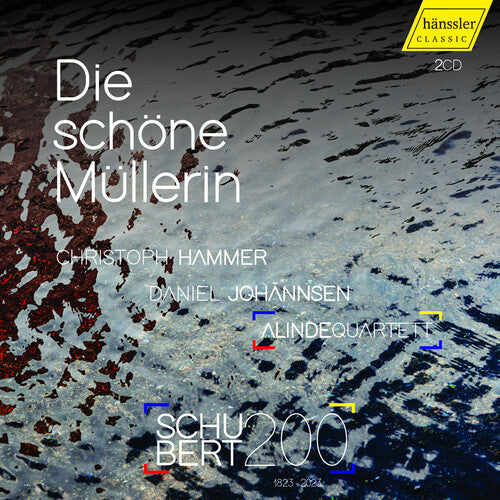
Schubert: Die schone Mullerin / Hammer, Johannsen, Alinde Quartet
With his song cycle, Die schöne Müllerin op. 25, published in Vienna in August 1824, Franz Schubert created one of the first song cycles in music history. It is a real cycle, not just a loose collection, because all the poems united in it hang firmly on a narrative thread: a narrated story, presented in 20 individual songs. It is clear that the most appropriate instrument for Die Schöne Müllerin is not the modern concert grand piano, but rather the fortepiano of Schubert's time, with its delicate, transparent sound and enormous richness of color. This makes for a completely different listening experience. But the arrangement that Tom Randle wrote for the ALINDE Quartet in 2022 can also open one's ears in a completely new way.
Ian Partridge 85th Birthday Tribute - Stimme der Liebe (The Voice of Love)
SOMM RECORDINGS is delighted to pay tribute to the British tenor Ian Partridge on his 85th birthday on June 12 with Stimme der Liebe (The Voice of Love), a collection of iconic songs by Schubert, on which he is joined by his pianist-sister Jennifer Partridge and pianist Ernest Lush. The great German lyric baritone Dietrich Fischer-Dieskau hailed Partridge’s Schubert interpretations as “a pure joy”, an accolade that these 20 performances of Lieder, taken from BBC Radio broadcasts between 1968 and 1972 – and available now for the first time on disc – readily illustrate. They reveal Partridge’s unique, insightful affinity with the complexity and nuance of Schubert’s response to matters of the heart, a quality Fischer Dieskau described – in a facsimile letter to the singer included in the booklet – as his “respect and love for the music”. Among familiar works such as ‘Im Frühling’, ‘Das Fischermädchen’ and ‘An den Mond’, are relative rarities such as ‘Vor meiner Wiege’, which Partridge describes in his booklet interview with Jon Tolansky exploring his “life-long love affair” with Schubert’s Lieder, as one of the composer’s “most inspired creations”.
With a repertoire ranging from Monteverdi and Elizabethan lute songs to Schoenberg and Britten, Ian Partridge is one of the most acclaimed lyric tenors of his generation. He is especially known for his success with songs and Lieder and regarded as one of the great modern Schubert interpreters. His hugely successful partnership with his pianist-sister, Jennifer, saw the duo giving more than 430 recitals and making numerous recordings over their 52-year-long partnership. The booklet also includes informative notes, texts and translations by Richard Stokes, Professor of Lieder at London’s Royal Academy of Music, and author of The Book of Lieder (Faber, 2005). Restoration of the original recordings has been undertaken by audio expert and long-time SOMM collaborator, Lani Spahr.
Schubert & Shostakovich: Viola & Piano
Schubert: Piano Sonatas, Vol. 1
Schubert on Violin: Works for Violin & Piano / Pusker, Fejérvári
Schubert: Voyage d'hiver (Live)
With this new B Records disc, the Miroirs Étendus company revisits one of the greatest classics of the Lieder repertoire, questioning the interpretative heritage that has long been associated with it. Pianist and artistic director Romain Louveau, baritone Jean-Christophe Lanièce and soprano Victoire Bunel propose a multi-voiced Winterreise that disembodies the overused figure of the Wanderer and favors the autonomy of Wilhelm Müller's poems. Like the Schubertian motifs that seem to appear of their own accord, only to eclipse themselves, the musicians venture a depersonalized interpretation that places the figure of the stranger at the center of this lyrical spectacle.
Schubert: Quintette imaginaire
Schubert: Lieder with Orchestra / Appl, Jockel, Munich Radio Orchestra
Time and again, composers – well-known and lesser-known – have arranged Franz Schubert's piano songs for orchestra. These versions are not in any way intended to cast doubt upon the powerful quality of the originals, they merely place them in a different light, and/or attempt to make them easier to perform on a larger scale – when an art song cannot be performed in an intimate salon or chamber music hall, it can also make an impact in a large concert hall.
Baritone Benjamin Appl has compiled nineteen such arrangements from the 19th and 20th centuries for this new CD from BR-KLASSIK. The Münchner Rundfunkorchester, conducted by Oscar Jockel, provides accompaniment that is subtle and in keeping with the work. The album is ultimately rounded off by the first recording of Johann von Herbeck’s orchestrations of Schubert's dances, thus establishing a connection between folk music and Schubert's art songs.
Schubert: String Quintet / van der Heijden, Brodsky Quartet
Celebrating its fiftieth anniversary in 2022, the Brodsky Quartet has performed more than 3000 concerts on the major concert stages of the world and has released more than seventy recordings. A natural curiosity and insatiable desire to explore have propelled the group in many artistic directions and continue to ensure it not only a place at the very forefront of the international chamber music scene but also a rich and varied musical existence. As they comment in their booklet note: ‘It seems fitting to mark the milestone by recording this epic and most celebrated of chamber works, Schubert’s String Quintet in C major, a piece which we have lived with since childhood, and which we have played with a long line of illustrious cellists. One of our earliest performances took place with Terence Weil, our mentor at college, at his retirement concert, just as we were starting out on our professional journey. Now the wonderful young Laura van der Heijden, who comes to this recording with a maturity which belies her years, represents with respect to us a similar age gap, proving that age is insignificant where there is a meeting of musical minds. Now we look forward to whatever our sixth decade might bring.’
REVIEW:
In this exceptional interpretation of Schubert’s C major Quintet, there are plenty of moments where the players individually or collectively make something happen – a tiny inflection in the phrasing here, an applied touch of color there. Yet nothing is overdone, and the music always flows as it wants to.
-- BBC Music Magazine
Schubert: Symphony in C, D. 944 "The Great" / Bernstein, BRSO
Leonard Bernstein conducted regularly in Munich from the 1980s onwards. It was during this time that he came to appreciate and love the Bavarian Radio Symphony Orchestra in particular. In October 1976, Bernstein had appeared with an all-Beethoven program, and in 1983 he began a series of annual concerts with the orchestra. In 1987, he rehearsed Franz Schubert's Great C Major Symphony, which was performed in the Congress Hall of the Deutsches Museum in Munich. This BR-KLASSIK CD features not only the live recording of this concert event but also a rehearsal recording on a bonus CD, "Conductors in Rehearsal," which has been preserved in the sound archives of Bavarian Radio. Bernstein's warmth and friendliness, as well as his astonishingly good German, are most impressive.
Franz Schubert most probably composed his Great C Major Symphony in Bad Gastein in the summer of 1825. Chronologically speaking, it is his eighth symphony, although it is still sometimes referred to as his ninth. It can be assumed that Schubert, who had witnessed the first performance of Beethoven's Ninth Symphony in Vienna in 1824, wanted to be on an artistic level with his much older colleague. He dedicated his work to the Gesellschaft der Musikfreunde in Vienna, in whose archives the score can be traced back to the end of 1826. However, it was not until 1839—after Schubert's death—that the history of its performance began, after Robert Schumann became aware of the work and organized its publication. In 1840, after the posthumous first performance by the Leipzig Gewandhaus Orchestra conducted by Felix Mendelssohn Bartholdy on March 21, 1839, Schumann formulated one of the most famous quotations about Schubert’s symphony, that of its "heavenly length." Because of the value the composer himself attached to it, and to distinguish it from the much shorter Sixth Symphony in the same key (therefore often referred to as the "Little C Major"), it was titled "The Great.
"The live recording was made on June 13 and 14, 1987, in the Congress Hall of the Deutsches Museum in Munich. In the rehearsal recording “Conductors in Rehearsal – Leonard Bernstein Rehearses with the BRSO in German,” Friedrich Schloffer (narrator) and Johannes Ritzkowsky (horn) can be heard alongside Bernstein.