Friedrich Kuhlau
30 products
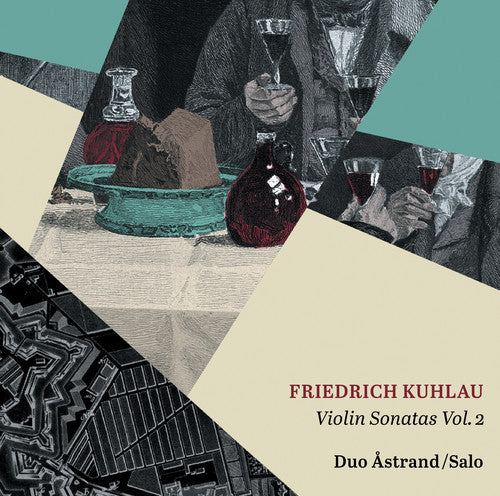
Kuhlau: Violin Sonatas, Vol. 2 / Duo Astrand/Salo
-----
REVIEW:
Kuhlau’s music sounds thoroughly Germanic, and he makes no attempt to develop a Danish national style. He is definitely one of the best composers of his era, though; and it wouldn’t be until Schumann in the early 1850s that anyone would write better for violin and piano.
– American Record Guide
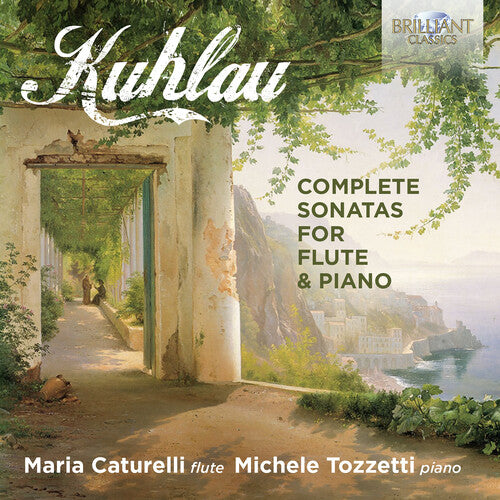
Kuhlau: Complete Sonatas for Flute and Piano / Tozzetti, Caturelli
| Friedrich Kuhlau (1786 - 1832) lived and worked during a transitional period of classical music. A contemporary of Beethoven and Schubert, his works remain almost unknown to this day, except for some compositions for the flute. The compositional style of the sonatas featured in this recording perfectly identifies with that of his contemporaries, while showing some differences in content; the structure of the sonatas is that of the classical period, but the use of melodic themes and harmony looks to the romantic period. These interpretations of the sonatas for flute and piano highlight the constant dialogue between the two instruments; in fact there is a continuous thematic exchange, which the artists found interesting to discover and highlight. The synergy is perceived above all in choppy tempos, while in every Adagio or Andante the flute assumes the role of the solo instrument, and the piano accompanies and responds. The themes in the slow movements are sweet and moving, and the composer manages to evoke emotions that are always different from each other, thus bringing out his predisposition for this type of tempo, present even in the most brilliant movements: in fact in every allegro, even in the one characterized by the greatest energy, there is a moment of tranquility in which the composer takes the time to make performers and listeners ponder. |
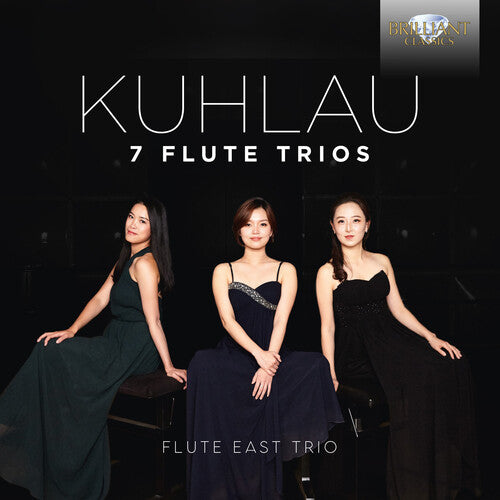
Kuhlau: 7 Flute Trios / Flute East Trio
Born in Hamburg in 1786, the son of a military bandsman, Friedrich Kuhlau showed early musical promise and took lessons with a student of CPE Bach. When Napoleon’s troops invaded Hamburg in 1810, the 24-year-old Kuhlau fled with his family to Copenhagen, and there he made his name as a pianist and composer to the royal court. Taking Danish citizenship in 1813, he worked in the vanguard of the country’s fast-moving cultural scene, enjoying huge success as a composer of operas and incidental music. Kuhlau was himself a flautist of modest accomplishment, but the popularity of salon culture in Denmark increased the demand for flute and piano music - which were both fashionable at the time - to such an extent that Kuhlau complained, in a letter to his publisher in 1829, about having too many commissions. While a flautist of modest accomplishment himself, Kuhlau wrote with unfailing craft, sympathy and imagination for the instrument and before their publication he submitted his new works for approval from the principal flautist of the Court Chapel’s orchestra. The seven trios recorded here display a surprising variety of texture and mood. Even the trio of Op.13 works from 1815 ranges from the Baroque manners of No.3’s Adagio to a much grander scale of expression in the slow introduction which opens the curtain on No.1 and on the set as a whole. There is a dashing, Mendelssohnian quality to both the melodies and the sunny disposition of the Op.86 set from 1827 which itself is set aside for a more intense, Beethovenian argument in the grand trio Op.90. In 2015 three Asian flautists founded the Flute East Trio at the Hanns Eisler Academy of Music in Berlin.
Works for Solo Piano, Vol. 1 / Marie-Luise Bodendorff
Friedrich Kuhlau is known as Beethoven’s strongest advocate in Denmark and the man who wrote Elverhøj. But Kuhlau was first and foremost a pianist, one whose works for the instrument have a depth and character of their own. In the first of a new series, Marie-Luise Bodendorff reassesses Kuhlau’s contribution to the piano literature with fresh, muscular performances of music including the previously unrecorded Divertissement, Op. 37. Marie-Luise Bodendorff took her first piano lessons at the age of five and was admitted to the Hochschule fur Musik in Karlsruhe at the age of 10. From 2002 to 2007 she studied with Russian piano authority Vladimir Krainev at the Hannover University of Music, Drama, and Media. She currently resides in Copenhagen, Denmark, and has been a part time professor of piano at the Royal Danish Academy of Music since 2016.