Georg Muffat
14 products
-
Muffat: Apparatus Musico -Organisticus
$20.99CDChâteau de Versailles Spectacles
Mar 14, 2025CVS131 -
-
-
-
-
-
-
-
-
-
-
-
-
-
-
-
Muffat: Apparatus Musico -Organisticus
APPARATUS MUSICO-ORGANISTICUS
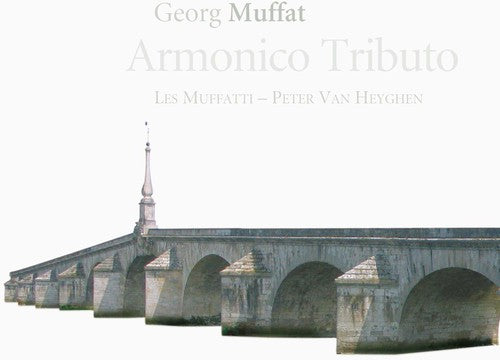
Muffat: Armonico tributo
Muffat, G.: Harpsichord Music
Gottlieb Muffat: Suites for Harpsichord, Vol. 1
Gottlieb Muffat: Suites for Harpsichord, Vol. 2
Muffat: Missa In Labore Requies / Guillon, Le Banquet Céleste, La Guilde des Mercenaires
The powerful Catholic Archbishop of Salzburg, renowned for the extraordinary religious ceremonies held at his cathedral, received a splendid festival mass from Muffat. Muffat was a true European: he studied music in Paris with Lully, was an organist in Alsace, and had positions in Vienna, Prague, and Salzburg. He was a man who fused Italian, French and German styles, adding his extravagant verve, especially for this 1690 Pentecost. The music is written for twenty-four different voices and has to be distributed through the space by five choirs, along with impressive effects from the trumpets and percussion. The Royal Chapel allows this “immense” music to be set in space as it deserves. Le Banquet Céleste (Damien Guillon) and La Guilde des Mercenaires (Adrien Mabire) rise to the challenge of performing this work of exceptional proportions!
The Organ Encyclopedia - Muffat: Organ Works Vol 1
Muffat, a student of Jean-Baptiste Lully, lived and composed at the cusp of a new era in European history. He stepped beyond the limitations of national character, and sought to incorporate elements of Italian and German music in his own French compositions. He was also aware of the new tonality put forth in the 'Well-Tempered Clavier' by his contemporary, J. S. Bach. Though Part I of the 'Apparatus' uses mean tuning, he was eager to experiment with the newer even temperament, which he did in Part II, so it could not be recorded on this instrument. Given the choice, however, Part I is much more interesting listening.
The Organ Encyclopedia - Muffat: Organ Works Vol 2
Muffat: Concerti Grossi No 7-12 / Zajicek, Musica Aeterna
Muffat: Concerti Grossi No 1-6 / Zajícek, Musica Aeterna
Muffat: Complete Apparatus Music-Organisticus / Falcioni
The Apparatus originally consisted of 12 toccatas, but in a later edition three pieces were added to the set: Ciacona, Passacaglia and Nova Cyclopeias Harmonica. The organist is certainly put to the test, what with the scales, the leaps, double trills and a wide variety of figures that express 'contrasting affections' in the works -- the last of which alludes to the story of Pythagoras, who discovered the foundations of musical tuning by listening to the hammering of a blacksmith on various anvils. Brilliant Classics regular, Adriano Falcioni -- whose previous recordings for the label include Duruflé's Complete Music for Choir and Organ (9264) -- performs this magnum opus with aplomb, revealing the skill of a composer who is credited with being the first musician to introduce the Italian concerto grosso and the French suite to the German-speaking countries.
Other information:
- Recorded 15--17 May 2013.
- Georg Muffat was a cosmopolitan artist. In a time when no work permits were needed he travelled Europe and worked in Strassbourg, Berlin, Vienna, Prague, Rome and ultimately in Salzburg, at the court of the Archbishop.
- Like a musical sponge he absorbed every current style of his time in his music, which contains Italian melodiousness, French ornamentations and Germany's severe structures and counterpoint. He published a volume of organ works which became immensely popular among musicians, containing a series of Toccatas, Ciaconas and Passacaglias, works of the highest technical order: the Apparatus Musico-organisticus, a survey of all instrumental and compositional tricks and accomplishments of the time.
- Adriano Falcioni, one of the foremost organists of Italy, offers impressive performances of this complete collection, showing great insight into the styles and performance practice.
- Booklet contains information on the music, artist and the organ.