Giovanni Battista Martini
13 products
Martini: Sei Sonate per l'organo e il cembalo
Martini: L'Opera per Flauto
Martini: Requiem - Missa Solemnis
Martini: Sonate d'intavolatura per l'organo e il cembalo - S
Martini: Sonate d'intavolatura per l'organo & il cembalo - S
Giovanni Battista Martini: Sonate d'intavolatura per l'organ
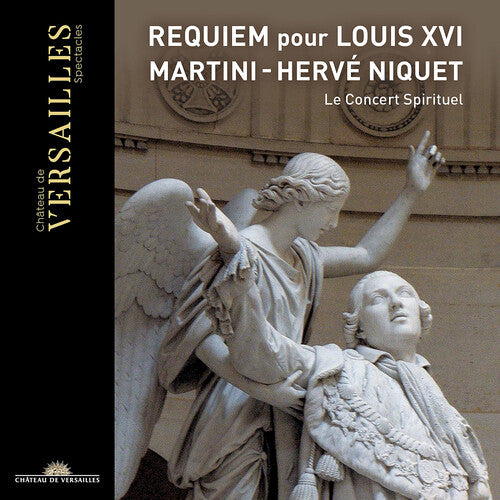
Martini: Requiem pour Louis XVI
Martini: Pro Defunctis
The catalog of sacred vocal compositions by Padre Martini is vast. From the library of the International Museum of Music and the Diocesan Archdiocesan Archive of the Cathedral of San Pietro in Bologna, the orchestra of “San Pietro” has reconstructed one of the most moving liturgies for the Catholic liturgical year: the rite of the dead, which is proposed here in an accurate selection. To crown this work, an unusual (but not distant) psalm to the Office of the Dead: the De Profundis for solo baritone, filled with 4 voices and strings, representing the pinnacle of Martini’s compositional ability and complexity, both in instrumental and choral music.
Mozart, Martini & Sterkel: Piano Concertos / Kronenberg, Capriccio Baroque Orchestra
These three piano concertos provide new insights: two discoveries from the classical era that alter our perspective on the seemingly familiar. Giovanni Battista Martini was a leading music theoretician of his time. His compositions caused a sensation. His many pupils included Johann Christian Bach. Christoph Willibald Gluck, Wolfgang Amadeus Mozart and Johann Franz Xaver Sterkel sought musical instruction from him. His piano concerto is particularly remarkable for its songful lyricism, whose expressiveness is far ahead of what was customary at the time. Johann Franz Xaver Sterkel worked as a court musician, and from 1802 directed the court music in Aschaffenburg. We know of contacts with Beethoven and Carl Maria von Weber. The piano concerto in D major is characterized by clear structure and instrumental virtuosity. The piano concerto in D minorK466 is one of Wolfgang Amadeus Mozart's greatest works. Comparing it to the now almost forgotten concertos by Sterkel and Martini yields an added perspective: it is a psychological drama, in which we encounter Mozart's matchless genius.
Martini: Complete Organ Music / Tomadin
Giovanni Battista Martini (1706-1784) was born in Bologna, in that era part of the Papal States. His father, Antonio Maria Martini, a violinist, taught him the elements of music and the violin and he later learned singing and harpsichord playing and the art of counterpoint from Giacomo Antonio Perti. Having received his education in classics from the priests of the "Congregation of the Oratory of Saint Philip Neri”, he became a priest himself in 1722. In 1725, though only nineteen years old, he received the appointment of chapel-master at the Basilica of San Francesco in Bologna, where his compositions attracted attention. At the invitation of amateurs and professional friends he opened a school of composition at which several celebrated musicians were trained; as a teacher he consistently declared his preference for the traditions of the old Roman school of composition. Martini was a zealous collector of musical literature, and possessed an extensive musical library, estimated at 17,000 volumes. Among his many students was…Wolfgang Amadeus Mozart, who held him in high regard and always spoke fondly of him. “Padre” Martini, as he was called, wrote an immense oeuvre of more than 2500 works, many of them sacred vocal works. His keyboard works include more than 100 sonatas.
This new recording presents the complete organ works of Martini, consisting mainly of Sonatas, but also shorter pieces like fugues, toccatas and preludes. In his earlier works Martini adopted the style of his illustrious predecessors, the masters of Baroque counterpoint, later he wrote in a less learned, more elegant and “pleasant” style, according to the demands of his audience. Played on a variety of historic Italian organs from the 18th century by Manuel Tomadin, one of the foremost Italian organists of today, a scholar and passionate musician, with an impressive discography to his name.
REVIEW:
Scholar, bibliophile, musicologist, teacher, composer: the life of Giovanni Battista Martini was divided between faith and scores. After brilliant studies, he was admitted to orders at the Monastery of San Francesco in his native Bologna. He became chapel master at just nineteen years old. It was from there that he corresponded with luminaries of the time, where he taught for five decades without asking for remuneration, to students from all over Europe. A certain W.A. Mozart took lessons (a CD by Stefano Molardi from Divox paid tribute to this meeting). A selfless, affable, modest person - revered as such. And prolific: sacred music of course, but also symphonies, and numerous keyboard pages.
Until now, however, the discography had not panicked around the organ work of Padre Martini, sporadically included in the 18th century anthologies of gallant style. Few albums are entirely dedicated to him...As in his box sets covering works by Johann Ludwig Krebs, Hans Leo Hassler and Christian Erbach on the same label, Manuel Tomadin sees broad and dares long-distance running, total immersion: nothing less than an announced complete works edition, here a dozen hours on the clock; a treasure hunt. We do not know according to what criteria the works were distributed over the nine discs, but the fact remains that the allocation optimizes the timings (78'47, 75'15, 77'42, 79'32, 77'41 , 79'09, 75'23, 78'36, 75'41).
The two large collections of sonatas [Op. 2 and Op. 3] are there, except that the fifth of opus 3, dedicated to the harpsichord, does not appear...The rest provides a harvest of sweet Sonata sui flauti, Toccatas, Elevazioni, (simili) solemn Pieni, but also liturgical contributions...
...the exhaustive discovery turns out to be addictive...The recipes never tire (we salute here a certain genius for loquacity), the delicacies are renewed, especially as Manuel Tomadin chooses the registrations masterfully. Another incentive for immoderation in listening: the box set alternates locations from one disc to another. No less than nine historic organs from Northern Italy, including five by Gabriel Callido, all built at the end of the settecento except that of Val di Zoldo (1812, the last of this maker), and the Pescetti of Polcenigo, a bit earlier (1732). The distinguished plenitude of the Principals, the enchanting Flutes, the luscious basses, the verbose reeds which take us to the theater: we swoon, especially when the sound recordings flatter the ear like this.
...the desire for completeness did not compromise the care of the production, carried out over only sixteen months. Manuel Tomadin, who is known to be an expert in the less luminous and more austere regions of Northern Germany, here demonstrates a sonic imagination and a Latin volubility which do more than convince...his marathon approach does not prevent perfectionism or preciousness. In this regard, note that the last page of the booklet details the temperature and humidity of each session.
For this great euphonious work and its lively and colorful interpretation, this inexhaustible candy box erects a powerful bulwark against all gloom.
-- Crescendo
Martini: 16 Unpublished Organ Works / Cominetti
Giovanni Battista Martinis sacred compositions are considered to be of absolute value for their formal rigor and teaching counterpoint, whereas the works for keyboard instruments, mostly composed for the regligious service at St. Francis chapel in Bologna, already anticipate that gallant taste, with th epractice of teh accompanied melody, which will become trendy at the end of the 18th century. The sonatas included on this album, many of which have eloquent titles don't go beyond that context and if this feature can result in a small interest for such works, they certainly deserve more attention for their historical value.
Martini: La Fleur de Biaulte / Roman, Le miroir de musique
Born in Leuze (Hainaut) around 1430, Johannes Martini was initially active in Konstanz, then in Milan and Ferrara, where he died on 23 October 1497. Closely connected with the d’Este family, he was paid in 1479 for the production of a large volume of vocal music for the ducal chapel of Ferrara. He is also the key contributor to the Casanatense Chansonnier, which was compiled for the marriage of Isabella d’Este to Gianfrancesco II Gonzaga in 1490. Thanks to these collections, we can for the first time present a glimpse of the immense output (motets, psalms, mass movements, chansons, instrumental chansons) of one of the most refined composers of the generation before Josquin’s.
Martini: Azione Teatrale & Richiami degli ambulanti al mercato di Bologna / Scattolin, Circe
Few musicians were as versatile as the humble Brother Martini, who insisted on being called that way in spite of all the honors rendered to him in Bologna and everywhere. He is celebrated in our time as an extraordinary keeper of books, scores and paintings; in his time, he was quite famous also as an erudite musician, an expert writer of treatises, a pioneering historian, and an authentic “maestro” of music. And as a composer, obviously; but of what? Of everything that pertained to a Kapellmeister and an organist: masses, motets, psalms, hymns, organ sonatas, and so on; and also harpsichord sonatas, concertos, cantatas, duets and profane arias. The Euridice Choir conducted by Pier Paolo Scattolin and the soloists Giacomo Contro, Angela Troilo, and Vincenzo Di Donato are the protagonists of the reconstruction (seen the several gaps found on the original score) of the intermezzo ”Azione Teatrale” of 1726, and of the realization of the “Calls of the street vendors at the Bologna market,” including 13 amongst the countless vocal canons composed by Padre Martini that, once for all is offering to us a lively cross-section of eighteenth-century Bologna in its most daily and popular aspects.