Giovanni Battista Pergolesi
32 products
Pergolesi: Il Prigionier Superbo / La Serva Padrona [2 CDs]
Il Prigionier Superbo was first staged on August 28, 1733. The chronicles report that the intermezzos of La Serva Padrona were so successful they overshadowed Il Prigioniero, in spite of its obvious merits. Pergolesi’s adhesion to the stylistic standards and the formal customs of his time is total and his respect for the taste of the audience entirely focused on belcanto is never in discussion. (Bongiovanni)
Pergolesi: Stabat Mater; Laudate Pueri / Hofstetter, Neumeyer Consort, Ensemble Barock Vokal, Mainz
Pergolesi: Stabat Mater, Et Al / Waschinski, Chance, Et Al
Pergolesi: La Serva Padrona / Dallara, Zanello, Govi, Regia
The work is simplicity itself. Its two acts last barely forty-five minutes and contain five arias, two duets, a finale, and lots of secco recitative. No single number lasts much longer than four minutes, and several of the recitatives are bigger than the arias. The plot is rudimentary: Serpina the maid is so pushy that her bachelor employer, Uberto, decides to get married simply to get her under the control of the household’s new mistress. Serpina, seeing her chance, decides that she will marry Uberto herself, and after she arranges her own trumped up wedding to a stranger Uberto realizes that he loves her and all ends as planned.
Pergolesi’s music seems to have been designed to show off in the most schematic way all that was most appealing in the Italian school. The scoring is paired down to strings and continuo; the accompaniments are simple, the characters (only two of them) come from the middle and working classes, the action moves swiftly, and best of all, the tunes are pure vocal gold. Consider, for example, the sweetly lyrical aria, “A Serpina penserete”. Music historians, scholars, and theoreticians have never been able to wrap their brains around a style dependent on quality of melody as its primary constituent–it really is unanalyzable–and the result has always been a tendency to disparage Italian music as compared to the German or French schools, especially when those doing the analyzing happen to be German or French. Audiences, of course, have no such difficulties, hence the Querelle des bouffons and other, similar controversies throughout history.
This performance, fortunately, is quite a good one. As Uberto baritone Michele Govi sings with firm tone and he acts well with the voice; only a weakness in his lower register prevents him from being ideal. Federica Zanello’s soprano sounds a bit heavy, dare I say “matronly?” for the waspish Serpina, but she uses what she has intelligently and she is never unpleasant to listen to. The Ensemble Regia Accademia, a pick-up group drawn from various northern Italian orchestras, plays well under the direction of Marco Dallara, and the engineering sounds warm and well-balanced. As I said at the start, it’s very odd that there are so few choices available for this work, but this one will do nicely.
-- David Hurwitz, ClassicsToday.com
Pergolesi: Adriano In Siria / Dantone, Comparato, Dell’oste, Heaston [blu-ray]
Also available on standard DVD
PERGOLESI Adriano in Siria. Livietta e Tracollo 1 • Ottavio Dantone, cond; Marina Comparato ( Adriano ); Lucia Cirillo ( Emirena ); Annamaria dell’Oste ( Farnaspe ); Nicole Heaston ( Sabina ); Stefano Ferrari ( Osroa ); Francesca Lombardi ( Aquilio ); 1 Monica Bacelli ( Livietta ); 1 Carlo Lepore ( Tracollo ); Accademia Bizantina • OPUS ARTE OA 1065D (2 DVDs); OA BD7098D (Blu-ray: 190:00 + 12:00) Live: Jesi 2010
Adriano in Siria is a Baroque opera and a prime example of the genre of opera seria , a stylized form that was to dominate Italian opera production for nearly the entire first half of the 18th century. Handel and Vivaldi both composed opera seria but were good enough musicians and smart enough theater professionals not to let the conventions rule them; they made numerous changes to the format to suit their own audiences. Adriano has a libretto by Pietro Metastasio, as many other operas of the period do. His poetry dominated the era and his librettos were set over and over again by many different composers. Adriano had been written only two years previously when Giovanni Batista Pergolesi set it for Naples in 1734, and it had already been set by two other composers and would be set by many more to follow. Pergolesi was from the town of Jesi in the Italian Marches near the Adriatic coast, but was sent to Naples as a boy to study at one of the music academies. When he graduated he was talented enough to find a patron there. His entire short career (he died at 26, it is thought from tuberculosis) was spent in the orbit of the then-dominant Naples music establishment. Pergolesi wrote eight surviving works for the stage as well as his well-known Stabat Mater and other sacred works. In 2010 the Pergolesi Spontini Foundation in Peri announced it would be helping to underwrite the production and video recording of all of Pergolesi’s operas and intermezzos, the first two of which are seen here. Interpolated between the three acts of Adriano is the short comedic intermezzo Livietta e Tracollo.
To say the libretto is by Metastasio is a bit misleading, since many of the arias were rewritten by local poets to suit the particular singers. In the case of Adriano, seven of the 27 musical numbers provided by Metastasio were jettisoned, and of those remaining, 10 were rewritten. The stars of the original production were the castrato Caffarelli and the soprano known as “La Droghierina,” both of whom later appeared with Handel in London. Two additional arias are cut here, which seems a bit odd if one reason for recording the work is to save it for posterity. A new critical edition of the score prepared by Dale E. Monson is used. The story involves the Roman Emperor Hadrian (yes, the same guy who built the wall in Great Britain to keep out the wild Scots from the north). He is in Antioch after defeating the Parthians and their king, Osroa. He holds captive Osroa’s daughter, Emirena, with whom he is falling in love. Farnaspe, a Parthian army leader and Emirena’s beloved, comes to plead for her release. To complicate the situation Adriano’s own intended, Sabina, shows up from Rome wondering what’s going on, and Osroa, the defeated king, is also present in disguise. After quite a bit more opera and many musical numbers, Adriano does the noble thing, pardoning all the Parthians, giving the king back his kingdom, and reuniting Farnaspe and Emirena, pledging his own love for Sabina.
This production from the small regional opera house in Jesi is quite charming. Although Pergolesi’a opera calls for six scene changes, there is only one set here, an open area surrounded by broken columns and fallen large building stones as if in the ruins of a great castle. Chains come down from above to form a cell door when a prison scene is needed. Of the four male roles three are taken here by women; only Osroa is a male, and unusually, a tenor King! All of the six young singers seen on the video sing exceptionally well in this music, though Pergolesi apparently doesn’t really challenge the singers in these roles like Mozart or Handel were wont to do. Annamaria dell’Oste, who plays the soldier Farnaspe, suffers from rather amateurish makeup and her costume does nothing to hide her rather voluptuous female curves. The acting is a bit stilted, as one would expect from young singers, and many of the arias are stand-and-deliver, but that is partly the nature of opera seria . The small Baroque pit band propels the action well but doesn’t show much flexibility in tempos to accommodate the singers; it just keeps chugging along. The intermezzo seen between acts of the main opera is quite charming as well. Two singers, including the only one here I’d ever heard of before, mezzo Monica Bacelli, drive the comedic action of this piece. It is not as good or funny as the only other intermezzo Pergolesi wrote, the famous La Serva Padrona , but it makes a refreshing break from the more serious opera.
Adriano is not really compelling drama; apparently most of the Italian patrons already knew the story, ignored the recitatives, and only paid attention when the most florid singing was occurring. Otherwise they chatted, ate, or played cards. Tough crowd. This production is, however, a fascinating glimpse of a genre long dead, performed and sung well in a setting not unlike one where it may have been performed nearly 300 years ago. It is much more compelling visually in the Blu-ray format. I enjoy it; you just might as well. Conductor Ottavio Dantone talks about the opera, the composer, and this production in the interesting bonus feature.
FANFARE: Bill White
------
Adriano Marina Comparato
Emirena Lucia Cirillo
Farnaspe Annamaria Dell’Oste
Sabina Nicole Heaston
Osroa Stefano Ferrari
Aquilio Tribuno Francesca Lombardi
Accademia Bizantina
Director Ignacio García
Conductor Ottavio Dantone
Recorded live from the Teatro Comunale Pergolesi, Jesi, 2010
Extra features:
Interview with Ottavio Dantone
Cast gallery
Duration: 188 mins
Regions: All regions
Picture Format: 1080i High Definition
Sound Type: LPCM 2.0 / DTS 5.1
Subtitles: English, French, German, Spanish, Italian
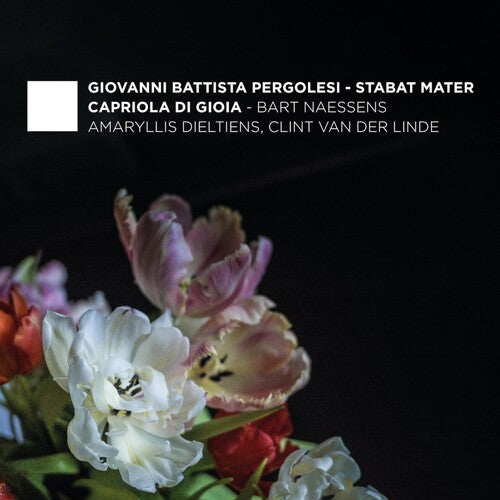
Pergolesi: Stabat Mater / Naessens, Dieltiens, Linde, Capriola di Gioia
Pergolesi: Stabat Mater and Haydn: Symphony no. 49 / Devos, Charvet, Chauvin, La Concert de la Loge
Pergolesi’s Stabat Mater has enjoyed enormous fame ever since the eighteenth century – Jean-Jacques Rousseau called its first movement ‘the most perfect and touching that has ever come from the pen of any composer’. There were many arrangements of the work, by Bach among others. It was performed more than eighty times at the Concert Spirituel in Paris between 1753 and 1790, in multiple versions, probably also with the participation of a choir.
After consulting several manuscripts and editions held at the Bibliothèque Nationale de France, Julien Chauvin has chosen to record it with soprano and mezzo soloists (the equivalent of the French dessus and bas-dessus) and a two-part children’s choir: ‘The choir can play a real role in the narration of so powerful and poignant a text’, he says. This recording teams two emblematic singers of the Alpha label with the excellent Maîtrise de Radio France, of which Adèle was a member as a girl. To complement the Neapolitan masterpiece, we have a ‘sacred’ symphony by Haydn, "La Passione," probably written for Good Friday and in the same key as the Stabat.