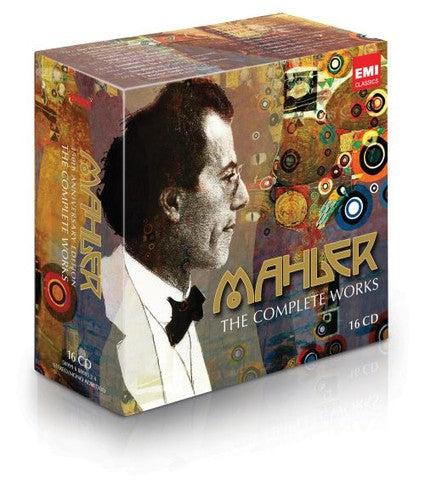
Gustav Mahler
369 products
-
-
-
-
-
Symphony No. 2 in C Minor, "Resurrection"
$27.99CDHalle
Nov 07, 2025CDHLD7568 -
Symphony No. 2 in C Minor "Resurrection"
$21.99CDFra Bernardo
Aug 15, 2025FB2564847 -
Gary Bertini conducts Mahler's Symphony No. 5
$20.99CDSWR
Apr 11, 2025SWR19164CD -
Mahler: Symphony No. 5
$20.99CDAlpha
Mar 14, 2025ALPHA1127 -
-
-
Mahler: Symphony No. 3 / Bychkov, Czech Philharmonic
$26.99CDPENTATONE
Mar 07, 2025PTC5187363 -
Mahler: Symphony No. 1
$20.99CDUrania Records
Mar 07, 2025LDV14122 -
-
-
-
SYMPHONY NO.9
SYMPHONY NO. 10
COMPLETE SYMPHONIES
Vienna - Joyful Apocalypse / Aurélien Pontier
A veritable musical metaphor for the suicide of Europe that was the Great War, both apotheosis and apocalypse. We also hear evocations of Schubert, Liszt, Mahler and Kreisler, all imbued with a kind of nostalgia that belongs only to this mythical city. - Aurélien Pontier
Dedicated to the last years of Imperial Vienna, which gave rise to an artistic effervescence unique in European history. The program opens with a piano transcription of Strauss's Die Fledermaus and ends with Ravel's La Valse.
Antonio Pappano - Complete Santa Cecilia Symphonic,Concertante & Sacred Music Recordings
Mahler: Symphony No.7 (LP)
Mahler: Symphony No. 7
Gustav Mahler: Symphonie Nr. 6 - Mariss Jansons
Mahler: Songs of Fate
Mahler: Symphony No. 1 (LP Version)
Symphony No. 2 in C Minor, "Resurrection"
Symphony No. 2 in C Minor "Resurrection"
MAHLER: Symphony No. 2 / Kindertotenlieder (Fried) (1915-19
SYMPHONY 2 SACD
The Voices Of Living Stereo Vol 2 / Lanza, Price, Et Al
Gary Bertini conducts Mahler's Symphony No. 5
Mahler: Symphony No. 5
Mahler: Symphony No. 3 / Bychkov, Czech Philharmonic
The Czech Philharmonic and its Chief Conductor and Music Director Semyon Bychkov continue their acclaimed Mahler cycle with the composer's Third Symphony, working together with mezzo-soprano Catriona Morison, the Prague Philharmonic Choir and Pueri Gaudentes. In this monumental work, Mahler combines a text from Nietzsche's Also sprach Zarathustra with the folk song inspirations of Des Knaben Wunderhorn, culminating in eternal bliss in the closing Adagio. To Bychkov, this longest Mahler symphony offers his "least hysterical" music, and hearing it for the first time as a 10-year-old choirboy kindled his life-long fascination and love for this composer. With this recording, it comes full circle.
The Czech Philharmonic - recently awarded Gramophone's Orchestra of the Year Award - is one of the world's orchestral gems, recognized for its rich tradition with the Czech masters as well as European repertoire. Together with their Chief Conductor and Music Director Semyon Bychkov, they have so far recorded for PENTATONE Mahler's First, Second, Fourth and Fifth Symphonies (2022-2023), part of the complete Mahler cycle to be released by the label, as well as Smetana's Ma vlast and Dvorak's Seventh, Eighth and Ninth Symphonies (2024). The Orchestra is also featured on the albums Folk Songs (2023) and Czech Songs (2024) recorded by Magdalena Ko�ena and Sir Simon Rattle, as well as Dvorak Legends & Rhapsodies with Tomas Netopil.
Mahler: Symphony No. 1
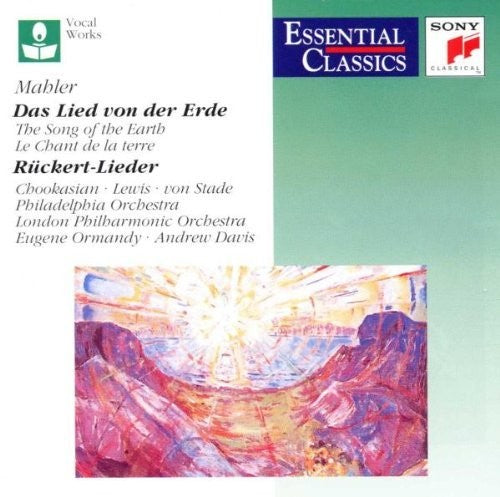
Mahler: Das Lied Von Der Erde, Lieder / Ormandy, Davis Et Al
Ormandy opens the second song with admirable restraint and icy-coldness. This is late autumn with no heat at all. Lili Chookasian has a light voice and her first entrance doesn't bode too well for what is to come. All this brings some dividends when the orchestra shows a wonderful burst of warmth, especially from the lower strings at "Bald werden die verwelkten" ("Soon the withered golden leaves"). In fact, the Philadelphia strings are (and it should be no surprise) one of the glories of this recording and show Chookasian up rather. If only she could sing as well as they do! At "Ich weine viel in meinem Einsamkeiten" ("Long do I weep in my loneliness") hear also the solo horn against the oboe picked out by Ormandy and then "Sonne der Liebe willst du nie mehr scheinen" (Sun of love will you never shine again), where, as with Lewis in the "ape and graves" section of the first song, Chookasian is rather overwhelmed by the power of the orchestra. In "Von Der Schoenheit" she struggles to make the words tell, not least in the horse section which Ormandy takes very fast making her hang on for dear life. Then in the opening of "Der Abschied" there is some lack of tragic weight. But this is in common with what appears to be the philosophy behind Ormandy's performance. Again and again the stress is on refinement, fastidiousness, polish and no praise can be too high for the orchestra who bring really cultured playing to everything. Again Chookasian seems more than a touch under-involved. With Lewis detachment could be looked on as a positive stance but with Chookasian I feel it's simply that she isn't quite up to the peculiar demands of this piece. This is never more so than in the challenge of the last song where her rather peripheral feeling for the words tells most of all. But Ormandy's polish is in evidence throughout and a good example is his accompaniment of "Die Blumen blassen im Dammerschien" ("The flowers grow pale in the twilight"). He is very controlled too, helped by a slightly faster tempo than we are used to so that crucial line "Alle sehnsucht will nun traumen" doesn't move us as it should. He also skates too discursively over the wonderful bird section. This is a real example of his refinement robbing the music of one of its most distinctive moments: more "Ma Mere l'oye" than "Le Chant de la terre". Although that expressionist, "Pierrot Lunaire-like" section beginning "Es wehet kuhl" with flute and string bass underpinning has a fine sense of stillness it has less depth than it needs so that when the music warms up there is less feeling of respite. In the funeral march orchestral passage there is some extraordinary music where Mahler pushes the boundaries of tonality to the limit, but Ormandy rather throws it away in pursuit of smooth edges. The overall tempo is also too quick to make the effect it has to, though there is some wonderful playing from the cellos at the climax, really digging into their phrases. This is more than Chookasian does in the closing section, I feel. Her attention to the words is not really close and her tone rather one-dimensional; not expressive enough for music that expresses so much and Ormandy rather forces her on.
In sum a beautiful performance of Mahler’s late masterpiece, especially from the point of view of conductor and the orchestra. But there is more to this work than what lies on the surface and Ormandy's apparent stress on those symphonic aspects seems to encourage him in his refinement of everything else. Lewis's detachment at least seems to have point. Chookasian, on the other hand, one suspects is witness because she doesn't know how to get more involved or whether she should. On balance I think the same applies to Ormandy who doesn't really impress as a Mahlerian in this most elusive of works. He is saved by his wonderful orchestra who, in spite of some slightly faster tempi than we are used to, make this a performance to be enjoyed, for all I may not regard it as a front runner.
A coupling for Das Lied is rare but here is a very substantial one in the shape of the five Rückert Songs in a performance that finds Frederica Von Stade at the height of her considerable powers and Andrew Davis as ever an excellent accompanist. This is not a reason to buy this release, but certainly one to make up for any shortcomings in the main work.
Ormandy and his great orchestra are the real stars of this fine release.
-- Tony Duggan, MusicWeb International
Mahler/Berio, Strauss: Orchesterlieder / Andreas Schmidt
Mahler: Das Klagende Lied / Boulez, London So & Chorus
Mahler: Symphony No 4 / Davis, Blasi, Bavarian Radio So
-- Gramophone [7/1996]
SYMPHONY 9