Mahler: Das Klagende Lied; Blumine, 10 Symphony / Blunier, Beethoven Orchestra
MDG
$24.99
April 01, 2013
Mahler initially had a hard time of it. A few compositional attempts from his youth did not turn out to his liking and were destroyed. When Das klagende Lied finally met with his own critical favor, he stated, "My first work in which I have found myself as 'Mahler'!" Here it is heard in colorful contrast to the fragment from his last symphony and the "Blumine" andante originally intended for the first symphony. The Beethoven Orchestra of Bonn under its resourceful conductor Stefan Blunier is in top form on this fascinatingly detailed look at Mahler's compositional workshop.
{# optional: put hover video/second image here positioned absolute; inset:0 #}
MDG
Mahler: Das Klagende Lied; Blumine, 10 Symphony / Blunier, Beethoven Orchestra
Mahler initially had a hard time of it. A few compositional attempts from his youth did not turn out to his liking...
‘The symphony must be like the world. It must embrace everything.’ This oft-quoted statement by Mahler serves to illustrate his extraordinary artistic ambition and focus. The journey through his symphonies is rich and emotionally charged, imbued as they are with the influences of his surroundings, his suffering as well as his joy, and his unique sense of satire. These critically acclaimed recordings culminate in the Tenth Symphony completed by Joe Wheeler (‘Heartily recommended’ – CDnow) and the box-set includes detailed notes and sung texts.
“…if you want to hear a performance that combines the best of just about all of the competing versions...then this is way to go.” ClassicsToday.com on Symphony No. 8
“Antoni Wit conducts a fresh, spontaneous-sounding reading, beautifully played and recorded.” Penguin Guide on Symphony No. 4.
“This is a very impressive recording indeed.” American Record Guide on Symphonies Nos. 3 & 10.
{# optional: put hover video/second image here positioned absolute; inset:0 #}
Naxos
Mahler: Complete Symphonies / Wit, Halasz, Olson
‘The symphony must be like the world. It must embrace everything.’ This oft-quoted statement by Mahler serves to illustrate his extraordinary artistic...
Mahler: Complete Symphonies Nos. 1-9 / Bavarian Radio Symphony
BR Klassik
$69.99
April 06, 2018
In his nine symphonies, Gustav Mahler created an entire world for himself and his listeners. More than any other composer, he tries in his symphonic oeuvre to get to the very depths of the circle of life – the eternal cycle of growth and decay. What set of complete works would be more appropriate, therefore, for bringing the qualities and the unique sound of one of today’s leading orchestras to their fullest expression?
In the Mahler complete edition released by BR-KLASSIK, the Symphonieorchester des Bayerischen Rundfunks – under some of its most influential conductors, but above all its current chief conductor Mariss Jansons – tackles Gustav Mahler's symphonic works. The performances were recorded live between 1996 and 2016 in the Philharmonie im Gasteig and the Herkulessaal of the Munich Residenz, and most of them are recent. Yannick Nézet-Séguin conducts Mahler's Symphony No. 1, Mariss Janson conducts Symphonies Nos 2, 5, 7 and 9, Bernard Haitink Nos. 3 and 4, Daniel Harding No. 6 and Colin Davis no. 8, the "Symphony of a Thousand". Numerous soloists and choirs are also featured. The recordings form a challenging part of the symphonic repertoire from the recent history of the Symphonieorchester des Bayerischen Rundfunks; under the baton of Mariss Jansons, and other conductors of the late 20th and early 21st century especially associated with it, this renowned orchestra, with the musical and interpretive mastery for which it is justly famed, provides truly memorable performances.
{# optional: put hover video/second image here positioned absolute; inset:0 #}
BR Klassik
Mahler: Complete Symphonies Nos. 1-9 / Bavarian Radio Symphony
In his nine symphonies, Gustav Mahler created an entire world for himself and his listeners. More than any other composer, he tries...
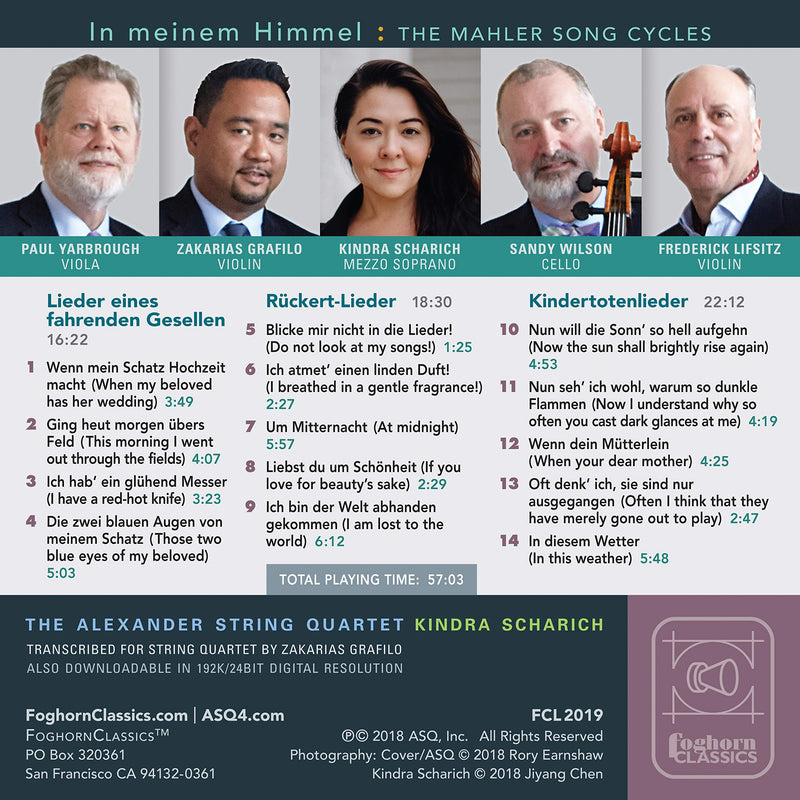
In meinem Himmel: The Mahler Song Cycles / Alexander String Quartet
Foghorn Classics
$18.99
November 16, 2018
The award-winning Alexander String Quartet joins with acclaimed mezzo soprano Kindra Scharich in this world premiere recording of some of Mahler’s great orchestral Lieder — transcribed for voice and string quartet by Zakarias Grafilo. Commissioned by Lieder Alive! these exquisite transcriptions combine the lushness of the orchestral versions with the intimacy of chamber music — and the result is transcendent. Kindra Scharich has performed more than 50 art songs in 10 languages and sung over 30 roles in the lyric mezzo opera repertoire. Recording projects include Beethoven, Schumann and the complete non-Portuguese song repertoire of the great Brazilian composer Alberto Nepomuceno. A dedicated recitalist with a deep love of chamber music, she has performed and premiered numerous works by living composers. The Alexander String Quartet’s discography includes major cycles by Bartok, Kodaly, Mozart, Shostakovich, and Beethoven. An important advocate of new music, with over 35 commissions and premieres, they have performed on five continents. Directors of the Instructional Program of the Morrison Chamber Music Center at San Francisco State University, ASQ is the subject of an award-winning documentary “Con Moto: The Alexander String Quartet.”
{# optional: put hover video/second image here positioned absolute; inset:0 #}
Foghorn Classics
In meinem Himmel: The Mahler Song Cycles / Alexander String Quartet
The award-winning Alexander String Quartet joins with acclaimed mezzo soprano Kindra Scharich in this world premiere recording of some of Mahler’s great...
Marianne Beate Kielland’s discography has grown rapidly since I first reviewed a collection of Bach cantatas a dozen years ago. Recitals with Grieg, Elling, Schumann and Mozart have come my way for review, the latter was one of my Recordings of the Year 2017 (review). Thus it was only a matter of time before she would tackle one of the real summits in the song repertoire, Gustav Mahler’s three song cycles. They have been recorded innumerable times and it seems that they invariably inspires the singers to surpass themselves, both in pure vocalism and interpretation of the texts. The Mozart recital mentioned above was titled “Whispering Mozart” since Ms Kielland and her sensitive accompanist Nils Anders Mortensen had opted for uncommonly intimate readings of the songs, as though they were performed before a small group of listeners gathered in someone’s living room. There is something of the same approach here. All three cycles are most often heard with orchestral accompaniment and the Rückert songs and Kindertotenlieder (also to Rückert texts) were conceived that way. The presence of an orchestra almost by definition excludes close intimacy. Certain singers still manage to communicate closeness when allied with a sensitive conductor. The best example is Janet Baker and John Barbirolli in the famous recordings from the 1960s. Through shunning the orchestra Marianne Beate Kielland can scale down to the same whispering intimacy as on the Mozart album at the expense of the orchestral colours. The piano, exquisitely played by Nils Anders Mortensen, provides something similar to a black-and-white photograph or etching, which still has marvellous nuances.
That is immediately noticeable in the five Rückert songs. Ich atmet’ einen linden Duft! is careful, delicate, restrained, light; Liebst du um Schönheit restrained and extremely inward with exquisite nuances, superbly adjusted to the sparse accompaniment; in Blicke mir nicht in die Lieder the sound is fuller but the lightness is retained, as is the sense of folk song; Ich bin der Welt – my personal favourite among the Mahler songs – is utterly sensitive and in the last stanza the line “und ruh’ in einem stillen Gebiet” is so soft and dreamy, lingering …. Um Mitternacht is a grander song and the manner of her reading is grander with glowing tone, absolutely steady and sooo beautiful.
Kindertotenlieder, the darkest of song cycles, is permeated by inwardness and pensiveness. The piano accompaniment makes the songs more transparent than the orchestral version. Oft denk’ ich, sie sind nur ausgegangen is particularly touching in Marianne Beate Kielland’s reading. The concluding song In diesem Wetter is the dramatic outbreak that literally cries out for the orchestral background but the piano here thunders convincingly in the opening and the reading as a whole is quite overwhelming. I still, when writing this, feel the shivers it provoked. At the same time the simple beauty of the final stanzas is like balm for the soul. The ultimate reading of Kindertotenlieder for me is Brigitte Fassbaender’s whom I heard in the Royal Castle in Stockholm many years ago. She sang the whole cycle with closed eyes and with an intensity that was almost unbearable. That was of course the orchestral version, but Marianne Beate Kielland comes very close to Fassbaender in her more small-scale reading.
The same commitment and insight is also apparent in Lieder eines fahrenden Gesellen, which was originally conceived for voice and piano and several years later was scored for orchestral forces. That version was first performed in 1896 and there seems to be no documentation that the voice-and-piano version was ever performed before that. There is again a captivating simplicity about Ms Kielland’s readings also here, a simplicity that doesn’t exclude depth. The opening of Ging heut’ Morgen has a kind of jubilant rusticity that reminds the listener that the songs were inspired by Des Knaben Wunderhorn, even though the words are Mahler’s own. Ich hab’ ein glühend Messer is swift and rhythmically intense in the opening, but the second stanza, Wenn ich in den Himmel seh’ is soft and inward while O Weh! when it is repeated is heartrendingly intense. Die zwei blauen Augen is so sad with the last stanza, Auf der Strasse steht ein Lindenbaum, magically sung. Whispering Mahler, indeed!
I have lots of marvellous Mahler recording on my bending shelves, recordings that I will not voluntarily be separated from. This latest disc will now join those with Janet Baker, Christa Ludwig, Brigitte Fassbaender, Dietrich Fischer-Dieskau, Thomas Hampson and several others. I urge readers to follow my example.
– MusicWeb International (Göran Forsling)
{# optional: put hover video/second image here positioned absolute; inset:0 #}
LAWO Classics
Einsamkeit: Songs by Mahler / Kielland, Mortensen
A MusicWeb International Recording of the Month Marianne Beate Kielland’s discography has grown rapidly since I first reviewed a collection of Bach...
Bruno Walter Conducts Mahler Symphonies 1 & 2 - 1942 Live Performances
Music and Arts Programs of America
$32.99
August 28, 2012
MAHLER Symphonies Nos. 1 and 21 • Bruno Walter, cond; 1Nadine Conner (sop); 1Mona Paulee (ms); 1Westminster Choir; New York P O • MUSIC & ARTS 1264, mono (2 CDs: 132:17 & English only) Live: New York, 11/25 and 10/25/1942
Elsewhere in this issue I review a two-CD set of historic Bruckner symphony performances conducted by Bruno Walter. Here we have two more premiere publications of historic broadcasts, drawn from the same private collection recently acquired by Music and Arts, with the promise of still more to come. Their chief point of interest is that they are among the earliest recorded performances by Walter of works by the composer to which, far above and beyond any other conductor, he could claim a unique, profoundly personal connection, as Mahler’s longtime assistant and protégé, who led the world premiere performances of the Ninth Symphony and Das Lied von der Erde. To be more precise, this is the earliest surviving Walter account of the “Resurrection,” whereas the “Titan” is preceded by a 1939 broadcast with the NBC Symphony.
Back in 34:6, in reviewing a 1950 Vienna Philharmonic broadcast of the Mahler Fourth that also made it into my 2011 Want List, I briefly surveyed all of Walter’s surviving performances of that work—12 in all. The First ranks second (got that?) in Walter’s Mahler discography, with nine extant versions, given variously with the NBC Symphony, London Philharmonic, Concertgebouw, Bavarian State Symphony, New York Philharmonic, and Columbia Symphony. As in the similar tables in the Bruckner set review, if a particular performance has appeared more than once on CD, I have cited the best version currently in print (excluding versions included in large multi-CD anthologies); studio recordings are marked with an asterisk.
Date Orchestra CD or LP Issue (if any) Timings
04/08/39 NBC SO Music & Arts CD-1241 11:55 6:09 11: 19 18:04
10/25/42 NYP Music & Arts CD-1264 12:34 6:34 11: 27 18:55
10/02/50 BSSO Orfeo C 562 021 B 12:03 6:15 11:18 18:17
01/24/54 NYP Movimento Musica 01.106 12:20 6:17 11: 35 18:42
(LP only, Italy)
01/25/54 NYP Sony MHK 63328* 12:33 6:22 11:18 18:17
01/14 /61 CSO Sony SM2K 64447* 13:20 6:50 11:24 20:25
- 02/06/61
Again very much like Walter’s eight surviving performances of the Bruckner Ninth, the timings here indicate a remarkable stability in his interpretive approach among the performances pre-dating his March 1957 heart attack—and in this instance, even the 1961 studio recording differs in little else except the somewhat broader tempi in the outer movements. The sound of the 1939 NBC broadcast is surprisingly decent, a vast improvement on previous issues on other (and much less reputable) labels. For whatever reason, Walter’s 1947 performances in London feature noticeably quicker tempi than those of the same works in other venues. (A positively Toscaninian Beethoven Ninth issued by Music and Arts clocks in at a torrential 61:58, compared to his 1949 studio recording of 65:12, with most of the difference occurring in the first and third movements.) The London performance also unfortunately suffers from the poorest recorded sound (it is afflicted with noticeable tape wow and flutter) and sometimes dicey orchestral playing.
Several of these performances have been reviewed in these pages before, mostly with glowing praise. In 28:1 James H. North termed Walter’s 1947 Concertgebouw outing “magnificent ... a performance for the ages.” Jeffrey J. Lipscomb’s review of the 1950 Munich performance in 29:3 said that it “captures Walter’s artistry at its finest,” and he then placed it on his 2006 Want List. In 34:3 Boyd Pomeroy likewise lauded the 1939 NBC performance as “a reading of thrilling spontaneity, a combustible meeting of Walter’s totally idiomatic Mahler style with the distinctively bright, tightly focused expressive intensity of the NBC orchestra, which responds with total commitment.” He also commented briefly on the two 1947 renditions plus Walter’s two studio recordings, where his evaluations agree with those of his colleagues. The less positive reviews—Peter J. Rabinowitz on the 1950 New York performance in 13:3, and Arthur Lintgen on the 1947 London performance in 32:6—have faulted poor recorded sound rather than the interpretation. Except for finding the sound of the 1950 New York performance far more listenable than did Rabinowitz, I otherwise concur with all of the foregoing reviews and happily refer readers to them.
To their observations I will append a few of my own. The 1947 Concertgebouw and 1950 Munich performances feature a more mellow orchestral timbre than do those of their American counterparts, with Munich having the better recorded sound. However, the 1947 performance features the finest orchestral playing; it has a superior rendition of the treacherous double-bass solo in the third movement, and is the only live performance in which there is not at least one prominently cracked or blown note on the trumpets or horns (though such lapses are few and momentary in the other ones). The live 1954 New York performance cries out to be issued on CD; it has superior sound to the other live American recordings, and the crackling frisson of a live performance that the estimable studio account recorded the following day does not quite replicate. Unlike some critics who discount Walter’s 1960 account as relatively slack and a letdown from his previous versions, I still regard it as virtually nonpareil among studio recordings, even if I do prefer the greater tensile strength of the earlier monaural studio account. Mahler as a hyper-neurotic has been grossly overdone, and Walter’s balancing of what he called the Apollonian and Dionysian sides of the composer is a far more accurate view that reflects his own intimate acquaintance with Mahler’s personality rather than latter-day pseudo-Freudian projections upon it.
Unless and until the live 1954 New York account becomes available on CD, my top recommendations for the Mahler collector who wants a representative performance of the First by Walter would be either the 1947 Concertgebouw or 1950 Munich performance, along with the newly issued super-budget seven-CD set on Sony of all of Walter’s Mahler recordings for Columbia, just reviewed by Christopher Abbott as a “Classical Hall of Fame” entry in 35:6. As for this 1942 performance, while it is naturally a necessary acquisition for Walter collectors such as myself, it is a luxury acquisition for others; it is a typically excellent interpretation, but not sufficiently distinct from other and better-sounding Walter performances. Those desiring to hear Walter’s earlier thoughts on the work would do better to turn to the 1939 NBC outing.
Much the same can be said of the 1942 performance of the “Resurrection” presented here, though in this case there is considerably less competition. This is now the fifth performance by Walter of this work to appear in print, an extraordinarily high number considering the relative rarity of performances of it before the Mahler boom of the 1960s. As before, the following tables provide specific details. For all of the New York Philharmonic performances, Walter used the Westminster Choir; for the Vienna Philharmonic performance he employed the chorus of the Vienna State Opera Concert Society.
Date Orchestra / Soloists CD or LP Issue (if any)
01/25/42 NYP / Conner / Paulee Music & Arts CD-1264
12/05/48 NYP / Conner / Watson Bruno Walter Society BWS 1067/8
(LP only, Japan)
02/17/57 NYP / Stader / Forrester Music & Arts CD-1199(1)
02/17-21/58 NYP / Cundari / Forrester Sony SM2K 64447*
Timings for these are as follows:
Date Timings
01/25/42 22:06 9:59 10:18 4:40 32:30
05/15/48 22:28 10:53 10:56 4:38 34:47
12/05/48 22:20 11:24 10:54 5:13 34:35
02/17/57 21:30 10:36 10:44 4:39 33:01
02/17-21/58 21:37 10:35 10:43 4:11 32:26
Christopher Abbott reviewed and praised the deluxe Andante release (most regrettably out of print) of the 1948 Vienna performance in 26:6. (The current Andromeda issue, coupled with the 1950 New York performance of the First, appears to be a clone of the Andante issue, muddied with added bass reverberation.) Boyd Pomeroy (whose recent departure from these pages is a sore loss) waxed enthusiastic over the live 1957 New York performance in 34:5; an earlier issue (also by Music and Arts) was welcomed with equal enthusiasm by Abbott in 31:2, who also discusses the 1958 studio recording in his aforementioned recent Classical Hall of Fame entry in 35:6.
The Mahler Second is unique in Walter’s discography in being the only recorded work in his repertoire where his final performances are faster instead of slower than his earlier ones. Here, the 1942 performance is a few seconds behind the 1958 studio recording, and a bit ahead of the 1957 live performance, but all three are a few minutes faster than the two versions from 1948. As Abbott notes, this belies oft-repeated assertions that the post-1957 heart attack recordings led to a slackening of Walter’s interpretations; there is certainly no lack of energy and dynamism in this account. Moreover, this is a notable instance in which advances in remastering technology substantially alter discographic evaluations. The superlative deluxe Andante release of the 1948 Vienna performance transformed it from a dim-sounding mess to a listenable recording of considerable historic interest, even if in the process it revealed additional flaws (more on which anon). Boyd Pomeroy’s preference for the live 1957 performance over the 1958 studio recording was quite justifiable in light of the rather poor remastering that Sony produced of the latter for its “Bruno Walter Edition,” with a dry, constricted bass register. While this has been slightly but noticeably improved in the new boxed set reviewed by Abbott, that too would not be enough to change the assessment. But this evaluation must be radically altered once one hears the DSD (Sony SRCR 2334-5) or Blu-Spec (Sony SICC 20075-6) editions issued by Sony in Japan (the latter at least is already out of print, alas). Suddenly the entire frequency range is opened up to a hitherto unimagined degree, with a bass register that now has depth and warmth, and the choir finally emerging with the presence and impact one sensed it always had but felt was somehow imprisoned behind invisible sonic bars. (Special thanks to Fanfare reader and friend Robert Alps for both the information on these releases and for generous gift copies of them as well. Through him I have also just learned that by the time this review appears in print, Sony in Japan will have released some CDs in a newly upgraded sonic format, Blu-Spec2.)
Of these five performances, the one from Vienna in 1948 ranks a rather distant last place. While much improved by Andante, the recorded sound is still rather dry and boxy, with limited frequencies; the orchestral playing is surprisingly ragged (including a horrible cracked note in the crucial fifth movement trombone solo), and the choir not much better; and Rosette Anday’s wobbly, hollow-voiced attempt at the solo alto part is the kind of thing one hears on parody discs rather than in serious performances. This 1942 performance occupies the next-to-last position. It is very fine on its own terms, and if no other example of Walter’s art in this work survived it would be of immense value, but it is outclassed by all three succeeding performances. As in the 1948 New York performance (more on which shortly), the soloists and choir sing an English translation—revised by Walter himself—rather than the original German. Mona Paulee is a committed soloist, but her voice has more of a mezzo-soprano cast than the dark contralto one truly needed for the part. Nadine Conner, a Walter favorite for soprano vocal assignments who also sang supporting roles at the Met, fulfills her smaller role capably, and the Westminster Choir sings with power and enthusiasm.
In his typically superb program notes—which include fascinating details regarding behind-the-scenes negotiation of the Boston and New York orchestras with various musical figures and how these affected concert programming—Mark W. Kluge opines that this is “an account that is noticeably more rhetorical and dramatic than his later performances.” With this assertion I must respectfully disagree. Both the 1957 live and 1958 studio versions (the latter in its new Japanese remasterings) yield nothing on this score to the 1942, and indeed have more forward drive and energy. However, the real but frustratingly elusive prize is the live 1948 New York performance. It was released only in Japan on an ultra-scarce set of Bruno Walter Society LPs, though cassette and CD copies have circulated among private collectors as well. That is the performance to which Kluge’s observation rightly applies. It simply beggars superlatives—utterly titanic, of a white-hot intensity and level of interpretive inspiration that causes the limitations of a 1948 AM broadcast sound (superior to that from 1942) to fall away and leave one slack-jawed in dumbfounded amazement. In Rose Watson, Walter this time has the true contralto voice needed for the primary solo part; Nadine Conner repeats her fine rendition of her supporting role; both the Westminster Choir and New York Philharmonic play and sing as if their very lives depended on it, leaving their previous efforts trailing in the dust; and the audience roars and whistles its ecstatic approval at the close.
Music and Arts has done its usual superlative job with remastering and tape-to-disc transfer (by Aaron Z. Snyder and Eric Jacobs, respectively). These are both excellent performances that are necessary acquisitions for the committed Walterian such as myself. Anyone else who has the money and inclination to acquire them also will certainly get his money’s worth. The one major caveat is the existence of superior alternatives. Thus, an urgent personal plea to the good folks at M&A: how about issuing a two-CD set coupling the 1954 performance of the First and the 1948 one of the Second? That would be a must acquisition for every lover of Mahler and for collectors of historic recordings alike.
FANFARE: James A. Altena
{# optional: put hover video/second image here positioned absolute; inset:0 #}
Music and Arts Programs of America
Bruno Walter Conducts Mahler Symphonies 1 & 2 - 1942 Live Performances
A. Mahler: Complete Songs / Paasikivi, Panula, Tampere Philharmonic
Ondine
$18.99
June 23, 1999
REVIEW:
It's the marvelous singing of Lilli Paasikivi, with her intelligence, penetrating insight, and richly rounded tone that fully captures the spirit of these works and makes them little gems that no Lieder enthusiast can afford to overlook. Ondine's warmly resonant, naturally balanced recording makes this important disc even more welcome. It's a "must-have".
It's not long into this disc before it becomes evident that Alma Mahler was a very different composer from her famous husband Gustav. Alma studied with Zemlinsky, whose influence (along with that of Hugo Wolf) shows most readily in her work--yet this is Alma's music through and through. Even before Mahler forbade her from composing once they were married, Alma displayed a distinctive voice, one steeped in 19th-century Romanticism (her father often sang Schumann lieder) as well as the musical currents of the new century. The first set of Five Songs comes from this early period, and right from the opening "Die stille Stadt" Alma's skill at word setting captivates, as does her ability to recreate in music each poem's unique emotional state. Of the five, "Bei dir ist es traut", with its recurring falling major second, is the only one that sounds remotely close to her husband's style.
After Gustav's death Alma again took up composition, and the following Four Songs reveal a new richness and poignancy in her writing as well as an expanded harmonic palette. "Licht in der Nacht"'s haunting atmosphere lingers after the song has ended, while "Anstrum"'s tonal waywardness displays Alma's awareness of modern musical developments. Alma's last set of Five Songs, published in 1924, is based on spiritual texts, emphasizing both their reverential (Hymne) and mystical (Hymne an die Nacht) themes.
The program concludes with two unpublished songs, "Leise Weht ein erstes Bluhn" and "Kennst du meine Nachte", both composed in a cultivated Romantic style that would indicate their belonging to Alma's earlier period. The impact of the music is no doubt enhanced by Jorma Panula's idiomatic and imaginative orchestrations, beautifully rendered by the Tampere Philharmonic.
--Victor Carr Jr, ClassicsToday.com
{# optional: put hover video/second image here positioned absolute; inset:0 #}
Ondine
A. Mahler: Complete Songs / Paasikivi, Panula, Tampere Philharmonic
REVIEW: It's the marvelous singing of Lilli Paasikivi, with her intelligence, penetrating insight, and richly rounded tone that fully captures the spirit...
A CONCERT FOR NEW YORK In Remembrance and Renewal – The Tenth Anniversary of 9/11
On September 10, 2011, The New York Philharmonic presented ‘A Concert for New York,’ a free performance led by Music Director Alan Gilbert of Gustav Mahler’s Symphony No. 2, Resurrection. This performance, hailed by the New York Times as “intensely moving,” was given in remembrance and renewal of the tenth anniversary of September 11, 2001. Telecast in the US on Sunday, September 11, 2011 on PBS’ Great Performances, this musical tribute is now available on DVD and BluRay.
“Mahler’s Second Symphony, Resurrection, powerfully and profoundly explores the range of emotions provoked by the memories of 9/11,” said Alan Gilbert. “This great masterpiece has a very special place in the history and psyche of the New York Philharmonic, but its message of renewal and rebirth is universal. We offer it as a tribute to those lost ten years ago.”
Gustav Mahler: Symphony No. 2 in C minor, “Resurrection”
Dorothea Röschmann, soprano Michelle DeYoung, mezzo-soprano New York Choral Artists New York Philharmonic Orchestra Alan Gilbert, conductor
Recorded live at Avery Fisher Hall at Lincoln Center, New York City, 10 September 2011.
Bonus: - Interview with Alan Gilbert and Zarin Mehta
Picture format: NTSC 16:9 Sound format: PCM Stereo / Dolby Digital 5.1 / DTS 5.1 Region code: 0 (worldwide) Subtitles: German, English, French Running time: 96 mins (concert) + 14 mins (bonus) No. of DVDs: 1 (DVD 9)
{# optional: put hover video/second image here positioned absolute; inset:0 #}
Accentus Music
A Concert For New York
Also available on Blu-ray A CONCERT FOR NEW YORK In Remembrance and Renewal – The Tenth Anniversary of 9/11 On September 10,...
Mahler: Das Lied von der Erde / Degout, Amiel, Pacal, Le Balcon
B Records
$20.99
July 08, 2022
The Song of the Earth is Gustav Mahler’s most personal composition, as the composer himself revealed. It takes on all its twilight hues with Stéphane Degout’s vocal performance. Ardently conducted by Maxime Pascal, Le Balcon delivers a performance which sets the standard, using Arnold Schönberg’s pared-down transcription in the royal acoustic setting of the Basilica of Saint-Denis.
Le Balcon and the Saint-Denis Festival have a long history, which began in 2014 with a recital by the soprano Julie Fuchs in the Music Pavilion of the Maison d’Éducation de la Légion d’honneur. Since then, all Le Balcon’s concerts given in the Basilica of Saint-Denis have left their mark on our respective histories: whether it be Monteverdi’s Vespers in 2015 (with a sound system and an electric guitar in the orchestra, a historic first for this repertoire), the final scene of Stockhausen’s Samstag aus Licht in 2016 (impressively rigorous, it literally transfixed the audience) or Mahler’s seventh symphony in 2017. Freedom, innovation, creativity but total respect for the works and composers are the words that immediately come to mind when thinking of Le Balcon, whose collective ad-venture is the basis of a faultless career.
{# optional: put hover video/second image here positioned absolute; inset:0 #}
B Records
Mahler: Das Lied von der Erde / Degout, Amiel, Pacal, Le Balcon
The Song of the Earth is Gustav Mahler’s most personal composition, as the composer himself revealed. It takes on all its twilight...
Gustav Mahler and Richard Strauss were united by their deep relationship to literature and especially to poetry as a source of inspiration for it's musical interpretation and transcendence into a sphere of expression that reflected their own feelings about life. Nevertheless, both composers worked on their texts in very different ways. While Mahler adjusted the texts through a multitude of interventions - omissions, rearrangements, and even his own additions - according to need and expressive demand, Strauss stuck strictly to the poems. On this release Alois Muhlbacher performs an exciting program combining the lieder of both of these composers. He is joined by pianist Franz Farnberger.
{# optional: put hover video/second image here positioned absolute; inset:0 #}
Ars Produktion
Mahler & Strauss: Urlicht
Gustav Mahler and Richard Strauss were united by their deep relationship to literature and especially to poetry as a source of inspiration...
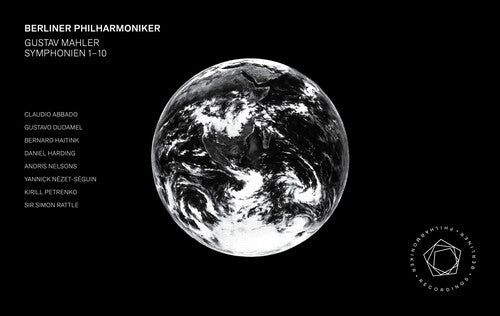
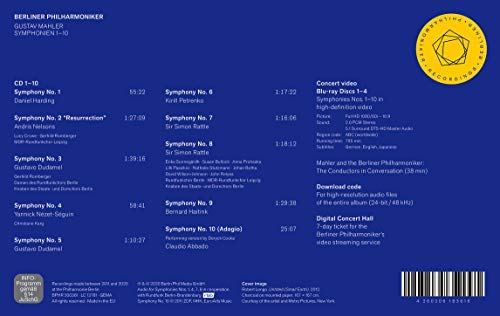
Mahler: Symphonien 1 - 10 / Berliner Philharmoniker
Berlin Philharmoniker
$160.99
$120.99
March 05, 2021
The edition brings together Berliner Philharmoniker recordings from the last ten years. It includes the nine completed symphonies and the Adagio of the Tenth, whose performance under the direction of Claudio Abbado on the 100th anniversary of Mahler’s death is one of the highlights. In addition to chief conductor Kirill Petrenko and his predecessor Sir Simon Rattle, the edition features other outstanding Mahler interpreters closely associated with the orchestra: Gustavo Dudamel, Bernard Haitink, Daniel Harding, Andris Nelsons and Yannick Nézet-Séguin.
{# optional: put hover video/second image here positioned absolute; inset:0 #}
On Sale
Berlin Philharmoniker
Mahler: Symphonien 1 - 10 / Berliner Philharmoniker
The edition brings together Berliner Philharmoniker recordings from the last ten years. It includes the nine completed symphonies and the Adagio of...
Throughout his lifetime, Gustav Mahler's musical imagination got sparked by the Wunderhorn anthology of folk poetry compiled by Achim von Arnim and Clemens Brentano. Whether autonomous lieder or conscripted into symphonic service, Mahler’s Wunderhorn settings represent some of his most exotic, exhilarating, but also visionary music. The Wunderhorn songs evoke and celebrate a lost era but they also prefigure its demise. Mahler captures this ambiguity in uncompromisingly melodious and idyllic, but also satiric, relentless and cruel music. In this soundtrack from the movie WUNDERHORN by Clara Pons, baritone Dietrich Henschel, “a towering figure, physically, intellectually, musically and theatrically” (Herald Scotland) gives a vibrant rendition of 24 Lieder from Gustav Mahler’s “Des Knaben Wunderhorn”, masterly accompanied by the Bochumer Symphoniker under the baton of Steven Sloane.
{# optional: put hover video/second image here positioned absolute; inset:0 #}
The Czech Philharmonic and its Chief Conductor and Music Director Semyon Bychkov present a new recording of Mahler’s Fourth Symphony, laying the foundation of a complete Mahler symphonies cycle to appear on PENTATONE. It will be the label’s first ever full Mahler cycle, and the Czech Philharmonic’s first survey of this extraordinary symphonic opus since their recording under Vacláv Neumann between 1976 and 1982. Although chiefly active in Vienna during the heydays of his career, Mahler was born in what is now the Czech republic, and through this recording project, he returns to his native soil. For conductor Semyon Bychkov, Mahler’s symphonies are all about expressing the polyphony of life, and recording these works is the fulfilment of a life-long fascination. This cycle deliberately starts with the most popular and frequently-played Fourth, famous for its macabre scherzo, soothing slow movement and heavenly finale, sung by soprano Chen Reiss. The Czech Philharmonic is one of the world’s most acclaimed orchestras, with a rich tradition of performing Czech masters and music from Central Europe. Semyon Bychkov has led the greatest orchestras of the world, and is Chief Conductor and Music Director of the Czech Philharmonic as of the 2018/2019 season. Soprano Chen Reiss frequently appears on the biggest opera and concert stages throughout the world. Chen Reiss, Semyon Bychkov and the Czech Philharmonic all make their PENTATONE debut.
REVIEW:
The music of Gustav Mahler may have no greater champions than the Czech Philharmonic Orchestra and Semyon Bychkov, the orchestra's music director since 2018. The Czech Philharmonic's association with Mahler dates back to 1908, when the composer led the orchestra in the premiere of his Symphony No. 7.
Soprano Chen Reiss is a perfect match for the finale. She delivers the light playfulness necessary to depict a child and is equally serious when the mood shifts. The trust and communication between the musicians of the Czech Philharmonic and Bychkov is evident throughout as the orchestra responds to his demands and delivers an exciting and clean reading. One looks forward to further editions in this cycle with anticipation.
-- AllMusic.com (Kevin Finke)
{# optional: put hover video/second image here positioned absolute; inset:0 #}
Mahler: The Complete Symphonies / Feltz, Stuttgart Philharmonic, Dortmund Philharmonic
Dreyer Gaido
$69.99
April 01, 2022
To record such a global oeuvre as Gustav Mahler’s ten symphonies is a truly Herculean task. After 15 years of intensive musical labor, Gabriel Feltz, former participant of the Deutsche Musikrat’s Conductors Forum and now General Music Director of the City of Dortmund, has produced a really impressive complete recording, and is the only German conductor of his generation to have done so. Two orchestras, namely the Stuttgart Philharmonic and the Dortmund Philharmonic, can be heard on this highly acclaimed album cycle. Once again it reveals Feltz’s instinct to focus on the inner core of Mahler’s music, even in these almost over-exuberant works. Fono Forum praised him for his “recordings which are conceived with a cool head”, and the Stuttgarter Nachrichten rejoiced at “a production of unfettered sound contrasts”. In September 2021 the project reached its dazzling conclusion with the release of the stunning 9th symphony and the original, two movement fragment of the 10th symphony.
The complete edition includes a 108-page booklet with comments by the conductor on all works as well as an original contribution by Volker Hagedorn.
Excerpts of select reviews from previously released volumes included in this set:
Feltz's Mahler Fourth certainly shows off the prowess of his relatively unheralded ensemble. The playing is buoyant and alive as well as disciplined.
-- Gramophone
The vocals heard in this performance of the Eighth Symphony are all especially vibrant, and Feltz creates an ideal sense of propulsive energy without ever sounding rushed. There is something special about the earthy, deeply felt playing of these so-called second-tier European orchestras that works wonderfully for Mahler.
-- Fanfare
{# optional: put hover video/second image here positioned absolute; inset:0 #}
Dreyer Gaido
Mahler: The Complete Symphonies / Feltz, Stuttgart Philharmonic, Dortmund Philharmonic
To record such a global oeuvre as Gustav Mahler’s ten symphonies is a truly Herculean task. After 15 years of intensive musical...


 {# optional: put hover video/second image here positioned absolute; inset:0 #}
MDG
{# optional: put hover video/second image here positioned absolute; inset:0 #}
MDG {# optional: put hover video/second image here positioned absolute; inset:0 #}
Naxos
{# optional: put hover video/second image here positioned absolute; inset:0 #}
Naxos {# optional: put hover video/second image here positioned absolute; inset:0 #}
BR Klassik
{# optional: put hover video/second image here positioned absolute; inset:0 #}
BR Klassik {# optional: put hover video/second image here positioned absolute; inset:0 #}
Foghorn Classics
{# optional: put hover video/second image here positioned absolute; inset:0 #}
Foghorn Classics {# optional: put hover video/second image here positioned absolute; inset:0 #}
LAWO Classics
{# optional: put hover video/second image here positioned absolute; inset:0 #}
LAWO Classics {# optional: put hover video/second image here positioned absolute; inset:0 #}
Music and Arts Programs of America
{# optional: put hover video/second image here positioned absolute; inset:0 #}
Music and Arts Programs of America {# optional: put hover video/second image here positioned absolute; inset:0 #}
Ondine
{# optional: put hover video/second image here positioned absolute; inset:0 #}
Ondine {# optional: put hover video/second image here positioned absolute; inset:0 #}
Accentus Music
{# optional: put hover video/second image here positioned absolute; inset:0 #}
Accentus Music {# optional: put hover video/second image here positioned absolute; inset:0 #}
B Records
{# optional: put hover video/second image here positioned absolute; inset:0 #}
B Records {# optional: put hover video/second image here positioned absolute; inset:0 #}
Ars Produktion
{# optional: put hover video/second image here positioned absolute; inset:0 #}
Ars Produktion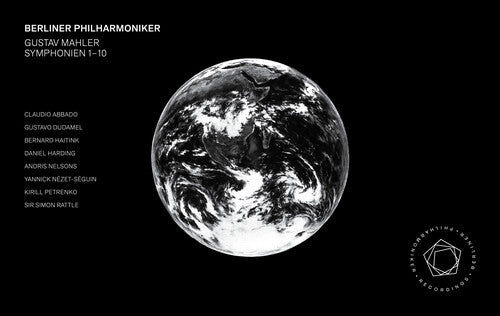 {# optional: put hover video/second image here positioned absolute; inset:0 #}
On SaleBerlin Philharmoniker
{# optional: put hover video/second image here positioned absolute; inset:0 #}
On SaleBerlin Philharmoniker {# optional: put hover video/second image here positioned absolute; inset:0 #}
On SaleAvanti Classic
{# optional: put hover video/second image here positioned absolute; inset:0 #}
On SaleAvanti Classic {# optional: put hover video/second image here positioned absolute; inset:0 #}
PENTATONE
{# optional: put hover video/second image here positioned absolute; inset:0 #}
PENTATONE {# optional: put hover video/second image here positioned absolute; inset:0 #}
Dreyer Gaido
{# optional: put hover video/second image here positioned absolute; inset:0 #}
Dreyer Gaido {# optional: put hover video/second image here positioned absolute; inset:0 #}
Ondine
{# optional: put hover video/second image here positioned absolute; inset:0 #}
Ondine
 {# optional: put hover video/second image here positioned absolute; inset:0 #}


 {# optional: put hover video/second image here positioned absolute; inset:0 #}


 {# optional: put hover video/second image here positioned absolute; inset:0 #}



 {# optional: put hover video/second image here positioned absolute; inset:0 #}


 {# optional: put hover video/second image here positioned absolute; inset:0 #}


 {# optional: put hover video/second image here positioned absolute; inset:0 #}


 {# optional: put hover video/second image here positioned absolute; inset:0 #}


 {# optional: put hover video/second image here positioned absolute; inset:0 #}



 {# optional: put hover video/second image here positioned absolute; inset:0 #}


 {# optional: put hover video/second image here positioned absolute; inset:0 #}


 {# optional: put hover video/second image here positioned absolute; inset:0 #}


 {# optional: put hover video/second image here positioned absolute; inset:0 #}


 {# optional: put hover video/second image here positioned absolute; inset:0 #}


 {# optional: put hover video/second image here positioned absolute; inset:0 #}


 {# optional: put hover video/second image here positioned absolute; inset:0 #}