Gustav Mahler wanted his Second Symphony to exceed any known format - and he also wanted it to tackle the key questions of existence: "Why have you lived? Why have you suffered? Is everything just one enormous, terrible joke? We have to solve these questions in some way if we want to carry on living," said the composer. Similar questions preoccupied him throughout his life, and with a special intensity during his time as an opera conductor in Hamburg. The Second Symphony, also referred to as the "Resurrection Symphony", is a complete expression of Mahler’s existential struggle; both its form and its overpowering sound make this utterly clear. The symphony took several years to compose – it was written between 1888 and 1894. In September 1888, the first movement – which at this point still bore the title "Totenfeier” (“Funeral Rite”) – was already complete. The second and third movements were not written until 1893 and Mahler only completed the entire work in 1894. Like most of Mahler’s symphonies, the work follows a "Per aspera ad astra" pattern (“through difficulties to the stars”). Starting with a funeral march in the main theme of the opening movement - the passing of a life full of vigor, pain, blows of fate, and only a few brief and beautiful moments - the symphony concludes with a triumphant resurrection movement. The premiere of the complete symphony took place on December 13, 1895 in Berlin under Mahler's direction; previously (on March 4 of that year) he had already performed the first three movements. The premiere of the Second Symphony thus took place after that of the Third. The reactions were initially subdued, but today the work ranks as one of the most popular of Mahler’s symphonies.
{# optional: put hover video/second image here positioned absolute; inset:0 #}
BR Klassik
Mahler: Symphony No. 2 / Jansons, Bavarian Radio
Gustav Mahler wanted his Second Symphony to exceed any known format - and he also wanted it to tackle the key questions...
Recording such a world-spanning œuvre as Gustav Mahler's ten symphonies is truly a Herculean task. After 15 years of intensive musical work, Gabriel Feltz is the only German conductor of his generation to present such an impressive complete recording. Two orchestras, the Stuttgart Philharmonic and the Dortmund Philharmonic, are featured in this highly acclaimed album cycle. It reveals once again Feltz's flair for focusing on the essentials of Mahler's music in these exuberant works. The German magazine Fono Forum praised him for "recordings conceived with a cool head," and the Stuttgarter Nachrichten exulted over "a production of unleashed sonic contrasts." In September 2021, the project will come to a brilliant conclusion with the release of the overwhelming 9th Symphony and the original two-movement fragment of the 10th Symphony.
{# optional: put hover video/second image here positioned absolute; inset:0 #}
Mahler: Symphony No. 8 / Chailly, Lucerne Festival Orchestra
Accentus Music
$41.99
May 19, 2017
Gustav Mahler’s 8th Symphony breaks the boundaries of the symphonic form in a world-embracing gesture. Riccardo Chailly is one of the staunchest performers of this work, and therefore it seemed appropriate in many ways that he chose this work for his inaugural concert as Claudio Abbado’s successor and new music director of the Lucerne Festival Orchestra. The artistic statement was combined with a deeply personal conviction: it should be a “tribute to Claudio,” the highly esteemed friend and colleague to whom Chailly, as he emphasizes, owes very much. On 12 August 2016, Claudio Abbado’s unfinished Mahler cycle with the Lucerne Festival Orchestra was completed in a breathtaking performance of the Mahler 8th, simultaneously heralding in a new era in Lucerne.
{# optional: put hover video/second image here positioned absolute; inset:0 #}
Accentus Music
Mahler: Symphony No. 8 / Chailly, Lucerne Festival Orchestra
Gustav Mahler’s 8th Symphony breaks the boundaries of the symphonic form in a world-embracing gesture. Riccardo Chailly is one of the staunchest...
The series of the Mahler Symphonies with the Dusseldorf Symphonic under the baton of Adam Fischer has come to this end with the release of the Symphony No. 6.
Over the last four years Adam Fischer's Mahler recordings grew to a most successful recording project, winning the BBC Music Magazine Award, and the OPUS KLASSIK Trophy in Germany and many splendid and outstanding reviews from around the world.
In the Dusseldorf Tonhalle in late February and early March 2020, we gave Mahler's Sixth Symphony in three live concert performances which we recorded for this CD. This date in the calendar had special significance: the first lockdown period due to the Corona pandemic set in immediately thereafter.
The orchestra was playing in full line-up in front of a full house for the last time for a long while. The mood was ominous: we all felt something was amiss, and the next day everything had to be cancelled. We strongly associate those circumstances with our work on the Sixth, and with the foreboding we felt of a catastrophe that has since ruined the livelihoods of many musician colleagues and deprived us all of a meaningful period in our lives. Mahler's Sixth is always a major event for the orchestra and for the audience. One leaves the concert hall weary and exhausted; time is required to regain one's composure. This symphony requires a gigantic orchestra: here, once more, Mahler was attempting to stretch the boundaries of what was possible in his day.
Not to achieve a mere effect, but simply because he needed such a gigantic instrumental apparatus to express his feelings. The sheer amount of emotions we deal with in this symphony is almost unbearable. The controversial third hammer blow provides a good example: Mahler most certainly crossed it out after a rehearsal, overcome by emotion, afraid of dying. In his very bones he thought and felt that this symphony would prompt his demise.
{# optional: put hover video/second image here positioned absolute; inset:0 #}
Mahler: Symphony No 2 / Chicago Symphony Orchestra, Haitink
CSO Resound
$26.99
November 17, 2009
The most recent release from the Chicago Symphony Orchestra Resound label is an impressive recording of Mahler’s Second Symphony. Based on performances given in late November 2008, this recording preserves the memorable readings CSO principal conductor Bernard Haitink gave this work last year. While comparisons can be awkward, the previous point of reference for CSO audiences was the series of performances by Michael Tilson Thomas in early 2006. At that time Tilson Thomas conducted the work dynamically, but some elements did not emerge readily as, for example, the portamento in the strings in the second movement. Haitink’s approach may be characterized as attentive to the details of the score, and his mastery of those various elements has resulted in an intensely moving interpretation.
While it is possible to distinguish the first three instrumental movements from the last two vocal ones, Haitink fused the five movements into a convincing whole in the concerts he gave in Fall 2008. It may be difficult, at times, to perceive such cohesiveness in a recording, since listeners can stop and start at various points. Nevertheless, the disc captures the style Haitink achieved in live concerts in a fine recording of Mahler’s Second Symphony.
In this recording, it is possible to hear the attention to detail which Haitink brought to those live performances. Such integrity allowed the score to play as intended by the composer, an intention implicit in the various revisions Mahler made after the premiere of the Second in 1894 - particularly the refinements he published in the 1906 edition of the score. From the start Haitink made the work resonate, with the tremolo with which the first movement opens as intense as a climactic moment in an opera. The opening tempo is engaging, and Haitink is able to propel the movement forward by drawing from the orchestra nicely etched articulations at cadences and other structurally important places, as indicated in the score. He broadens the tempo when necessary and, when marked in the score, allows various passages to push forward. The swells of sound Mahler orchestrated have a clear shape, as the sonorities build to fullness and decay naturally. While some of this ambience may be the result of the acoustics of the hall, the tight ensemble of the CSO must be acknowledged as the source of the solid and mature sound in this masterful performance. With the strings at the core, the orchestra offers equally strong sonorities from the woodwinds and brass. At the same time, the percussion deserves recognition for the effective use of the timpani, along with support from the non-tuned instruments. With its immediate and upfront sound in this recording, the softer passages are never lost in the mix; however the tutti passages at the end of the first section of the first movement, to cite one example, can be overwhelming. The passages which conclude the movement reveal an appropriate pacing, with the final gesture bringing the movement to a resounding conclusion.
While some labels issue Mahler’s Second Symphony on a single disc, CSO Resound offers it on two, with the one devoted to the first movement, the piece Mahler once entitled “Todtenfeier,” in the manner of a tone poem Mahler once intended for the piece. The remaining four movements are found on the second of the two CDs. This division also assists in adhering to the marking Mahler put in the score to allow some time before proceeding with the second movement. In the medium of a sound recording, this physical separation supports that kind of stage direction. Likewise, the placement of the second through fifth movements on the second disc helps to prevent any kind of artificial separation of the instrumental movements from the vocal ones.
In contrast to the dramatic effect Haitink brings out in the first movement, the second conveys a delicacy implicit in the score. This emerges not only in the softer, more restrained playing, but in the clean articulations of the accompanying figures. In a similar way, the woodwinds are not just soft, as marked in the score, but seem sotto voce in approach, with a reedy blend prominent in the second section of the movement. With the return of the first area, Haitink’s hesitant gestures helped to distort the expected melodic pattern before the variation proceeds. Even within the delicate shadings of the movement, full sounds of the central section never seemed to be a compromise. Rather, the plaintive effect fits into the sometimes elegiac character of the movement.
The Scherzo in Haitink’s hands is relatively brisk, and the tempos convey a sense of the instrumental idiom of the movement. While the music from Mahler’s Wunderhorn setting Des Antonius von Padua Fischpredigt (“St. Anthony of Padua’s Sermon to the Fish”) is recognizable, Haitink allows the other ideas in the movement to emerge easily from that vocal model. Those brisk tempos set up the middle section of the movement, where the brass fanfare introduces music by Mahler’s deceased colleague Hans Rott, specifically the opening of the Scherzo from the Rott’s Symphony in E. When the thematic content from both Rott’s Scherzo and Mahler’s Wunderhorn song combine near the end of the movement, Haitink sustains the tension of the orchestral outburst sufficiently to allow the remainder of the movement to dissipate naturally.
The quieter sounds and thinner textures at the end of the Scherzo fit nicely into the chamber-music-like sonorities at the beginning of Urlicht, the fourth movement. In this movement Christianne Stotijn uses her full mezzo sound to color the text from Des Knaben Wunderhorn. Her voice blends well with the middle-string sounds, yet is never obscured within the orchestral textures. The calm and paced song gives way, in turn, to the choral Finale, and in this movement Haitink delivers a compelling reading of Mahler’s cantata-like structure which centers on the famous “ Auferstehungs” Ode of Klopstock.
The contrasts found in the score are realized nicely in this recording, with the thunderous opening of the movement serving as a foil for the relatively quiet sounds from the off-stage brass which follow and, later, the development of the opening theme on solo instruments. Haitink restrains the horns in the first part of the movement, with the fanfares from that section quite rich in color, but never as prominent as they are later in the movement. Likewise, the low brass are wonderfully clear and resonant, without overbalancing the ensemble - not only in the reprise of the “O Roschen rot” idea from Urlicht, but also later, Mahler develops motifs around the interval of the tritone. Ultimately, the repose which accompanies the instrumental presentation of the Aufterstehungs-Motif from the third act of Wagner’s Siegfried (the passage in which the character Brünnhilde sings "Ewig war ich, ewig bin ich" -- "I was eternal, I am eternal") serves as a further foil for the various off-stage and solo instruments in the section before the a capella chorus enters.
At this point, it is difficult to recall a more satisfying interpretation of the choral entrance with the words “Aufersteh’n, ja aufersteh’n, wirst du, mein Staub” (“Arise, yes, arise, my dust”), with the vocal textures full and rich. Miah Persson’s soprano solo plays off the choral timbre with ease and assurance as her passages emerge clearly. When Persson interacts with Stotijn in the duet which follows, both women’s voices blend well in conveying not only the meaning of the text but also the emotional pitch of the music. This sets the tone for the choral sections which follow. The full sounds of the male voices are impressive for the textured sonorities they create. Haitink is good to allow the passage “Bereite dich” to resonate, and then to linger on the passages that follow. In such a way, the text and music build to a fitting and appropriate conclusion, which climaxes on the phrase “Sterben werd’ ich um zu leben” (“I perish in order to live”) before the reprise of the text “Aufersteh’n, ja aufersteh’n” (“Arise, yes arise”). Here the combined sounds of the chorus, soloists, and orchestra have free rein in bringing this monumental work to its conclusion, as Mahler creates a vocal tableau as the culmination of his Second Symphony.
The recording does justice to the performances on which it is based, and also points to the affinity between Haitink and the CSO when it comes to interpreting Mahler’s music. This recording is a worthy addition to the already fine set of recordings from these performers, which include the two symphonies which frame this one, the First and Third, as well as Haitink’s incisive recording of Mahler’s Sixth Symphony. Whether these will result in a cycle is less important than the fine interpretations each recording contributes to the legacy of recordings for these works. With this newly issued disc, Haitink and the CSO offer a powerful reading of this important score. It stands apart from others not only for the interpretation Haitink offers but also for the execution of the score by one of the finest orchestras in the world. Available both on CD on a two-disc set and also as a download, this recording bears careful listening for the detailed reading it brings to Mahler’s familiar score.
-- James L Zychowicz, MusicWeb International
{# optional: put hover video/second image here positioned absolute; inset:0 #}
CSO Resound
Mahler: Symphony No 2 / Chicago Symphony Orchestra, Haitink
The most recent release from the Chicago Symphony Orchestra Resound label is an impressive recording of Mahler’s Second Symphony. Based on performances...
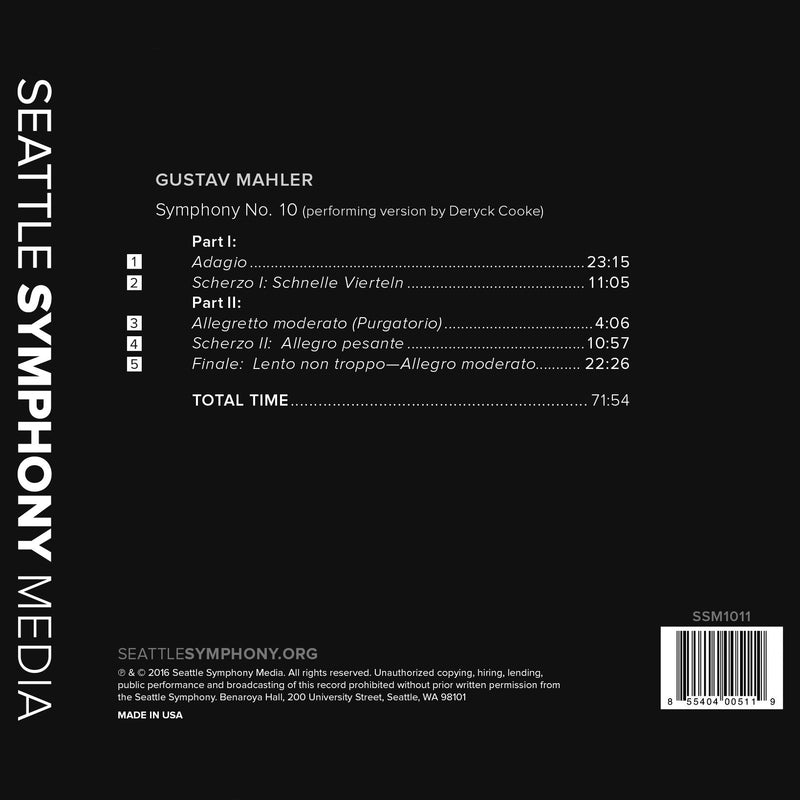
This terrific performance of the Cooke edition of Mahler’s Tenth is a rather swift performance, just 71 minutes, and certainly one of the best–right up there with reference recordings by Gielen (Hänssler/SWR), Sanderling (Berlin Classics) and Chailly (Decca).
I do have some reservations: the opening Adagio could have more gravitas at a slightly slower basic tempo, especially for it’s second thematic group, and the fourth movement doesn’t quite convince. It comes across as rather scrambled compared, say, to Gielen. Also, if you’re going to start the finale with the same muffled drum stroke that ends previous movement, why not play the first one softly, and launch the finale with a startling, Mahlerian bang?
Still, what this performance has all the way through is conviction: a total confidence in the music’s cogency and ultimate direction. It doesn’t sound threadbare or sketchy, even at the finale’s big climax, the optimal shape of which no arranger or conductor has quite figured out. The first scherzo bounces along brilliantly; the central Purgatorio flows with sinister grace; and most importantly, the last seven or eight minutes of the finale never drag, never turn static. The music’s last gasp relaxes in a way that’s truly fulfilling.
Dausgaard also has the orchestra playing with tremendous flair and virtuosity. They make the music sound almost easy (in a good way). You’d never know that this performance was captured live, before a dead-silent audience. The sonics too are excellent. So: a recording that sheds new light on the work, and reflects proudly on all concerned.
– ClassicsToday (David Hurwitz)
{# optional: put hover video/second image here positioned absolute; inset:0 #}
The series of the complete Mahler Symphonies with the Düsseldorf Symphonic under the baton of Ádám Fischer continues here with the release of the Symphony No. 9. Over the last two years Ádám Fischer’s Mahler recordings grew to a most successful recording project, winning the BBC Music Magazine Award, and the OPUS KLASSIK Trophy in Germany. Adam Fischer: "Mahler wrote his Ninth symphony in 1909, and it is about death. To be more precise it is about dying. And I know of no other language apart from German in which the words 'death' (Tod) and 'dying' have entirely different etymologies."
{# optional: put hover video/second image here positioned absolute; inset:0 #}
In setting out to record the complete symphonies of Gustav Mahler with the Dusseldorfer Symphoniker, Maestro Adam Fischer hoped to create something special with the ensemble. He hoped that conductor and musicians would mutually inspire one another, not creating Fischer’s Mahler, but rather “our” Mahler. Fischer writes of this process: “Whenever I conduct Mahler, I attempt to find a way to formulate each symphony’s world and its emotional content in a way that I can apprehend. Out of the music, I spin stories for myself… It is the result of a long process, in the course of which I ensure that the scores become my innermost conviction. In my view, this is the conductor’s task. It is exactly the opposite of “work-to-rule.”
-----
REVIEWS:
The Düsseldorf Symphony plays with skill and precision, keeping together without any signs of fatigue and playing with the commitment and passionate intensity of the world’s great Mahler orchestras.
– All Music Guide
Adam Fischer leads a completely convincing interpretation of the symphony. The truculent first movement flows with unusual coherence; the two Nachtmusiks are perfectly paced, the creepy scherzo has a nicely slithery transparency of texture, and the finale rises to an aptly raucous final climax.
– ClassicsToday.com
{# optional: put hover video/second image here positioned absolute; inset:0 #}
Mahler: Symphonies no 3, 6 & 10 / Adler, Vienna SO
Sony Masterworks
$36.99
June 28, 2011
Charles Adler, a student of Mahler himself, provides emotional truth and scrupulous attention to dynamics in this pioneering first ever commercial recording of Mahler's 6th Symphony.
These are 'historic recordings', but you won't have to listen through a sea of crackles to appreciate them. It is astonishing to consider that Mahler's Sixth, long recognized as one of the century's seminal works, had to wait until 1952 for this, its first commercial recording. Its reappearance reminds us just how recent a phenomenon is the Mahler boom. The conductor may be unfamiliar. A refugee from the Nazis, Charles Adler settled in the USA and married into money, using it to subsidize his own record label, SPA. Which is not to decry the venture: SPA issued records of many new and unknown works, while Adler's own musical credentials were impressive enough — he had been a pupil of Felix Mottl and Mahler himself. That said, he wasn't a man to worry too much about fraudulent marketing. On the original LPs, the Vienna Symphony Orchestra masqueraded variously as the 'Vienna Orchestra' and 'Vienna Philharmonia'. Interested readers should note that an article in the winter issue of Gramophone's sister publication, ICRC, provides further useful background. Whatever may be wrong with Adler's Mahler performances, their emotional truth and scrupulous attention to dynamics goes a long way to compensate for indifferent intonation and some rather rough-and-ready orchestral playing. The timpani are the most persistent offenders and brass tuning often slips under pressure.
Adler's pioneering Sixth is said to have been set down in only 11 hours. Writing in these pages, Deryck Cooke was much taken with it, but then he always saw the first movement as a world-weary trudge rather than the brutal, authoritarian march conceived by Bernstein and emulated by most subsequent interpreters (including Karajan whose own recording is due for reissue). Adler is nothing if not direct. Having chosen his tempo, he sticks to it right through the chorale, the 'Alma' theme and even (no exposition repeat) the pastoral interlude. Mahler warns against undue 'dragging' but Adler's cowbells are anything but distant and quiet - the herd is close by and frisky. By contrast, the beginning of the coda is surely too slow. The Andante is placed second (the documentation by Gerald Fox of the Gustav Mahler Society of New York - is exceptionally strong on the composer's vacillations regarding the order of the middle movements). Cooke thought Adler sluggish here and the deliberate speed does rather draw attention to the thinness of the string sound. Notated portamentos, here as elsewhere, are too reticent. On the other hand, the narrow-bore horn produces a slightly 'stopped' tone which seems just right in context: this is clearly some sort of Viennese orchestra. Sadly, brass intonation again slips at the climax. The Scherzo fares least well. Timpani tuning is fairly wretched, and, despite a slowish tempo, orchestral ensemble and intonation leave much to be desired. Adler's finale is also on the slow side (the whole movement lasts over 33 minutes) but convincingly so, as if recognizing at the outset that the battle has been lost. It's a pity that the second hammer blow (18'55") wasn't retaken as the tam-tam is late. But the closing page is remarkable, the fate motif hammered out in very measured quavers, the finality of the strings' pizzicato emphasized by a lengthy, rhetorical pause.
At which point you may need to sprint across to your CD player to avoid launching into the opening of the Third Symphony. Back in August 1962 (its first release in the UK), Cooke was less enthusiastic about this, eagerly anticipating Bernstein's more professional CBS set. On its own terms, however, I found myself enjoying Adler's reading a good deal. The orchestral playing is better, presumably on account of the symphony being easier to play, and Adler's direct and unaffected approach seems well suited to the vernal, 'outdoors' mood of the work. The second and third movements respond particularly well to his unfussy direction, though again intonation can be poor, especially noticeable when flutes, E flat clarinets or horns are supporting the 'posthorn'. The mezzo gives a notably eloquent account of the fourth movement. Inevitably, there are weaknesses too. Cooke pointed out the excruciating wrong entry by the second violins in the finale (9.01ff. -why was this allowed to stand?) and the symphony's peroration is torpedoed by the sour tuning of the wind choir and a curiously abrupt last note. Adler is not the only conductor unsure how to pace the first movement. He has summer march in at a noticeably slower tempo (against Mahler's instructions) at 2304" and the transition to the recapitulation is awkward. The Fafner-like glissandos in horn and bassoon at the outset are strongly characterized, but those seismic runs in the basses are nowhere near distinct enough. Tension is allowed to dissipate.
Conifer find room for Adler's textually suspect torso of the Tenth (the first movement plus the "Purgatorio"). The violas cope well in the rarefied atmosphere of the opening, but the violins struggle later on. For once, Adler and/or his recording team do not make quite enough of dynamic markings and you may feel that a basic tempo is never adequately established. Still, the closing pages are as affecting as ever, notwithstanding a peculiarly 'twangy' and close-miked harp. All in all, this is a set of undoubted historical interest, if not quite on a par with the 'classic' Mahler recordings of, say, Bruno Walter. Those constitute essential purchases for the general collector. Adler's Mahler on the other hand will appeal primarily to Mahler completists who will scarcely believe their luck. Despite the difficulties encountered in preparing the present release, the remastering has been well handled and the notes are excellent.
-- Gramophone [2/1998]
{# optional: put hover video/second image here positioned absolute; inset:0 #}
Sony Masterworks
Mahler: Symphonies no 3, 6 & 10 / Adler, Vienna SO
Charles Adler, a student of Mahler himself, provides emotional truth and scrupulous attention to dynamics in this pioneering first ever commercial recording...
Albert Camus once wrote ‘when I describe what the catastrophe of modern man looks like, music comes into my mind – the music of Gustav Mahler’. If asked to specify a particular work, it is quite possible that Camus would have proposed Symphony No. 6 in A minor – the symphony that Bruno Walter claimed portrayed ‘a terrifying, hopeless darkness, without a human sound’. Nevertheless, the period during which Mahler wrote his Sixth was one of the most successful and happiest of his life – prior to any marital difficulties, at the time of the birth of his second daughter Anna, his professional reputation growing. Alma Mahler, in her memoirs, suggested that the symphony was in fact predicting instances of future distress in the composer’s own life, and she and various commentators have proposed various interpretations of different elements. Most famous of these are possibly the hammer strokes in the Finale, falling, according to Alma, like ‘blows of fate’ on the ‘hero’ of the symphony. But Osmo Vänskä has a reputation for engaging with even the most iconic scores at face value, avoiding preconceived ideas and ‘time-honored’ traditions.
His and the Minnesota Orchestra’s recording of Mahler’s Sixth follows upon the 2017 release of the composer’s Fifth Symphony. Nominated to a 2018 Grammy Award, that interpretation has been described as ‘at once committed and detached, intense and transcendentally timeless’ (Norman Lebrecht) and ‘an exceptional performance that promises great things to come’ (allmusic.com).
REVIEWS:
The Finnish maestro opts for the revised order of middle movements, the searing andante preceding the scherzo, with its “old fatherly”, Ländler-like trio. The Minnesotans shine in the eerie sonorities of the finale, building to another allegro energico, but ending, movingly, in the minor tonality.
– Sunday Times (UK)
The interpretation here is intensely focused and utterly compelling, and the playing is impassioned and unnervingly vivid in the multichannel format, so listeners who loved the exceptional analog versions by Solti and Tennstedt or modern digital recordings by Abbado, Tilson Thomas, and Pappano can be sure that Vänskä's audiophile version ranks just as high in quality. The integrity of the performance and the expressive heights that are achieved carry the day and make Vänskä's recording essential for Mahler buffs.
– All Music Guide
{# optional: put hover video/second image here positioned absolute; inset:0 #}


 {# optional: put hover video/second image here positioned absolute; inset:0 #}
Sony Masterworks
{# optional: put hover video/second image here positioned absolute; inset:0 #}
Sony Masterworks {# optional: put hover video/second image here positioned absolute; inset:0 #}
BR Klassik
{# optional: put hover video/second image here positioned absolute; inset:0 #}
BR Klassik {# optional: put hover video/second image here positioned absolute; inset:0 #}
Dreyer Gaido
{# optional: put hover video/second image here positioned absolute; inset:0 #}
Dreyer Gaido {# optional: put hover video/second image here positioned absolute; inset:0 #}
Accentus Music
{# optional: put hover video/second image here positioned absolute; inset:0 #}
Accentus Music {# optional: put hover video/second image here positioned absolute; inset:0 #}
On SaleCAvi-music
{# optional: put hover video/second image here positioned absolute; inset:0 #}
On SaleCAvi-music {# optional: put hover video/second image here positioned absolute; inset:0 #}
CBS Masterworks
{# optional: put hover video/second image here positioned absolute; inset:0 #}
CBS Masterworks {# optional: put hover video/second image here positioned absolute; inset:0 #}
RCA
{# optional: put hover video/second image here positioned absolute; inset:0 #}
RCA {# optional: put hover video/second image here positioned absolute; inset:0 #}
CSO Resound
{# optional: put hover video/second image here positioned absolute; inset:0 #}
CSO Resound {# optional: put hover video/second image here positioned absolute; inset:0 #}
RCA
{# optional: put hover video/second image here positioned absolute; inset:0 #}
RCA {# optional: put hover video/second image here positioned absolute; inset:0 #}
RCA
{# optional: put hover video/second image here positioned absolute; inset:0 #}
RCA {# optional: put hover video/second image here positioned absolute; inset:0 #}
Seattle Symphony Media
{# optional: put hover video/second image here positioned absolute; inset:0 #}
Seattle Symphony Media {# optional: put hover video/second image here positioned absolute; inset:0 #}
On SaleCAvi-music
{# optional: put hover video/second image here positioned absolute; inset:0 #}
On SaleCAvi-music {# optional: put hover video/second image here positioned absolute; inset:0 #}
CAvi-music
{# optional: put hover video/second image here positioned absolute; inset:0 #}
CAvi-music {# optional: put hover video/second image here positioned absolute; inset:0 #}
Sony Masterworks
{# optional: put hover video/second image here positioned absolute; inset:0 #}
Sony Masterworks {# optional: put hover video/second image here positioned absolute; inset:0 #}
On SaleBIS
{# optional: put hover video/second image here positioned absolute; inset:0 #}
On SaleBIS
 {# optional: put hover video/second image here positioned absolute; inset:0 #}


 {# optional: put hover video/second image here positioned absolute; inset:0 #}


 {# optional: put hover video/second image here positioned absolute; inset:0 #}


 {# optional: put hover video/second image here positioned absolute; inset:0 #}


 {# optional: put hover video/second image here positioned absolute; inset:0 #}

 {# optional: put hover video/second image here positioned absolute; inset:0 #}

 {# optional: put hover video/second image here positioned absolute; inset:0 #}


 {# optional: put hover video/second image here positioned absolute; inset:0 #}

 {# optional: put hover video/second image here positioned absolute; inset:0 #}

 {# optional: put hover video/second image here positioned absolute; inset:0 #}



 {# optional: put hover video/second image here positioned absolute; inset:0 #}


 {# optional: put hover video/second image here positioned absolute; inset:0 #}


 {# optional: put hover video/second image here positioned absolute; inset:0 #}

 {# optional: put hover video/second image here positioned absolute; inset:0 #}


 {# optional: put hover video/second image here positioned absolute; inset:0 #}