Henri Dutilleux
20 products
Weinberg & Dutilleux: Cello Concertos / Moreau, Poga, WDR Sinfonieorchester
Belcea Quartet - The Complete Warner Classics Edition
Today one of the most highly respected string quartets, the Belcea were established in 1994 at the Royal College of Music in London and studied with the Chilingirian, the Amadeus, and later the Alban Berg quartets. Today one of the most highly respected string quartets, the Belcea were established in 1994 at the Royal College of Music in London and studied with the Chilingirian, the Amadeus, and later the Alban Berg quartets. They recorded for EMI Classics across nearly a decade, between 2000 and 2009, bringing about tremendous versions of quartets by Schubert, Britten, Bartók, and Mozart, to name a few.
"The Belcea Quartet throw every fibre of their beings into the most vivid projection of the masterpieces they undertake." - The Independent "These recordings form a crucial part of our life as a quartet and we hope that over the ensuing years they haven't lost their freshness and sense of adventure." - Krzysztof Chorzelski, violist of the Belcea Quartet
MUSIQUE DE CHAMBRE
CENTURY FRENCH: DUTILLEUX
Dutilleux: Music for Orchestra / Morlot, Seattle Symphony
VIOLIN CTO
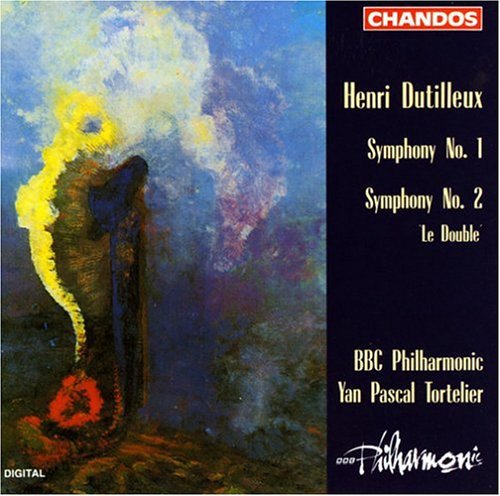
Dutilleux: Symphonies 1 & 2 / Tortelier, Bbc Philharmonic
Recorded in: New Broadcasting House, Manchester 16-17 December 1992 Producer(s) Ralph Couzens Sound Engineer(s) Don Hartridge
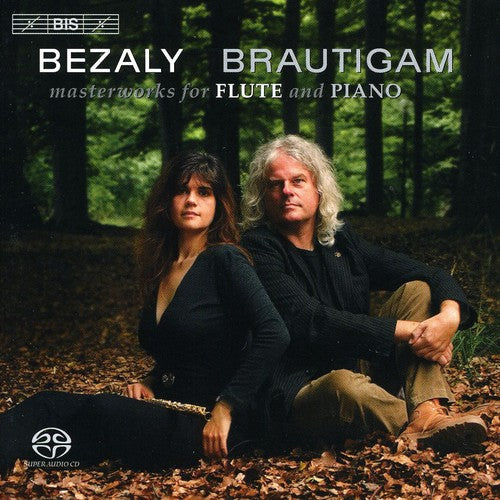
Masterworks for Flute and Piano / Bezaly, Brautigam
Recently released recordings of Mozart's concertos, of three contemporary works for flute and orchestra and of a programme for solo flute have earned Sharon Bezaly epithets such as 'God's gift to the flute', 'an amazingly talented performer' and 'a First Lady among equals'. Here she has turned to some of the central works for flute and piano, and with Ronald Brautigam, familiar from many BIS releases, gives her interpretations of three master-pieces of the 1940s flanking Schubert's great Trockne Blumen variations, composed some 120 years earlier. Though written in the span of two years, Prokofiev's Sonata, Dutilleux's Sonatine and Jolivet's Chant de Linos each show the flute in a different light. Prokofiev was preoccupied with clarity of style and found the instrument a perfect vehicle: 'The sonata should be played with a bright, transparent, classical tone', he wrote. (David Oistrakh later convinced the composer to create a violin version, which quickly became very popular.) A distinctly different approach was taken by Jolivet, who wrote his Chant inspired by the ancient Greek concept of 'linos', a ritual lament punctuated by cries and dancing. It is thus based on musical material associated with Greek modes and explores the extremes of expression. Dutilleux, finally, composed his Sonatine as a set piece for the flute competitions of the Paris Conservatoire. But these academic-sounding origins are belied by the by turns atmospheric and spirited writing, so typical of the multi-faceted Dutilleux. Sharon Bezaly and Ronald Brautigam have previously collaborated on BIS-CD-1439, with violist Nobuko Imai. Upon its release this disc received a number of distinctions and highly favourable reviews, not least because of the superb ensemble playing.
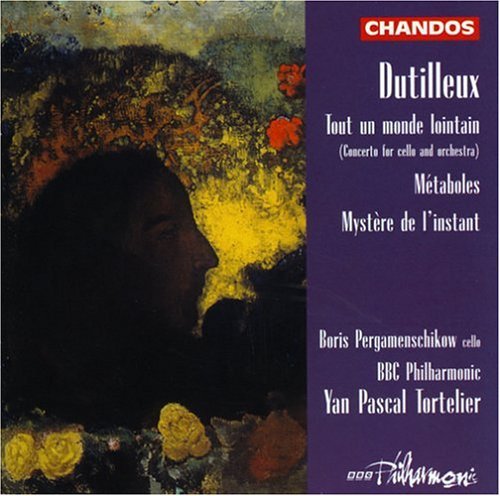
CONCERTOS METABOLES MYSTERE
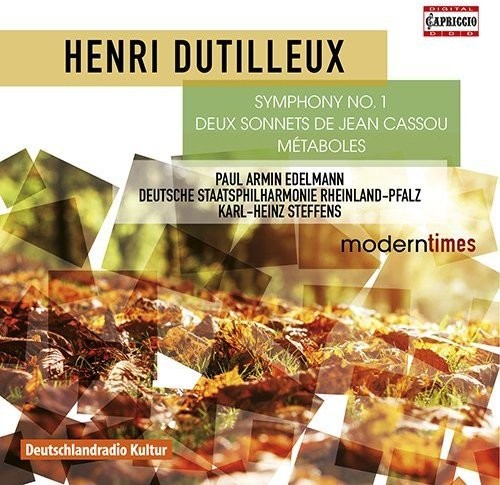
Dutilleux: Symphony No. 1, 2 Sonnets de Jean Cassou & Métabo
Henri Dutilleux, named the “van Gogh of classical music” (Die Welt), was a maverick, a dreamy and stubborn man searching for his own style between tradition and modernism, oriented toward his great paragons Paul Dukas, Maurice Ravel and Albert Roussel. “I compose colors,” he would always point out, admitting to his great reverence for van Gogh. His colorful music finally found for him much late success, especially the orchestral works. This CD offers the rarely performed First Symphony, two almost unknown orchestral songs set to poems of Jean Cassou and finally the far better known Métaboles.
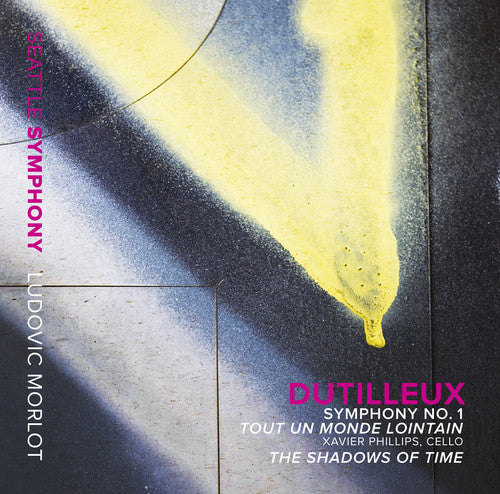
Dutilleux: Symphony No. 1, Tout un monde lointain
Henri Dutilleux' Symphony No. 1 is an early work and the composer’s first piece for orchestra. It is in four movements, but these do not all conform to traditional types. (SSM)
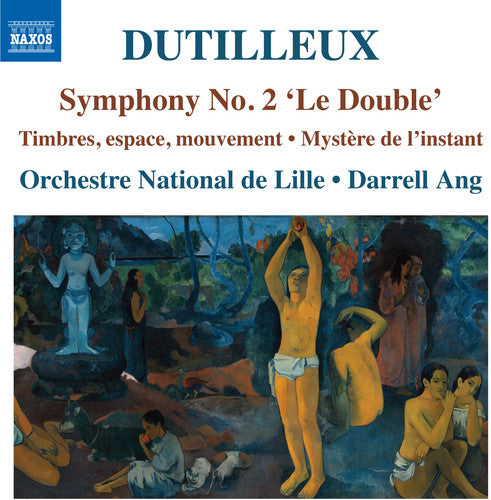
Dutilleux: Symphony No. 2 "Le double" / Ang, Orchestre National de Lille
Henri Dutilleaux's perfectionism resulted in a distinctive and individual musical language of rare poetry and invention. The interplay of stereophonic and polyrhythmic effects and jazzy brass writing in Symphony No. 2 "Le Double" forms, in the composer's own words, 'a musical play of mirrors and of contrasting colours', while Timbres, espaces, mouvement is Dutilleux's response to Vincent van Gogh's Starry Night, a 'longing for the infinity of nature'. The series of snapshots in Mystère de l'instant evokes fleeting and almost magical moments in time, its cumulative power indicative of a consummate composer at the height of his powers.
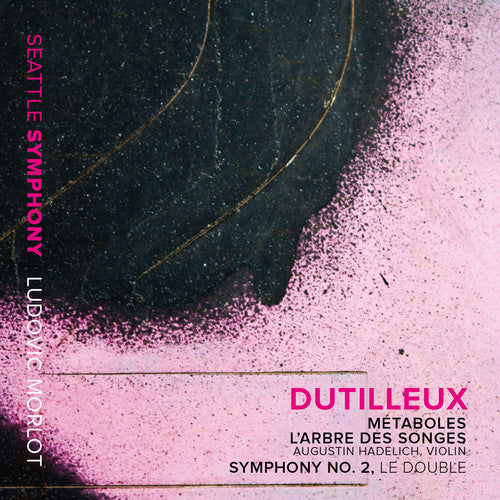
Dutilleux: Metaboles; L'arbre Des Songes; Symphony No. 2, Le Double
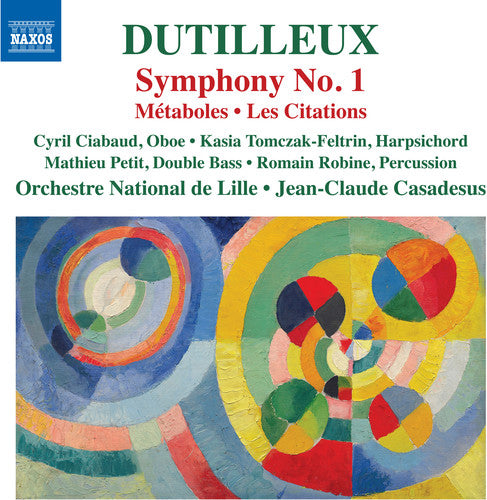
Dutilleux: Symphony No. 1, Metaboles, Les citations / Casadesus, Lille National Orchestra
A fiercely independent composer, Henri Dutilleux wrote music that is refined, colorful and scrupulously crafted. Symphony No 1, his first purely orchestral score, established his international reputation. Structurally unconventional- it opens, unusually, with a passacaglia- it illustrates his principle of ‘progressive growth’ through its sustained lyricism and towering, chorale-like statements. Metaboles was inspired by the virtuosity of the woodwind section of George Szell’s Cleveland Orchestra. Distinctive instrumentation for each movement allows for deep expression, jazzy rhythms and moments of irony. The enigmatic diptych Les Citations quotes from fellow composers Benjamin Britten and Jehan Alain. After over 40 years at the head of the Orchestre National de Lille (ONL), of which he was the founder, Jean-Claude Casadesus enjoys an international career that has brought seasons in Germany, Russia, Japan, Latvia, and in Lille. His 30 albums with the orchestra have won critical and public acclaim and as a guest conductor he has appeared in Moscow, Singapore, Montreal, Baltimore, Seoul, St. Petersburg and Berlin. He is an enthusiastic champion of contemporary music and set up residences for composers with the Lille orchestra.
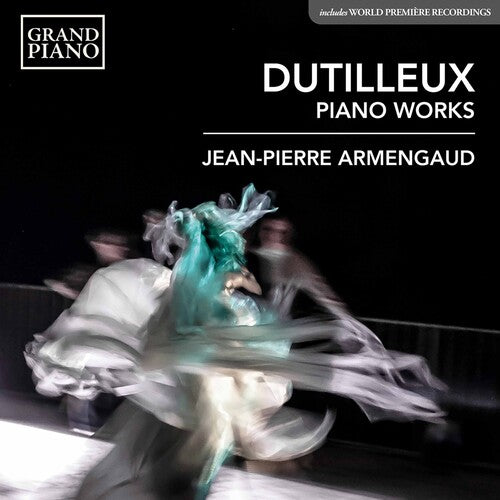
Dutilleux: Piano Works / Armengaud
The music in this album spans a forty-year period from 1948 to 1988 and reflects Dutilleux’s stylistic development as a composer. He considered the Sonata to be the first main work in his catalogue and it represents a turning away from tradition and embraces the transformative musical explorations of the day. The Three Préludes are pieces of concentrated atmospheres, ‘a kind of study of timbres’, in the composer’s words, and each are dedicated to a renowned pianist: No. 1 to Arthur Rubinstein, No. 2 to Claude Helffer, and No. 3 to Eugene Istomin. Dutilleux’s lively music for the ballet Le Loup (‘The Wolf’) is heard here in a première recording of the original piano solo version.
REVIEW:
The pianist here is the veteran Jean-Pierre Armengaud, who has recorded a great deal of French piano music and also works as a musicologist. He studied under Geneviève Joy and was also given advice by Dutilleux and, not surprisingly, his performance is much like hers. If it sounds rather more full-blooded that may well be because the excellent new recording is rather better than that provided for Joy in her own recording of 1988 on Erato. Dutilleux also approved of his performances of the Prèludes. His performance of the piano version of Le Loup is sparkling and convincing and sounds like idiomatic piano music. The sleeve notes, in English and French are really helpful and this is a valuable issue.
-- MusicWeb International
Dutilleux: Orchestral Works / Morlot, Seattle Symphony
-----
REVIEW:
The defining recording project of Ludovic Morlot’s tenure as music director in Seattle, this luscious three-disc set is a compendium of the orchestral canvases of Henri Dutilleux, whose centenary has been celebrated this year. It’s all played with considerable refinement, but there are particularly special results when the poised violinist Augustin Hadelich joins in for “L’arbre des songes” and “Sur le même accord.”
– New York Times (David Allen)
Laureate Series, Piano - Dutilleux / John Chen
DUTILLEUX Piano Sonata. 3 Préludes. Au gré des ondes. Bergerie. Blackbird. Tous les chemins . . . mènent à Rome. Résonances. Petit air à dormir debout. Mini-prélude en éventail • John Chen (pn) • NAXOS 8.557823 (61:23)
In 2004, Kuala Lumpa-born pianist John Chen became the youngest-ever winner of the Sydney International Piano Competition. On the evidence of this disc, it is easy to share the jury’s enthusiasm for this young man. His choice of repertoire is at once brave and praiseworthy; the complete piano music of Henri Dutilleux fits neatly on one disc and acts as a reminder of the stature of this fine composer.
The 1948 Piano Sonata is surely Dutilleux’s most famous work for this instrument. John Ogdon made a famous recording (apparently currently unavailable and last seen on a hard to find EMI Matrix disc) and more recently the highly talented Claire-Marie Le Guay recorded her thoughts on the score. Chen finds the perfect atmosphere for the opening, conjuring up an explicitlly French world related to but not derivative of Messiaen. Chen finds much sense of play in the capricious opening section. His light touch has much to do with this; in fact, he owns a wide tonal range that enables him to bring real depth to the more sonorous, contrastive sections. The ultra-gentle second movement, entitled “Lied” by the composer, rises inevitably to a climax of cut crystal clarity. Chen brings out a processional quality that seems most apt, while the finale reveals Chen’s superb fingerwork (tremendous Debussian roulades here).
The first of the Trois Préludes seems again to make explicit reference to the rarefied world of Debussy; the second, even more so. This is truly beautiful music, and Chen holds back interpretative intervention just enough to enable the music to speak naturally while still adding his own stamp to the score. The third Prélude was written over a decade later than the other two and at nearly eight minutes is by far the most substantial. Exploratory in nature but nevertheless clearly highly structured, it leaves a lasting impression.
Au gré des ondes of 1946 is a sequence of six movements taken from Dutilleux’s work at Radio France to provide interludes between programs. There is a simplicity here that is utterly charming (“Prélude en berceuse”), pure (“Hommage à Bach”) and even almost jazzy (“Mouvement perpétuel”). The remainder of the disc is devoted to miniatures, of which the 1965 Résonances is probably the most important for the composer’s development in its exploration of sonority.
This is a significant disc in two ways. First, the complete Dutilleux piano music at bargain price in fine performances and recording is a must for all fans of this composer; second, here we have an introduction to a pianist who is clearly a major talent.
FANFARE: Colin Clarke
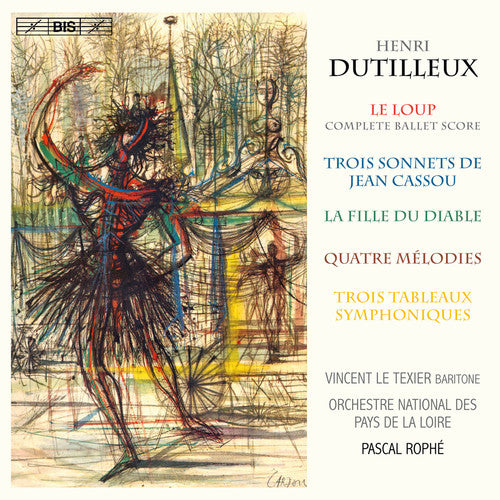
Dutilleux: Le loup / Rophe, Orchestre national des Pays de la Loire
Reviews:
This music might play it safe harmonically but Dutilleux splashes orchestral timbres around with the abandon of an action painter, as blood-curdling swoops from an ondes martenot add local colour. Pascal Rophé and his Orchestra National des Pays de la Loire take these scores at face value, carving through notes with flamboyant cliffhanger urgency.
– Gramophone
Dutilleux shows his attraction towards Alban Berg's orchestral colors, and the playing throughout the disc is superb, using a vast range of dynamics.
– BBC Music Magazine
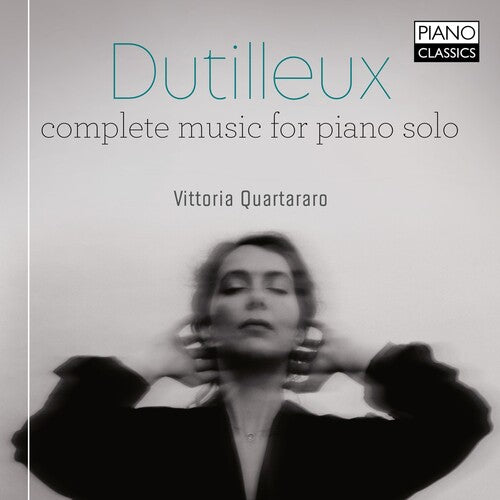
Dutilleux: Complete Music for Piano Solo / Quartararo
| Though Dutilleux began composing at an early age and undertook the rigorous course of study at the Paris Conservatoire, culminating in the much sought-after Prix de Rome in 1938 with a cantata, he regarded his Piano Sonata of 1946-8 as an Opus 1. This attitude was characteristic of a remarkably fastidious and self-critical composer who dedicated his life to composition –and the nurturing of young composers –and yet whose published output is influential out of all proportion to its size. He wrote the sonata for the pianist Geneviève Joy whom he married in 1946. The musical language is as much modal as tonal, owing as much to Bartók’s methods of musical organization and the 19th-century Germanic concept of the large-scale masterpiece as contemporary developments in harmony. Everything he wrote seems to repudiate the commonly held idea that French music is essentially frivolous and charming, but Dutilleux’s music can smile and relax, too: while working at French radio he composed a series of short pastiche pieces as air-filler, later compiling them as a suite, Au gré des ondes. Blackbird is Dutilleux’s sole trespass on the territory of his contemporary Messiaen: knowingly brief and non-naturalistic by comparison, a portrait of the blackbird’s soul more than its song. The Debussian heritage of painting on the piano comes to the fore on the set of Three Preludes composed between 1973 and 1988, while Resonances is a study in timbre built with the composer’s individual technique of pivot notes and chords. As Vittoria Quartararo observes in her booklet introduction, ‘the music of Dutilleux often seems to shift towards a visual level. While the verticality of piano chords can resonate like light does on a black canvas, one’s gaze becomes more horizontal, distant, and at times visionary, detecting the reverberation of a sound transformed in liquid crystal.’ |
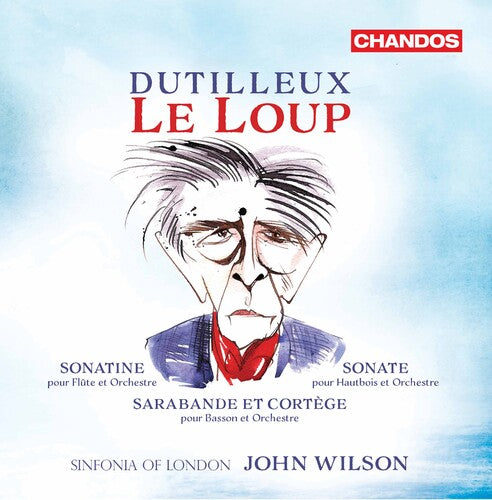
Dutilleux: Le Loup / Wilson, Sinfonia of London
Following the success of their previous album, English Music for Strings, John Wilson and his Sinfonia of London turn their attention to the music of Henri Dutilleux. His ballet Le Loup was composed as a commission for Roland Petit’s dance company and premièred in Paris in March 1953. Rarely recorded – this is the first recording by a non-French orchestra – the work unfolds in three tableaux and tells a convoluted tale of a bridegroom who jilts his bride (to run away with a gypsy) by persuading her that he has been changed into a wolf. Over time she discovers that the wolf is real, but her feelings turn from terror to love and when the alarmed villagers hunt the wolf, she defends him and dies at his side. The album is completed by three world première recordings of new orchestrations (by Kenneth Hesketh) of wind solos written for the Paris Conservatoire in the 1940s. Both the Sarabande et Cortège and Sonate pour hautbois are virtuosic tours de force for their soloists, as is the Sonatine pour flûte, which displays the lyricism, agility, and sparkling incisive qualities of the flute in what became Dutilleux’s most-performed work.