Iannis Xenakis
15 products
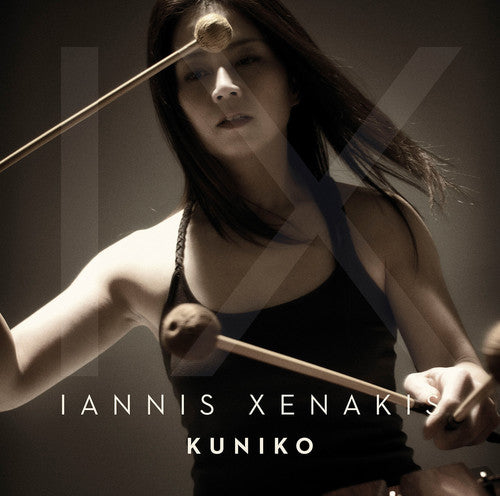
Xenakis: IX / Kuniko
Since becoming a percussion soloist, Rebonds is a piece that KUNIKO has been playing and performing throughout her entire career. After hearing this performance of Xenakis' popular piece, renowned percussionist Sylvio Gualda congratulated KUNIKO on her ‘marvellous' interpretation.
V10: IANNIS XENAKIS
Xenakis: Orchestral Works / Tamayo, Hague Residentie Orchestra
The orchestral works on this recording include two of Xenakis’ adventurous spatialized works along with Metastaseis, the work with which he emerged onto the international avant-garde scene. Metastaseis A is the original version, which is better known by its revision, Metastaseis B. The revision was the result of conductor Hermann Scherchen, who was critical of the size of the score and of elements of its instrumentation. He agreed to perform it if certain revisions were made. Ultimately, the première of the revised version, Metastaseis B, would be conducted by Hans Rosbaud at Donaueschingen in 1955, where it created a sensation. The public would have to wait until after the composer’s death before hearing the original version of Metastaseis A, which took place in 2008 in Torino under the direction of Arturo Tamayo, who conducts the work in this recording, its first commercial release. Xenakis explained that the sound world of Metastaseis was inspired by his experiences as a member of the student Resistance during the Nazi occupation of Greece. In Nomos Gamma, the listener is struck by the increased size of the percussion section, which rings the orchestra and audience, lending a kind of ritual brutality to the piece.
V9: IANNIS XENAKIS
V11: IANNIS XENAKIS
V14: IANNIS XENAKIS
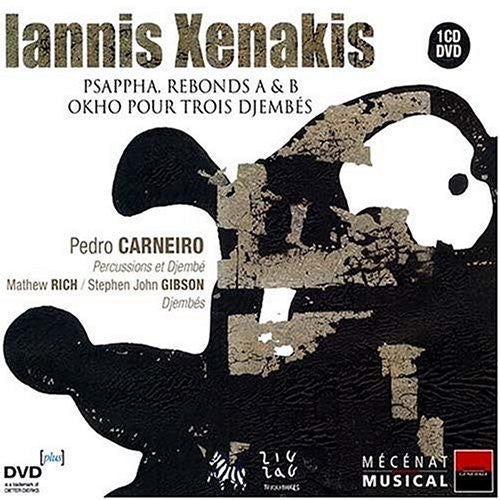
Xenakis: Psappha - Rebonds - Okho
V8: IANNIS XENAKIS
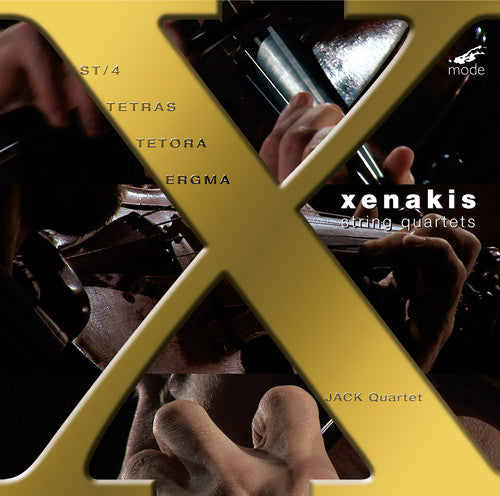
Xenakis Edition Vol 10 - Complete String Quartets / Jack String Quartet
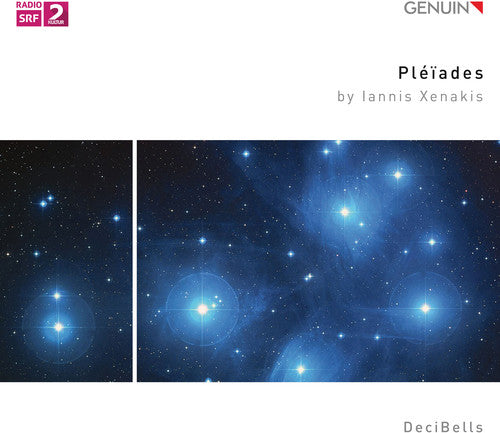
Xenakis: Pleiades / DeciBells
Iannis Xenakis invented his own instruments for Les Pléiades, a suggestive, interstellar work for percussion ensemble. And once again the Ensemble DeciBells commissioned their very own grandiose musical instruments for their outstanding recording of this work. The musicians led by Basel solo timpanist Domenico Melchiorre play the shimmering music, which fuses the boundaries between individual instrument, ensemble, and listener on a dizzying scale: subtle and yet with nerve! Percussion ensemble DeciBells is closely associated with new music, and regularly works on projects with contemporary composers. The ensemble’s roots are in Basel, however, concert tours have taken them to Asia and throughout Europe. DeciBells is Adrian Romaniuc, David Gurtner, Robin Fourmeau, Sakiko Yasui, Szilard Buti, Till Lingenberg, and Domenico Melchiorre.
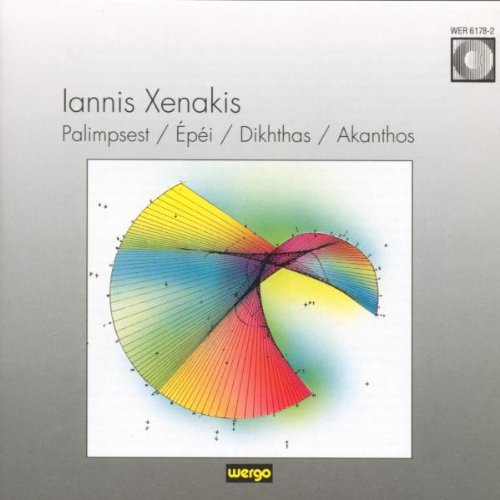
Xenakis: Palimpsest, Épéi, Dikhthas, Akanthos
Xenakis - Ensemble Music Vol 1 / Charles Z. Bornstein, St-x
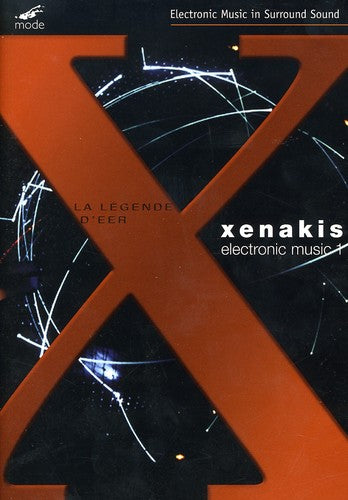
Xenakis: Electronic Music 1 - The Legend Of Eer
Disques Montaigne has already released the original tape piece on MO 782058. This DVD is the first chance we have to experience something of the full piece, through the visuals of Bruno Rastoin. I say “somewhat,” because alas (and amazingly) no video walk-through of the work was ever made (though admittedly the technology at that point would be quite primitive by current standards). Instead, hundreds of slides of the piece in progress were made, and Rastoin has essentially arranged them into a Powerpoint presentation, flowing from one to another in conjunction with the music. There’s no indication whether the sequence of images corresponds to the original sequence of the piece (or even if that sequence was set in a predetermined loop, or more random). While hardly ideal, working with what was available, this at least gives some sense of a visionary project.
The music itself is spectacular, one of the great landmarks of “pure” electroacoustic music. Lasting 47 minutes, the piece moves through a series of overwhelming climaxes. Some are shatteringly ugly, but all are bracing in their uncompromising power. (I heard the piece at the above-mentioned lecture, which was at the International Computer Music Conference, with one of the most knowledgeable audiences in the world for such. Even here a large portion of the audience fled, perhaps because of the sonic onslaught, perhaps out of aesthetic disagreement, probably a combination of both.) This DVD claims to have restored about three minutes to the original tape, and I honestly don’t know where, but it’s welcome and doesn’t change overall the impact any would know from earlier encounters.
Finally, there’s a 67-minute interview with Xenakis in 1995 at his Paris center CCMIX, conducted by Harry Halbreich, one of the most knowledgeable, imaginative, and enthusiastic of European musicologists devoted to contemporary music. The production quality of the document is very poor—an unstable camera, variable focus, moments of blackout—but it remains important nonetheless. Xenakis eventually would suffer the tragedy of dementia in his last years, but in this, six years before his death, there’s almost no sign of any mental decay, and amazingly enough, the whole interview is conducted in English, in which both participants are fluent. One only laments that if one-tenth the resources devoted to a VH-1 documentary on a washed-up 1970s band could be given to chronicling the life and ideas of one of the great revolutionary musical geniuses of the century, this video product would be at least 10 times better. But we deal with what we’ve got, and I’m very grateful for it.
It may seem I have quibbles here, but this really does have my highest recommendation. Mode is carving out an exceptional catalog of new music DVDs (I already know their Carter and Cage releases), and this one is a heroic rescue operation, a treasure. Bravo to all concerned.
Robert Carl, FANFARE
Milano Musica Festival Vol 2 - Xenakis, Varese, Romitelli
XENAKIS Phlegra. Anaktoria. Dhipli Zyla. Waarg. VARÈSE Octandre. ROMITELLI Mediterraneo I & II • Stefan Asbury, cond; Asko Ens; Marieke Koster (mez) • STRADIVARIUS 33871 (72:34) Live: Milan 11/6/2005
GERVASONI Meta della ripa. MANZONI Ode. Sembianti. WEBERN Passacaglia • Lothar Koenigs, cond; RAI Natl SO • STRADIVARIUS 33872 (69:16) Live: Milan 11/4/2006
Thanks to the cost-cutting and absence of commercial considerations that occur as more orchestras, ensembles, artists, and in this case festivals issue their own recordings or find new outlets for them, audiences now have an increased opportunity to experience more unusual repertory, especially contemporary music. The Milan Music Festival has specialized in the latter since 1991, and these two concert recordings—Volume 2 featuring the Xenakis, Volume 3 the Gervasoni, et al.—show how they are frequently able to establish helpful thematic, stylistic, or conceptual connections between familiar and lesser-known works in their programming.
The Netherlands’s Asko Ensemble, featured in Vol. 2, has a long history of exceptional performances of 20th- and 21st-century works (see its large and impressive catalog of recordings at askoschoenberg.nl), and by anchoring its concert with Edgard Varèse’s Octandre , it focuses the listener’s attention on the variety of ways in which kindred composers Iannis Xenakis and Fausto Romitelli construct surprising tonal environments out of sometimes subtle, sometimes extravagant timbral and textural resources. The four Xenakis selections wisely reflect different periods, and thus distinct characteristics, from his career. Dhipli Zyla (1952), the earliest, is a contrapuntal dance for violin and cello, showing Bartók’s influence on the composer’s use of Greek folk material, while Phlegra (1975), for 11 instruments, suggests a Stravinsky-like rhythmic lilt and an almost slapstick humor to the ever-more-insistent harmonic disorientation. The harsh juxtaposition of colors swells and recedes in Anaktoria (1969), while the separate layers of activity in Waarg (1988), like isolated lines drawn in the air, twist and blend in the wind. Heard together, they are good preparation for Romitelli’s Mediterraneo (1992). Divided into two parts, the first sets contrasting qualities in instrumental groups against each other—sliding strings, resonating chimes, sustained wind tones—as if the sounds were reaching out from a common nucleus; the second part, including mezzo-soprano Marieke Koster’s intonation of an elliptical text by the French poet Paul Valéry, is equally dense but more compact, implying a nevertheless vague tonal center toward which the pitches are now drawn.
Though placed at the end of Vol. 3, Anton Webern’s richly textured, lyrically abstracted Passacaglia (1909) conceptually sets the stage for the music of Stefano Gervasoni and Giacomo Manzoni, whose works imaginatively reorganize the orchestra into patterns of colors rather than instrumental sections. The shimmering motives and static but evocative sonorities in Gervasoni’s Meta della ripa (2002–03) may seem reminiscent of some spectral strategies, but the fluctuating events, alternately chilly and heated, form a cohesive, gradually emerging drama. Likewise, Manzoni’s two compositions are full of shifting textures and dynamics creating dramatic tension, but obtained through unpredictable, partially indeterminate, devices. In Ode (1982), the orchestral material is divided into five “tracks” that progress horizontally in and out of sync with each other, although the blend of sounds is altogether natural and convincing. Sembianti (2003) is a kind of Enigma Variations , with parts of the composition dedicated to friends, using pitch motives derived from their names, mixing in solos from all sections of the orchestra, and inserting free rhythmic episodes—less of a storytelling enigma, however, à la Elgar, than a structural one.
Both the Asko Ensemble and the RAI National Orchestra make a strong case for the new music as well as the more familiar items they are presenting. Recommended to adventurous listeners.
FANFARE: Art Lange