James MacMillan
27 products
-
Kiss On Wood
$16.99CDSono Luminus
May 09, 2025DSL-92283 -
-
-
-
-
-
-
-
-
-
-
-
-
-
-
-
-
-
STRING QUARTETS NOS. 1-3
Kiss On Wood
Macmillan: Veni, Veni, Emmanuel / Glennie, Saraste
MACMILLAN: Cantos Sagrados - Choral Music by James MacMillan
Tenebrae: New Choral Music by James MacMillan
Alpha & Omega
Macmillan: Organ Works / Stephen Farr
James MacMillan has written for the organ in many different settings, from choral accompaniment to his monumental and deeply-satirical ‘enigmatic variations’ for organ and orchestra 'A Scotch Bestiary' from 2004. The organ has formed a key part of the sounds and colors that MacMillan draws on to realise his compositional ambitions and his growing number of works for solo organ now represent a significant strand of his artistic fabric, featuring works written across his active life as a composer. The critically acclaimed organist Stephen Farr here presents all of MacMillan’s organ works to date, from the 'Wedding Introit', written for his own wedding in 1983, to the 'Toccata', that received its premiere in 2019.
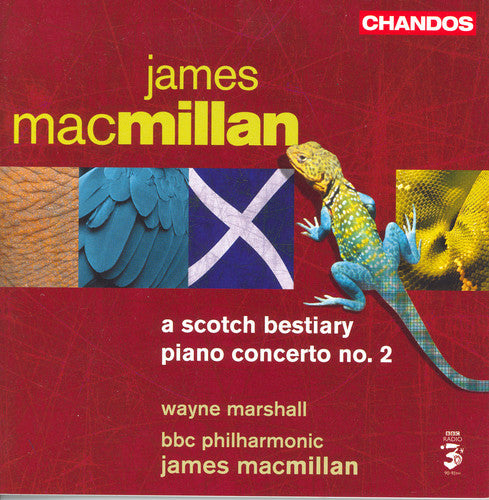
Macmillan: Piano Concerto No 2, A Scotch Bestiary
Grammy Award Nominee 2006 'Best Classical Contemporary Composition' Composed in 2005 as a specially commissioned ballet score fo New York City Ballet, 'Piano Concerto No.2' comprises three movements: cumnock fair, shabards and shamnation. The work here receives its world premiere recording. It is a highly energetic work - a frenzy of folksong and dance; the first movement, cumnock fair, is a whirling fantasy of eighteenth-century Scottish dance melodies; shambards makes use of Burnsian folksong with fragments of the Mad Scene from Lucia di Lammermoor drifting in and out of focus; shamnation is heavily influenced by Scottish folklore, often quite devilish. 'For sheer excitement...this half-romp, half tantrum of a work is hot stuff', wrote The Times. 'A Scotch Bestiary' was commissioned by the Los Angeles Philharmonic and the BBC Philharmonic to inaugurate the new organ in the Disney Hall in Los Angeles. This is a conertante work for organ (an instrument rarely used by contemporary composers) and orchestra, in two parts, and follows in a tradition of musical portraiture to which Elgar, Saint-Saëns and Mussorgsky have made significant contributions.
Macmillan: Visitatio Sepulchri- Sun-Dogs
Macmillan: Why Is This Night Different? / Tuireadh / Visions
Macmillan, J.: Epiclesis / Ninian
Macmillan: Sinfonietta / Cumnock Fair / Symphony No. 2
Macmillan: Tryst / I (A Meditation On Iona) / Adam
Macmillan: The Confession Of Isobel Gowdie, Tuireadh & The E
Macmillan, J.: Triduum, Part I: The World'S Ransoming / Trid
MacMillan, E.: A Centenary Celebration
Currents of Sable Island (Live)
Macmillan: Triduum, Part Iii: Symphony Vigil
MaCMILLAN: Magnificat / Nunc dimittis / Exsultet / The Galla
MacMillan: Into the Ferment / The Berserking / Britannia
Who Are These Angels? - Choral Music Of MacMillan / Cappella Nova
"Cappella Nova present illuminating performances which perfectly capture MacMillan's profound sense of the sacred, but here the sense of looking back over the centuries is especially strong...[an] essential addition to the rapidly growing discography of one of Britain's most self-assured musical voices."
- Gramophone, February 13, 2012
Aside from being very rewarding to sing, James Macmillan's religious music makes such a refreshing change from what's usually offered in churches today. Approachable without being apologetic, emotional but with a sense of dignity, the best of these works can both delight and challenge. Wonderful surprises, like the string quartet's seagull effects in Who are these Angels?, or the Gesualdo-like harmonic shifts in Pascha nostrum immolatus est, rub shoulders with music that matches the unselfconscious directness of folk or even pop music - MacMillan's early experience in folk bands has done him no harm at all. At the same time, it must be stressed that we are worlds away here from the limply syncopated pseudo-pop that the church often seems to think will entice the people back into the pews.
The backbone of this programme is the second set of Strathclyde Motets, and this is where you'll generally find the most absorbing music. The Mass of Blessed John Henry Newman strikes this listener as a little more functionally liturgical - effective enough in context, but relatively short on the kind of ideas that make you catch your breath. At the other end of the scale is the simple but touching Think of how God loves you, written for the baptism of the composer's granddaughter. (James MacMillan a grandfather? Older readers take a deep breath!) Everything is performed with elegance and the requisite intensity., and the recordings are clear and atmospheric.
- Stephen Johnson, BBC Music Magazine, March 1, 2012
This disc is a follow-up to the very fine 2007 Cappella Nova CD which included the first set of James MacMillan’s Strathclyde Motets. It contains the second and final set of seven motets. Most of the music here is of fairly recent vintage and the majority is designed for use in the Roman Catholic liturgy. That includes the short Mass of Blessed John Henry Newman. This sets the words from the new English translation of the Mass which the Roman Catholic Church brought into use towards the end of 2011. MacMillan says in the booklet that he is “really excited” by this new translation; well, he and I will have to differ there but it’s good that he’s moving quickly to compose some worthwhile music to fit the new words. Listeners should bear in mind that the mainly unison music has been specifically designed for congregational participation. That doesn’t mean that it’s in any way simplistic; I should think the average congregation would need to do a bit of work to master it but the effort would be worthwhile.
The remaining music is specifically to be sung by a choir. I was struck by Tota pulchra es. MacMillan’s response to this Marian text is like no other that I’ve heard. Most are gentle and prayerful or implicitly feminine in tone. MacMillan, by contrast, has composed a surprisingly dramatic, urgent piece. In his setting the devotion to Mary is exciting and fervent and Alan Tavener and his expert choir give it a thrillingly affirmative performance. Another fervent piece is the Easter proclamation Pascha nostrum immolatus est. Indeed, here the fervour is evident even when the music is quieter in tone.
O Radiant Dawn is about the only piece on the disc that I’ve heard previously. It’s become quite popular and I’m not surprised. It’s very attractive and its harmonic language is pretty straightforward. The music has an obvious – and beneficial – indebtedness to O nata lux by Tallis.
Os mutorum is one of the pieces on the disc that’s not specifically for liturgical use. This is an interesting piece which is sung by Canty, a four-voice female ensemble which is a spin-off from Cappella Nova. Rather like Anonymous 4 these ladies specialise in medieval music but they also do quite a bit of music of our own time. Here they sing with a regular collaborator, William Taylor, a specialist in the performance of ancient harp music. MacMillan’s piece is chaste and pure in tone. The textures are spare and the music moves slowly. It’s most effective. And lo, the Angel of the Lord was designed for performance by a group resourced to sing multi-part or antiphonal music; in this case the Birmingham-based Ex Cathedra. The piece sets the passage from St Luke’s Gospel in which the Angels announce the birth of Christ to the shepherds. The writing is imaginative and evocative, especially what I can only describe as the choral fireworks at the words “Glory to God in the highest”. This splendid piece is sung tremendously well by Cappella Nova.
I was intrigued to hear what MacMillan would do with John Donne’s wonderful lines in Bring us, O Lord. Sir William Harris is the exemplar here with his glorious setting of the same words. MacMillan’s music is very different and yet … to my ears he achieves the same ambience of longing and quiet intensity. I admire this piece very much indeed.
I’m not quite sure what I make of Who are these Angels? Although the piece is dated 2009 it appears that elements of it go back to when the composer was just seventeen. The new work into which he’s incorporated that early music is rather strange. There are three strands. The male voices declaim passages in Latin – the teenage music, if you like – while the ladies sing a simpler refrain in English. The third strand is provided by the string quartet whose music is mainly quiet and discreet. The c losing moments feature the quartet alone playing strange, high glissandi which, it is suggested in the notes, sound like bird cries.
This is an absorbing disc. It is full of interest and I admire greatly the way in which the composer responds to the words he is setting. Through his music he enriches and enhances them – as a good musical setting of words always should. We are challenged at times but it’s always accessible. The music is superbly performed by Cappella Nova and the recorded sound is excellent, as you’d expect from this label. As with the earlier release, the booklet notes take the form of a very interesting conversation between MacMillan and Rebecca Tavener. I suspect many of these pieces are receiving their first recordings here.
-- John Quinn, MusicWeb International
MacMillan: Seven Last Words From The Cross / Ross, Dmitri Ensemble
There has been a flurry of performance and recordings of Macmillan's music in this, the year of his 50th birthday. This offering from Naxos - at the usual budget price - is from the talented young Dmitri Ensemble under their composer/conductor-director Graham Ross and includes two world premiere recordings. This recording is warmly commended by the composer himself and is a sheer pleasure to listen to.
In the sound-world of this disc, there is a slight echo of the very enjoyable disc of modern choral music by Giles Swayne which I reviewed last year. This is less of a surprise when one sees that both discs were recorded in the same venue - All Hallows church in London's Gospel Oak - and produced by the same engineer, John Rutter, himself a distinguished composer of modern choral religious music.
Although many of Macmillan's works are directly related to his devout Catholic faith, Seven Last Words was first shown on BBC television during Holy Week and is perhaps one of his most frequently performed and best known works. It sets texts from all four of the Gospels to build a composite presentation of the last seven sentences uttered by Jesus. It draws musically on Macmillan's own work Tuireadh - lament, and on Scottish traditional lament music as well as making occasional reference to Bach's Passion chorales.
This powerful work could be expected to be hard to follow. Adding further accompanying works might seem brave. However, the one thematic step which enables this sequence to work is the decision to adopt the theme of resurrection. Christus Vincit is a setting of the twelfth century Worcester Acclamations. Its plainsong-like phrases are punctuated by silence.
Nemo te condemnavit, which follows, is the most recent work on the disc. It is contented, reassuring and positive and is in a capella style - points of similarity with the Swayne choral disc. Taking the theme of forgiveness as expressed in the parable of the woman caught in adultery, it is one of a series of new works for post-communion reflection.
The final work is another motet, ... here in hiding .... It incorporates the Gregorian hymn Adoro te devote but intercuts the original Latin of St Thomas Aquinas with an English translation by the poet-monk Gerard Manley Hopkins. It has been recorded previously by the Hilliard Ensemble in a version for four solo voices. The present edition is the world premiere recording of the version for ATTB chorus a capella.
Seven Last Words has previously been recorded on Hyperion by Polyphony under Stephen Layton. It received superlative reviews and was a Recording of the Year in 2005. The Naxos disc is a budget version by a newer ensemble. The Hyperion, although more generous in its pairing, is perhaps less satisfactory in its programming. Serious enthusiasts will want both. Those who choose the cheaper Naxos recording will be getting a very enjoyable disc and one which compares very favourably with its Hyperion cousin.
Notwithstanding its inexpensive price, recording, production, singing and playing are excellent. The disc is attractively presented with informative notes by the composer, full lyrics and a cover featuring a painting on the same theme by Graham Sutherland.
The Sixteen have also paid tribute to Macmillan, bringing out with impressive speed a recording linked to their anniversary-studded Thirtieth Choral Pilgrimage. Recorded only in late February 2009, Bright Orb of Harmony, on the choir's own CORO label (COR16069) came out on 30 March 2009. It’s a disc combining music by two of the three composers whose anniversaries are featured in their tour this year: Purcell, the three hundred and fiftieth anniversary of whose birth (1659) is this year, and James Macmillan who celebrates his fiftieth birthday on 16 July 2009.
James Macmillan's fiftieth year is marked by international acclaim. Scots percussionist Colin Currie performs the concerto Veni, Veni Emmanuel in Finland and the St John Passion receives its German premiere in Berlin, this time with staged choreography. Further performances follow in Amsterdam with the Royal Concertgebouw Orchestra under Sir Colin Davis. Closer to home for British readers, in London the Britten Sinfonia mounts the first fully-staged presentation of his concert piece Parthenogenesis at the Royal Opera House's Linbury Studio Theatre.
Perhaps the most impressive half century birthday tribute, has been in Manchester. There Macmillan has a long history, having studied and taught at the University of Manchester before returning to live in his native Glasgow. The Royal Northern College of Music paid early respects with a three-day festival entitled Raising Sparks: The Music of James MacMillan (28-30 April) a title also used in an earlier Macmillan retrospective at London's South Bank.
A birthday salute is also scheduled at the BBC Proms, where the main work of this disc, the Seven Last Words from the Cross is paired with Haydn's work of the same title in a performance by the BBC Singers and the Manchester Camerata on 20 July 2009. Macmillan is also one of the composers featured in a series on 100 years of British Music on Radio Three's Afternoon on Three this week (w/c 22 June 2009) (also available as audio on demand), with The World's Ransoming, The Seven Last Words, and Symphony No3 (Silence) being broadcast in this mini-series.
-- Julie Williams, MusicWeb International
Macmillan: Quickening, 3 Interludes from "The Sacrifice"
As James MacMillan celebrates his 50th birthday he here conducts his large-scale, complex work, The Quickening coupled with the symphonic suite The Sacrifice: Three Interludes, taken from his opera, The Sacrifice, a work based on a medieval Welsh tale and focusing on issues of love and conflict. Co-commissioned by the BBC Proms and the Philadelphia Orchestra, The Quickening sets poetry by MacMillan's frequent collaborator Michael Symmons Roberts. Hailed as some of the most distinguished writing since that of Benjamin Britten, the powerfully imaginative score explores the themes of birth, new life and new impulses, but as MacMillan says, it also has its dark side out of which hope is glimpsed. Joining the BBC Philharmonic is the Hilliard Ensemble, who premiered the work at the BBC Proms, accompanied by the City of Birmingham Symphony Chorus and Youth Chorus. MacMillan was awarded the 2008 Royal Philharmonic Society Opera and Music Theatre Award The Sacrifice following its premiere in September 2007 by Welsh National Opera. As did Britten in the now famous Four Sea Interludes from his opera Peter Grimes, MacMillan uses the Interludes as opportunities to withdraw from and reflect on the action, and he says, 'the orchestra provides another dimension to the narrative and to the drama, which allows the imagination to travel deeper or in a different direction.' James MacMillan is one of the UK's leading contemporary composers, and several of his earlier compositions are available on Chandos under his direction, including The Confessions of Isobel Gowdie (Classic FM Award winner), and The Berserking. Also available: CHAN 10092, 10275, 10377, 9997.
MacMillan: Symphony No. 5 & The Sun Danced / Christophers, The Sixteen, Britten Sinfonia
Imagine a vision too wondrous for eyes alone – ‘the lady more brilliant than the sun’. ‘The lady’ is the Virgin Mary, and The Sun Danced is an ecstatic choral celebration of the Miracle of Fatima commissioned by the Shrine of Fatima for the celebration of the Centennial of the Apparitions in Portugal. Celebrated British soprano, Mary Bevan, features on this, the premiere recording. It’s no secret that James MacMillan’s profound religious belief drives his creativity, but music this powerful conveys a universal message, and the title of his new symphony Le grand Inconnu suggests many possible interpretations. Harry Christophers writes: ‘By calling his new Symphony ‘Le grand Inconnu’ James has given himself that freedom to explore the mystery of the subject matter and, with repeated listening, we, the listener, discover more and more within the music… From the barely audible breathing at the start of the symphony to the first forte that is so sudden and ecstatic that it produces one of those heart pounding moments. Everything is drawn together by James into a cornucopia of sheer virtuosity and brilliance.’
MacMillan: Stabat Mater / Christophers, The Sixteen, Britten Sinfonia

Few living composers communicate with the emotional directness of Sir James MacMillan and his belief that "beauty is at the heart of our Christian faith" is profoundly present in his new setting of the Stabat mater. Arguably one of the most powerful poems in the liturgy, only a small number of composers have tackled the Stabat Mater in the last 30 years and the musical world has waited a long time for a substantial setting. In James MacMillan's version we are witness to a new and intensely personal work which encapsulates the power of the poem in a way no other composer has done to date. Harry Christophers writes: "James digs deep underneath the surface of this 13th century Marian hymn meditating on Mary's suffering as she stands at the foot of the cross. He speaks of 'a painful world of loss, violence and spiritual desolation' and the score is packed to the full with those intense feelings. Our collaboration with the Britten sinfonia on this project has been a marriage made in heaven - both groups have had long associations with James's music and both give of their all in bringing this score to life." Sir James MacMillan writes: "It was a great delight and honour to respond to The Sixteen...I regard Harry Christophers' choir as one of the great choirs of the world and their standards of vocal brilliance and blend are unsurpassed."