The present recording presents two of "Papa" Haydn's great late symphonies together with a rarity. Symphony No. 89 was composed during the interim following Haydn's triumphant tour in Paris and just prior to his conquest of London in 1791. The work reflects the influence of his young friend, Wolfgang Amadeus Mozart, and is one of the rare examples of Haydn borrowing from himself; in this case, the second and fourth movements were repurposed from a Concerto for two Lire Organizzata. Symphony No. 102 is from the set of 12 masterworks that have come down to us as the "London" Symphonies. This symphony also includes a reworking of a previously written piece (the second movement is an orchestration of the second movement of the F sharp Minor piano trio). Our rarity is the Sinfonia Concertante in B flat Major, composed at the request of his friend, the English impresario Johann Peter Salomon - no doubt as a special treat for the London audiences who flocked to hear Haydn.
In 2011, Thomas Fey was nominated for a Grammy for his world premiere recordings of the music of Antonio Salieri. Every new release of Haydn symphonies from Thomas Fey and his ensemble is greeted with enthusiasm; truly, this is how Haydn should sound today. To bring this about, Fey's musicians bridge past and present, performing both on modern string instruments and replicas of authentic period woodwind, brass and percussion instruments.
{# optional: put hover video/second image here positioned absolute; inset:0 #}
In 2011 Thomas Fey was nominated for a Grammy for his world premiere recordings of the music of Antonio Salieri. Every new release of Haydn symphonies from Thomas Fey and his ensemble is greeted with enthusiasm; truly this is how Haydn should sound today. To bring this about, Fey's musicians bridge past and present, performing both on modern string instruments and replicas of authentic period woodwind, brass and percussion instruments.
There is nothing immature about the earliest Haydn symphonies, which in style straddle the older Italian overture and Baroque musical world while simultaneously looking forward to exciting new melodic and rhythmic developments of the Classical era.
{# optional: put hover video/second image here positioned absolute; inset:0 #}
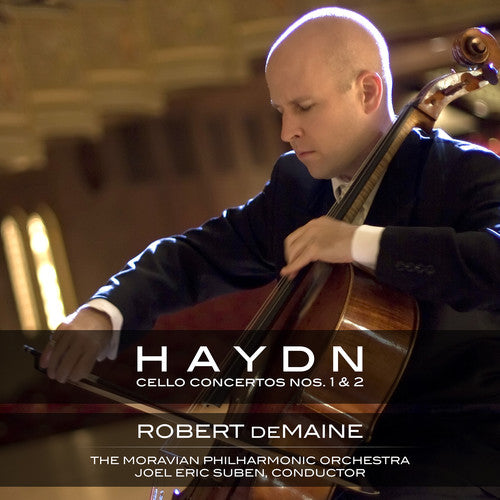
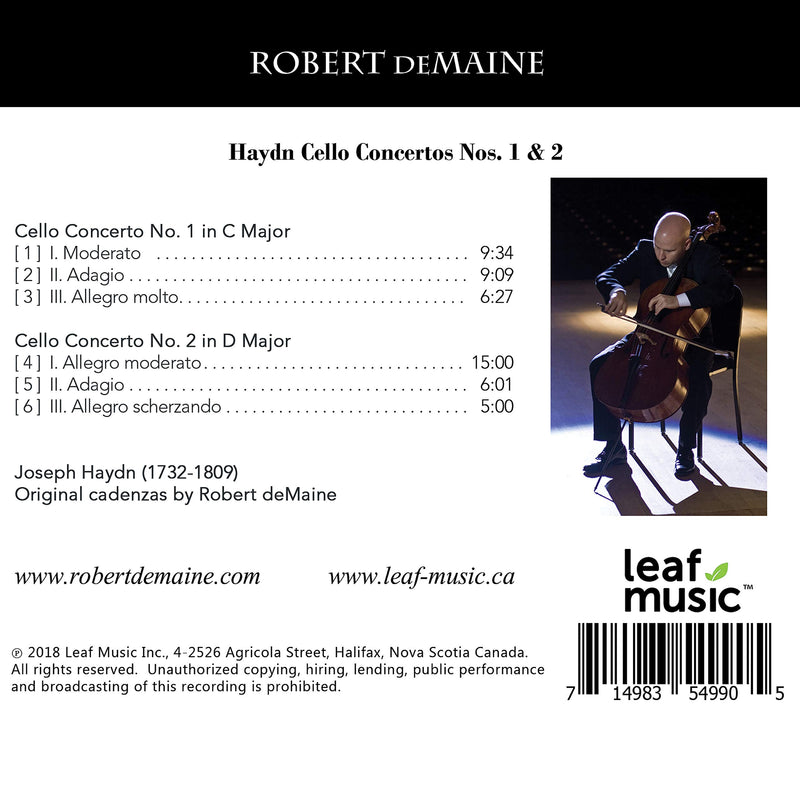
Robert deMaine is an American virtuoso cellist who has been hailed by The New York Times as "an artist who makes one hang on every note.” He has distinguished himself as one of the finest and most versatile instrumentalists of his generation, performing to critical acclaim as soloist, recitalist, orchestral principal, recording artist and chamber musician. He is currently Principal Cellist of the Los Angeles Philharmonic and is in demand around the world as a soloist, chamber musician and clinician. This recording is a collaboration with New York conductor Joel Eric Suben and the Moravian Philharmonic Orchestra recorded at Reduta Conceret Hall in Olomuc, Czech Republic. It was in this spirit of personalized composition that Haydn wrote his Cello Concerto in C major, Hob. VIIb:1, for the Esterházy family. The piece was unknown to modern audiences until 1961, when a copy of the score was uncovered. Since that time, it has become a staple of the cello repertoire, championed by many of the world’s greatest cellists. Robert deMaine adds his name to that list with this lush recording. Haydn’s Cello Concerto in D major, Hob. VIIb:2 was written for the Esterházy orchestra’s principal cellist Antonín Kraft, who is said to have had a beautiful singing tone, expressive phrasing, and an explosive technique, especially in the cello’s upper register. All of this is realized once again in this fresh performance from Robert deMaine.
{# optional: put hover video/second image here positioned absolute; inset:0 #}
The second disc by Einav Yarden, she performs Beethoven and Stravinsky flawlessly. "She pairs up Beethoven with Stravinsky to striking effect, merging that unlikely couple with imagination and exceptionally vivd playing." Along with Beethoven and Stravinsky, this release has some rarely recorded Haydn sonatas as well.
{# optional: put hover video/second image here positioned absolute; inset:0 #}
Challenge Classics
Haydn: 6 Piano Sonatas / Yarden
The second disc by Einav Yarden, she performs Beethoven and Stravinsky flawlessly. "She pairs up Beethoven with Stravinsky to striking effect, merging...
Haydn 2032, Vol 4: Il Distratto / Antonini, Il Giardino Armonico
Alpha
$20.99
March 10, 2017
The fourth volume of the Haydn2032 project thrusts into the limelight one of the most important stock characters in the theatre of sounds and words, the Kapellmeister, and explores some glamorous and (in)glorious moments in the career of Maestro Haydn. It features three symphonies by the ‘Shakespeare of Music’ – one of which is even associated with an actual play. This bears the title ‘Sinfonia in C. per la commedia intitolata Il distratto’ (the name of the play soon became the symphony’s nickname) and consists of an overture, four entr’actes, and a finale to be played at the end of the performance. Also on this disc is a large-scale buffo scene by his colleague Cimarosa. Il maestro di cappella is a witty and ironic parody, in which a member of the ‘old school’ of musicians tries to improve the ensemble playing of his orchestra. To his chagrin, the players do react, but in extremely undisciplined fashion: they are distracted, make false entries and disagree musically...
{# optional: put hover video/second image here positioned absolute; inset:0 #}
Alpha
Haydn 2032, Vol 4: Il Distratto / Antonini, Il Giardino Armonico
The fourth volume of the Haydn2032 project thrusts into the limelight one of the most important stock characters in the theatre of...
Great Haydn Symphonies - No 6, 45, 48, Etc / Fischer, Et Al
Nimbus
$20.99
September 01, 2004
A strong contender as an introduction to some wonderful music.
There are two ways to obtain the complete Haydn symphonies: a third set on Sony, conducted by Dennis Russell Davies seems no longer to be generally available in the UK, even as a download.
One was made some time ago by Antal Doráti with the Philharmonia Hungarica (Decca 448 5312, 33 CDs). From this set only the Paris Symphonies seem currently to be separately available (Decca E473 8102) and, at prices ranging from around £165 to £195 – even more, £352.15, for the download from hmvdigital.com – buying the whole thing may be something of a daunting proposition. Even as a download, only that Paris set, two Double Decca sets of the London Symphonies and a Decca Eloquence recording of Nos. 94, 100 and 101 remain available separately. These are fine performances of which I can speak from personal experience, having owned several of them on LP; I still have and regularly play some of the smaller CD sets from the series which were once available.
There is, however, a far less expensive way to obtain the symphonies complete, from the Austro-Hungarian Haydn Orchestra under Adam Fischer; the whole set comes on just 8 CDs in mp3 format (NI1722) and can be purchased from MusicWeb International for £23.00 post free. The discs can be played directly from any CD, SACD or blu-ray player which offers mp3 playback, but it’s better to drop and drag the files onto a computer hard drive and play them from there.
Dominy Clements in recommending the set went so far as to include graphic print-outs of the same segment of Symphony No.1 from the normal CD and the mp3 version, demonstrating not only that they sound identical but that there is objective evidence to support the point.
The selection listed above comes from that complete set and, although I don’t have access to that mp3 edition on disc, I’ve been listening to some of the symphonies in mp3 sound from the Naxos Music Library and I’m blessed if I can hear any difference between the versions on CD and the mp3 equivalents.
I’ve reviewed the classicsonline.com downloads of Symphonies Nos.1-20 – July 2012/2 Download Roundup – and Symphonies 21-39 and ‘107’-‘108’ (also known as ‘A’ and ‘B’) – July 2009 Download Roundup. Though I could hardly recommend the downloads when they are more expensive (£39.95) than their physical equivalents on 5 CDs (NI5426-30 and NI5683-7 respectively, £23.00 each post free from MusicWeb International), I was able to confirm the high quality of the mp3 sound. So if you are looking for a complete set of the Haydn symphonies that mp3 set, NI1722, looks to me like the best. If, however, you would like to ease yourself into this wonderful music gradually, the ‘Great Haydn Symphonies’ pair of CDs, obtainable from MusicWeb International for £12 post paid, would be an excellent way to dip your toe into the water.
By no means all the Haydn symphonies with a nickname received their nomenclature from Haydn himself, and by no means all of them are accurate. In this case, however, the set of six nicknamed works provides a very useful peg on which to hang a 2-CD set of works from all periods of Haydn’s long productive life. Not only that, but these are six of my own favourites among the composer’s huge symphonic output.
No.6 comes from the earliest period of his tenure with the Esterházy family. It’s one of a series of three linked works, depicting Morning, Noon and Evening, though it stands well enough on its own. Early it may be, but Haydn never really had a period when his music didn’t sound fully accomplished and its appeal is enhanced by the excellent performance which it receives.
Symphony No.45 is the most famous of the Sturm und Drang symphonies from Haydn’s middle period, around 1770. The name Sturm und Drang or storm and stress refers properly to the pre-romantic literature of the period, notably to a series of works by Goethe and Schiller. The story behind the last movement, with the musicians leaving one by one as a hint to their employer that they needed a break, is well known but that doesn’t diminish the power of the music; it remains unhackneyed no matter how many times I must have heard it. Perhaps the performance here doesn’t quite match the power of a Vanguard recording with Antonio Janigro at the helm, which used to be available, but it comes pretty close.
No.48 also comes from the Sturm und Drang period. Its nickname refers to the belief formerly held that it was composed specially for a visit from the empress, Maria Theresa. For some reason she always seems to develop an spurious extra ‘i’ in the name of this symphony, perhaps by false association with the German name Mariatheresien-symphonie. As with No.45, it’s easy to see why the symphonies of this period came to be linked with the literature of the period. My only reservation about Fischer’s performance of this symphony may sound irrational, but the modern horns hit their notes just slightly too comfortably in comparison with period-instrument performances.
It’s not that I didn’t enjoy Fischer’s account of this work, but compare the period-instrument performance from Roy Goodman and the Hanover Band on an inexpensive Hyperion recording (Helios CDH55119, with Nos. 49 and 50, £6.99 or less; £5.99 for mp3 or lossless download: see March 2012/2 Download Roundup) and the extra adventure involved in hitting the right notes adds an extra touch of zest to the performance, as does the inclusion of a just-audible harpsichord. Any one of the budget-price discs from this series might make a useful addition to the Nimbus ‘Great Symphonies’ set; it’s a series that was never quite completed, though it contains recordings from all periods of Haydn’s symphonic output.
If you’ve fallen for the appeal of Haydn in Sturm und Drang mode, Nimbus offer another 2-CD set of Nos. 43, 44, 49, 52, 59 and 64 (here).
Symphony No.82 moves us on several years to Haydn’s visit to Paris in 1785/7. Fischer’s performances of the six symphonies from this period are available on a pair of Nimbus CDs (NI5419-20 - £16.00 post free from MusicWeb International here). The only reservation that I have about recommending the ‘Great Symphonies’ set is that you may well fall for the charms of No.82 and want the whole set. If you doubt the validity of the ‘bear’ nickname for this symphony, Fischer’s growly finale makes it seem thoroughly appropriate, even though it isn’t one of Haydn’s own devising. Here again, only a preference for a period-instrument performance such as Harnoncourt’s Deutsche Harmonia Mundi 3-CD set (82876606022, all repeats observed) or Roy Goodman’s on Hyperion (Nos. 82-4, CDH55123) would be reason to look elsewhere – I’m happy with either approach.
The Oxford Symphony was performed at Haydn’s award of an honorary doctorate by the university, so the title has some validity even though in the end he failed to compose the new work he had intended for the occasion and substituted one that was already well known in England. Simon Rattle’s account of this and other symphonies from the period between the Paris visit and Haydn’s first to London has received critical praise (Nos.88-92 and Sinfonia Concertante, EMI 3942372: Recording of the Month, but I find it too heavy by comparison with the best period performances. You don’t need period instruments, however, to make the symphonies of this period sound well, as Eugen Jochum demonstrated in his BPO recordings of Nos. 88 and 98 and his later LPO set of the ‘London’ Symphonies and as Fischer demonstrates in his version of the Oxford. This is modern-instrument Haydn without the ‘big band’ effect that I find from Rattle and I found it an excellent complement to Roy Goodman’s period-band on Hyperion Helios CDH55125.
The nicknames of Haydn’s symphonies don’t always translate from one language to another. In German No. 94 is known as the Drum Stroke Symphony (mit dem Paukenschlag), so easily confused with what is known in English as the Drum Roll Symphony, No.103. The English nickname, Surprise, like the German, refers to the loud stroke in the slow movement, designed to wake the ladies. I first got to know this symphony from Beecham’s early-1950s Columbia (CBS) performance, once available on the Philips Classical Favourites label – no longer available but his later 1950s remake, still in mono, is on the first of two EMI Gemini 2-CD sets: details below. If Fischer and his team don’t quite recapture the magic of that version – could anyone? – I can’t think of any better recent version.
Hungarian orchestras and conductors seem to have a particularly strong rapport with Haydn – surely it can’t just be due to the fact that he composed for the Esterházy family whose palaces spanned what is now the international border. There used to be several CDs of his music on the Hungaroton White Label which, if reissued at budget price, would still be well worth considering. David Blum recorded several of the symphonies with the Esterházy Orchestra for Vanguard which, like those Hungarotons, I still listen to with pleasure. Intermittently available on CD, there’s a very strong case for the latter especially to be reissued. Despite their Eastern European name, the Esterházy Orchestra are American. Still available, however, and of genuine Hungarian provenance, are the successful recordings which Naxos has made of Haydn symphonies with the Nicolaus Esterházy Sinfonia and Béla Drahos.
Good as all these are, the Austro-Hungarian Orchestra, drawn from top-flight Austrian and Hungarian players, is best of all. These recordings were made over a period of seven years, during which time the orchestra had three Konzertmeister, or leaders: Rainer Küchl, Erich Binder and Wolfgang Redik. The quality of performance over that period is remarkably consistent.
I’m not suggesting that these are perfect – even if such a thing were possible. I would have liked a little more generosity in the matter of first movement repeats, for example. Without necessarily wishing for every repeat to be observed, as Harnoncourt does in his most recent recording of the Paris Symphonies for Deutsche Harmonia Mundi, I do feel that there’s imbalance in Fischer’s No.82 – Doráti’s, too, for that matter – where the first and second movements are almost exactly the same length and the finale is shorter than either. Goodman strikes a neat compromise by observing the first-movement repeats but not those in the finale (Hyperion Helios CDH55123, with Nos.83 and 84).
Just occasionally, too, I felt that some of Fischer’s ritardandi were slightly artificial, but that’s only if one judges them against those of Thomas Beecham, who somehow manages to make everything he does seem thoroughly natural and Haydnesque, even though he clung to outdated editions which he knew to be erroneous when better texts were already available. See the review of his EMI recordings of the London Symphonies – Bargain of the Month – and my November 2011/1 Download Roundup. Beulah have reissued Beecham’s Symphonies Nos. 101 and 103 – see April 2012/1 Download Roundup.
The recordings are excellent throughout. Even the two earliest here, of Nos. 45 and 94 from 1988, are not at all bad but the later recordings sound even better. With short but valuable notes this inexpensive set is a strong contender.
-- Brian Wilson, MusicWeb International
{# optional: put hover video/second image here positioned absolute; inset:0 #}
Nimbus
Great Haydn Symphonies - No 6, 45, 48, Etc / Fischer, Et Al
A strong contender as an introduction to some wonderful music. There are two ways to obtain the complete Haydn symphonies: a third...
Haydn's piano sonatas have thrilled me since childhood. This music may seem easy to grasp at first glance: so much seems clear and straightforward. However, once you take a closer look and spend more time playing and listening to Haydn's music, it develops an endless, multifaceted life of its own. It becomes more concrete and at teh same time it develops an endless, multifaceted life of its own. It becomes more concrete and at teh same time more mysterious. Unexpected turns of phrase, sudden occurences, humorous juxtapositions and startling asymmetries are just as much a part of this music as its extended melodic arcs that make the piano sing. Haydn's music forms an intimate bond between song and speech. In each movement of the ca. 60 piano sonatas he wrote, we meet a personality, an unmistakeable character, evoked in detail. Haydn was long viewed as teh mere forerunner of vienna Classicism - Mozart and Beethoven's Papa, so to speak. His sonatas were mainly regarded as witty, useful pedagogical material. Several generations seem to have been unaware of his profoundly nuanced approach. Perhaps, however, Haydn's keyboard oeuvre might require even better interpreters than the works written by his towering colleagues. One cannot clothe this music in an adequate form without applying a great deal of fantasy in one's choice of timbres, along with a keen sense for musical thetoric and careful regard for phrasing. Most of all, the Haydn performer should be able to modify the entire timbre effect and redistribute the balance among parts from one moment to the next. We must not forget that he was born way back in 1732: Haydn thus still had one foot in the Baroque age, as one can tell from the latent polyphony and frequent figures of musical rhetoric. His variegated types of articulation cover a wide spectrum: dozens of nuances fill out the range between Haydn's profound, songlike legato and his humorously accentuated staccato. Here is not where we will find Beethoven's force and dramatic vigor, neither Mozart's ethereal beauty. Haydn wrote a music of profound humanity, with a basic outlook similar to what the German Romantics called humor": a reflection of human life with all its beauties, unfathomable depths, hopes, losses, crises and joys, all shouldered with a large dose of passion and irony.
{# optional: put hover video/second image here positioned absolute; inset:0 #}
CAvi-music
Franz Joseph Haydn: Piano Sonatas
Haydn's piano sonatas have thrilled me since childhood. This music may seem easy to grasp at first glance: so much seems clear...
Esterhazy Recordings - Haydn: Symphonies Vol 2 / A. Fischer
Nimbus
$37.99
September 01, 2002
Fischer brings his Haydn cycle to a more than satisfying conclusion with this superb volume.
Adám Fischer and the AustroHungarian Haydn Orchestra go from strength to strength. This culminating volume of their Haydn symphony cycle – built up over 14 years – is in many ways the most enjoyable of all‚ not just because it covers a fascinating range of works written in the 1760s‚ when the young Haydn was busy experimenting‚ but in the performances too. In most previous volumes the advantages of Fischer’s cycle as against those of Antál Dorati’s everfresh pioneering Decca cycle‚ have been relatively slight. Here the new performances‚ with lighter‚ more transparent textures and generally faster speeds‚ take far more note of period practice while staying faithful to modern instruments. More than ever one registers the individual virtuosity of the various soloists in the orchestra‚ often challenged to the limit by fast speeds. So a movement such as the variation finale of No 31‚ The Hornsignal‚ features a sequence of brilliant soloists such as Haydn himself might have been writing for in the Esterházy orchestra – violin‚ cello‚ horn and so on‚ even doublebass. That symphony‚ in Professor Robbins Landon’s description one of the most spectacular of the early works‚ is here presented with panache‚ with the four horns braying out superbly‚ and the fast opening Allegro adding to the intensity. The immediately preceding symphony‚ No 30‚ nicknamed Alleluia after the chant quoted‚ is hardly less striking‚ the more so here when Fischer has adopted‚ with brilliant results‚ the option for this C major work of having trumpets and drums as well as horns – a later addition as Robbins Landon suggests in Volume 1 of his monumental Chronicle and Works (Thames &Hudson: 197678). The horns are prominent throughout these performances‚ helped by the recording balance‚ bringing out the boldness of inspiration. Symphonies Nos 30 and 31 evidently date from 1765‚ but generally the regular numbered sequence from the old Breitkopf edition is even more misleading than usual. So No 26 in D minor‚ Lamentation‚ another work that quotes a chant‚ is in the darkly intense Sturm und Drang style of the middle symphonies‚ where No 37 in C is evidently one of the earliest works here‚ dating from the brief period from 1759 when Haydn was Kapellmeister to Count Morzin. Fischer in the Lamentation Symphony again makes the music more biting with his emphasis on sharp dynamic contrasts and his very fast Allegro – faster even than with Christopher Hogwood in his period performance on L’OiseauLyre (4/94). Even more strikingly‚ No 39 in G minor‚ the last of the numbered symphonies here‚ is a wonderful example of Sturm und Drang‚ enhanced by Fischer at the start by the way he exaggerates the pauses between the nervily tentative opening phrases‚ leading to the fierce and urgent Allegro. The finale too is vehemently Sturm und Drang‚ with its rushing strings and four horns‚ again brilliantly used as in the Hornsignal‚ No 31 – as Robbins Landon puts it‚ ‘a tightfisted work’. Throughout this set Fischer consistently relishes the originality of scoring‚ as in the Trio of the Minuet of No 29 in E‚ where suddenly in E minor the horns in octaves hold a sustained note‚ an effect made the more eerie here with the strings stilling their vibrato in period style‚ as they regularly do in these performances. The Symphonies ‘A’ and ‘B’‚ the one dating from the Morzin period‚ the other from the early 1760s‚ make an apt supplement as they come from the same period. These are both works which were only identified as symphonies rather than string quartets when in recent years wind parts were discovered. Whether or not Fischer and his orchestra of selected players from Vienna and Budapest will go on to record other supplementary works and alternative versions (for another record company following Nimbus’s demise)‚ as Dorati did‚ theirs is a superb achievement‚ with the cycle of numbered symphonies now most satisfyingly completed.
-- Gramophone 1/2002
{# optional: put hover video/second image here positioned absolute; inset:0 #}
Nimbus
Esterhazy Recordings - Haydn: Symphonies Vol 2 / A. Fischer
Fischer brings his Haydn cycle to a more than satisfying conclusion with this superb volume. Adám Fischer and the AustroHungarian Haydn Orchestra...
The tour visits historic sites in the Czech Republic, Austria, Germany, Switzerland and Belgium. These include the castles of Litomyšl and Konopišt? in Bohemia, and the historic town of M?lnik, the Horological Museum at Le Locle in Switzerland, relics of war from the Bavarian Army Museum in Ingolstadt, and a glimpse of the Belgian Château of Gaasbeek.
The Music:
The tour brings two of Joseph Haydn’s most famous symphonies, written for a London concert season in 1794, Symphony No. 100, the so-called Military Symphony, and Symphony No. 101, nicknamed The Clock.
In rapid succession, the Stuttgart label TACET has completed the recording of all the String Quartets of Joseph Haydn with the Auryn Quartet. With the last volume, coupling the two Quartets of Op. 77 and the individually published Opuses 103 and 42, we now have all the Haydn Quartets in an exemplary and thrilling complete recording. (...) Full of sustainable substance both in strong-willed forte and in the most tender pianissimo, fascinatingly impeccable in their intonation and completely balanced in terms of sound, one experiences the Auryn Quartet here, once again, as a top-class ensemble.' (Klassik heute)
Composer: Joseph Haydn (1732 - 1809)
Performers: Matthias Lingenfelder, violin Jens Oppermann, violin Stewart Eaton, viola Andreas Arndt, violoncello
Track Listing: 1. String quartet op. 77 no. 1 Hob. III: 81 in G major Allegro moderato 2. String quartet op. 77 no. 1 Hob. III: 81 in G major Adagio 3. String quartet op. 77 no. 1 Hob. III: 81 in G major Menuet. Presto - Trio 4. String quartet op. 77 no. 1 Hob. III: 81 in G major Finale. Presto 5. String quartet op. 77 no. 2 Hob. III: 82 in F major Allegro moderato 6. String quartet op. 77 no. 2 Hob. III: 82 in F major Menuet. Presto - Trio 7. String quartet op. 77 no. 2 Hob. III: 82 in F major Andante 8. String quartet op. 77 no. 2 Hob. III: 82 in F major Finale. Vivace assai 9. String quartet op. 103 Hob. III: 83 in D minor Andante grazioso 10. String quartet op. 103 Hob. III: 83 in D minor Menuet ma non troppo presto - Trio 11. String quartet op. 42 Hob. III: 43 in D minor Andante ed innocentemente 12. String quartet op. 42 Hob. III: 43 in D minor Menuet - Trio 13. String quartet op. 42 Hob. III: 43 in D minor Adagio e cantabile 14. String quartet op. 42 Hob. III: 43 in D minor Finale. Presto
Total playing time: 78:36
{# optional: put hover video/second image here positioned absolute; inset:0 #}
Here Joseph Haydn's music is revealed as the perfect expression of truth. And the Auryn's performance of his string quartets is exactly as it should be: vigorous, beautiful to listen to, and full of feeling. A rediscovery both of sheer beauty and intellectual development.
Composer: Joseph Haydn (1732 - 1809)
Performers: Matthias Lingenfelder, violin Jens Oppermann, violin Stewart Eaton, viola Andreas Arndt, violoncello
Track Listing: Disc One: 1. String quartet op. 1 No. 1, Hoboken III:1 in B flat Major: Presto 2. Minuet - Minuet secondo - Minuet primo da Capo 3. Adagio 4. Minuet - Trio - Minuet da Capo 5. Finale. Presto 6. String quartet op. 1 No. 2, Hoboken III:2 in E flat Major Allegro molto 7. Minuet - Trio - Minuet da Capo 8. Adagio 9. Minuet - Trio - Minuet da Capo 10. Finale. Presto 11. String quartet op. 1 No. 3, Hoboken III:3 in D Major Adagio 12. Menuet - Trio - Menuet da Capo 13. (Scherzo). Presto 14. Menuet - Trio - Menuet da Capo 15. (Finale). Presto J Disc Two: 1. String quartet op. 1 No. 4, Hoboken III:4 in G Major Presto 2. Minuet - Trio - Minuet da Capo 3. Adagio 4. Minuet - Trio - Minuet da Capo 5. Finale. Presto 6. String quartet op. 1 No. 0, Hoboken II:6 in E flat Major Presto 7. Menuet - Trio - Menuet da Capo 8. Adagio 9. Menuet - Trio - Menuet da Capo 10. (Finale). Presto 11. String quartet op. 1 No. 6, Hoboken III:6 in C Major Presto assai 12. Minuet - Trio - Minuet da Capo 13. Adagio 14. Minuet - Trio - Minuet da Capo 15. Finale. Allegro
Timing: 97:54
{# optional: put hover video/second image here positioned absolute; inset:0 #}
TACET Musikproduktion
Auryn's Haydn Vol 1 Of 14 - Op. 1 / Auryn Quartet
Here Joseph Haydn's music is revealed as the perfect expression of truth. And the Auryn's performance of his string quartets is exactly...
The second subgroup of “Tost” quartets is my first acquaintance with this cycle, which is now at a well-advanced stage. That the Auryn is a class act is evident from the word go in No. 1 in A: alert, well focused, and tight-knit in ensemble. The first violin is often primus inter pares in these works, and his virtuoso flights are dispatched with shapely panache and a well-judged degree of soloistic freedom. The second-half repeat is observed (and consistently throughout the set). The Adagio is taken at a nicely flowing pace, its airy lyricism beautifully conveyed. The marvelous cadenza juggernaut at bars 61 ff. is impressively realized in its combination of slowly gathering weight with improvisatory freedom. The Minuet goes at a buoyant one to the bar, and the finale has an irresistible surging flow. Comparison with their former mentors, the Amadeus (DG), is intriguing: the old Anglicized Germans attack the first movement with a larger-than-life vibrancy that would be hard for anyone to match, and makes the Auryn sound a little pallid by comparison (although its response to dynamic nuances is keen, its deliberate underplaying of single fortes is occasionally overdone). The Amadeus displays an earthier richness in the Adagio, but its Minuet is heavier and its finale has less light and shade than its protégés.
No. 2 in F Minor (the celebrated “Razor” quartet, whose hoary old anecdote is debunked in the notes) struck me as less successful overall; the opening double variations are authoritatively dispatched, but with a tendency to a kind of gliding suaveness—very beautiful in its way, but I find myself craving more friction, or resistance, to the tone (especially the first violin in the major-mode variations). More rhythmic and tonal bite would again not go amiss in the second-movement Allegro, though its oppressively eerie atmosphere is well caught. But the strict contrapuntal “ars combinatorial” of the Minuet is excessively smoothed out, imparting an inappropriately tentative feeling. The performance finds perfect form, though, in an exciting account of the F-Major Presto finale, whose elusive character, alternately tensely conspiratorial and swashbuckling, is very well captured. By way of comparison, I prefer the greater rhythmic solidity and tonal weight of the Angeles Quartet (Philips) in three movements out of four, but its staid finale is no match for the Auryn.
The sinuous first movement of No. 3 in B? receives a subtle, nuanced performance, occasionally slightly over-ethereal in feeling (see the tense first violin/cello dialogue of the second theme—here the Auryn is the polar opposite of the Aeolian [Decca], which goes over the line to an unattractive grittiness; the Tatrai [Hungaroton] strikes a nice balance in its understated brand of deadpan rusticity). The slow movement is beautifully done, with wonderfully soaring flights from the first violin. Once again, its Presto finale finds the requisite headlong drive—truly exhilarating!
The recording is beautifully balanced and natural. All in all, an impressive release that will be self-recommending to collectors of the series, or to anyone wanting a single disc of these incomparable masterpieces.
FANFARE: Boyd Pomeroy
{# optional: put hover video/second image here positioned absolute; inset:0 #}


 {# optional: put hover video/second image here positioned absolute; inset:0 #}
On SaleHaenssler Classic
{# optional: put hover video/second image here positioned absolute; inset:0 #}
On SaleHaenssler Classic {# optional: put hover video/second image here positioned absolute; inset:0 #}
Haenssler Classic
{# optional: put hover video/second image here positioned absolute; inset:0 #}
Haenssler Classic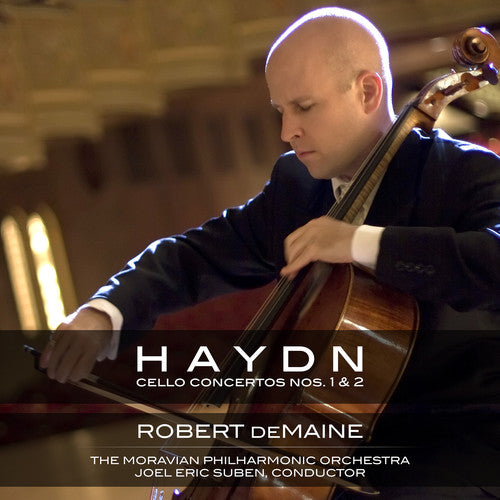 {# optional: put hover video/second image here positioned absolute; inset:0 #}
Leaf Music
{# optional: put hover video/second image here positioned absolute; inset:0 #}
Leaf Music {# optional: put hover video/second image here positioned absolute; inset:0 #}
Naxos
{# optional: put hover video/second image here positioned absolute; inset:0 #}
Naxos {# optional: put hover video/second image here positioned absolute; inset:0 #}
Challenge Classics
{# optional: put hover video/second image here positioned absolute; inset:0 #}
Challenge Classics {# optional: put hover video/second image here positioned absolute; inset:0 #}
Alpha
{# optional: put hover video/second image here positioned absolute; inset:0 #}
Alpha {# optional: put hover video/second image here positioned absolute; inset:0 #}
Nimbus
{# optional: put hover video/second image here positioned absolute; inset:0 #}
Nimbus {# optional: put hover video/second image here positioned absolute; inset:0 #}
CAvi-music
{# optional: put hover video/second image here positioned absolute; inset:0 #}
CAvi-music {# optional: put hover video/second image here positioned absolute; inset:0 #}
Nimbus
{# optional: put hover video/second image here positioned absolute; inset:0 #}
Nimbus {# optional: put hover video/second image here positioned absolute; inset:0 #}
Musicaphon
{# optional: put hover video/second image here positioned absolute; inset:0 #}
Musicaphon {# optional: put hover video/second image here positioned absolute; inset:0 #}
Naxos AudioVisual
{# optional: put hover video/second image here positioned absolute; inset:0 #}
Naxos AudioVisual {# optional: put hover video/second image here positioned absolute; inset:0 #}
 {# optional: put hover video/second image here positioned absolute; inset:0 #}
TACET Musikproduktion
{# optional: put hover video/second image here positioned absolute; inset:0 #}
TACET Musikproduktion {# optional: put hover video/second image here positioned absolute; inset:0 #}
TACET Musikproduktion
{# optional: put hover video/second image here positioned absolute; inset:0 #}
TACET Musikproduktion {# optional: put hover video/second image here positioned absolute; inset:0 #}
TACET Musikproduktion
{# optional: put hover video/second image here positioned absolute; inset:0 #}
TACET Musikproduktion


 {# optional: put hover video/second image here positioned absolute; inset:0 #}


 {# optional: put hover video/second image here positioned absolute; inset:0 #}


 {# optional: put hover video/second image here positioned absolute; inset:0 #}

 {# optional: put hover video/second image here positioned absolute; inset:0 #}


 {# optional: put hover video/second image here positioned absolute; inset:0 #}


 {# optional: put hover video/second image here positioned absolute; inset:0 #}

 {# optional: put hover video/second image here positioned absolute; inset:0 #}


 {# optional: put hover video/second image here positioned absolute; inset:0 #}

 {# optional: put hover video/second image here positioned absolute; inset:0 #}


 {# optional: put hover video/second image here positioned absolute; inset:0 #}


 {# optional: put hover video/second image here positioned absolute; inset:0 #}
 {# optional: put hover video/second image here positioned absolute; inset:0 #}


 {# optional: put hover video/second image here positioned absolute; inset:0 #}

 {# optional: put hover video/second image here positioned absolute; inset:0 #}

 {# optional: put hover video/second image here positioned absolute; inset:0 #}