

Kaija Saariaho
16 products
-
Kaija Saariaho: Touches - Complete Works for Piano & Harpsic
$18.99CDOndine
Jun 06, 2025ODE 1469-2 -
 On Sale
Saariaho: Cinq Reflets De L'amour De Loin, Etc / Saraste
CD$18.99$14.99Ondine
Sep 06, 2000ODE 1049-2 -
![]()

-
![]()

-
Saariaho, K.: Graal Theatre / Solar / Lichtbogen
$18.99CDOndine
Apr 30, 1998ODE 997-2 -
![]()

-
![]()

-

Saariaho X Koh: Chamber Music with Violin
$19.99CDCedille
Nov 09, 2018CDR 183 -
![]()

-
![]()

-
 On Sale
Saariaho: True Fire, Trans & Cier d'hiver / Lintu, Finnish Symphony Orchestra
CD$18.99$14.99Ondine
May 10, 2019ODE 1309-2 -
![]()

-
![]()

-

Kaija Saariaho: D'om Le Vrai Sens; Laterna Magica
$18.99CDOndine
Sep 27, 2011ODE 1173-2 -
![]()

-
![]()

-
 On Sale
Saariaho: Chamber Works for Strings, Vol. 2 / Freund, META4
CD$17.99$13.99Ondine
Nov 11, 2016ODE 1242-2 -
 On Sale
Saariaho: Emilie Suite; Quatre Instants; Terra Memoria
CD$18.99$14.99Ondine
Jan 13, 2015ODE 1255-2 -
![]()

-
![]()

-
 On Sale
Saariaho: Chamber Works for Strings, Vol. 1 / Meta4
CD$18.99$14.99Ondine
Jul 30, 2013ODE 1222-2 -
![]()

-
![]()

-
 On Sale
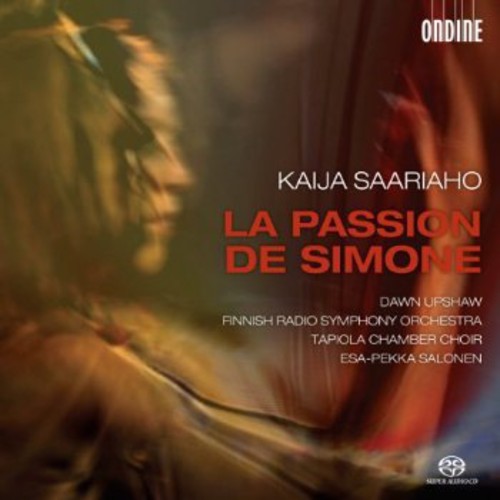
Saariaho: La Passion De Simone / Upshaw, Salonen, Finnish Radio Symphony
SACD$18.99$14.99Ondine
Mar 26, 2013ODE 1217-5 -
![]()

-
![]()

-

Saariaho: Maan Varjot etc. / Latry, Martinez-Izquierdo, Orchestre Philharmonique de Radio France
$20.99CDOcora Radio-France
Feb 16, 2024FRF072 -
![]()

-
![]()

-
 On Sale
Saariaho: Reconnaissance / Schweckendiek, Helsinki Chamber Choir
SACD$21.99$15.99BIS
Jul 07, 2023BIS-2662 -
![]()

-
![]()

-
 On Sale
Saariaho: Notes On Light, Orion, Mirage / Mattila, Karttunen, Eschenbach
CD$18.99$14.99Ondine
Sep 02, 2004ODE 1130-2 -
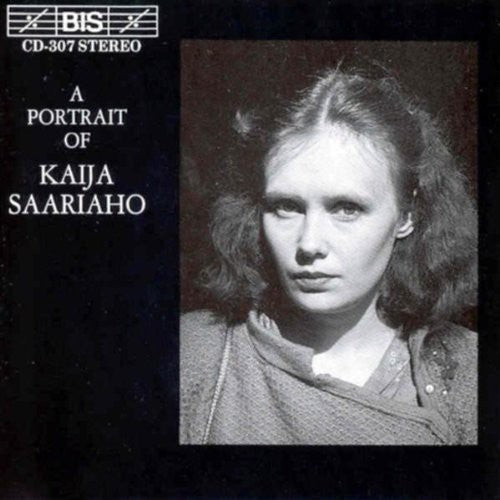
A Portrait Of Kaija Saariaho / Saariaho, Hoitenga, Et Al
$21.99CDBIS
Jan 01, 1997BIS-CD-307 -
![]()

-
![]()

-
Saariaho: Works for Cello / Gutkowska
$21.99CDDUX
Jul 15, 2022DUX1686 -
![]()

-
![]()

-
 On Sale
Saariaho: Works for Orchestra
CD$32.99$24.99Ondine
Feb 28, 2012ODE 1113-2Q

Kaija Saariaho: Touches - Complete Works for Piano & Harpsic


Saariaho: Cinq Reflets De L'amour De Loin, Etc / Saraste


Saariaho, K.: Graal Theatre / Solar / Lichtbogen


Saariaho X Koh: Chamber Music with Violin
Jennifer Koh, a “brilliant violinist” (The New Yorker) who performs with “conviction, ferocity, and an irresistible sense of play” (Washington Post), showcases works by Kaija Saariaho, the visionary and influential Finnish composer with whom Koh has closely collaborated and feels a deep personal bond. The album offers the world-premiere recording of Saariaho’s Light and Matter for violin, cello, and piano, inspired by sunlit colors and shadows in a city park outside the composer’s window. Also receiving its first recording is the violin and cello version of Aure, meaning a gentle breeze, created for and dedicated to Koh and cellist Anssi Karttunen, another champion of Saariaho’s music. The album’s largest work is the one that first attracted Koh to the composer: the violin concerto Graal Théâtre, written for Gidon Kremer, which Koh has performed many times and performs here in the composer’s chamber-orchestra version. Grove Music Online notes that the work illustrates “Saariaho’s rich and expansive string style, but places greater emphasis on melody than earlier works.”
Tocar, Spanish for “to touch,” explores the playful and tactile aspects of the word through violin and piano. Cloud Trio for violin, viola, and cello was prompted by shape-shifting clouds in the French Alps. Saariaho X Koh is the violinist’s twelfth Cedille Records album in a discography that includes the Grammy-nominated String Poetic.


Saariaho: True Fire, Trans & Cier d'hiver / Lintu, Finnish Symphony Orchestra
Kaija Saariaho (b. 1952) is among the most prominent names in contemporary music scene today. This new album by the Finnish Radio Symphony Orchestra conducted by Hannu Lintu includes world première recordings of three works by Saariaho featuring bass-baritone Gerald Finley and harpist Xavier de Maistre as soloists. True Fire is a six-movement song cycle that was written to a commission from the Los Angeles Philharmonic, the NDR Symphony Orchestra, the BBC Symphony Orchestra and the Orchestre National de France, for baritone Gerald Finley with an original idea to explore the scope of the baritone voice. The texts conclusively determined what the vocal expression would be like and how the details in the musical material would shape up. The disparate texts chosen by Saariaho in fact have a common underlying theme: the status of humankind surrounded by nature, our observations of it and our belonging to it. Saariaho’s orchestral triptych Orion (2002) is one of her most performed works. Orion as a celestial phenomenon is showcased in the middle movement, Winter Sky. In 2013, Saariaho rescored this movement for a smaller orchestra, and to distinguish it from the original she gave it a title in French with the same meaning, Ciel d’hiver. It joins the series of works by Saariaho that are in one way or another inspired by things in sky and space. Trans for harp and orchestra is the composer’s latest addition to a series of concertos. It was written to a joint commission from the Suntory Foundation for Arts, the Finnish Radio Symphony Orchestra, the Swedish Radio Symphony Orchestra, the Tonhalle Orchestra in Zurich, Radio France and the Hessen Radio Orchestra. The premiere was given by Xavier de Maistre in Tokyo in August 2016.


Kaija Saariaho: D'om Le Vrai Sens; Laterna Magica
SAARIAHO Clarinet Concerto, “D’Om le vrai sens.” Laterna Magica. Leino Songs • Sakari Oramo, cond; Finnish RSO; Kari Kriikku, (cl); Anu Komsi (s) • ONDINE 1173-2 (67:31 Text and Translation)
Over the years my admiration for Kaija Saariaho (b. 1952) has only grown. From early in her career she’s had an identifiable voice, one that comes from the intersection of a certain Nordic directness with a very French taste for refinement of timbre and texture (she’s Finnish, but worked at IRCAM and has lived for decades in Paris). The result is music that pleases on multiple levels: It’s highly lyrical, explores new sonorities with experimental rigor, and is never afraid of sensuality.
The three works on this program (basically hot off the press) all partake of the above-described aesthetic. The Clarinet Concerto (2010) is a suite of six movements inspired by the famous medieval “Unicorn” tapestries at the Cluny Museum in Paris, which in turn represent the senses (the final movement evokes a culminatory “sixth sense”). It’s truly haunting, in that the clarinet often uses noise and multiphonics (though always scrupulously) to suggest a sort of ghost-like keening and shrieking. Saariaho is very much in the spectralist school, which develops its harmonic practice from precise analysis of sounds in their microscopic realm, and from their correspondence to the overtone series. As a result, even her most dissonant sound masses have a spaciousness that always sounds natural and open, and that’s the case throughout this piece.
Laterna Magica (2008) is a tone poem evoking the life and work of film director Ingmar Bergman, though it never falls into any film-music cliché. It has an interesting dialectic between rich clouds of sound and more rhythmically pulsating textures (film threading through a projector’s sprockets?), and a passage where the orchestral players whisper various words (in German) relating to light is particularly striking. It falls a little more into what feel to me certain standard gestures and sonorities of this style and era, but it remains consistently appealing and mysterious. And the 2007 Leino Songs are four settings from one of Finland’s greatest poets, Eino Leino (1878–1926). This is technically the most conservative work, in that the voice is used for a traditionally beautiful melody; the instruments provide an aura about it that sometimes is more distorted, but never at the expense of the vocal line’s beauty. All this is not a surprise, since the composer has established one of the few successful track records for innovative and beautiful opera.
All these are exceptional performances, but by now would we expect less from anything coming out of Finland, perhaps the world’s most advanced musical culture (at least for what we call “classical”)? If you’ve not heard Saariaho before, this is an excellent introduction.
FANFARE: Robert Carl
-------
Susanna Välimäki’s booklet notes sum up the music of Kaija Saariaho remarkably succinctly: “Saariaho may be regarded as a philosophical composer of mysteries … her music seems to suggest an invisible yet tangible ‘other world’ that can be sensed in the translucent sonorities, echoes, overtones, harmonics, shadow tones and reflections of her music ... [It] conjures up a sense of infinite space and multimodality.” The colours of the orchestration in a work like the Clarinet Concerto are almost as elusive as the tonalities and harmonic language used, but at the same time the ear is granted access into a world which is infinitely fascinating - subsumed at times with an icy northern chill, but also irrigated by the magnetic shifting patterns of an aurora borealis.
As the subtitle suggests, the Clarinet Concerto “D’OM LE VRAI SENS” refers to the human senses, each inspired by the panels of a medieval tapestry called The Lady and the Unicorn. These physical aspects are suggested with instrumental symbolism and meditations rather than literal descriptive elements easily divined by an audience, but the atmosphere of mystic other-worldliness brings us into a state of wonder which can perhaps be interpreted as comparable with that of the medieval lay person confronted by inexplicable worlds beyond experience, expressed by an almost equally inexplicable miracle of craftsmanship in the tapestries. Kari Kriikku’s remarkable clarinet playing is a real treat in this work, sometimes imitating animal sounds, at times sounding like declamatory speech, and always filled with drama and intensity which equals that conjured by the entire orchestra.
Laterna Magica is titled after the memoirs of film director Ingmar Bergman, and refers to the earliest of image projectors, the magic lantern. This transfers into music in a series of ‘mirages in sound‘, creating spaces into which the imagination can project its own images. This again is more than a merely literal conjuring and teasing of our pictorial senses, and the mystic symbolism of passing time and the universal questions of existence are powerful elements in the score. Machine-like noises and quasi-spoken whisperings express the intangibility of images which seem real, and challenge perceptions of permanency and reality.
The Leino Songs use poems by Eino Leino, considered one of the most important of all Finnish poets. Reading the texts in the booklet, and it is immediately apparent as to why these texts would appeal to Saariaho, as their themes and content can easily be interpreted as expressing the very essence of her compositions. Beautifully sung by Anu Komsi, each song is compact, the words used directly and without distortion of the original poem. Each song creates its own world, reflecting the themes of love and violence, fragrant serenity and death.
This is a superbly produced recording from the Ondine label, which has been championing Saariaho’s music for some time now. Justly celebrated as one of the leading composers of our time, this varied and deeply fascinating programme is as good a place as any to become acquainted with her remarkable universe of expressive sonority and mystical depth. This isn’t Bach or Beethoven of course, but neither is it work which will turn you off with impenetrable intellectual challenges. The deeper you look the more you can reveal, but what you find is more often one or other revelation about yourself as much as an understanding of music which is of its very nature a kind of tuning fork held up to the harmonies and dissonances of existence.
-- Dominy Clements, MusicWeb International


Saariaho: Chamber Works for Strings, Vol. 2 / Freund, META4
Ondine releases the long-awaited second instalment of Kaija Saariaho’s (b. 1958) chamber works with the award-winning Meta4 string quartet. The recording also includes three chamber music songs together with soprano Pia Freund. Kaija Saariaho (b. 1958) is one of the most important Finnish contemporary composers. She is equally known for her operas, the oratorio La Passion de Simone, orchestral works and concertos and also for rich small-scale works. Saariaho’s instrumental style is particularly richly manifested in her works for strings, where she makes use of a variety of playing techniques.


Saariaho: Emilie Suite; Quatre Instants; Terra Memoria
– Bradley Bambarger, Listen Magazine


Saariaho: Chamber Works for Strings, Vol. 1 / Meta4
This is the first of two releases of Chamber Works for Strings by Kaija Saariaho, and also a tribute to the composer Kaija Saariaho who turned 60 on 14th of October 2012. Saariaho is renowned across the world for her vivid orchestration. Her chamber works highlight her ability to create unique sound worlds with only a few instruments. Here she also adds live electronics to create a unique colour.


Saariaho: La Passion De Simone / Upshaw, Salonen, Finnish Radio Symphony
SAARIAHO La Passion de Simone • Esa-Pekka Salonen, cond; Dawn Upshaw (sop); Tapiola CCh; Finnish RSO • ONDINE 1217 (SACD: 66:32 Text and Translation) Live: Helsinki 10/19–20/2012
La passion de Simone is a one-person oratorio by Kaija Saariaho based on the writings of philosopher Simone Weil (1909-1943). Unlike many assimilated Jews from Europe, Weil was lucky enough to be able to escape Nazi-occupied France and left for New York. Later she moved to London, where she worked from across the channel with the French Resistance, but died of tuberculosis in 1943, largely by refusing food or treatment. Although Weil was a German Jew, the text of this work is in French. The text, though including quotes from Weil, is as much a commentary on her life and work written for the composer by Armin Maalout.
I was deeply impressed with both the seriousness and textural beauty of Saariaho’s music. She creates an almost prismatic web of sound that underlines the solo and choral writing like a low-lying mushroom cloud; even when the music gets busy, as in the “Second Station,” the wind and brass figures seem subjugated to the overall ambience of the orchestral sound. Indeed, the chorus often seems to be a part of the orchestra, not something external or independent of it.
No one would ever claim that the solo vocal writing is tonal or melodic in the strict sense of the words, but as a friend of mine likes to say, the music does “begin.” There is a definite directionality to its progression. He and other listeners attuned only to tonality, however, may not appreciate the dark shards of brass playing tone clusters that interrupt the musical flow here and there, but I found it intensely interesting. Moreover, Saariaho has the gift of being able to match the music to the mood of the text, even though I personally felt that the words of the “Third Station” do not entirely evoke nightmarish brass explosions. The text here is:
Another person would have
Turned away from the world
To care for his own suffering.
You turned away from yourself
To fix your gaze upon the world.
Over the years, soprano Dawn Upshaw’s voice—never entirely steady to begin with—has become even more fluttery in tonal emission and a bit thin in sound, but her musicality and phrasing are beyond question. More importantly, Salonen’s conducting—so very familiar to American listeners from his years with the Los Angeles Philharmonic (where he is still Conductor Laureate)—is simply magnificent, leaving no detail unattended to in his progression from beginning to end. He even manages to find rhythmic cells within this largely amorphous music that help propel it and give it forward momentum, a task I do not envy him in. In the very busy Fifth and Sixth Stations, for instance, the music becomes exceedingly busy, with a battery of percussion driving the brass, wind, and string figures as well as chorus, which is now separate in sound from the orchestra. Salonen finds exactly the right mood and tempo for this, which then blends into the Sixth Station where the percussion moves away temporarily and the stabbing brass is confined to occasional chords, driving a sonic wedge between voices and instruments. I should also mention that every so often, certain lines are spoken (actually whispered) rather than sung. At first I thought it was Upshaw, since no one else is credited on the CD back insert, but in small print on the first page of the booklet, Dominique Blanc is credited as speaker.
By Stations 13 and 14, which discuss Weil’s illness and death, the orchestra all but falls away as the (whispering) speaker and singer dominate the proceedings. Only in the 15th and “Final Station” does the orchestra return in full force, summing up the piece musically as the text sums it up dramatically “By your death, everything that you had said/Was transformed into a testament/You walked towards your own annihilation/And you won a resurrection.”
It isn’t often that I say anything about SACD sonics (particularly in solo piano or chamber music) because I don’t have an SACD player, but in this case the sound is absolutely fantastic. Even on a conventional CD player (and this may be due as much to Salonen’s conducting as to the recorded sound), the orchestra and chorus seem to “spread out” and envelop you from the very first note, and this feeling never leaves you at any point throughout the cantata. Thus I simply must give big kudos to the recording engineers, Antti Pohjola and Enno Mäemets, the latter of whom also did the sound mixing. Not only did they capture the full ambience of Saariaho’s sound world, but they also managed not to blur the orchestral details when it was important for the inner voices to be heard. You really feel that you are sitting in the hall where this piece is being performed and recorded as you listen to it; in many places, the sound is so rich that it is almost tactile—you almost feel that you can reach out and touch it.
On the last page of the booklet, it says that La passion de Simone originally premiered as a stage work directed by Peter Sellars. I can only pray that he didn’t do to it what he did to conventional opera 30 years ago, which is to ruin it, but since it included choreography (by Luca Veggetti) my fears are compounded. Why the heck would anyone dance to this music or, even worse, to these lyrics? How do you dance through a life of misery, selflessness to others, and a personal search for spirituality in a dark and ugly world? More importantly, why would you dance this? But no matter. Although it is noted that this recording “was made in connection with this live concert performance,” the medium of a CD happily spares us these unnecessary images except for the photos on the cover and CD inlay. We are, then, happily free to imagine the music and words as separate entities, which indeed they are, and to marvel at the skill that Saariaho used in creating this marvelous work.
FANFARE: Lynn René Bayley


Saariaho: Maan Varjot etc. / Latry, Martinez-Izquierdo, Orchestre Philharmonique de Radio France
Kaija Saariaho (1952-2023), featured in 2017 at Radio France's Festival Presences of contemporary music, was a central figure in a generation of internationally renowned Finnish composers and performers.
Kaija Saariaho developed computer-assisted composition techniques and mastered working with tape and live electronics, but she also encountered French composers of so-called spectral music, whose techniques are based on computer analysis of the sound spectrum of individual notes on different instruments.
In the profusion of works that Saariaho has produced in recent years, two features have marked her entire career. One is the close collaboration with other artists –writers, directors, musicians, etc.– in the creation of new works. The other is the concern to make her music, not the treatment of an abstract process, but an urgent sharing of ideas, images and emotions from the composer to the listener.
This collection is the recording echo of the Festival Presences (created in 1991) and its commissioning and creation activities, supported by Radio France's musical ensembles.


Saariaho: Reconnaissance / Schweckendiek, Helsinki Chamber Choir
The album Reconnaissance was, of course, never intended as an epitaph. Nonetheless, It is difficult to imagine a more fitting summary of, or introduction to, the character, spirit and life’s work of Kaija Saariaho (1952-2023) on a single disc, especially where her choral repertoire is concerned.
This recording presents Kaija Saariaho’s works for choir, a cappella and with electronics, and displays her virtuosity in the treatment of texts, which she endows with the full range of verbal expression. Nuits, adieux, presented here both in its a cappella version and with electronics, could be described as a lullaby, not so much for a sleeping child as for an elderly person sleeping out of our world. Funny and very serious at the same time, Horloge, tais-toi was conceived for a children choir.
Écho! deals with the myth of Echo and Narcissus, with the idea of echo being naturally extended with electronics that process and reverb the voices of the singers. Based on poems by German poet Friedrich Hölderlin, Tags des Jahrs display an archaic choral treatment expanded by sounds of the human voices, birds, wind and other natural phenomena. Überzeugung engages with medieval music and treats the contrast between light and dark as a trance-like interplay between past and present. Finally, Reconnaissance can be seen as a ‘science-fiction madrigal’.
Nils Schweckendiek and the Helsinki Chamber Choir initially performed this program in concert in August 2022 as part of the celebrations surrounding Saariaho’s 70th birthday.
REVIEW:
The album Reconnaissance was, of course, never intended as an epitaph. Nonetheless, it is difficult to imagine a more fitting summary of, or introduction to, the character, spirit and life’s work of Kaija Saariaho on a single disc, especially where her choral repertoire is concerned. To quote her artistic statement on choral music from the booklet, ‘the entire range of verbal expression is available to be woven into a multi-layered and heterogeneous whole’. The remarkable array of works showcased here – and mostly in recording premieres, no less – demonstrates just how dedicated she was to this principle over the course of so many decades.
In addition, by presenting two contrasting versions of the same piece (Nuits, adieux) together, the album provides a rare example of a composer’s process of revisiting the same material for different times and places, allowing us a glimpse into a whole other dimension of Saariaho’s musical thinking. Lastly, the album is a testament to her ongoing collaboration with other members of the musical community, including high-profile colleagues and young family members alike. How fortunate we are to have this one last gift from Saariaho, a document that not only expands the discography of her critically important oeuvre but also serves as a testament for future generations to the example of a composer’s life exceptionally well lived.
-- Classical Music Daily
The opening work, Nuits, adieux, is as good an illustration as any of the manifoldness of Saariaho’s sound-world. It exists in two versions: the original (with electronics) from 1991, and the a cappella version from 1996. Together, they bookend this delectable programme...A particular attraction is the recurring solos by the marvellously beautiful soprano voice of Linnéa Sundfær Casserly. In the a cappella version, the electronics are replaced by eight-part chorus, while the solo parts are practically identical with the original. It is a special treat to return to the work in that modified version at the end of the programme.
Écho! from 2007 for eight voices and electronics, was inspired by a double-choir motet by Claude Le Jeune (c. 1528/30–1600), which deals with the Echo myth...It is immensely beautiful.
To me, [the title work, Reconaissance] is the most important choral work composed on this side of the turn of the millennium, and in harness with the rest of the programme, which is just as valuable, this is an indispensable disc for all lovers of choral music. The performances are tremendous. It is also a worthy memorial to Kaija Saariaho.
-- MusicWeb International


Saariaho: Notes On Light, Orion, Mirage / Mattila, Karttunen, Eschenbach

A likely masterpiece from Finland joins new music from scintillating Saariaho
Kaija Saariaho is the Finnish composer, alongside Magnus Lindberg, who most excites me at present. Like her fellow countryman, she finds textures that feel absolutely fresh, vibrant and full of colour. Her journeys of imagination here are gripping. And it’s good to see such high-profile performers in new music – perhaps especially the sublime Karita Mattila.
-- Gramophone [11/2008]
SAARIAHO Notes on Light.1 Orion. Mirage1,2 • Christopher Eschenbach, cond; Anssi Karttunen (vc);1 Karita Mattila (sop);2 O de Paris • ONDINE 1130 (63:22)
Kaija Saariaho writes exciting music. At one time associated with the spectral school of composition, in which spectra, the harmonic fingerprints of sound, were used to generate new works, she’s been able to assimilate and then transcend such a purely analytical approach to arrive at her present individual, communicative language. In the past, she’s also broadened her palette with electronics. Her vivid music is characterized by an acute sense of color and texture, allied to a sure feeling for form and pacing. Melody, too, plays an important part. Although there are no big tunes to whistle, the musical flow can be lyrical, even rhapsodic. At times, an almost oriental melisma wafts through the music: at others, what I would call “proto-melodies” (four or five note phrases) accrete to form larger modules, most notably in Orion.
Notes on Light, Saariaho’s cello concerto, often projects a mysterious mood. Glissandos of varying lengths in cello and orchestra, and a line that sways and sighs as it evolves and devolves suggest a yearning, or questing aspiration. The evocative title comes from T. S. Eliot’s The Wasteland, and inspired Saariaho’s vision of the cello as a source of light. The energetic second movement stands apart from the rest, with swift, downward cascades in tuned percussion and flute mirrored by exuberant, upward-winging piccolo flurries. These effects, plus the churning cello, create a drive and momentum distinct from the slower, exploratory nature of the other four movements. That’s not to say that the rest of the concerto is placid, or without internal drama. Throughout, Saariaho skillfully deploys her “transparent” orchestra in often-delicate counterpoint to the soloist.
Orion finds Saariaho reveling in larger forces, with more brass (there are no trumpets and trombones in the concerto) and even organ: some of the climactic moments must be quite overwhelming in person. Unifying thematic elements link the three movements. A subtle pulse as Orion begins arrests the attention, drawing the listener into this “constellation” of sound. Gradually, ideas and images coalesce, until the orchestra achieves a monumental presence worthy of the young god. The volume waxes and wanes, but the overall impression is massive. The second movement’s texture is primarily diaphanous, although heavier “clouds” of sound arise before the ethereal conclusion. A piccolo plays a pastoral tune over a dreamily shimmering background, ushering in a violin solo that could be a distant cousin to Shéhérazade. This gives way to an exotic, sinuous clarinet and oboe, and so it goes, one colorful episode succeeding another. The third movement starts out like Notes on Light’s second, but becomes even more wild and tempestuous. Trumpets, swirling winds, and scintillating strings fluoresce, illuminating the orchestral landscape. The storm eventually subsides, its mass floating away, the last note struck by a single triangle.
Mirage is a passionate setting of the “song” of a Mexican woman, shaman, and healer who, in this ecstatic musical incarnation, affirms her being while summoning the forces that pass through her to effect her cures. Karita Mattila brings Saariaho’s hypnotic score to vibrant life, swooping and gliding effortlessly, imparting a palpable exaltation. From the first half-whispered “I am” one is swept up and riveted by this spellbinding performance. The cello is an equal partner in Mirage, probing at the opening, acquiring confidence, and increasing in strength until it joins with the voice in its voyage of discovery. The two dip and soar in tandem, although the melodic outline is not identical.
Mattila and Karttunen are superb musicians who are perfectly attuned to Saariaho’s style. Their long friendship with the composer guarantees informed, sympathetic performances, and it would be difficult to imagine better ones. Eschenbach and the orchestra support the soloists beautifully in Notes on Light and Mirage, and contribute stunning playing in Orion. Saariaho’s many admirers will enjoy these latest additions to her discography, while anyone who’s been afraid to dip a toe into contemporary waters should consider taking the plunge, for while undeniably “modern,” the music’s range of expression, melodic flexibility, invention, and pervasive color make it immediately accessible. While not neo-Romantic by any means, it’s nonetheless music that manifests beauty and feeling in every note.
FANFARE: ROBERT SCHULSLAPER

A Portrait Of Kaija Saariaho / Saariaho, Hoitenga, Et Al


Saariaho: Works for Cello / Gutkowska
Joanna Gutowska writes: “The album Kaija Saariaho – Works for Cello has been inspired by Saariaho’s extremely rich musical language, which significantly influenced my artistic development and inspired me to further exploration of colors. The album largely refers to my doctoral dissertation ‘Kaija Saariaho’s cello works as an example of new qualities of sound and expression,’ in which I focused on identifying the key factors that contributed to the development of her original musical language. It mainly focuses on the composer’s small instrumental works (Petals for cello and electronics [1988], Spins and Spells for solo cello [1996], Mirrors for cello and flute [1997], Neiges for eight cellos [1998], Sept Papillons for cello solo (2000), and Light and Matter for violin, piano and cello [2014]).”


Saariaho: Works for Orchestra
On the occasion of her 60th anniversary in 2012, this 4-CD collector's box contains recordings of fourteen orchestral works by Grammy-awarded Kaija Saariaho, many of them featuring vocal or instrumental soloists. This specially priced anthology highlights the Finnish composer's oeuvre from 1986 to 2007, a period that follows the evolution of her compositional style from the early days of her career to more recent times. The featured works have helped to cement Saariaho's international position as one of the most successful living composers and have garnered her several important awards along the way (Grawemeyer Award 2003, Musical America's Composer of the Year 2008, MIDEM Classical Award 2009, Wihuri Sibelius Prize 2009, Sonning Music Prize 2011). Kaija Saariaho has been the New York Carnegie Hall's Composer-in-Residence since the beginning of the 2011-12 Season.
The recordings were made between 1992 and 2008 have been previously released by Ondine to international popular and critical acclaim.
