Max Bruch
47 products
Bruch: String Octet, Quintets / Ensemble Ulf Hoelscher
Bruch: Concerto for 2 Pianos; Suite on Russian Themes / Bard, Matiakh, Staatskapelle Halle
100 years ago the composer Max Bruch died. His remarkably long life of 82 years covered a period in contemporary history that was determined by scientific progress and comprehensive industrialization, developments that also found expression in art. Shortly after the turn of the century the scandals concerning the compositions by Igor Stravinsky and Arnold Schoenberg were already rocking the musical world, however, Bruch met the tide of events as stoically as a rock: conservative, patriotic and above all unconditionally beholden to Romanticism in music. The present program was recorded during a Max Bruch Jubilee Concert in Halle and focused besides the famous Suite on Russian Themes also on the rarely performed Concerto for 2 pianos and orchestra.
REVIEWS:
This fine disc presents two Bruch rarities, composed towards the end of his life, both of which started out in other guises. The five-movement Suite on Russian Themes is an adaptation (with new material added) of his Songs and Dances Op. 79, originally for violin and piano. It is remarkable (even for a composer in his mid-60s) that music of such Mendelssohnian deftness and sparkle could have emerged during the first decade of the last century. But putting aside issues of chronology, those who delight in the charming rusticity of, say, the Scottish Fantasy, should find these well-crafted miniatures enchanting.
-- BBC Music Magazine
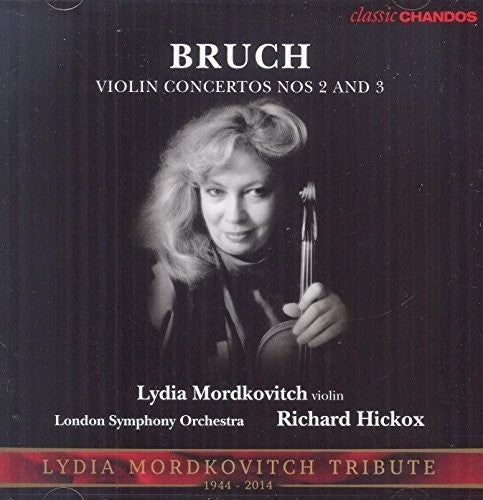
Bruch: Violin Concertos Nos. 2 & 3 / Mordkovitch, Hickox, LSO
This Chandos re-issue of Max Bruch’s Violin Concertos Nos. 2 and 3, recorded in 1998 by Lydia Mordkovitch (1944-2014) with Richard Hickox and the LSO is released in tribute to the late Russian-British violinist. • In the Violin Concerto No. 2, “Hickox draws radiant sounds from the LSO, and Ms. Mordkovitch ... plays with rapt dedication [and] breathtaking beauty…” (Guardian) • The third Violin Concerto’s robust, heroic opening concertante movement precedes a slow movement reminiscent of the same in the famous First Concerto and a rondo Finale dominated by a strongly rhythmic perpetuum mobile.
Bruch: Piano Works / Christof Keymer
Over the course of his life Max Bruch often made uncomplimentary remarks about the piano as an instrument – even though he himself was an outstanding and successful pianist. On the whole it was not until his later years that increasing occupation with the piano could be observed in his compositions. His late chamber music with the piano and the Concerto for Two Pianos and Orchestra may be understood as a return to this instrument. The selection of piano works recorded here by the pianist Christof Keymer demonstrates beyond any doubt Bruch’s mastery in the compositional treatment of the piano and its special resources. Here we find a cosmos of romantic emotional worlds that in Bruch’s hands produce original, unique tones. This very personal treatment of piano sound, melodic invention, and melodic leading shows us Bruch as a great composer personality. The transcriptions almost incidentally reveal his great command of the tonal transformation of the originals, while many virtuoso elements in turn have a signature that is very much Bruch’s own. All the piano works have in common Bruch’s love of melody, which was his creed as a composer.
Bruch: Lieder / Mouissi, Fingerlos
The first piece composed by Max Bruch during his child prodigy years was a song, and the Five Songs op. 97 number among the last creations with which he closed the files on his long artist’s life shortly after World War I. This fact alone would suffice to make us understand the great value attached to song – whether of vocal or instrumental nature – in the oeuvre of this lifelong Romanticist. From the peppy male chorus to the full-length colossal oratorio, from the Loreley to the immortal cantilenas of his Violin Concerto No. 1, Scottish Fantasy, and Kol Nidrei, he sang out his songs to his heart’s content while revealing lyrical qualities that come to light in special measure in his collections of solo songs distributed over the entire course of his career – a fact underscored by the Austrian baritone and his piano partner Sascha El Mouissi on this new and so far absolutely unique anthology. Along with delightful tidbits from all of Bruch’s compositional periods, we are presenting the five songs from Paul Heyse’s novella Siechentrost for One to Four Voice Parts, Violin, and Piano op. 54. Max Bruch’s musical setting produced not only an original piece of chamber music but also an intimate look at his self-understanding and his goals. Behind their creator’s blustery façade there was also a man of tender, vulnerable character!
Bruch: Symphonies Nos. 1-3 / Trevino, Bamberg Symphony
Max Bruch has never made things easy for fond listeners or performers of music; his contemporaries found him hard to handle, and so have later generations. The reason behind this has nothing to do with the superlative, worldwide renown of the first of his violin concertos, or with his musical language, which had already fallen out of fashion when he died exactly a hundred years ago. Instead, Bruch himself much too quickly and all too often lost his faith in his “musical progeny” because he did not have the patience to let them mature in peace and to secure a place in the broader public consciousness. This applies to the opera Die Loreley, which offers a rewarding listening experience, as well as to his three symphonies composed between 1868 and 1882 and originally intended as a series of works forming a trilogy. However, Max Bruch set aside the third part in order to focus on dramatic and choral symphonic projects. He first wanted to write his second opera, Hermione after The Winter’s Tale by William Shakespeare, and Odysseus, his first secular oratorio. As things turned out, the spectacular long-term success of these musical pictures from antiquity meant that his original symphonic project was relegated to the back burner. However, once we experience the three sister works in their originally planned context, as the present new production enables us to do, the tide turns in their favor. The revealing path from the heroic idea underlying the first symphony, which, by the way, we are presenting for the first time in its original five-movement version, over the tragic stance of the second symphony, to the “Rhine idyll” of the third symphony leads us to the realization that this triad deserves much more credit than its meager performance figures would make us believe.
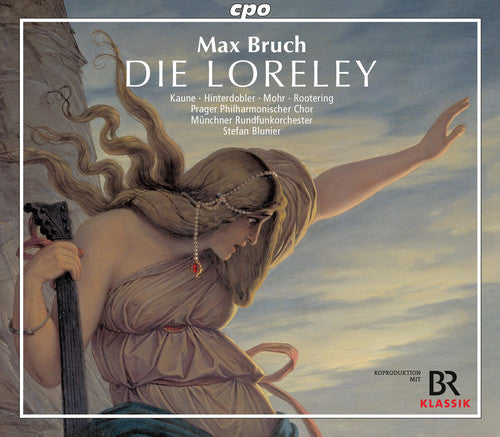
Bruch: Die Loreley / Blunier, Munich Radio Orchestra
The Loreley is one of the most famous figures of the romantic era, and even today the massive rock in the Rhine is notorious for threatening the river’s skippers with shipwreck. The legendary female figure with her seductive beauty today no longer haunts the river, but her story continues to resonate in the imagination. In 1861, when he was a mere twenty years old, Max Bruch, a Rhinelander born in Cologne, devoted an opera to the Loreley, a work based on a libretto by the great Emanuel Geibel himself. This opera in four acts is only rarely performed and until now has never been recorded on album. The Munich Radio Orchestra will now change this state of affairs: in a concert performance initiated by cpo the orchestra presented the work under the conductor Stefan Blunier, who was the General Music Director of the City of Bonn – that is, in the vicinity of the Loreley – when the recording was produced. The marvelous Michaela Kaune interpreted the title role in a top-quality performance, and Thomas Mohr was her male counterpart. Bruch set the Loreley story, in which everything, both in ambience and action, constituting a “Grand Romantic Opera” (thus the work’s subtitle) is present, in a highly romantic musical language. It is not without reason that Hans Pfitzner lent his support to this forgotten gem throughout his life.
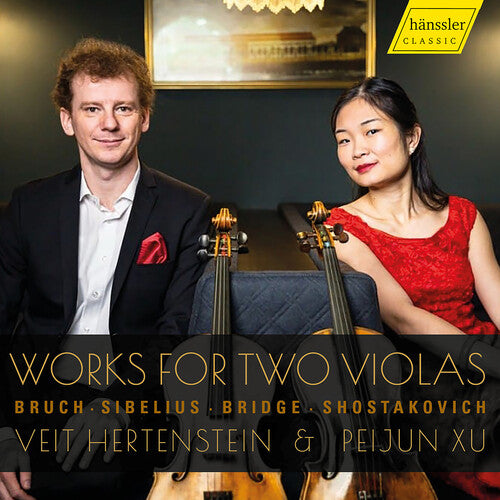
Bruch, Bridge, Sibelius, Shostakovich: Works for 2 Violas / Hertenstein, Peijun Xu, Ahn
Peijun Xu, born in Shanghai, is one of the leading violists of her generation. As a soloist, Peijun Xu has performed in renowned venues such as the Shanghai Concert Hall, the Laeiszhalle Hamburg or the Alte Oper Frankfurt. Her chamber music partners include Paul Rivinius, Evgenia Rubinova, Alexander Sitkovetsky and Veit Hertenstein. German violist Veit Hertenstein plays with “brigthly ringing, luminous and finly finessed sound (The Strad Magazine 2022).
Veit Hertenstein is Professor for Viola at the Musikhochschule Detmold, Germany since 2015.
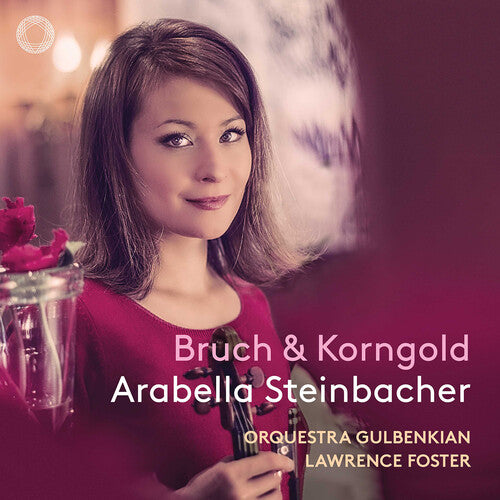
Bruch & Korngold: Violin Concertos / Steinbacher, Foster, Gulbenkian Orchestra
On this critically-acclaimed recording, Arabella Steinbacher brings together Bruch’s world famous First Violin Concerto with Chausson’s lush Poème and Korngold’s Violin Concerto, which is gradually gaining ground as a twentieth-century masterpiece. Steinbacher is joined by the Orquestra Gulbenkian under the baton of Lawrence Foster, with whom she has developed a congenial musical partnership over the years. BBC Music Magazine commented that “there is no doubting Steinbacher’s refulgent sound or the flair of her delivery” while MusicWeb International praised “the tingling climax of this Chausson.”
After a temporary absence, this album now returns to the physical market in an affordable Stereo re-issue. Arabella Steinbacher is a multiple award-winner with an extensive Pentatone discography spanning more than a decade. Lawrence Foster and the Orquestra Gulbenkian are also longstanding partners of the label.
Excerpt from review of the original SACD version of this release:
There is no doubting Steinbacher's refulgent sound or the flair of her delivery.
-- BBC Music Magazine
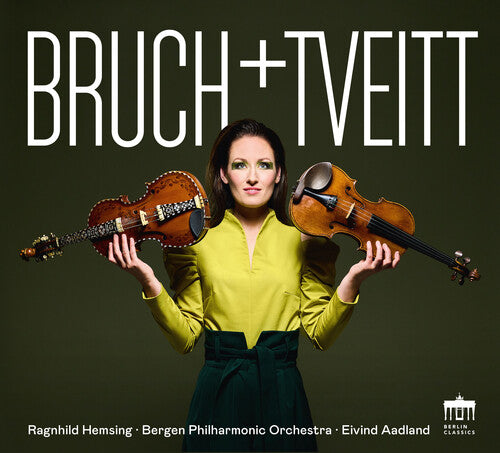
Bruch & Tveitt / Hemsing, Aadland, Bergen Philharmonic Orchestra
Experience the rich and vibrant sounds of Europe's Romantic tradition with our latest CD featuring music by four talented composers. Discover the little-known talent of Sigurd Lie, a highly skilled violinist and composer from Norway who studied with leading teachers in Leipzig and Berlin. Immerse yourself in the enchanting folk tale inspiration of Lie's "Huldra aa'n Elland" for violin and orchestra and be captivated by the playful and seductive solo violin performed by the renowned violinist Ragnhild Hemsing. Follow in the footsteps of Lie's compatriot, Johan Svendsen, a famous violinist and composer who studied in Leipzig and Paris and is best remembered for his Romance for Violin and Orchestra, Op. 26. Svendsen's work was admired by Belgian violinist and composer Eugène Ysaÿe and was reprinted 65 times. This CD is a must-have for any lover of the Romantic era, the diverse sounds of Norway and Europe, and the virtuosic performances of Hemsing.
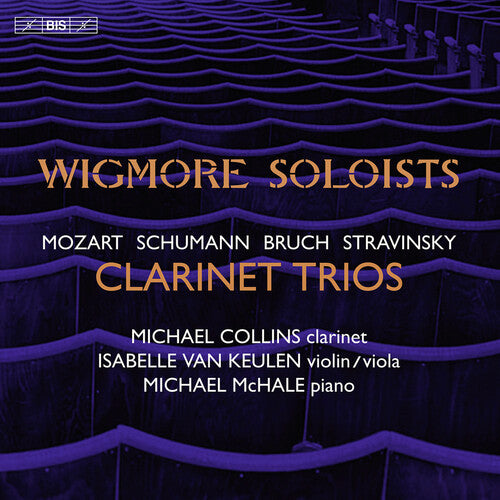
Bruch, Mozart, Schumann & Stravinsky: Clarinet Trios / Wigmore Soloists
As core members of the ensemble Wigmore Soloists, Michael Collins, Isabelle van Keulen and Michael McHale present four works for clarinet trio composed over a period of some 130 years. Mozart’s Kegelstatt Trio was long believed to have been composed during a game of bowling. The writing is reminiscent of a conversation between three friends in which contrasts are not excluded: we hear affection, divergences and even disagreements. This atmosphere of friendly, playful, and sometimes very intimate exchange also pervades Schumann’s Märchenerzählungen (Fairy Tales). While its spirited conviviality might give the impression that this work was the product of idyllic times, it was actually composed during Schumann’s last full year of sanity before his final mental collapse in 1854. There is a similar atmosphere of warm intimacy in Max Bruch’s Eight Pieces, written in 1910. Four of them are presented here, giving not a single hint of the approaching First World War. Based on a Russian folk tale, Stravinsky’s stage work L’Histoire du Soldat may be less good-natured than the preceding works. But the music is wonderfully entertaining, borrowing from various genres, including jazz. The composer’s trio version consist of five movements and has deservedly become his most frequently performed chamber composition.
REVIEW:
As expected, the performances are excellent. The Mozart is wonderfully lyrical; the Stravinsky crackles with energy; and the Schumann and the Bruch have the intensity and heartfelt phrasing the composers require. Collins leads with his clear and resonant timbre, dazzling fingers and articulation, and superb musicianship; and McHale lends splendid tone, touch, technique, and sensitivity. Van Keulen demonstrates terrific versatility all through, from warm contralto utterances to spunky fiddle playing, though sometimes her viola lines are a little thin and scrappy. Even so, the profound devotion to each score makes this album very worthwhile.
-- American Record Guide
Bruch: Violin Concertos Nos 1 And 3 [sacd]
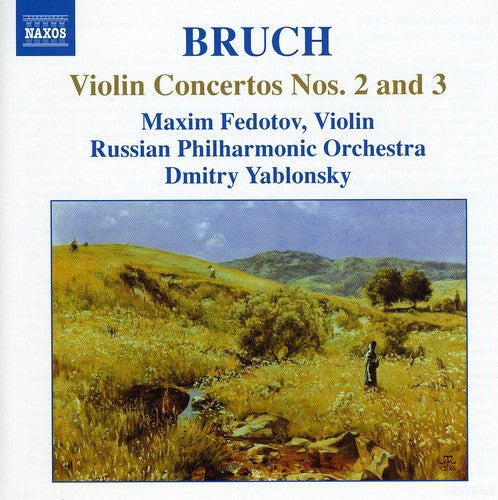
Bruch: Violin Concertos No 2 & 3 / Fedotov, Yablonsky, Russian PO

My French colleague Christophe Huss called a few days ago and said "You've got to try the new Bruch Concerto disc on Naxos. It's really excellent." Now Christophe really does know his stuff, and even his Bruch, which is saying a lot. Tovey thought Bruch was a genius, especially for his choral works, but then he said the same thing about Parry, so even great writers on music have their weak spots. Still, there's no denying that in writing for violin and orchestra Bruch was in his element, and the neglect of these two works is rather remarkable.
The Second concerto always has impressed me as being every bit as good as the First. Like its more famous predecessor, it avoids that Romantic Achilles' heel, the sonata-form first movement. Here a voluptuous and melodically stunning Adagio leads to a brief, dramatic recitative and a lively finale. The Third concerto isn't quite so lucky--sonata form rears its ugly head in the very long first movement--but violinist Maxim Fedotov and conductor Dmitry Yablonsky take Bruch's "energico" directive at face value and all comes out well. Certainly, Bruch had no issues with finales (almost as big a problem as opening movements), and that of the Third concerto is particularly winning, and marvelously scored.
Fedotov plays both works splendidly. He has that gutsy, vibrant tone characteristic of so many Russian string players, which means that he's able to relax into the lyrical music without ever turning coy. In the finale of the Third, especially, his double-stopping is a joy, his passage work pretty immaculate, and he projects both concertos with real virtuoso relish. Yablonsky and the orchestra accompany with similar enthusiasm, and the sonics are extremely natural and well balanced. You might be tempted to overlook this release--but don't. Thank you, Christophe!
--David Hurwitz, ClassicsToday.com
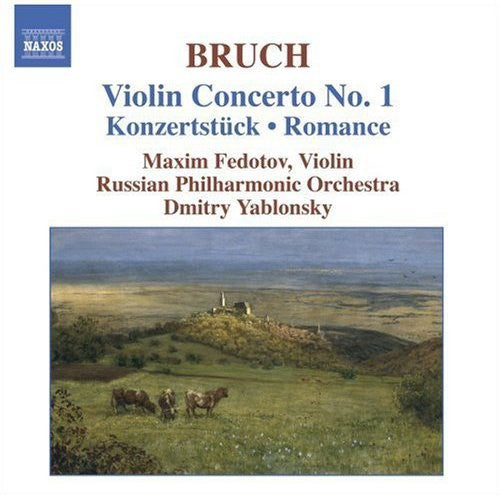
Bruch: Violin Concerto No 1, Etc / Fedotov, Yablonsky, Et Al
--Victor Carr Jr, ClassicsToday.com
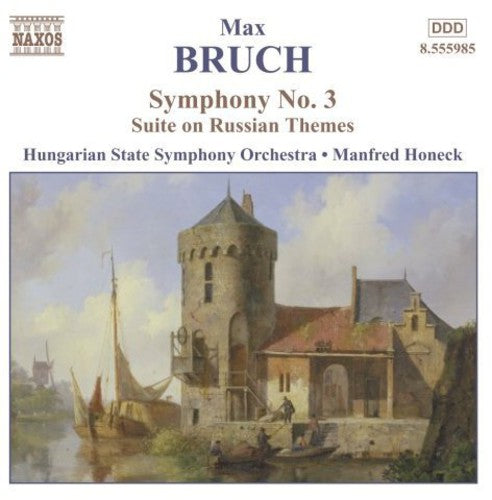
Bruch: Symphony No 3, Suite On Russian Themes /Honeck, Et Al
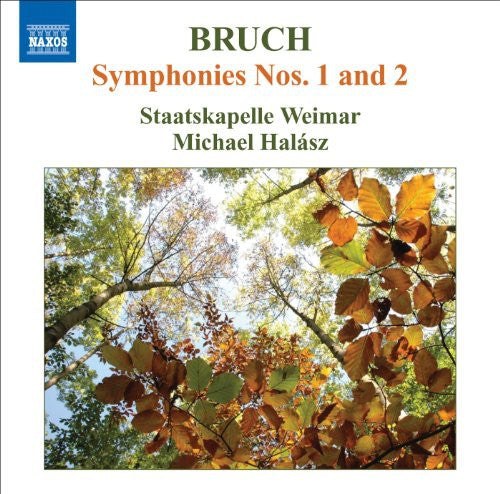
Bruch: Symphonies 1 & 2 / Halasz, Staatskapelle Weimar
Max Bruch (1838–1920) continues to be known almost exclusively by three works that have virtually eclipsed everything else he wrote: the Violin Concerto No. 1 in G Minor, the Scottish Fantasy for violin and orchestra, and the Kol Nidre for cello and orchestra. Yet even at that he fared a lot better than the practically anonymous August Friedrich Martin Klughardt (1847–1902) who, after four operas, five symphonies, concertos for violin and cello, and a number of chamber works, has not one, let alone three, box-office hits to his name. As for Bruch, it’s possible that his most enduringly popular works may not even be his best works, for in my opinion, he was a far better composer than is generally acknowledged.
Of his three symphonies, the first two are presented here. Both scores were produced in rapid succession between 1867 and 1870, sandwiching between them the composer’s First Violin Concerto, which was first performed in its present form by Joseph Joachim in 1868. Bruch dedicated the E?-Major Symphony to Brahms and the F-Minor Symphony, not surprisingly, to Joachim, who had just premiered the revised G-Minor Concerto. There is little in either of these works, however, to suggest Brahms as a strong influence; for Bruch’s sin, if you wish to call it that, was his musical conservatism, at least insofar as content is concerned. Form is another matter, as is evidenced in the first two of his violin concertos and Scottish Fantasy , none of which conform to traditional classical models.
While the First Symphony sports a conventional four-movement layout, with the Scherzo placed second, there are some idiosyncratic Bruch oddities. The first movement, for example, even with its customary exposition repeat, wants to cast off its sonata-allegro legacy. The brief introductory statement becomes inextricably entwined with the main thematic material, the development section is not clearly differentiated from the exposition, and the recapitulation is a heavily modified version of its antecedent exposition. Also unusual, though not unprecedented for Bruch, is that all of this is compressed into nine and a half minutes, which, by later 19th-century standards, is quite short, though we see this same condensed brevity in the first movement of the First Violin Concerto.
As for content, Bruch’s models are obvious: Schumann in the first and fourth movements and Mendelssohn in the second and third. In fact, there are moments in the Scherzo and Quasi Fantasia: Grave where Bruch seems to be revisiting Mendelssohn’s Midsummer Night’s Dream music and the “Scottish” Symphony of a quarter-century earlier. But the sheer melodiousness of the music and the resplendent orchestration are irresistible.
Formally, the Second Symphony is even more unusual for its time. In only three movements (fast-slow-fast) instead of four, it more closely resembles a concerto than it does a symphony. Yet its three movements combined exceed the First Symphony’s four by six minutes. Content-wise, the minor key makes for a darker-hued, more somber-sounding work. But there’s more to it than that. Mendelssohn and Schumann seem to have faded into the background. The thematic material is not as immediately melodic in a hummable way. Lines are more chromatic, statements more stentorian, almost hectoring at times, and the orchestral fabric granitic. It’s hard to say if at this early date Bruch might have heard something by Bruckner or, if he had, what it might have been, for as of 1870, when Bruch’s Second Symphony was completed, Bruckner had only gotten as far as an early student symphony (1863), the Symphony No. 1 in C Minor (1866), and the Symphony No. 0 in D Minor (1869). But Bruch’s work does sound closer to early Bruckner than it does to Mendelssohn, Schumann, or to anyone in the Brahms orbit.
Bruch’s symphonies are not without prior representation on disc, but current choice is limited. The main competition to this new Naxos recording with Michael Halász and the Staatskapelle Weimar comes from the long-established Kurt Masur leading the Leipzig Gewandhaus Orchestra, originally and still available on mainline Philips, and reconstituted with a different set of works on a Philips Duo release. It was the Masur recordings through which I first became familiar with Bruch’s symphonies, and they still have a great orchestra and a celebrated conductor going for them.
Halász’s work on disc is well documented, with some 150 recordings to his name. The Weimar Staatskapelle, however, has a much smaller presence on the recording landscape, with some 10 entries currently listed. And its only other team-up with Halász, at least on CD, has been a recent Naxos release of Joseph Joachim’s violin concerto. Frankly, what the Masur/Leipzig performances do not have going for them are great recordings. I always felt the Philips sound was a bit woolly around the edges, taking the bite out of the trumpets and muddying the cellos, double basses, and timpani at the low frequencies. The Naxos recording exhibits wider frequency and dynamic ranges, and seems to have been captured from a mid-hall perspective, making for a very satisfying listening experience.
As for interpretive disparities between Masur and Halász, they strike me as relatively inconsequential. Overall, Masur tends to adopt slightly broader tempos in most movements, but evens out the timings with slightly faster tempos in a couple of instances so that in the end both conductors come within seconds of each other. I think it’s the somewhat opaque sound of the Philips recordings that makes Masur’s readings sound a bit slower than they actually are. Halász, aided by an excellent recording and by very fine playing from his Weimar forces, would now be my first choice for these works. I would also expect that Naxos, not being averse to duplicating material already in its catalog, will soon give us Bruch’s Third Symphony with Halász and the Staatskapelle Weimar to complement its two-decades old version with Manfred Honeck and the Hungarian State Symphony Orchestra. Strongly recommended.
FANFARE: Jerry Dubins
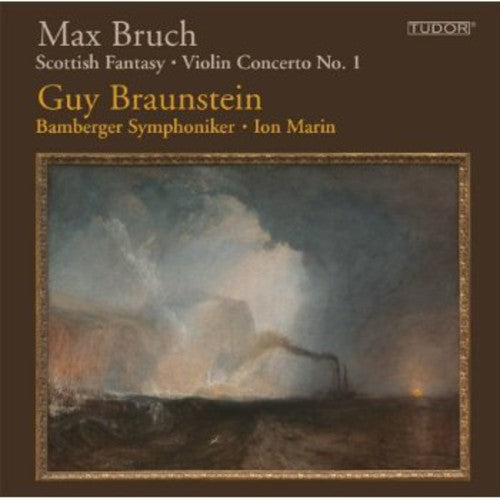
Bruch: Scottish Fantasy; Violin Concerto No. 1 / Braunstein, Marin, Bamberg Symphony
-- Classical Candor
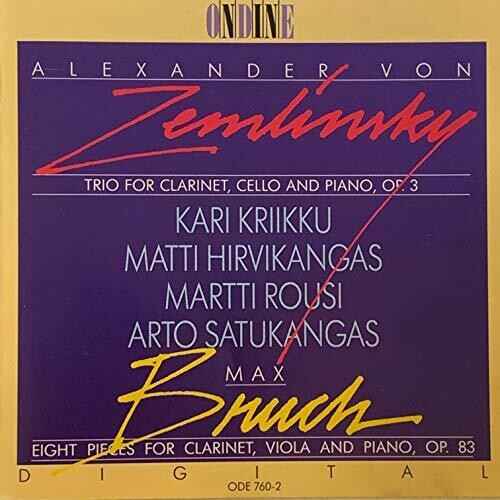
Zemlinsky, Bruch: Clarinet Trios / Kari Kriikku
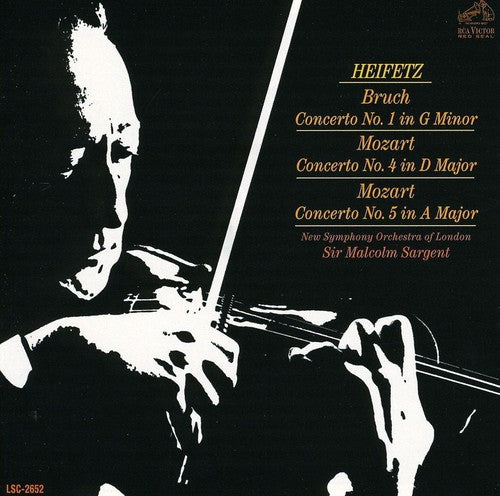
Bruch: Violin Concerto No. 1; Mozart: Violin Concertos Nos. 4 & 5 / Sargent, Heifetz
-- Arthur Lintgen, Fanfare [7/2006]
"Except for the human voice itself, probably no instrument of music so intimately reflects the individuality of the musician as the violin. So this record gives us, in addition to the fabled Heifetz technical wizardry, the Heifetz personality. That personality is encountered here in its maturity—and in the A major Concerto perhaps something slightly beyond that. Throughout the D major, however, the justly famous powers of intonation are exhibited at their nearly supernatural best."
-- Gramophone [9/1972] Reviewing Mozart Concertos
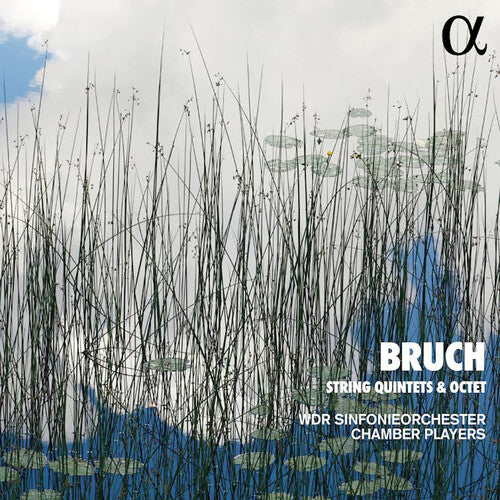
Bruch: String Quintets & Octet / WDR Sinfonieorchester Chamber Players
Max Bruch was eighty years old when, in 1918, he decided to return to the chamber music genre he had frequented in his early years. Stimulated by the violin virtuoso Willy Hess, he composed two string quintets and an octet, monuments to beauty and harmony, at the end of a tumultuous personal life and in the midst of a western world on the brink of collapse. After an album devoted to Beethoven’s chamber music, the Chamber Players of the WDR Sinfonieorchester now tackle one of the last chapters of German Romantic music, with pieces that constitute Bruch’s swansong.
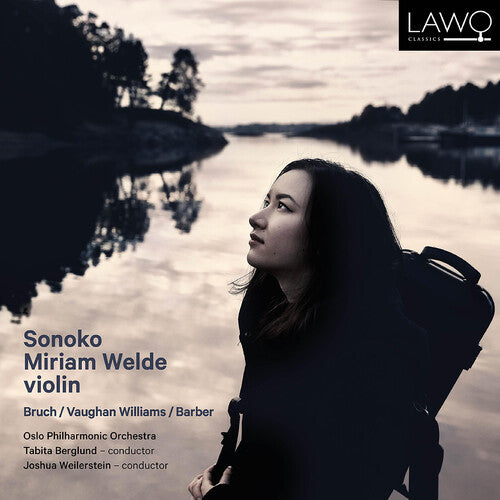
Bruch, Barber, Vaughan Williams: Violin Concertos / Sonoko Miriam Welde
Sonoko Miriam Welde writes: “When you ask people which superpower they would choose if they could have only one, many answer that they would want the power of flight. Although I personally would prefer invisibility, I also think there is something enviable about the freedom of being able to fly... A lot has been said and written about how Vaughan Williams wrote The Lark Ascending during the 1st World War “when a pastoral scene of a singing bird on the wing seemed far removed from reality” (Betsy Schwarm, Britannica). I sometimes imagine people living through difficult times looking up at the lark, envying its life and freedom that they wish they had. It's a moving piece with soaring melodies and the lark's “silver chain of sound.” Soaring melodies are present in Barber's Concerto as well. Although it opens with a generous and warm melody, it doesn't take long for uncertainty to creep in, and large sections of the 1st movement are dominated by an “in-between” kind of feeling – in addition to the unbelievably triumphant and satisfying return of the opening theme of course! The 2nd movement is, for me, one of the most touching and heartbreaking pieces of music. It reminds me of "Somewhere" from West Side Story. Hope, pain and perhaps longing for something better. It is just endlessly beautiful... Bruch's Violin Concerto is a piece with its heart on its sleeve. The 1st movement is a very serious and dramatic introduction, the 2nd incredibly touching and sincere, and the 3rd so joyous and life affirming. This piece has accompanied me in many important and special moments in my life so far and I am so happy that it is with me in this one as well – my debut album with the Oslo Philharmonic, a fantastic group of musicians that I have loved and admired for many years!”
REVIEW:
This album is most definitely a fine showcase of Welde’s incredible artistry. Her energy, tone, even the skillful deployment of her vibrato (which is capable of both subdued and glowing hues) all speak to the years of study, practice, and work she has done. As a soloist of this highly emotive repertoire, Welde absolutely leans into the emotionality of these violin standards, but then again, she has earned that lean. My former violin teacher always reminded me that a violinist only earns this kind of emotional playing after first doing the enormous work of understanding the music and her instrument inside and out.
Vaughan Williams’s The Lark Ascending offers a nice sort of pause between the big emotions of Bruch and Barber. Welde’s harmonics are absolutely perfect—bright and breathy and sustaining the tension of the piece—and again, she is very comfortable deploying the tools at her disposal: her clean articulation, consistent and dynamic bowing, her anticipation of the overall structure of the solo part within the grander work. Welde’s extreme tonal control—perhaps on full display in the Bruch second movement—in her seemingly effortless movement from pianissimo to forte, feels as though she is able to shift dynamics within a single bow.
This is, overall, a really lovely album.
— Fanfare
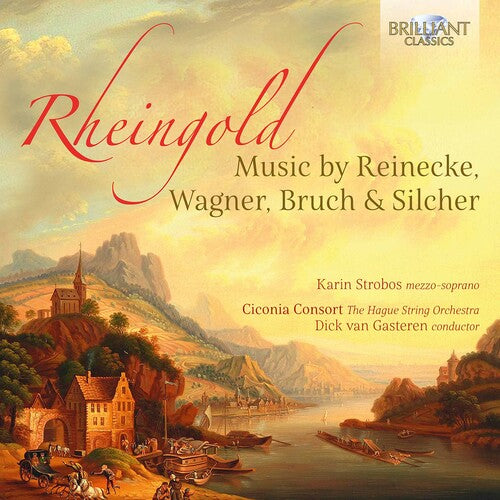
Rheingold / Strobos, Gasteren, Ciconia Consort
Previous Brilliant Classics albums by this Dutch string orchestra, based in The Hague, have focused on late-Romantic ‘American Pioneers’ (96086) and composers in early 20th-century Paris (95734). Under their founder-director Dick van Gasteren, they now turn to the rich history of Rhineland music from the high-point of its immortalisation in operatic culture as the bedrock of Wagner’s Ring cycle. Das Rheingold itself is present by implication in the cycle of Wesendonck-Lieder which Wagner composed on the shore of Lake Zurich, initially as sketches for Tristan und Isolde, which he had embarked upon as a venture to drum up interest and capital for the larger project of the Ring. Inspired by his intimate association with as well as the poetry of Mathilde Wesendonck, the wife of a wealthy silk merchant who was underwriting the composer’s sojourn in Zurich, Wagner then developed the songs into a self-contained cycle which throbs with transfigured desire much like the opera. The cycle is sung here by the mezzo-soprano Karin Strobos, whose career was launched by singing Octavian in Der Rosenkavalier at the Netherlands Opera under Sir Simon Rattle. She also sings the album’s notable rarity: a setting of Heine’s Loreley text, which describes the mythical creatures who lure unsuspecting Rhenish sailors to their doom like Greek Sirens. Originally composed as a male-voice partsong by Friedrich Silcher (1798-1860), the song has been transcribed by Dick van Gasteren for Strobos and La Ciconia. Complementing the songs are two unfamiliar but attractive examples of late-Romantic German string music: the Serenade Op.242 by Carl Reinecke, and the Concerto for String Orchestra by Max Bruch. Neither work enjoys more than a toehold on the record catalogue, and this engagingly vivid new recording makes the most persuasive case for them.
REVIEW:
Somehow this quartet of pieces brought to my mind the old wedding saw of “something old, something new, something borrowed, something blue.” For “something old” there is this Serenade of Carl Reinecke (1824–1910). Although I certainly recognize his name, I cannot recollect ever having heard any of his music before now, but this thoroughly delightful six-movement work shows that his oeuvre warrants further investigation.
For “something new” we have a work by Max Bruch (1838–1920) — the string octet he wrote in 1920, only a few months before his death. In the score, Bruch indicated that the piece was also suitable for performance by a full string orchestra, and upon publication of that version his publisher Simrock attached the title “Concerto.” While the octet has enjoyed no less than six previous recordings in its original form, this is the first one for full orchestra, and thus makes a welcome addition to the Bruch discography.
“Something borrowed” comes in the guise of Wagner’s Wesendonck Lieder, in a 2006 reduction for string orchestra by Gerhard Heydt. Frankly, I’m not certain what the point of this exercise is; certainly Wagner is hardly in need of reorchestration, and a good degree of tonal color is lost in subtracting woodwinds and brass. Mezzo-soprano Karin Strobos has a reasonably attractive and well produced but not exceptional voice; she sings with sincerity, but not the degree of subtle inflection these texts and settings require. This was by no means unpleasant to listen to, but there is no strong incentive to return to it.
Finally, for “something blue,” Strobos sings a setting by Friedrich Silcher (1798–1860) of Heinrich Heine’s famous poem of the original Rhine Maiden, whose beautiful appearance and singing lure ships and sailors to destruction. Silcher’s Lied is a bit peculiar in that it’s a lilting, waltz-like ditty, devoid of any darker undertones. Here Strobos and the ensemble are in their proper element.
The Ciconia Consort is further identified as being a nom de guerre for The Hague String Orchestra. Dick van Gasteren directs the players with a sure hand. The recorded sound is warm, with a certain degree of plush resonance. The booklet provides brief notes and song texts in German without translations. Although I would have preferred a full disc of lesser-known German string serenades, this definitely makes for enjoyable listening; cordially recommended.
-- Fanfare (James A. Altena)