Mily Balakirev
17 products
-
-
-
-
-
-
-
-
-
-
-
-
-
-
- Balakirev: Piano Sonata in B flat minor
- Balakirev: Piano Sonata No. 1 in B flat minor, Op. 5
- Balakirev: Piano Sonata in B flat minor, Op. 3 'Grand Sonata'
- Balakirev: Waltz No. 1 in G - Valse di Bravura
- Balakirev: Nocturne No. 1 in B flat minor
- Balakirev: Waltz No. 2 in F minor
- Balakirev: Waltz No. 3 in D - Valse Impromptu
- Balakirev: Nocturne No. 2 in B minor
- Balakirev: Waltz No.4 in B flat
- Balakirev: Nocturne No. 3 in D minor
- Balakirev: Waltz No. 5 in D flat major
- Balakirev: Nocturne in G sharp minor (early version of Nocturne No. 1)
- Balakirev: Fantasiestuck
- Balakirev: Chant du pêcheur
- Balakirev: Waltz No. 7 in G sharp minor
- Balakirev: Mazurka No. 1 in A Flat
- Balakirev: Mazurka No. 2 in C sharp minor
- Balakirev: Sonatina (Esquisses) in G
- Balakirev: Berceuse
- Balakirev: Mazurka No. 3 in B minor
- Balakirev: Mazurka No. 4 in G flat minor
- Balakirev: Dumka
- Balakirev: Mazurka No. 5 in D
- Balakirev: Rêverie in F major
- Balakirev: Mazurka No. 6 in A Flat
- Balakirev: Piece in F sharp minor
- Balakirev: Mazurka No. 7 in E flat minor
- Balakirev: Capriccio
- Balakirev: Scherzo No. 1 in B minor
- Balakirev: Novelette
- Balakirev: Pustinya
- Balakirev: Scherzo No. 2 in B flat minor
- Balakirev: Fandango-Etude
- Balakirev: Spanish Serenade
- Balakirev: Caprice Brilliant Sur La Jota Aragonesa
- Berlioz: L'Enfance du Christ, Op. 25: La fuite en Egypte - Overture
- Balakirev: Scherzo No. 3 for Piano in F sharp major
- Balakirev: Spanish Melody
- Taneyev, S: Valse-Caprice No. 1 in A flat
- Taneyev, S: Valse-Caprice No. 2 in D flat major
- Glinka: Ivan Susanin (A Life for the Tsar): Overture
- Glinka: Ruslan and Lyudmila: Chernamor's March
- Chopin: Piano Concerto No. 1 - Romanza (transc Balakirev)
- Balakirev: Impromptu on the themes of two Preludes by Chopin
- Chopin: Scherzo No. 2 in B flat minor, Op. 31
- Liszt: Mazurka brillante, S221
- Beethoven: String Quartet No. 8 in E minor, Op. 59 No. 2: Allegretto
- Beethoven: String Quartet No. 13 in B flat major, Op. 130: Cavatina
- Balakirev: Gondellied
- Balakirev: Tarantelle in B
- Balakirev: Polonaise Brillante
- Balakirev: La fileuse
- Balakirev: Au Jardin
- Glinka: Kamarinskaya
- Balakirev: Symphonic Poem 'Tamara'
- Balakirev: Polka in F sharp minor
- Balakirev: Elegy on the Death of a Mosquito
- Balakirev: La Danse De Sorcières (Witches Dance)
- Glinka: Ne Govori: Lyubov' Proydyot (Do Not Say: Love Passes Away)
- Balakirev: Tyrolienne
- Zapol'sky: Reverie
- Balakirev: Toccata
- Balakirev: The Lark
- Balakirev: Islamey - Oriental Fantasy
-
-
-
-
BALAKIREV: Symphonies Nos. 1 and 2 / Piano Concerto in F-Sha
Balakirev: Symphony No. 1 & Piano Concerto No. 1
SYMPHONY NO. 1 SYMPHONIC POEM
Glinka: Complete Piano Music Vol 3 / Victor Ryabchikov
Includes polonaise(s) by Mikhail Glinka. Soloist: Victor Ryabchikov.
Includes waltz(es) for pno by Mikhail Glinka. Soloist: Victor Ryabchikov.
Includes work(s) for pno by Mikhail Glinka. Soloist: Victor Ryabchikov.
TCHAIKOVSKY / BALAKIREV / GLAZUNOV: Arrangements for 2 Piano
Balakirev: Complete Piano Works Vol 1 - Sonatas / Nicholas Walker
Balakirev: Complete Piano Works, Vol. 4 / Walker
This fourth volume in Nicholas Walker’s complete edition of Balakirev’s piano music is structured around his three Scherzos, which take us from the youthful influence of Chopin and Liszt in the First Scherzo, to the music of his prolific final decade, from which the Second Scherzo is one of his finest compositions. Balakirev’s interest in Spanish music was kindled by his mentor Glinka, creating surprisingly authentic sounding textures and rhythms, and the programme is topped with the elegantly masterful poetry of the two Valse-Caprices. Nicholas Walker studied at the Royal Academy of Music and the Moscow Conservatoire. Winner of the first Newport International Piano competition, he has performed with major British orchestras, given recitals worldwide, and recorded for the BBC, BMG Arte Nova, ASV, Chandos and Danacord labels. He is also sought after as an imaginative and sensitive accompanist. Although his Beethoven performances have brought him special critical acclaim, and his performances of lyrical and late Romantic piano music have also been highly praised, he is best known for championing the neglected leader of ‘The Mighty Handful,’ Mili Alekseyevich Balakirev. In 2010 he organized the Balakirev Centenary concerts in London. He also teaches at the Royal Academy of Music.
Mussorgsky, M.P.: Pictures At An Exhibition / Ravel, M.: Gas
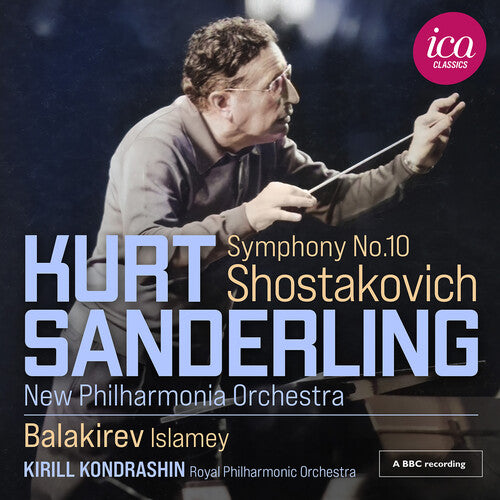
Shostakovich: Symphony No. 10; Balakirev: Islamey / Sanderling, Kondrashin
Kurt Sanderling (1912–2011), born in Prussia, fled Germany for the USSR on the invitation of his Jewish relatives living there, to seek artistic and personal refuge from the Nazi regime. He remained in the Soviet Union until 1960, working as assistant conductor and sharing concerts with the legendary Yevgeny Mravinsky, chief conductor of the Leningrad Philharmonic. In 1960, he moved to East Berlin to become music director of the Berlin Symphony Orchestra (1960–1977) and the Dresden Staatskapelle (1964–1967) and started conducting around Europe, Japan, the US, and in the UK forming a close rapport with the New Philharmonia (later Philharmonia) in 1972. He developed a strong personal relationship with Shostakovich, which began in 1943 and which lasted for decades. Shostakovich’s Symphony No.10, written in 1953 following the death of Stalin, is regarded by many as his greatest work. The composer said of it, ‘I wrote it right after Stalin’s death and no one has yet guessed what the symphony is about. It’s about Stalin and the Stalin years. The second part of the Scherzo is a musical portrait of Stalin.’ The short filler is a performance of Balakirev’s Islamey, directed by Kirill Kondrashin (1914–1981), one of Russia’s greatest conductors and a close friend of Shostakovich who recorded the entire cycle of the composer’s symphonies with the Moscow Philharmonic.
Balakirev: Orchestral Works / Klinton, Kütson, Niederrheinische Symphoniker
The music of Mily Balakirev has largely disappeared from concert halls today. The dewy new recording by the Niederrheinische Symphoniker under the baton of chief conductor Mihkel Kütson comes at just the right time: the 1st Piano Concerto with Dinara Klinton as soloist, plus the 2nd Symphony and two highly original overtures attest to Balakirev's special place in music history, not least as the spiritus rector of the so-called "Mighty Group". With the "Mighty Group", Balakirev and his comrades-in-arms wanted to commit themselves to genuinely Russian music, in contrast to their "Westernised" colleagues Tchaikovsky and Rubinstein. Balakirev even founded his own music school, which dispensed with classical studies with lots of finger exercises and counterpoint lessons - not always to the students' advantage... Because of his commitment to young musicians, Balakirev often left compositions he had begun lying around for decades. It is uncertain whether this is why the one-movement piano concerto remained unfinished. However, the virtuoso work is convincing in every respect: wide-ranging passages of free fantasizing hint at Liszt and Chopin as models. The 2nd Symphony, which Balakirev was only able to complete towards the end of his life, is also formally idiosyncratic. Russian themes demonstrate Balakirev's deep knowledge of folk music, which he studied on his travels through the Caucasus. With the Niederrheinische Symphoniker, all this sounds fresh and unspent - and in the high-quality 3D recording, it is also an acoustic delight.
Balakirev: Grand Fantasia, 30 Songs / Krimets, Banowetz
The track from this album was nominated for the 2008 Grammy Award for "Best Chamber Music Performance."
The Year That Never Was - Piano Music / Matei Varga
Matei Varga writes: “To paraphrase Tolstoy, all happy memories feel more or less the same; but the unhappy times are experienced differently by each one of us. We’ve all had some really tough weeks, which sometimes turned into months, and (with a bit of bad luck) into years… I like to think that “off” years help us grow and prepare for the beautiful things that will undoubtedly come our way (I am an optimist at heart), but living through dark times is a complicated process.
The year 2020 was complicated indeed. The world was put on hold and we hardly remember what we did in February, or May, or September… Many suffered from isolation and the inability to socialize - and they probably prefer to think back to 2020 as a year that never happened… I, on the other hand, felt liberated by the lack of schedules, appointments and the pressure to be productive - that horrid word which is killing our souls, slowly but surely. Instead I embraced seclusion and enjoyed the time off which was forced upon us. Yes, I did miss performing in front of a live audience and traveling to beautiful places, but I found that staying home, with my piano, offered me a better view towards my inner self and a chance to experience the joy of a new discovery. That was for me the Cuban master Ernesto Lecuona…Two years later, the pandemic isn’t over and neither is the collective anxiety- but at least I can offer you this very personal recording, which I hope will take your mind away from current realities. This is music’s most phenomenal power- to bring joy when we really need it!...”
REVIEW:
The Year That Never Was in Romanian pianist Matei Varga’s title here is 2020; he writes of how he came to embrace the COVID-era isolation and explored the work of Ernesto Lecuona, a composer about whom he had previously known little. The output of Cuban composer Lecuona is sometimes categorized as salon music, and while it includes a few classical hits like the opening Andalucía (from the Suite española), much of his large production of some 600 works remains little explored. Here, the excerpts from the Danzas cubanas del siglo XIX and Danzas Afro-Cubanas will be worth the price of admission for Lecuona fans. He wants to expand the notion of salon music to include some of its predecessors, not only Chopin but going back as far as Domenico Scarlatti. That pandemic seems to have produced a boomlet in recordings of salon music, which is probably understandable, and Varga’s release is a novel take on the idea.
-- AllMuic.com (James Manheim)
Balakirev: Complete Works for Solo Piano / Walker
These recordings of Balakirev’s complete solo piano works by the much-lauded pianist Nicholas Walker have been hailed as ‘the reference set’ by the American Record Guide. Originally released between 2013 and 2020, these critically acclaimed performances are now collected together for the first time in a 6 album box set. Includes world premiere recordings. Hailed by the London Evening Standard as a 'prodigy, of awesome technical fluency backed by exceptional artistry', Nicholas Walker possesses a rare combination of talents combining sensitivity with 'the flair of a full scale virtuoso and a sparkling intelligence' (BBC Music Magazine). Nicholas Walker teaches at the Royal Academy of Music in London, where he devised the celebrated keyboard skills course, the advanced level of which not only helps students to be proficient in all aspects of practical musicianship, but offers them the chance to learn how to improvise in various forms, such as minuets, variations, sonatinas and Mozart-type cadenzas, in addition to devising and performing a virtuoso transcription of their own.
CONTENTS:
Past praise of previously released volumes included in this set:
Balakirev: Complete Piano Works Vol 1
Walker presents the works in reverse chronological order, thereby giving us the best and best-known work first. It is a masterly performance, fully on a par with or exceeding ones I have reviewed in recent years: Hinrose (Mirare 181, Nov/Dec 2012), Driver (Hyperion 67806, July/Aug 2011), and Hellaby (Cameo 2081, Sept/Oct 2009). Besides Kentner’s great recording (Naxos 111223, not available in US), I also enjoy Earl Wild’s (Ivory 73005, May/June 2004). Walker finds inner voices and emphasizes some different aspects of the harmony and form, making for a new and well thought out interpretation. He has the full technical capability to handle all of the demands of this score
– American Record Guide
Balakirev: Complete Piano Works Vol 3
This third volume of Balakirev’s complete piano works is built around his seven Mazurkas, joyous and colourful pieces with an unmistakable Slavic tone. This series continues to establish Walker as the new reference for Balakirev’s music.
– Musiq3
Balakirev: Complete Piano Works Vol 5
This one is particularly fascinating for transcription junkies, beginning with the spectacular (and spectacularly difficult) Reminiscences on Glinka’s A Life for the Czar, famous from Earl Wild’s 1969 recording. Walker is quite his equal—and that is saying something—and is also beautifully recorded in a realistic, sympathetic acoustic. Indeed, Walker’s playing throughout this absorbing disc is a pleasure to hear, with a sophisticated tonal palette and eschewing any superficial virtuosity: ‘bravura with integrity’ is how I would describe it. Why don’t we hear more of him?
–Gramophone
Tchaikovsky: The Seasons; Balakirev: Islamey / Bronfman
If you've seen Yefim Bronfman perform, you know that he's an assertive, brilliant pianist who commands attention, even in a large hall. The soloist is remarkably successful in scaling back his playing for the 12 modest pieces Tchaikovsky produced for serial publication in a monthly music magazine. Bronfman resists the temptation, for instance, to dazzle with a faster tempo in "The Harvest" (August), which he certainly could have undertaken with one hand (or at least a couple of fingers) tied behind his back. Nor does he look for profundity that isn't there in these unassuming miniatures, or "Chopinize" the more lyrical movements. The well-known "Barcarolle" (June) is played with a straightforward sort of melancholy that's exactly right—touching without seeming overwrought. Still, the playing is eventful and involving, and carefully articulated: Listen to the crystalline clarity of February's "Carnival." Sony provides superb sound, utilizing 24-bit encoding and their "Super Bit Mapping" methodology. The performances were taped at the Troy Savings Bank Music Hall, in New York State, a celebrated venue that has been exploited by a number of labels. The sonic presentation is warm yet immediate and clear, capturing fully the refinement of Bronfman's touch. I prefer Bronfman's Seasons to three others on hand: Antonin Kubalek (on Dorian, recorded 12 years earlier in the same Troy concert hall), Naum Starkman (on PopeMusic) and, by a smaller margin, Luba Edlina (on Chandos). As though to underscore that he was holding back in the Tchaikovsky, which is quite accessible to talented amateurs, the soloist proceeds on to an echt virtuoso vehicle. Islamev, of course, is for major-leaguers: Do not try this at home unless you are a trained professional. Bronfman gives us quite a ride. The work's considerable technical demands are fairly tossed aside as the pianist presents a coherent musical structure, not merely a succession of pianistic feats. This is a reading with sweep and even some majesty. In comparison, Alexander Paley, leading off his admirable six-CD set of Balakirev's complete piano music for ESS.A.Y with Islamey, sounds dutiful and a bit tentative.
One might grouse about the short timing of this disc. Bronfman could have given us more Tchaikovsky, more Balakirev, more something. But what's the better value: a humdrum 75 minutes or a soul-satisfying 50 that you'll return to often? Not a toughie.
-- Andrew Quint, FANFARE [3/1999]
Balakirev: Complete Piano Works, Vol. 6 / Nicholas Walker
Balakirev: Piano Concertos / Seifetdinova, Yablonsky
Although completed by Sergei Lyapunov, Piano Concerto No. 2 sounds more like the Balakirev we know from the symphonies. The musical argument is more dramatic and the melodic material is distinctively Russian, especially in the touching Adagio movement, the work's emotional center. Balakirev's piano writing has grown more evocative while becoming more technically demanding. Again, Seifetdinova handles these challenges with aplomb.
Finally, Balakirev's early Grande Fantaisie on Russian Folksongs is reminiscent of the composer's symphonic poem Tamara in its exotic themes and narrative style, wherein the piano, with its extended solo passages, takes on the role of story teller. All three works receive excellent orchestral performances by the Russian Philharmonic under Dmitry Yablonsky. The rich-sounding recording nicely balances soloist and orchestra. An enjoyable release, for Russophiles and piano fans alike.
--Victor Carr Jr, ClassicsToday.com