Morton Feldman
22 products
Complete Works for Multiple Pianos
VIOLIN & PIANO
Feldman: The Northern Shore
NEITHER
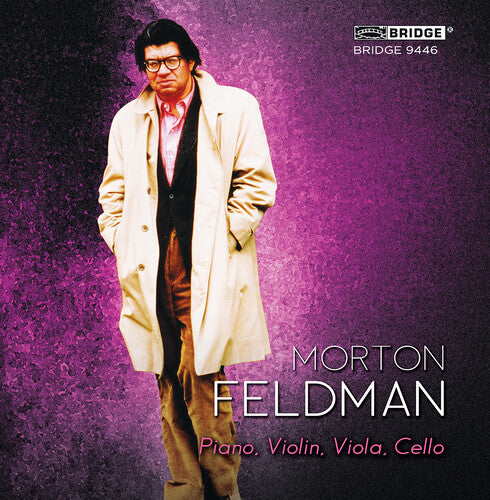
Feldman: Piano, Violin, Viola, Cello
Trio (Remastered)
Feldman: Triadic Memories and Piano
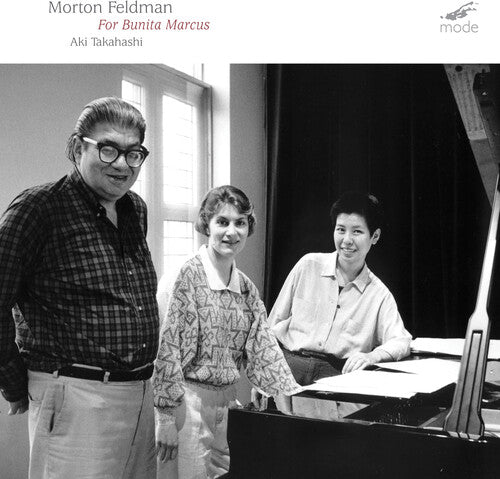
Feldman: For Bunita Marcus / Takahashi
For Bunita Marcus opens with a clear call to our attention. With these first six notes, we step over the threshold and into the journey of the piece. We know that we are in this for the long haul: Morton Feldman’s late works are notorious for being marathons. He composed For Bunita Marcus in 1985, immediately after his four-hour For Philip Guston, and two years after his six-hour String Quartet (II). These earlier works make an hour-long solo piano piece seem short. Still, it is a long time to sustain a single movement, a single journey, and we inevitably have this in mind as we take the first step: so this is how it starts.
Feldman: For Samuel Beckett / Kluttig, Neue Musik Berlin
Feldman: Patterns in a Chromatic Field / Mayr, Anissegos
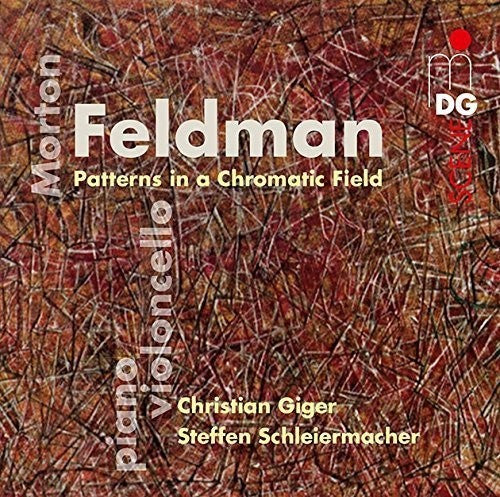
Morton Feldman's Patterns in a Chromatic Field is a major composition, not only in modern American music but in 20th-century music per se. The composer plays with the musical memory of his recipients and thus creates timeless spheres: In minimally varying patterns, the listener experiences a trance-like avant-garde event in which past, present and future cancel each other out. Patterns in a Chromatic Field is based on the principle of differentiation and repetition. The composition functions like a still life, using the color variations of Middle Eastern rugs as a basis: Even a pattern that appears to repeat itself exactly is actually slightly different in its iterations because of slight changes in hue. In his piece for piano and violoncello, Morton Feldman now creates a large-scale auditive pattern whose sound aesthetics from the layers of notes is no less than a transformative and meditative experience of music. With Antonis Anissegos on the piano and Mathis Mayr, this recording unites two performers who not only are excellent instrumental players but also feel at home in electronic music – a fact that is of benefit to their version of Morton Feldman’s minimalist soaring tonal architecture. Anissegos and Mayr create a detailed and intimate sound quality which can be regarded as referential in its antithesis of the ‘dramatic’.
Music of Morton Feldman, Vol. 5: Piano, Violin, Viola, Cello
There is much to be said about this music but there are few words which sum it up better than the composer’s own commentary on the stretched duration of his later pieces, “… scale is another matter. You have to have control of the piece – it requires a heightened kind of concentration. Before, my pieces were objects; now, they are like evolving things.”
Seventy-five minutes may seem daunting for a single piece of music, but it can easily embrace you in its time-altering atmosphere, and the duration can smoothly pass with the lightness of the beat of a butterfly’s wing. In the beauty of its closing minutes you can find yourself wishing it had been longer. That sense of ‘control’ is evident at every moment. There are no sections where the composer is marking time, nor thank goodness is there any evidence of the musicians back-pedalling in this excellent performance. There is relaxation and tension; as there is in the movement of your own chest when breathing. Notes and chords follow with impeccable logic from their predecessors, phrases are shaped, contrasts of timbre emerge, broad curves of profoundly far-reaching musical gesture are spread before us.
Everyone will have their own personal response to this, but for me it is an ultimate expression of loneliness. There is an undeniable melancholy about this piece, which always shifts away from any consolatory resolutions which seek to take root too firmly. There are fragments which might remind you of Debussy’s Des pas sur la neige, and in some ways it might be seen as a vast extension of its first two bars. As pianist Aleck Karis states in his brief booklet note, this is also a “luminous melancholy”, one which creates impulse and attracts rather than making one turn away and wish it would stop.
I’ve had a hunt around but there don’t seem to be any readily available alternatives. The Hat Hut label released a recording in 1995 with members of the Dutch Ives Ensemble which is no longer in print. In any case I have no hesitation in choosing this as a default first choice. If I have any criticism of the recording it is that the piano sounds a little soft-textured or mid-range heavy in its timbre, but this is not something which detracts from the effect of the whole.
-- Dominy Clements, MusicWeb International
Morton Feldman: Chamber Music
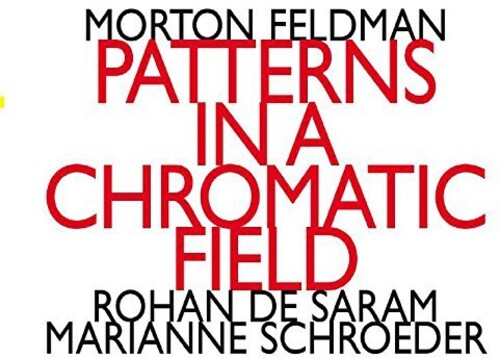
Feldman: Patterns in a Chromatic Field / Saram, Schroeder
Feldman: Patterns in a Chromatic Field / Giger, Schleiermacher
-----
REVIEW:
This is very satisfying and musically highly refined. There is a balance to be struck between enigmatic modernity and romantic affection for an abstract tradition which is in line with both Mark Rothko’s New York and Beethoven’s Vienna, and this is beautifully struck by these musicians. If you are a Feldman fan then this will be a very satisfying addition to your collection. Feldman newbies might find an 80 minute duo for cello and piano on a single CD track more than a little daunting, but, as with his other extended works, if you allow the piece its own space and inhabit it as you would an art gallery, then you will gradually sense your cells and synapses aligning themselves to something rather special.
– MusicWeb International
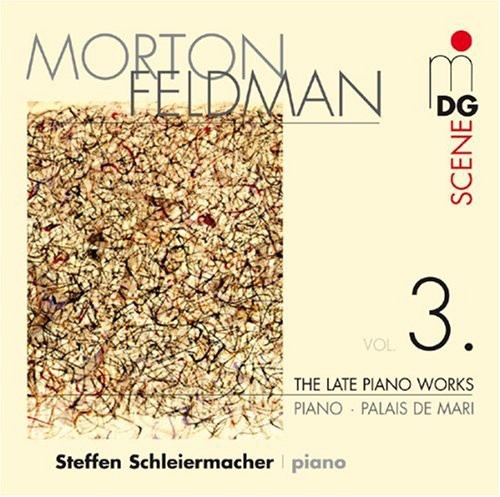
Feldman: Late Piano Works 3 / Steffen Schleiermacher
To be certain, Takahashi benefits from closer, more immediate engineering, and Mode fills out her disc with earlier (and much shorter!) Feldman fare. Yet Feldmanites who like MDG’s relatively distant ambience will appreciate how powerfully Piano’s sudden, loud chordal outbursts and residual overtones register. And in Palais de Mari, Schleiermacher’s vocally informed phrasing and long-lined fluidity contrasts to Sabine Leibner’s more austere deliberation (both interpretations hold equal validity, yet are quite different, and I wouldn’t want to give up either one). A worthy follow-up to Schleiermacher’s previous Feldman releases.
-- Jed Distler, ClassicsToday.com
Feldman: For John Cage / Haar, Snijders
Feldman: For Christian Wolf / Stone, Ray, California Ear Unit
For Christian Wolff is one of Morton Feldman's final compositions, and stands alongside the four-hours-plus For Philip Guston, the 70-minute For John Cage, and the six-hour String Quartet II. Writing about hearing this work, Christian Wolff says that "I found the experience of listening to it beautiful and interesting - it moves away partly from our (Morty's, John Cage's and mine) original preoccupation with just sound and sonority into areas of self-awareness about listening, being a listener, as such, because there's so much time to be thinking of this and that as well as just listening." The California EAR Unit's performances of Feldman's For Philip Guston (BRIDGE 9078A/D) and Crippled Symmetry (BRIDGE 9092A/B) have received high praise from the international musical press.
Feldman Edition Vol. 6 - String Quartet No 2 / Flux Quartet
String Quartet No. 2 (1983)
FLUX Quartet
Tom Chiu, violin
Cornelius Duffalo, violin
Kenji Bunch, viola
Darrett Adkins, cello
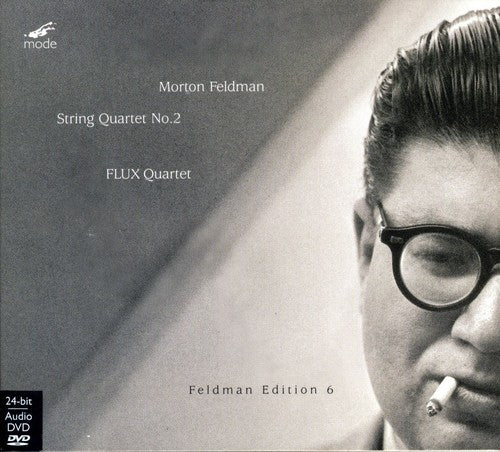
Feldman's monumental String Quartet No.2 is in one unbroken movement. The FLUX Quartet performance is complete, lasting a total of 6 hours 7 minutes and 7 seconds. Available in 2 Editions: a 5-CD set OR complete and uninterrupted on 1-DVD!
In the 1970s Feldman took up the study and collecting of antique Turkish rugs, a highly evolved and exquisite folk art. The rugs are intricately patterned, symmetrical in basic design but with constant variation and displacement in the detailed execution of that design; strikingly and subtly colored, including fine variegations of principal colors resulting from the dyeing process. Analogies are clear to Feldman's music as it takes up large-scale patterning, partly working with his familiar subtle gradations of rhythm and instrumental color and ostinati, loops or extended repetitions of a sounds, partly - and especially in this second string quartet - continually finding new and surprising qualities of color. There are a number of sounds in this piece unlike anything one has heard from a string quartet.
Lasting more than six continuous hours, it is "a disorienting, transfixing experience that repeatedly approached and touched the sublime." - Alex Ross, in his review of the FLUX Quartet's New York City performance in The New Yorker.
String Quartet 2's score is 124 pages, at one tempo marking of 63-66 beats per minute - as such, a slow tempo. Feldman idiosyncratically sets the bars, so one page may last as little as about half a minute or as much as nearly seven minutes.
"A very exciting quartet composed of four young men...who have lots of ideas and clearly enjoy making music together," - Anthony Tommasini, NY Times, the FLUX Quartet has performed to rave reviews at many music centers around the world. FLUX have performed Quartet 2 in concert numerous times and know the score intimately. The FLUX Quartet's repertoire consists of notable pioneers as well as visionaries of tomorrow - from "classics" by Nancarrow, Ligeti, and Cage, to works by John Zorn, Ornette Coleman, Oliver Lake, and tenor balloonist Judy Dunaway.
This deluxe set features liner notes by Feldman's colleague Christian Wolff, mixing personal experiences and recollections with analysis; and by FLUX founder Tom Chiu who writes of the "experience" of performing such a large-scale work.
One can experience the work uninterrupted - complete, with no need to change discs - on the DVD Edition; along with the thrilling realism of uncompressed 24-bit PCM sound. This audio-only DVD can be played on any DVD player (note: there are no visuals).
For ease of navigation, both the DVD and CD versions have many track points (approximately every 5-6 pages of the score) which allow you to navigate through the disc(s) and the piece. The tracks are identical for both the DVD and CD.
Feldman Edition Vol 2 - First Recordings / Turfan Ensemble
Feldman: Beckett Material
In 1976, Morton Feldman accepted a commission from the opera in Rome for the opera Neither. The works Orchestra, Elemental Procedures and Routine Investigations, represented a "triology" for Feldman with which he prepared himself for the work on his opera. In all thre epieces, Feldman uses a characteristic complex of material, clearly differentiated from his previous type of textural treatment and inserted as a fixed element into the course of the music.
Feldman: Atlantis / Vis, Frankfurt Radio Symphony
“As we relate to music in an on-going condition of becoming, and not (like painting) a state of being, we're able to experience these works much as Morton Feldman did, as they happen, with an equal sense of wonder and delight.” (Art Lange) A major figure in 20th-century music, Morton Feldman was a pioneer of indeterminate music, a development associated with the experimental New York School of Composers. Feldman’s works are characterized by notational innovations that he developed to create his characteristic sound: rhythms that seem to be free and floating, pitch shadings that seem softly unfocused, a generally quiet and slowly evolving music, and recurring asymmetric patterns. He wrote the title track of this album, Atlantis, in 1959.
American Classics - Feldman: String Quartet
FELDMAN String Quartet (1979) ? Group for Contemporary Music ? NAXOS 8.559190 (78:35)
The Group for Contemporary Music made several CDs of American music for Koch in the early 1990s, the above being one of them. Now here it is, reappearing as part of Naxos?s ?American Classics? series. I expect one of Fanfare ?s resident Feldman specialists covered it back then?I think Mike Silverton was doing it in those days?but I have been unable to locate any review. According to the CD information, this was a world premiere recording.
Although not to be confused with his monumentally long second string quartet, this late work of Feldman?s still runs for almost 80 minutes. (Well, it doesn?t exactly run .) Readers unfamiliar with this composer?s music but interested in experimenting at the low Naxos price should dispense with any normal idea of the passing of time. Feldman?s work unfolds at a snail?s pace, with the result that every musical incident is examined in minute, close-up detail. Imagine walking down your garden path to the mailbox; now imagine doing it on your hands and knees with a magnifying glass, taking over an hour to complete the journey. You would know a heck of a lot more about the nature of your garden path by the end of it.
Of course, it?s not entirely as simple as that. Feldman understood the big picture, form-wise: the apparent randomness of the sounds he dwells on in his own good time is kept in balance by a fierce musical intelligence. These sounds include rocking motifs, chords, and often even single notes, usually separated by moments of complete silence. Feldman requests the quartet to play without vibrato and, most of the time, using mutes. Much of the material consists of high harmonics. It is nearly all pianissimo or softer, except for some sudden loud interruptions?for example, at 26:00 and 33:30 respectively. (The Eastern-bloc composer Kancheli appears to have known his Feldman. Unheralded fortes are a fingerprint of his as well.) As the work progresses, earlier motifs or textures are revisited and developed, providing at least an unconscious sense of structure. In the end, the painstaking process undertaken together by the composer, the performers, and the listener creates a unique, mesmerizing context where sudden shifts of emphasis are almost seismic. The forte s mentioned above seem earth shattering. The occasional consonant harmony, unnoticed in another context, becomes pure balm. The slightest rhythmic acceleration feels like panic. High, quiet harmonics from the solo violin assume the cloak of unbearable loneliness.
For those readers already conversant with Feldman?s world, it need only be said that this performance seems to me as good as it could possibly be. (I don?t have access to a score.) The internal balance is finely judged, and all four members of the group must have spent many hours in meditation to be so at home in this time span. By the way, the stalwart players are Benjamin Hudson and Carol Zeavin, violins; Lois Martin, viola; and Joshua Gordon, cello. Recorded sound is first-rate. One can only hope Naxos will reissue the other recordings in the Koch series, particularly those of Wolpe and Wuorinen.
Morton Feldman?s mind worked in a manner unlike that of any other composer. This fact alone makes him important and his music riveting.
FANFARE: Phillip Scott