Rodion Shchedrin
10 products
Rodion Shchedrin: Music from the Lady with the Lapdog, Conce
Ondine
Available as
CD
$16.99
Mar 20, 2026
Composer Rodion Shchedrin (1932-2025) was one of the leading figures of post-war Soviet music. This album by the Turku Philharmonic Orchestra and conductor Olli Mustonen brings together four of his works, including music from his ballet The Lady with the Lapdog, as well as a viola concerto, Concerto dolce, performed by Lawrence Power, one of the greatest violists of our time. Rodion Shchedrin passed away while this album - a monument to the unique friendship and artistic collaboration that Olli Mustonen and Rodion Shchedrin cultivated over the course of three decades - was in preparation.
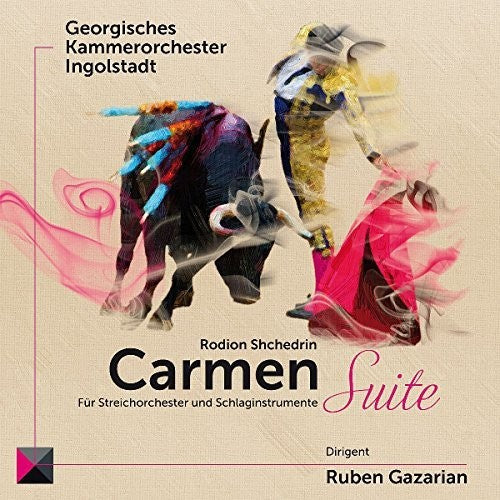
CARMEN SUITE
GKO
Available as
CD
The Georgian Chamber Orchestra of Ingolstadt and their principal conductor Ruben Gazarian present their third new recording. Rodion Schedrin’s “Carmen Suite,” is a tribute to the great Russian prima ballerina and choreographer Maya Plisetskaya (1925-2015). The recording also honors her husband, the composer Rodion Shchedrin, who will celebrate his 85th birthday in 2017. This release is a live recording of a concert which took place on October 15, 2015 in Ingolstadt. Shchedrin composed “Carmen Suite” in the mid-1960s for his wife. The composition for strings and percussion is music taken from a ballet based on motives from Georges Bizet’s Opera “Carmen.” Familiar melodies from the opera “Carmen” are stylistically transformed by the use of colorful instrumentation which creates a markedly different atmosphere, as well as by the use of sharpened rhythms. Furthermore, the “Carmen Suite” also reflects upon motives from the second “L’Arlesienne Suite.” The premiere of the “Carmen Suite” on the 20th of April 1967 at the Bolshoi Theatre in Moscow caused an enormous scandal: Schhedrin’s Carmen, portrayed by Plisetskaya in a highly erotic manner, was too suggestive for the Soviet society of the time. In spite of this, Plisetskaya was to personify Shchedrin’s Carmen in approximately 350 performances, for the last time in 1990 at the age of 65.
Shchedrin, R.K.: Sealed Angel (The)
Coviello
Available as
SACD
$21.99
Jun 03, 2006
Import Hybrid-SACD pressing.
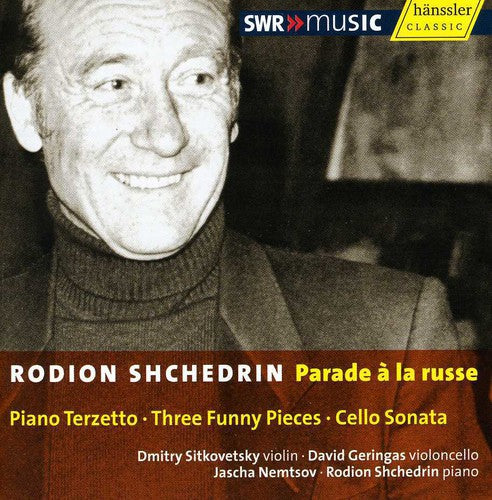
SCHEDRIN: Piano Terzetto / 3 Funny Pieces / Cello Sonata
SWR
Available as
CD
Classical Music
Shchedrin, R.K.: Russian Melodies / Sonata / A La Albeniz /
Nimbus
Available as
CD
$20.99
Sep 01, 2008
Classical Music
PIANO SONATA
Wergo
Available as
CD
$20.99
Oct 01, 2007
A brilliant pianist and organist, Shchedrin has appeared throughout the entire world as a successful performer of his own works. A second CD with recordings from 1964 and 1983 of his own piano works has appeared within the Edition Rodion Shchedrin on WERGO. This CD chiefly introduces his early works for piano, with the exception of "Notebook for the Youth", which was written in 1981 and which is, in contradiction to the title, not only meant for young people, but also for the advanced concert pianist. Shchedrin recorded this CD in the Great Hall of the Moscow Conservatory, "the place with the best acoustics in Moscow" - at night, when the team got the desired peace and quietness which is absolutely indispensable for recording quiet and "transparent" music. "Yes, we were children of our time and of our country where we were born and where we lived. You cannot run away from that. Time always leaves it's mark," says Rodion Shchedrin.
BOYARINA MOROZOVA
Wergo
Available as
CD
$26.99
Dec 01, 2007
On the occasion of the composer's 75th birthday on 16 December 2007, WERGO continues publishing CDs within the Edition Rodion Shchedrin with a world premiere recording. The Russian choral opera "Boyarina Morozova" describes the schism in the Russian Orthodox Church that began in the seventeenth century. This religious conflict, whose effects are still felt today, ignited in reaction to the ecclesiastical reforms of Nikon, then patriarch of Moscow. The composer's preface: "Setting to music this terrible page in the history of the schism of the church and the rise of the Old Believers in Russia and the bitter fates of the people involved was a long-held dream. Several times I began it, but each time I dropped it again, because I could not, it seemed to me, suitably tackle this gripping theme. Only when it became clear to me that it should take the musical form of a 'Russian choral opera' did my work make progress. As literary materials I used texts from the two great books 'The Life of Protopope Avvakum, Written by Himself', and 'The Life of Boyarina Morozova, Princess Urusova, and Mariya Danilova'. The four soloists (Boyarina Morozova; her sister, Princess Urusova; Protopope Avvakum, and Czar Alexei Mikhailovich) would be joined by three instrumental soloists: trumpet, timpani, and a percussionist playing other instruments. The choir would not only take on the usual role of a choir but that of the orchestra, which sometimes plays the part of a narrator, sometimes that of a modest accompanist."
Shchedrin: Der Versiegelte Engel
Wergo
Available as
CD
$20.99
Jun 01, 2010
The Latvian State Choir is one of the finest choirs I have ever heard... With Maris Sirmais, the choir is fortunate to work with an extraordinary choral director. The expressivity of his conducting places both the singers and the audience under his spell. In his experienced hands, the acoustics of the ancient, legendary Eberbach Monastery are transformed into a faithful ally and magician's assistant. I am sure that after hearing this CD you will share my joy and enthusiasm as well. (Rodion Shchedrin) With his Russian Liturgy, "The Sealed Angel", Rodion Shchedrin has written a work of inner contemplation of timeless relevance, which will deeply move every listener who approaches the piece with an open heart. Live recording of the concert on 17 July 2009 during the Rheingau Musik Festival in the great basilica of the Eberbach Monastery.
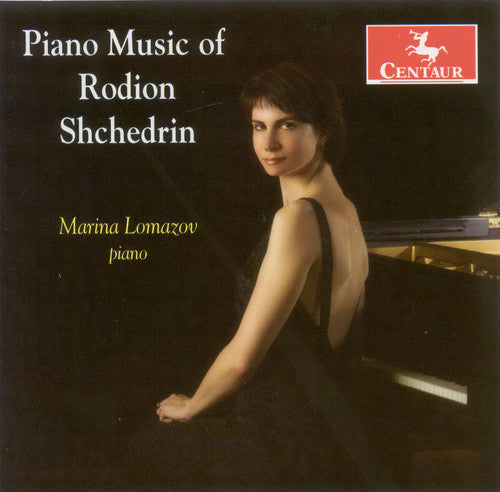
Piano Music Of Rodion Shchedrin / Marina Lomazov
Centaur Records
Available as
CD
$18.99
Dec 01, 2009
A great introduction to Shchedrin's piano music.
Two of Rodion Shchedrin's works are entitled Concerto cantabile and Concerto sotto voce. These two epithets - sotto voce and cantabile - can be applied to much of his output. He produced bright, brilliant pieces (like the justly famous Carmen-Suite ballet), or works full of daring, rough folk humor (like the popular Concerto for Orchestra Naughty Limericks). Still, the core of Shchedrin's music is dark-hued, philosophic, often religious, always thoughtful. The spiritual closeness to Bach is evident, and not only in the abundance of old-fashioned polyphony. Probably the most successful of the Soviet composers that emerged in the Fifties under the shadow of Shostakovich, Shchedrin is the one with his face turned to the past. Not technically: he knows and uses all the atonal - polytonal - dodecaphonic - aleatoric - you name it - brushes. His music rarely grips you from the first measure: it requires submergence and listening. But when you are in - you are in. And you can be sure that the experience won't leave you with disappointing emptiness: those simple, sparse, seemingly tuneless constructs are genuine, deep music. It is strange. It is Art.
More and more of Shchedrin's music is recorded in the West, but these are mostly concertos and choral works of the latest years. The more welcome is then the all-Shchedrin piano recital of pieces from his first creative period, presented so sympathetically by Marina Lomazov.
I can't say that I completely understand the logic of the Piano Sonata of 1962. The second and third movements hold very naturally together - the second is a dim, deep abyss, the third a devilish toccata, burning like black fire. Preceding these two goes a much lighter Allegro da Sonata, like an echo of Petrushka's Shrovetide Fair. It is attached, but does not seem to belong.
The ten preludes from The Polyphonic Notebook (1972, the latest composition on this disc) are very interesting and rewarding. I wish all 25 were recorded, but even the present torso is a wonderful sequence, full of delicacy and balance. This is one of Shchedrin's Bachianas. The texture is sparse - listen to the lower voices!
The earliest composition - Poem of 1954 - could be a page from Prokofiev's Romeo and Juliet. The Humoresque, similarly, may evoke Prokofiev in his more angular self. Yet its voice is not derivative, and the piece is funny and memorable. A la Albéniz is a cold-smoke tango, with enough big pauses for glances, yes and nos, and other decisions. Together, these three miniatures show how multi-faced Shchedrin's muse can be.
The four pieces arranged from The Hump-backed Horse ballet bring to the front another big love of the composer: the Russian folk culture. The music is very sincere and innocent, which suits well the fairytale subject of the ballet.
Finally comes my favorite: Two Polyphonic Pieces. The Invention is hypnotic. As it is often with Shchedrin, you cannot pinpoint exactly where the “musical experience” is coming from. It's like plain pieces of mosaic summing up into a picture. Basso Ostinato is another virtuosic toccata, a veritable tour de force, completely enthralling. There are torrents of energy, like armies clashing in the night, order and chaos in search of a resolution.
Marina Lomazov is a perfect performer for this music. She never "overcooks" it; everything that needs to be dry stays dry. Yet there is all the required energy, and maybe even more. Lomazov plays with ultimate precision, but the result is not mechanical: it is human, personal and soulful, even in the most abstract constructs. There is this "transparent virtuosity" that does not expose itself glamorously, but works for the good of the music. And she does wonders with the rhythm. I wish she considered recording Prokofiev's Sonatas.
The recording quality is very satisfactory. The liner-notes are not especially generous. Still there is enough information about the works, the composer and the performer. This disc gives a good overview of Shchedrin's directions in his earlier years, and the selections from the Polyphonic Notebook are a real teaser. It is a multi-character program, recital-like, with changing moods and styles, not a unified album. It is a great introduction to Shchedrin's piano music. It is also a great introduction to a very fine pianist, Marina Lomazov.
-- Oleg Ledeniov, MusicWeb International
Two of Rodion Shchedrin's works are entitled Concerto cantabile and Concerto sotto voce. These two epithets - sotto voce and cantabile - can be applied to much of his output. He produced bright, brilliant pieces (like the justly famous Carmen-Suite ballet), or works full of daring, rough folk humor (like the popular Concerto for Orchestra Naughty Limericks). Still, the core of Shchedrin's music is dark-hued, philosophic, often religious, always thoughtful. The spiritual closeness to Bach is evident, and not only in the abundance of old-fashioned polyphony. Probably the most successful of the Soviet composers that emerged in the Fifties under the shadow of Shostakovich, Shchedrin is the one with his face turned to the past. Not technically: he knows and uses all the atonal - polytonal - dodecaphonic - aleatoric - you name it - brushes. His music rarely grips you from the first measure: it requires submergence and listening. But when you are in - you are in. And you can be sure that the experience won't leave you with disappointing emptiness: those simple, sparse, seemingly tuneless constructs are genuine, deep music. It is strange. It is Art.
More and more of Shchedrin's music is recorded in the West, but these are mostly concertos and choral works of the latest years. The more welcome is then the all-Shchedrin piano recital of pieces from his first creative period, presented so sympathetically by Marina Lomazov.
I can't say that I completely understand the logic of the Piano Sonata of 1962. The second and third movements hold very naturally together - the second is a dim, deep abyss, the third a devilish toccata, burning like black fire. Preceding these two goes a much lighter Allegro da Sonata, like an echo of Petrushka's Shrovetide Fair. It is attached, but does not seem to belong.
The ten preludes from The Polyphonic Notebook (1972, the latest composition on this disc) are very interesting and rewarding. I wish all 25 were recorded, but even the present torso is a wonderful sequence, full of delicacy and balance. This is one of Shchedrin's Bachianas. The texture is sparse - listen to the lower voices!
The earliest composition - Poem of 1954 - could be a page from Prokofiev's Romeo and Juliet. The Humoresque, similarly, may evoke Prokofiev in his more angular self. Yet its voice is not derivative, and the piece is funny and memorable. A la Albéniz is a cold-smoke tango, with enough big pauses for glances, yes and nos, and other decisions. Together, these three miniatures show how multi-faced Shchedrin's muse can be.
The four pieces arranged from The Hump-backed Horse ballet bring to the front another big love of the composer: the Russian folk culture. The music is very sincere and innocent, which suits well the fairytale subject of the ballet.
Finally comes my favorite: Two Polyphonic Pieces. The Invention is hypnotic. As it is often with Shchedrin, you cannot pinpoint exactly where the “musical experience” is coming from. It's like plain pieces of mosaic summing up into a picture. Basso Ostinato is another virtuosic toccata, a veritable tour de force, completely enthralling. There are torrents of energy, like armies clashing in the night, order and chaos in search of a resolution.
Marina Lomazov is a perfect performer for this music. She never "overcooks" it; everything that needs to be dry stays dry. Yet there is all the required energy, and maybe even more. Lomazov plays with ultimate precision, but the result is not mechanical: it is human, personal and soulful, even in the most abstract constructs. There is this "transparent virtuosity" that does not expose itself glamorously, but works for the good of the music. And she does wonders with the rhythm. I wish she considered recording Prokofiev's Sonatas.
The recording quality is very satisfactory. The liner-notes are not especially generous. Still there is enough information about the works, the composer and the performer. This disc gives a good overview of Shchedrin's directions in his earlier years, and the selections from the Polyphonic Notebook are a real teaser. It is a multi-character program, recital-like, with changing moods and styles, not a unified album. It is a great introduction to Shchedrin's piano music. It is also a great introduction to a very fine pianist, Marina Lomazov.
-- Oleg Ledeniov, MusicWeb International
Shchedrin: Concertos For Orchestra / Karabits, Bournemouth Symphony
Naxos
Available as
CD

This is an exciting release of excellent music by one of Russia's greatest living composers (except that the last time I checked the Shchedrins were residents of Munich). As a composer, Rodion Shchedrin has been cursed by the popularity of his "Carmen" Ballet, but while you won't find the same level of tunefulness (obviously) in his original music, there's a similarly brilliant orchestral imagination at work, and no small level of arresting invention. Concerto No. 4, inspired by the folk music of Shchedrin's childhood, contains evocative writing for (among other things) recorder and harpsichord. Shostakovich's famous "tick-tock" percussion from the Fourth and Fifteenth symphonies also features prominently.
Shchedrin actually quotes a traditional Russian song in the Fifth concerto, but the remaining tunes are all original, and the title suggests the work's form--a simple alternation (with variations) of the basic material. Although characterized by some powerfully dissonant outbursts, the progress of the music is always clear and easy to follow, and the mood of both concertos is predominantly lyrical and often quite nostalgic. They are beautiful works. Kristallene Gusli is a brief, atmospheric exercise in mostly high sonorities, and it reveals Shchedrin's ability to write effective "modern" music (by which I mean essentially texture-based or athematic).
The performances under the able leadership of Kirill Karabits sound very confident, with the orchestra playing extremely well in music that affords numerous solo opportunities. Shchedrin attended the sessions and pronounced himself fully satisfied with the results. Certainly I see no reason to take issue with his judgment. The sonics are also extremely vivid and remarkably well balanced given some of the tricky juxtapositions of texture and sonority that Shchedrin explores in all of this music. Without question this is a major release from a composer who richly deserves the attention.
--David Hurwitz,ClassicsToday.com