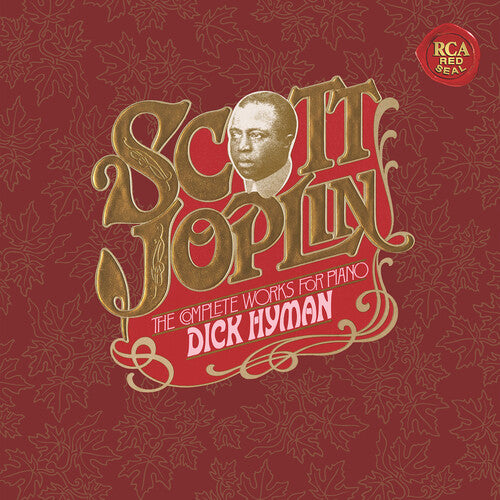
Scott Joplin
6 products
-
-
- Maple Leaf Rag
- Original Rags
- Swipesy
- Peacherine Rag
- The Easy Winners
- Sunflower Slow Drag
- The Entertainer
- Elite Syncopations
- The Strenuous Life
- A Breeze from Alabama
- Palm Leaf Rag
- Something Doing
- Weeping Willow
- The Chrysanthemum
- The Cascades
- The Sycamore
- The Favorite
- Leola
- The Ragtime Dance
- Eugenia
- Lily Queen
- Gladiolus Rag
- Nonpareil
- Heliotrope Bouquet
- Search-light Rag
- Rose Leaf Rag
- Fig Leaf Rag
- Pine Apple Rag
- Solace
- Sugar Cane
- Stoptime Rag
- Euphonic Sounds
- Country Club
- Wall Street Rag
- Felicity Rag
- Paragon Rag
- Silver Swan Rag
- Kismet Rag
- Magnetic Rag
- Reflection Rag
- Antoinette
- Cleopha
- March majestic
- Combination March
- Rosebud
- Great Crush Collision
- School of Ragtime (Exercises Nr. 1-6)
- Bethena (Concert waltz)
- Binks' Waltz
- Pleasant Moments
- Augustan Club Waltz
- Harmony Club Waltz
- New Rag
- +Dick Hyman-Improvisation on Peacherine Rag
- The Entertainer
- Elite Syncopations
- A Breeze from Alabama
- Something Doing
- Gladiolus Rag
- Heliotrope Bouquet
- Fig Leaf Rag
- Stoptime Rag
- New Rag
- Pleasant moments
EASY WINNERS & OTHER RAGS
I GOT DEM OL' KOZMIC BLUES AGA
CHEAP THRILLS
THE PEARL SESSIONS
Scott Joplin - The Complete Rags Marches & Waltzes / Albright
JOPLIN Complete Rags, Marches, Waltzes • William Albright, (pn) • NIMBUS 2546/8 (3 CDs: 211:40)
William Albright was a major figure in the ragtime revival, along with his friend and colleague in academia, William Bolcom. Together they recorded music of Joplin and James P. Johnson; separately, each composed and played many rags on his own, which they sent to the other for amusement and comment. These were recorded as well, though Albright’s album of his own rags is sadly no longer in print. It’s a pity, as he was a fine pianist with a strong technique, and a fine sense of style. That technique and especially the style are on display in this fine set of Joplin’s rags, marches, and waltzes, recorded over a four-day period in 1989 for the defunct MusicMasters label.
No collection of Joplin, of course, can claim to be truly complete. Some rags almost certainly went unpublished, and it is believed others might have been published under pseudonyms. What we have are 49 works definitely by Joplin or composed by him in collaboration with others. They span The Crush Collision March of 1896 to the Magnetic Rag of 1914, his last composition before tertiary syphilis killed him. A third and separate category is formed of doubtful attributions, rags that would have been credited to Joplin at the height of his evanescent fame, much in the spirit that French and Dutch music publishers in the final quarter of the 18th century produced far more string quartets and symphonies by Haydn than Haydn ever wrote. None of these apocrypha are offered here, save one, a curious piece, the Silver Swan Rag , included on stylistic grounds. Discovered in 1970, and twice performed on piano rolls from the 1914–1915 period, it is credited to Joplin, but shows some notable flaws of compositional technique. Albright surmises in his liner notes that it was probably an early work, held back for years, but we’ll likely never know why Joplin would have chosen to record it, if he did, since other, finer works of his were at his fingertips.
Albright avoids an anachronistic, speed demon approach that would be more appropriate to latterday stride pianists such as James P. Johnson or Willie “The Lion” Smith. Nor does he break heavily in such pieces as The Entertainer or the beautiful Weeping Willow for nostalgia addicts. Rhythmically firm, he avoids sudden shifts of tempo, preferring to maintain a steady pace or subtly accelerate through the four strains of a standard rag. His dynamic palette is broad, though he applies variation sparingly once again. Clarity of touch does not preclude beauty of tone, as The Cascades shows. Albright takes obvious enjoyment in the music he is playing.
Potential buyers might want to note that this is not “purist” Joplin, though it is perhaps all the more authentic for not exactly following the published scores. Like an earlier Joplin enthusiast and performer, “Knocky” Parker, Albright sometimes improvises or alters—though always more tastefully than the erratic Parker, who devalued these works by sometimes coining his own additional melodic lines. Albright’s most frequent type of change is the double-dotting of the thematic content, something he applies for example to the B section of Easy Winners , instead of playing it straight as written. Elsewhere, he may perform chords off the beat instead of the written figurations on it, as in the B section of The Maple Leaf Rag ; or strum a figure before the introductory chords to the A section repeat, as in The Entertainer ; or vary the repeat of a few D section chords in a blues direction, as in Elite Syncopations . The results are a matter of brief, tasteful highlights, and typical of the way rags were lightly embellished (by all reports) during and after Joplin’s lifetime.
With good notes by Albright and fine sound, it’s great to see this recording rereleased by a major classical label. Hopefully, it will bring new attention to both the composer and pianist—and maybe lead to Albright’s performance of his own rags showing up once again. Strongly recommended.
FANFARE: Barry Brenesal
Joplin: The Complete Works for Piano / Dick Hyman
No better Joplin cycle exists, and its first complete appearance on CD is long overdue.
Between January and April 1975, the classically trained, multi-award-winning jazz pianist and composer Dick Hyman – whose astounding résumé includes playing with Dizzy Gillespie, Charlie Parker and Benny Goodman, writing and arranging for Count Basie, and scoring most of the films of Woody Allen – went into RCA’s Studio A in New York City and set down the definitive recording of ragtime legend Scott Joplin’s piano works. In 1988, an hour-long selection from the five LPs was released on CD. Now at last, Sony Classical is issuing Hyman’s entire Joplin album on three well-filled silver discs.
This really is Joplin’s complete piano output. It even includes the six short exercises that form his 1908 School of Ragtime, with their printed prefatory remarks read by the 92-year-old Eubie Blake, a friend of Joplin and a distinguished ragtime player in his own right. Also here are Joplin’s less familiar marches and waltzes. And there’s a bonus: the set contains Hyman’s own twelve delightful improvisations on themes by Joplin, which he designed to demonstrate the composer's influence on the development of jazz harmony and melody. When the LPs were first released, Gramophone’s jazz critic wrote that “the eminently musical quality of Hyman’s playing is in evidence throughout the collection; he has the ability to characterize perfectly each piece and somehow to pinpoint every little harmonic subtlety and melodic felicity without in any way detracting from the conception as a whole.... He pays as much attention to matters of tempo, texture, phrasing and dynamics as though he were doing the twenty-four Chopin Preludes. Two for instance I particularly enjoyed were Cascades with its rippling lightness of touch and Scott Joplin’s New Rag in which Hyman’s cleanness of articulation and rhythmic exuberance are a joy. … Joplin well deserves this very handsome and well-recorded tribute.”
CONTENTS:
REVIEW:
The ragtime genre came into full flower from the mid-1890s through the end of World War I, spearheaded by Scott Joplin (1868-1917), whose 1899 composition Maple Leaf Rag became the template and standard bearer for classic through-composed rags. The late 1960s and early 1970s saw newfound interest in Joplin as a serious composer, starting with the New York Public Library’s publication of Joplin’s collected works. Joplin’s 1902 rag The Entertainer figured prominently in the soundtrack for the 1973 Academy Award-winning film The Sting, launching a floodgate of Joplin releases. Even classical artists as unlikely as Itzhak Perlman, James Levine, and E. Power Biggs hitched their stars to the Joplin bandwagon.
However, the most comprehensive, intelligently produced, respectful, and artistically satisfying collection of Joplin’s complete piano works came from RCA Victor in a five-LP boxed set, featuring pianist Dick Hyman. No better Joplin cycle exists, and its first complete appearance on CD is long overdue.
The music is presented by genre, with the rags arranged in loose chronological order by composition, followed by marches and waltzes. Also included is Joplin’s charming “School of Ragtime” Etudes complete with Joplin’s introductory remarks read by composer/pianist and Joplin colleague Eubie Blake, who was 92 when he faced the microphone to speak. Hyman also offers the Grand Crush Collision march both in its original text and in his own ragtime transformation.
Although Hyman’s pianism embraces the entire history of jazz piano, his effortless virtuosity is firmly rooted in classical training. As Rudi Blesh aptly stated in his brilliant and insightful original booklet annotations, the pianist “takes ragtime seriously without becoming solemn and portentous, more as one must do in approaching, say, much of Mozart.”
Two further qualities make Hyman’s Joplin stand out: his intelligent tempo choices, and his ideal fusion of classical projection and jazz time keeping. Take Joplin’s 1899 hit Maple Leaf Rag, for example. Hyman’s vigorous pace, dynamic contrasts, and clear articulation convey pure joy with a soupçon of brashness, so unlike Joshua Rifkin’s effete and rhythmically stiff traversal. The Cascades’ descending runs are as crystalline and transparent as Rubinstein’s Chopin. By contrast, Hyman’s measured tempo and ear-catching inflections of phrase in Elite Syncopations give shape and breathing room to Joplin’s polyphony.
Note, too, Hyman’s lovely legato touch and subtly lilting rubatos in Weeping Willow, Gladiolus Rag, and Solace, while Something Doing is pure lightness and effervescence. The pianist’s characterful animation keeps the episodic Bethena concert waltz afloat and moving. And although Hyman clearly respects Joplin’s texts, the pianist is not above filling out the texture with discreet octave reinforcements in the left hand, as he does in the difficult Euphonic Sounds, a rag that foreshadows elements of stride piano. Because Hyman approaches each piece on its own terms, one gleans more variety and expressive scope from Joplin’s oeuvre than we experience from most other Joplin interpreters.
The original LP edition devoted the tenth side to twelve of Hyman’s improvisations on Joplin themes, which here are spread across the three CDs, most likely for timing considerations. They are sheer delights, from The Entertainer’s bi-tonal coda to a brief and unbuttoned Peacherine Rag that brilliantly burlesques Art Tatum’s 1940 recording of Harold Arlen’s Get Happy.
A Breeze From Alabama is pure, unadulterated barrelhouse and boogie-woogie, while in Joplin’s New Rag Hyman can’t resist interpolating Juventino Rosas’ Over the Waves–better known as the summer camp ditty “George Washington Bridge”. In short, Dick Hyman and Scott Joplin unquestionably belong to the coterie of symbiotic performer/composer pairings that include Schnabel/Beethoven, Gould/Bach, Gieseking/Debussy, Larrocha/Albéniz, and Hamelin/Alkan.
Full disclosure: I met Dick Hyman nearly 60 years ago when I was eight years old, and he has been a friend, a colleague, and a musical father figure to me ever since. We even played two pianos together in several concerts. I vividly remember hearing Dick preparing these Joplin pieces at the time of the 1975 sessions, and marveled at his absolute commitment to the material, his focus and his flexibility in the process of getting all of the music under his awesome fingers. Thanks to Sony/BMG for reissuing and gorgeously remastering an important recording project that belongs in every serious collection.
-- ClassicsToday.com (10/10; Jed Distler)