Sofia Gubaidulina
20 products
Ander Perrino - Double Bass
Gubaidulina: String Quartets 1-3, Trio / Danish Quartet
Gubaidulina: The Canticle Of The Sun, Etc / Geringas, Et Al
Sofia Gubaidulina is one of the world's most famous living composers and her music has a tremendous worldwide following. This is currently the only available recording of Hommage à Marina Tsvetayeva, and there is only one other recording of The Canticle of the Sun. Recorded in: Danish Radio Concert Hall, Copenhagen 7 & 8 May 1999 (The Canticle of the Sun) and 15 & 16 November 2002 (Hommage à Marina Tsvetayeva) Producer(s) Claus Due (The Canticle of the Sun) Chris Hazell (Hommage à Marina Tsvetayeva) Sound Engineer(s) Jørn Jacobsen
SIEBEN WORTE IN CROCE
Gubaidulina: Offertorium / Rejoice! Freue Dich
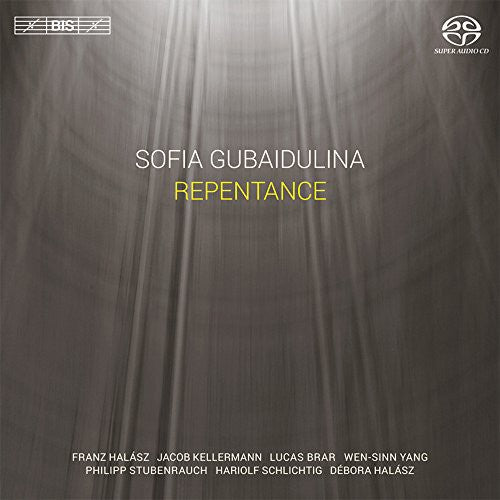
Gubaidulina: Repentance / Yang, Halasz, Kellermann, Brar, Stubenrauch
Within the output of Sofia Gubaidulina, solo and chamber music occupies a position of prominence; she has written more than eighty such works. One of the earliest is the brief – and not really typical – Serenade for solo guitar from 1960, composed as a commission from a Moscow publishing house for inclusion in a collection of guitar compositions. The composer was asked to write a piece not overly difficult or progressive, and has later described the result as ‘music for pleasure’. Demonstrating a particular closeness to the guitar, Gubaidulina’s later writing for it has exploited its sound spectrum in previously unimagined ways. Two further works involving the guitar are included here, with Repentance from 2008 being a reworking of an earlier work, just as its title is a translation of the original’s Italian one, Ravvedimento. Her latest work involving the guitar, and also the latest on this disc (and a world première recording) is Sotto voce for viola, double bass and two guitars. About this unusual combination, Gubaidulina has remarked: ‘It fascinated me on account of its dark colour and its potential for contrast between a muted, almost whispered sotto voce sound and that particular sort of expressivity that low-pitched instruments possess’. Each with a duration of more than 20 minutes, these two works frame the equally substantial but much earlier Piano Sonata. Looking back at her youth, the composer has described the piano in her family home as ‘the only light’ in ‘a fairly grey and uninteresting existence’. Striking features of the sonata include borrowings from jazz and the twelve-tone row which underpins all its three movements – a nod towards the dodecaphony through which Gubaidulina asserted her place in the Russian musical avant-garde at an early stage. This varied and fascinating journey into the world of Sofia Gubaidulina’s chamber music is given us by a Munich-based group of eminent musicians.
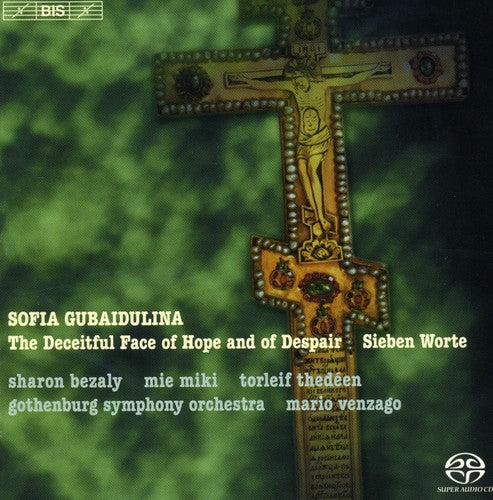
Gubaidulina: '...The Deceitful Face Of Hope And Despair' / S
Gubaidulina: Bassoon Concerto, Etc. / Ahmas, Pälli, Vänskä
Gubaidulina: In The Mirror - 3 Works, 3 Genres, 3 Epochs
Gubaidulina: Silenzio
Gubaidulina: Silenzio / De Profundis / Et Exspecto / In Erwa
Gubaidulina, S.: Piano Music (Complete)
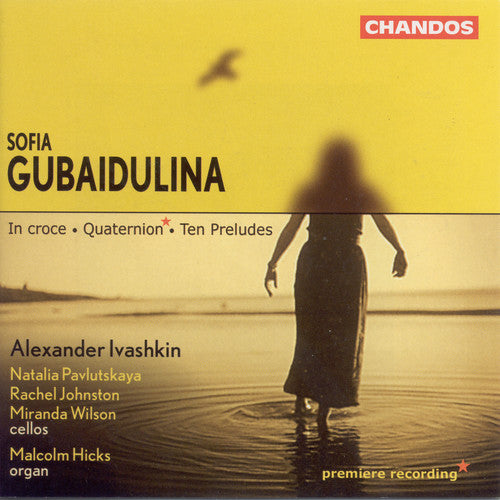
GUBAIDULINA: In croce / 10 Preludes / Quaternion
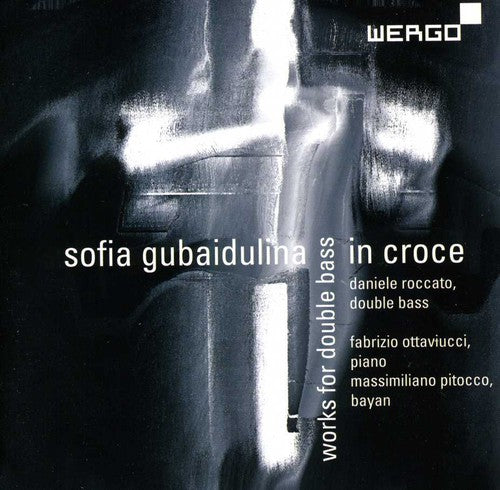
Gubaidulina: Works For Double Bass - In Croce Sonata Pantomine
Gubaidulina: Sonnengesang
A profoundly spiritual composer, Sofia Gubaidulina has said that ‘True art for me is always religious, it will always involve collaborating with God.’ As the present release demonstrates, it is therefore less than fruitful to try to divide her music into sacred and secular compositions. Jauchzt vor Gott, the opening work, is here being released for the first time. The nine-minute piece for choir and organ sets three verses from Psalm 66, and opens with a long cappella section on the word jauchzt, ‘rejoice.’ At this point, the organ enters with an extensive solo involving a massive dynamic intensification, after which choir and organ continue together in music which makes the concept of contrast a determining element. As the title signals, the organ work Hell und dunkel (Light and Darkness) also explores contrasts, especially in terms of color and brightness. Composed in 1976, the work is the earliest on the disc, and it is followed by the large-scale Sonnengesang, written some twenty years later and dedicated to Mstislav Rostropovich. The choir sings the words of St. Francis of Assisi’s celebrated Canticle of the sun, but it is the solo cello that is responsible for interpreting the meaning of the text. The important solo part is performed here by Ivan Monighetti, in dialogue with the eminent NDR Chor of the North German Radio, and with the support of percussionists from Elbtonal Percussion. Philipp Ahmann conducts this work as well as Jauchzt vor Gott, with Christian Schmitt performing the organ parts.
Gubaidulina: Seven Words, Silenzio, In Croce / Selmeczi
Gubaidulina: Fachwerk, Silenzio / Oyvind Gimse, Geir Draugsvoll
Born in the Tatar Republic she studied with Grigory Kogan in the Kazan Conservatory. Later she worked with composition professors Nikolai Peiko and the much older Vissarion Shebalin. For many years now she has been a cosmopolitan voice celebrated on disc, at music festivals, quickly published and multiply commissioned. Her keynote works, at least in terms of exposure, are the Violin Concerto Offertorium and the Symphony Stimmen.
The music is much taken with exotic mysteries, ideas and texts - somewhat in the manner of Tavener though her music differs. The two pieces recorded here are part of a not large but noteworthy stream of modern works written for the bayan - the folk derived accordion. Fachwerk is dedicated to the player featured here who also premiered it in Amsterdam in 2009. The single movement 37 minute span suggests a mercurial and lapidary fairy tale. The music is accessible enough with rumbling, cajoling, howling, ululating and balladeering from both bayan and orchestra. It's a virtuoso display in the manner of The Firebird - the latest manifestation of the Russian folktale. The music glitters and rings. Then comes the five movement Silenzio. This is more internalised and reflective, severe and less endearing.
Draugsvoll - a pupil of Mogens Ellegaard - proves himself a most subtly facetted artist whose collaborations with composers of the stature of Gubaidulina have yielded rewards for both himself and the composers.
Draugsvoll and Gubaidulina are by no means alone in the field of concert music for bayan. Another bayan player, Friedrich Lips has been active with symphonic works by Solotarjov, Podgaits, Bronner and Berinsky.
Gubaidulina's two works for bayan prove much more than curiosities.
-- Rob Barnett, MusicWeb International
Gubaidulina, Liebermann, Proto: Contemporary Sonatas for Double Bass and Piano / Romanowski, Holeksa
This album is the Polish phonographic premiere of works by three outstanding contemporary composers: Gubaidulina, Liebermann and Proto. The album presented by the performers is the outcome of ten years of cooperation, quest for a common sound, discovering new areas in music, artistic trips and creative interpretations. In their activities, double bass player Marek Romanowski and pianist Hanna Holeksa are guided by their common will to popularize new repertoire for this seemingly unobvious instrumental combination, proving its enormous potential.
Gubaidulina: Complete Guitar Works / Tanenbaum
Sofia Gubaidulina has found a soulfulness and freedom in the guitar which speaks to her musical language of expressive mood and often mysterious but precise sonorities. In both Repentance and Sotto Voce she combines guitars with lower stringed instruments, creating a virtuosic, multi-dimensional and deeply poetic role for each voice. Fascinating new sounds from the guitar are produced from the most eloquent chorales to remarkable effects using a drinking glass. The earlier Serenade is ‘music for pleasure’, while this première recording of the Toccata reveals a work with a driving momentum that hardly stops.
Glorious Percussion, In Tempus Praesens - Gubaidulina: Concertos
Sofia Gubaidulina, the 80-year old Russian/Tatar composer, is one of the most respected of living composers. She has composed in a variety of genres, but her concertos have gained a wide following and for good reason. As witnessed by the concertos on this CD, they are indeed remarkable and glorious works. In tempus praesens is her second violin concerto. The first such concerto, Offertorium, was written more than twenty-five years before this one. Both have received multiple performances and are considered two of the finest in recent times. Gubaidulina composed In tempus praesens for Anne-Sophie Mutter, who recorded it with the London Symphony and Valery Gergiev for Deutsche Grammophon. The concerto receives its second recording here.
Gubaidulina’s Russian Orthodox faith is never very far away in her compositions and they have religious significance. In the case of this violin concerto the title refers to the present time. More important, the work embodies the divine wisdom personified in the orthodox religion by the saint Sophia. Since Gubaidulina’s Christian name is Sophia and she composed the concerto for and dedicated it to Anne-Sophie Mutter, the figure of Sophia has a special significance in the work not only in her divine wisdom, but also in the very creative power of God. This is reflected throughout the work in the contrast between the dark as demonstrated by the use of the low brass and strings and the light by the violin solos. The concerto is in a single, long movement that is sub-divided into five parts. It is a shame that neither Mutter’s première recording nor this new one has more than a single track. It would have made it much easier to assimilate the work had there been separate tracks for the individual sections. As it is, though, the concerto grips the listener from the beginning and does not let go until it reaches ever upward in a spectacular climax by the whole orchestra like a burst of light, only to have the low brass (trombones and tubas) growl at the very bottom of the orchestra. The solo violin, however, gets the final say and ends the work on a high, sustained note. In tempus praesens is one of those works that exhilarate the listener so that you want to immediately go back and hear it all over again. There is a DVD out titled “Sophia: Biography of a Violin Concerto” with Gubaidulina and Mutter on this very composition. I haven’t seen it, but it has received critical acclaim. One would imagine, then, that Anne-Sophie Mutter “owns” the work, but here is a challenger in Vadim Gluzman who has his own equally valid interpretation. He is superbly accompanied by Jonathan Nott and the Lucerne Symphony and the recorded sound is indeed stunning. One associates Nott more with Schubert or Mahler, but it should be remembered that he did yeoman service to the large orchestral works of Ligeti in the Volume II of Warner’s Ligeti Project. To briefly sum up my impression of the main difference between these two recordings, Mutter’s is the more extrovert and Gluzman’s the more inward. Certainly, Mutter with her larger-than-life tone grabs the listener from the beginning and Gergiev’s orchestra also makes more of an impact for most of the concerto. Part of this is due to the recordings, where the DG seems to be somewhat more closely recorded; that is not to say the BIS is by any means distant. The balance on the BIS seems about perfect and there are places where the subtlety pays off. For example, in the last five or so minutes of the piece, there are tremendous percussion effects by cymbals, gongs, and bells. With their more distant placement down in the depths of the Lucerne orchestra, they create an especially eerie effect that is somehow more felt than heard. It plays right into Gubaidulina’s symbolism of dark vs. light. Gergiev here is more obvious, but nonetheless magnificent as well. The very ending of the concerto is telling. Gergiev builds the orchestral crescendo so that the light is almost blinding, but the following low brass and strings do not make the same impact as they do with Nott. Nott’s light may not be as blinding, but the low brass really growl and create a very unsettling experience before the violinist completes the work on the high, sustained note. Again that note is more intense with Mutter, but Gluzman with his purer tone is also convincing as he is throughout the concerto. I frankly would not want to be without either of these different interpretations of what is perhaps the greatest violin concerto this century has produced so far.
With that said, the primary interest of this CD must be the world première recording of Gubaidulina’s Glorious Percussion. I am familiar with a number of percussion concertos, including James MacMillan’s Veni, Veni Emmanuel, Toru Takemitsu’s From me flows what you call Time, and Joseph Schwantner’s Percussion Concerto. While all three of these possess their considerable merits, they did not prepare me for this extraordinary new work in the genre. As with the violin concerto, this percussion concerto requires a very large orchestra. In addition to the five percussion soloists placed at the front of the orchestra there is the usual contingent at the back; and the brass also plays a major role with the addition of four Wagner tubas interchanging with horns, two bass tubas, bass and tenor trombones, etc. Incidentally, Gubaidulina also employed Wagner tubas in the violin concerto. The work is thus distinguished by the percussion soloists who have seven sections in the work where they improvise in contrast to the more static nature of the rest of the orchestra. Again it’s unfortunate that the concerto receives a single track on the disc where it would have made a lot of sense to divide it into these sections. Glorious Percussion begins with the lower brass and percussion playing a chordal theme that lumbers like some behemoth in the depths of the orchestra. This theme recurs in key places in the work and at the end of it with the cymbals and tam-tam as they resonate, having the final say. Contrasting with the rather static nature of the orchestral part, the solo percussionists have a heyday with a huge variety of instruments, including all kinds and sizes of gongs, marimbas and xylophones, bells, woodblocks and rattles, four bass drums, and a whole variety of Asian folk instruments with such strange names as cabaza and darabuca. At one point in the piece the soloists go wild with their mallets on the marimbas and xylophones and later they do the same with the bass drums, creating quite a racket. While one can get a good appreciation of the concerto simply from listening to the fabulous performance on this recording, I think the visual element is of almost equal importance. Fortunately, you can “attend” a performance by the Berlin Philharmonic with Gustavo Dudamel and the Glorious Percussion soloists by visiting the Philharmonic’s website. There is a free preview of the concert - also including a blistering account of Shostakovich’s Twelfth Symphony - that will entice you to buy a ticket to the concert well worth the modest cost. Dudamel premiered the concerto with the Gothenburg Symphony in 2008 and this concert took place not long after that première. The percussion ensemble contributes a theatrical element — almost balletic at times — that adds a whole other dimension to the work. It really must be seen to be fully appreciated! The concerto in fact was co-commissioned by Anders Loguin, whose ensemble took their name from Gubaidulina’s composition, and four orchestras including the Lucerne Symphony. “Glorious” of the title of the work has its spiritual connotation as one would expect from any piece by Gubaidulina, and the concerto does connect with heaven and earth. If Mahler claimed to possess the whole world in his symphonies, Gubaidulina would seem to occupy the universe in this concerto. There is an interesting interview with her on the Berlin Philharmonic website accompanying the concert, where she talks about the concerto and her fascination with the different tones of the percussion and the whole complex of pulsating sounds in nature they depict. The interview is free of charge.
Except for the lack of multiple tracks and notes on the two works that could be more detailed, BIS has come up with a real winner here. It will likely rank high on my list of best recordings of 2012.
-- Leslie Wright, MusicWeb International