Steve Reich
12 products
ECM RECORDINGS
Sonic Wires / Katia & Marielle Labeque
Katia Labèque/Marielle Labèque/David Chalmin/Bryce Dessner -"Sonic Wires"
Founded in 2018, the Dream House Quartet is bringing classical and contemporary music into completely new forms as a matter of course. The members draw on decades of expertise: the two piano sisters, Katia and Marielle Labèque, are joined by Bryce Dessner (Grammy-winning guitarist, composer and founding member of The National), and composer, musician and producer David Chalmin. Together they perform radical commissions from visionary composers and key contemporary works from the past half century.
Reich: Drumming
Reich, S.: Phase Patterns / Pendulum Music / Piano Phase / F
Reich: The Desert Music, Three Movements / Jarvi, Chorus Sine Nomine, Tonkunstler Orchester, Niederosterreich
The American composer Steve Reich pioneered the style of minimalism in music. He has been hugely influential on contemporary composers such as John Adams, but also on the progressive rock movement of the 80s with bands such as King Crimson and rock musicians such as Brian Eno. The Guardian has described him as one of 'a handful of living composers who can legitimately claim to have altered the direction of musical history'. The Desert Music is perhaps Reich's most ambitious orchestral score to date - a setting of texts by the American poet William Carlos Williams (1886 - 1963) for chorus and large orchestra. It is a highly symphonic piece which is inspired by Reich's own travels in California's Mojave Desert, the White Sands - and perhaps in particular the Alamagordo in New Mexico, which carries sinister associations with secret weapons of mass destruction and suggests a geographical link with the poet's somber warning to mankind in the work's central movement. Another opportunity to write for large orchestra came when the St Louis Symphony Orchestra commissioned Reich to write his Three Movements. This work was premiered in St Louis under Leonard Slatkin in April 1986. As in The Desert Music, the sizeable string section is divided, here into two subsections which are placed to the left and right of the conductor to create the alternating antiphonal effect that is so characteristic of Reich's style. Hearing these performances, Steve Reich described them as 'Incisive, focused, and intense' and continued 'this recording of Three Movements is the best I have ever heard. The Desert Music is full, rich, yet full of detail. Kristjan Järvi, the Tonkünstler-Orchester, and Sine Nomine perform with a relaxed rhythmic precision that perfectly fits the music. Bravo and thanks to all.' This is the third SACD recording on Chandos by the Vienna-based Tonkünstler-Orchester, Niederösterreich under Kristjan Jarvi, its Chief Conductor and Music Director from 2004 - 2009. They are joined by Chorus Sine Nomine, one of Austria's leading vocal ensembles and winner of numerous awards and prizes.
Kuniko Plays Reich II
Following the tremendous success of her 2011 album Kuniko Plays Reich, and subsequent recordings of works by the pioneering composer, percussionist Kuniko has established a reputation as one of the foremost interpreters of Steve Reich. Here she has recorded Kuniko Plays Reich II, a bold programme of innovative works which span Reich’s artistic career and showcase some of his groundbreaking techniques. Composed in his early thirties, Piano Phase is performed in Kuniko’s own mesmerising arrangement for two vibraphones; characteristically Kuniko plays both parts. While Nagoya Marimbas uses some composition tools which Reich popularised in Piano Phase, Four Organs draws its inspiration from the Middle Ages. Closing this riveting recital, Mallet Quartet sees Reich in a more melodically expansive mood, albeit with his trademark tight rhythmic drive and canonic textures.
REVIEWS:
Before Steve Reich's minimalist structures come to life and become a sensual listening pleasure and adventure, there is a lot of intellectual hard work to do, because the constant rhythmic shifts and overlays are challengingly complex—especially in the American's percussion works. The minimal music guru has primarily written pieces for at least two instrumentalists or percussionists, which doesn't make the task any easier if you want to do everything alone, as a soloist. However, the Japanese drummer Kunino has already shown that she has mastered the art of reacting precisely to her own pre-recorded parts in 2018, with her recording of Reich's cult piece “Drumming”. Now she is following up with Episode II and – under the composer’s supervision – has selected four works, some of them arranged and all of them masterfully recorded. The program ranges from “Four Organs” from 1970, in which a simple interaction between maracas and organ develops an incredible pulling power, to “Mallet Quartet” (2009) for two vibraphones and two marimbas. And in the vibraphone version of “Piano Phase” as well as in the Asian-inspired “Nagoya Marimbas” (1994), the fine motorist Kuniko succeeds in generating a colorful flow of particularly attractive beauty from Reich's sophisticated, repetition constructions.
-- Rondo Magazine
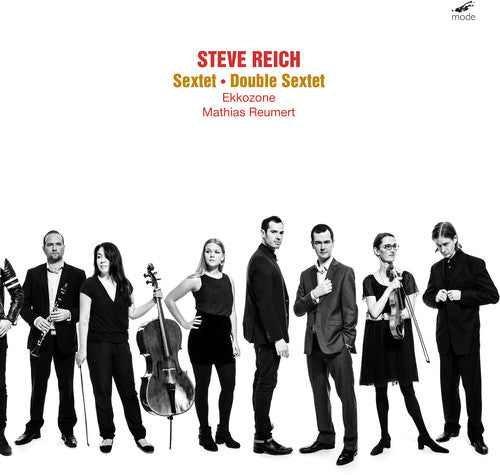
Reich: Sextet & Double Sextet / Reumert, Ekkozone
This release couples two of Reich’s “sextets” for the first time: the Sextet of 1984 and the Pulitzer Prize winning Double Sextet of 2007, which also makes its first appearance on LP. A striking difference between the two pieces is that the rhythmic world of Sextet mostly consists of a single-meter grooving, while Double Sextet works in the angular, off-kilter shifting meters reminiscent of Reich’s Tehillim (also of Stravinsky). Ekkozone impart a uniquely chamber music feel and color to these works while maintaining their propulsive character. Liner notes by Adam Sliwinski. LP lacquers and mastering by veteran Scott Hull at Masterdisk. Plated and pressed by RTI, California. Danish percussionist and conductor Mathias Reumert lives and breathes contemporary classical music. An in-demand soloist, he explores new percussive territory while remaining a committed interpreter of yesterday’s masterworks. As creator and leader of the acclaimed ensemble Ekkozone, he explores the bounderies between classical, world and experimental music in performances at rock and jazz festivals. Ekkozone is a Danish crossover ensemble that masterfully explores the lines between classical, world and experimental music. Formed by Mathias Reumert in 2013, the ensemble enjoys a special connection with Reich’s music and has performed a large part of his oeuvre, including several performances of Music for 18 Musicians.
REVIEW:
There is more than one way to skin a cat, and there is always more than one way to perform good music. Steve Reich’s Sextet is a long way past being ‘minimalist’, even though there are ostinato elements that recall that particular phase in Western music’s evolution. The first movement and other sections recall Reich’s The Desert Music, while the groovy low piano notes in the final Fast section have something of the finale of New York Counterpoint about them. Multi-layered percussion makes all of this a feast for the ear, and Ekkozone and their hyper-reality studio recording play the piece with a swing and uplifting sense of fun that is very infectious indeed. The bass drums on the second Moderate section are played with musical subtlety but have been balanced in such a way that you’ll enjoy seeing your woofers moving about at reasonable volume. Stereo spread is also a good feature of this recording for all but the piano sound, which is kept very much to the centre channel.
There are numerous recordings of Sextet around. Third Coast Percussion (review) is good, with marginally more measured tempi than Ekkozone and a close-miked balance that reveals superb playing while at the same time being less fun and involving. Steve Reich and Musicians on the Nonesuch label is a classic of course, but uses a rather heavy sounding organ in the opening – this first movement being a little faster than Ekkozone while the remaining movements are as close in timing as makes no difference. The LSO Percussion Ensemble is ok (review), but in this case is too light on the sustained organ notes in the first movement, and there are a couple of moments of imprecision in the ensemble playing elsewhere that dampened my enthusiasm somewhat – understandable for a live performance, but less desirable in repeated listening. Go back to the impact of Ekkozone’s opening after living the LSO for a while and you’ll be hooked straight away.
Double Sextet is also a fine piece, though to my ears not quite the masterpiece that is Sextet. Ekkozone put plenty of dramatic urgency into the first of its three movements, and once again the recording is full of detail and presence. The slow middle movement is soulfully melancholic and atmospheric – a cinematic scene of nocturnal regret, while the finale is even more of a bustling city street than the first.
I greatly enjoyed Ensemble Signal’s recording of the Double Sextet on the Harmonia Mundi label (review). The timings are a little shorter on this version, though not by enough to change the character of the music by a great deal. Ekkozone’s Slow movement has more emotional impact to my ears, their instruments more natural sounding in general, and the vibrato in the string sound adds an extra few ounces of heartstring tug to the cooler sound of Ensemble Signal.
All of these comparative notes are very marginal, and I haven’t come across any recordings of either of these works that are complete duds. As Adam Sliwinski writes in the booklet note for this release, Steve Reich’s music is “like a native language” to percussionists these days, and the chances are that if you walk down the corridor of any decently sized music academy’s percussion department you will hear one or other of his pieces being perfected. Ekkozone’s recordings of both works on this CD are second to none, and should be placed on your wish list forthwith.
-- MusicWeb International
Reich: Rain, Music for 18 Musicians / Opera National de Paris (DVD)
A DVD of a stunning 2014 performance choreographed by Belgian modern great Anne Teresa de Keersmaeker, performed by members of the Paris Opera Ballet and set to Music for Eighteen Musicians, Steve Reich's major score composed in 1976. In tandem with the score rendered here by Ensemble Ictus and the Synergy Vocals ensemble, ‘Rain’ draws its spatial polyphony which manifests on the stage in a glorious pastiche of dancers and rhythm. Created by De Keersmaeker’s company, Rosas in 2001, “Rain” entered the Paris Opera Ballet's repertoire ten years later and reinforces her key role not just in the world of modern dance but in the worlds of contemporary art.
Reich: Sextet & Double Sextet / Reumert, Ekkozone [Vinyl]
This release couples two of Reich’s “sextets” for the first time: the Sextet of 1984 and the Pulitzer Prize winning Double Sextet of 2007, which also makes its first appearance on LP. A striking difference between the two pieces is that the rhythmic world of Sextet mostly consists of a single-meter grooving, while Double Sextet works in the angular, off-kilter shifting meters reminiscent of Reich’s Tehillim (also of Stravinsky). Ekkozone impart a uniquely chamber music feel and color to these works while maintaining their propulsive character. Liner notes by Adam Sliwinski. LP lacquers and mastering by veteran Scott Hull at Masterdisk. Plated and pressed by RTI, California. Danish percussionist and conductor Mathias Reumert lives and breathes contemporary classical music. An in-demand soloist, he explores new percussive territory while remaining a committed interpreter of yesterday’s masterworks. As creator and leader of the acclaimed ensemble Ekkozone, he explores the bounderies between classical, world and experimental music in performances at rock and jazz festivals. Ekkozone is a Danish crossover ensemble that masterfully explores the lines between classical, world and experimental music. Formed by Mathias Reumert in 2013, the ensemble enjoys a special connection with Reich’s music and has performed a large part of his oeuvre, including several performances of Music for 18 Musicians.
Reich: Different Trains, Triple Quartet, Etc / Smith Quartet
Two major international forces at the leading edge of contemporary music - The Smith Quartet and American composer Steve Reich - come together for new recordings for three of his most inspiring works. Triple Quartet for three string quartets, Reich's personal dedication to the late Yehudi Menuhin, Duet, and the haunting Different Trains for string quartet and electronic tape.
Reich: Rain, Music for 18 Musicians / Opera National de Paris [Blu-ray]
A Blu-ray video of a stunning 2014 performance choreographed by Belgian modern great Anne Teresa de Keersmaeker, performed by members of the Paris Opera Ballet and set to Music for Eighteen Musicians, Steve Reich's major score composed in 1976. In tandem with the score rendered here by Ensemble Ictus and the Synergy Vocals ensemble, ‘Rain’ draws its spatial polyphony which manifests on the stage in a glorious pastiche of dancers and rhythm. Created by De Keersmaeker’s company, Rosas in 2001, “Rain” entered the Paris Opera Ballet's repertoire ten years later and reinforces her key role not just in the world of modern dance but in the worlds of contemporary art.
Reich: Eight Lines & City Life / Simon, Holst Sinfonietta, Et Al
Steve Reich is universally acknowledged as one of the foremost exponents of minimalism, arguably the most significant stylistic trend in late 20th-century music. This chronological survey shows how Reich’s innate curiosity has taken his work far beyond such musical boundaries. One of the first fruits of Reich’s creative quest is ‘Music for Two of More Pianos,’ in which the influence of Morton Feldman and jazz pianist Bill Evans can be heard. The rhythmic and flamboyant ‘Eight Lines’ comes from the true heyday of minimalism, while ‘Vermont’ and ‘New York Counterpoint’ both explore webs of phased patterns created by multi-tracked instruments. ‘City Life’ is a dramatic set of impressions of New York, vividly weaving sampled speech and street sounds into a work with symphonic depth of range and expression.
REVIEW:
This generously filled new release includes compositions from a wide swath of Reich’s career, from Music for Two or More Pianos from 1964 to City Life from 1995. All of the selections are clearly minimalist in that they employ simple chord structures, rhythmic patterns that revolve around a discernible driving pulse, and an abundance of energy. The earliest piece, for pianos, is the most abstract-sounding, but after something of a slow start, it picks up energy as it as it moves along. Reich’s compositions and these spirited performers project an undeniable feeling of life-affirming joy, a sense of sheer exuberance, and an expression of gratitude for the ability to create, perform, and enjoy the sounds of music and integrate them with the with the rhythms of life. This is a disc well worth an audition even if you have listened to a Philip Glass recording or two in the past and concluded that minimalism was not for you…
-- Classical Candor (Karl W. Nehring)